

By Adam Cruickshank
Adam Cruickshank is a team member at Birding Ecotours and the host of The Birding Life Podcast. He is based in South Africa and spends much of his time exploring African birding destinations, sharing personal field experiences, and working with local guides across the continent.
Since I first laid eyes on the African Pitta (Pitta angolensis) in my Newman’s Field Guide when I started birding, I knew this was a species I wanted to see. That same field guide is now well used, with dirty, dust-covered page edges and plenty of notes from my early days of learning how to identify birds.
The African Pitta is an explosion of color. Some of the notes I scribbled in my field guide included its thrush-sized build with a short tail, its blue rump, and its red underparts. I also noted its frog-like call. Over the years, while dreaming of seeing this sought-after species, I played that call hundreds of times on various birding apps.
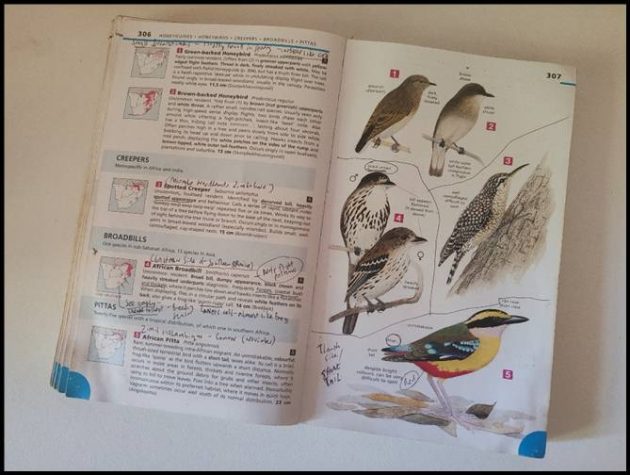
My well-used Newman’s Field Guide with handwritten notes
What made this species so special for me went beyond its looks and its status among birders. Those who had seen the African Pitta always returned with stories filled with adventure, and that sense of anticipation stayed with me.
There was also something deeply personal. Part of the African Pitta’s range lies in the Eastern Highlands of Zimbabwe, the area where I was born. Many of the stories I heard growing up were of my parents exploring this region. Both have since passed away, and seeing this bird felt like a small but meaningful connection to their stories and to my memories of them.
In 2024, I had the opportunity to travel to Malawi, and the African Pitta was one of my target species. There had been records from Liwonde National Park, but the most reliable site in the country was Blue Zebra Island Lodge on Nankoma Island in Lake Malawi. According to the local guide, pittas had been recorded on the island for the previous three years and had even nested there. Given the island’s size of 65 hectares and its well-maintained trail network, it is considered one of the more accessible places to look for this species.
My expectations were high, but we missed the bird by the narrowest margin. We arrived on the island only to learn that the pitta had migrated the day before. Missing it by a single day was hard to take.
I knew I had to return to Malawi. Not only to try again for the African Pitta, but also to experience the warmth of a country affectionately known as “The Warm Heart of Africa”. The smiles we encountered as we traveled left a lasting impression, and it is difficult not to fall in love with Malawi.
In December 2025, I found myself back in Malawi and once again booked three nights at Blue Zebra Island Lodge. This trip formed part of my work as a team member at Birding Ecotours, where I spent time in the field learning about destinations in depth. While the island can be one of the easier places to see African Pitta, it is important to be realistic. The terrain is steep in places, walking distances add up quickly, and a moderate level of fitness is required.
We arrived at the lodge around lunchtime and, after a scrumptious meal, set off to look for the pitta. We visited the areas where the species had been heard or seen in the week before our arrival, without success. Dinner that evening helped soften the disappointment, though the thought of another unsuccessful attempt lingered.
The following morning, after a quick cup of coffee, we headed out early before the heat and humidity built up. We checked the two most reliable areas on the island and still found nothing. With each stop, my confidence slipped a little further. We climbed another steep path, stopped halfway, and sat quietly listening for the pitta’s frog-like call. There was still nothing.
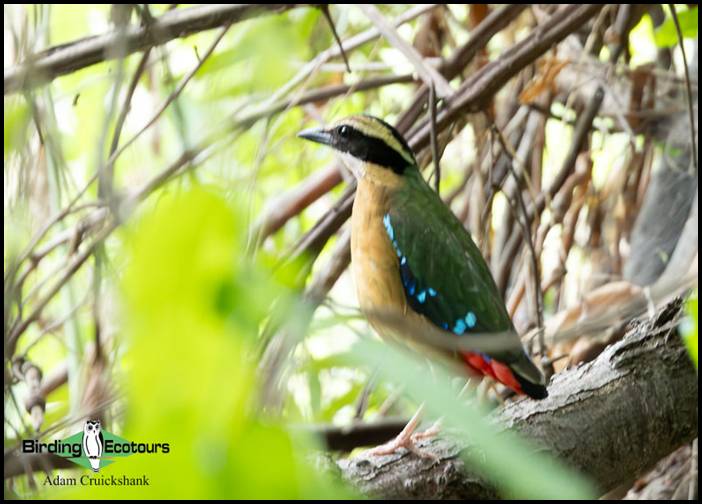
On the slow walk back toward the lodge, the guide suddenly asked us to stop. I scanned the trees and eventually saw the species I had dreamed of. It was perched upright at the base of a tree. The view was brief and did not allow for good photographs, but the moment was unforgettable. Time felt slower, my heart raced, and I struggled to contain my excitement.
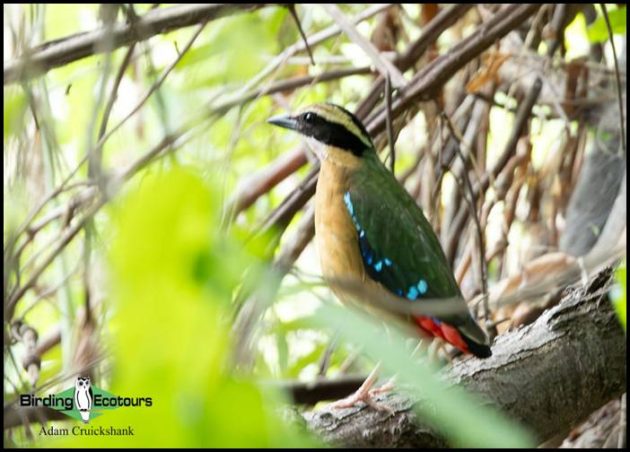
A photo showing my first African Pitta
We did not manage to get better views during our stay. The birds had started gathering nesting material and moved quietly through the forest floor, calling very little. It was remarkable how such a colorful, thrush-sized bird could remain so well hidden.
A few weeks later, photos from the island arrived. The African Pitta had nested and was showing well. One of the things that makes Blue Zebra Island Lodge special is the use of photography hides placed near nests when breeding begins. These hides allow photographers to work ethically and without disturbing the birds.
After leaving Blue Zebra Island Lodge, we spent two nights in Liwonde National Park. This produced species such as Pel’s Fishing Owl, Long-toed Lapwing, Rufous-bellied Heron, Böhm’s Bee-eater, Lilian’s Lovebird, and Brown-throated Barbet. A brief stop at Zomba Plateau on the way to Blantyre, between heavy rain showers, produced Malawi’s only endemic species, Yellow-throated Apalis.
The trip was a rewarding blend of local guiding expertise and experience gained from previous visits. Even with just seven days in the country, we made the most of every opportunity.








Having pursued African Pittas without success, I enjoyed this piece. In Uganda I even visited a forest where they are virtually guaranteed to be seen, but only when they are breeding. Not a sign when I was there, though the chimpanzees were compensation.
Excellent account and enjoyable read. They are tough birds but always worth the adventure. Hopefully we’ll have more contributions from Adam!