

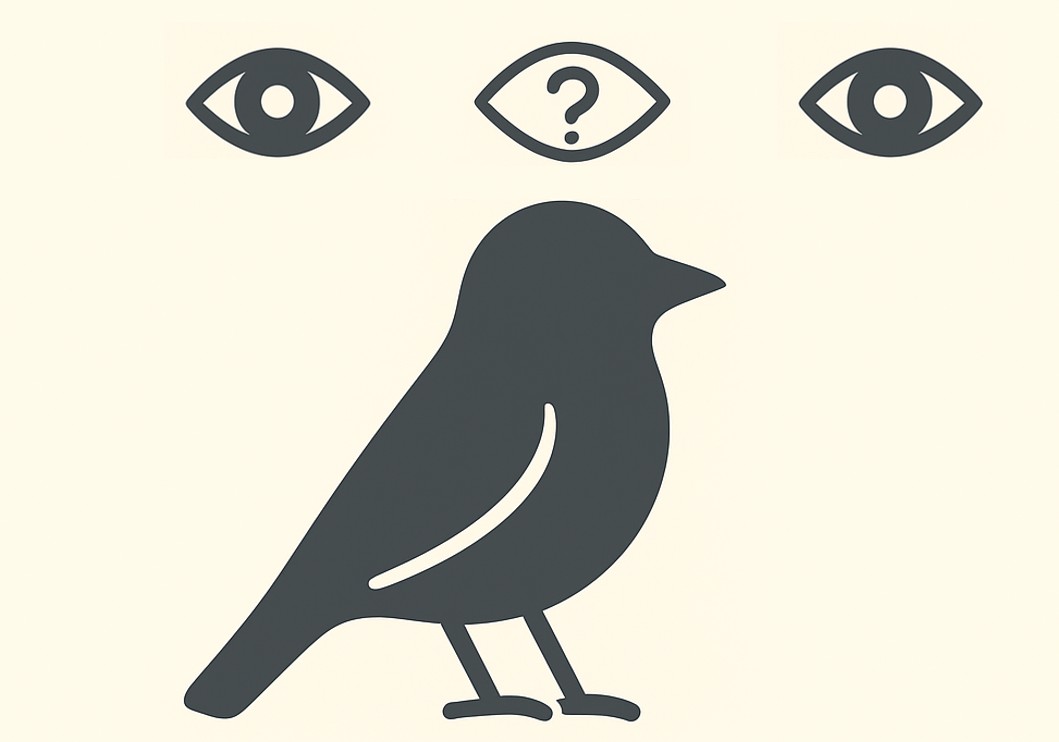
Last week, we looked at the advantages and disadvantages of sideways-facing and forward-facing bird eyes. A natural next question might be: why not add a third eye, giving a bird both a panoramic view and precise depth perception? Why don’t such species exist?
We don’t know for sure, but we can make some educated guesses.
Additional Costs
A third eye would add weight and vulnerability. Depending on its placement, it could also disrupt the bird’s aerodynamics. Nature tends to favor designs that are efficient rather than extravagant.
Limited Benefits
To justify those extra costs, a third eye would need to bring substantial benefits. But the current two-eye setup already provides a good compromise: binocular overlap for depth perception, plus the ability to fine-tune the field of view based on the species’ lifestyle. Two eyes get the job done.
Information Processing Limits
More eyes mean more information, which requires more brainpower — an energy-intensive investment. And, unfortunately, birds can’t put that extra processing power to work mining bitcoins when it’s idle.
Evolutionary Pathways
Adding a third eye would require a major reworking of embryonic development. Such a drastic change is highly unlikely to occur naturally. Evolution tends to tweak existing systems rather than invent entirely new ones.
Or – as this post might end, if it were published in The Economist, a magazine known for its intellectual image and its bad puns – “Three Eyes Good, Two Eyes Better”.









Leave a Comment