

If our recent trip to Spain, Morocco, and France, about which I have been writing recently, had occurred a few weeks earlier, this article would be all about the astonishing spectacle of migratory hawks and vultures crossing the Strait of Gibraltar. I had the enormous privilege of seeing this spectacle first-hand in 2022, and it was a true lifetime experience. I made my best effort to repeat that experience last year, but Spain’s historic 2024 rains got in the way. Unfortunately, this year we made our latest arrival yet, on the 27th of November. I made my way to the Cazalla Soaring Bird Observatory as quickly as possible, but the official season was over, and no other birders were present.
Still, my visit to the Observatory was not a total loss. One Western Marsh Harrier and a solitary Montagu’s Harrier straggled by. But Eurasian Griffons were the main raptors that crossed the Strait mercifully late, with at least 34 present. I find it impossible to complain about an outing that includes Griffons.

A large number of Griffons stayed a long time on a single electrical tower, waiting for the weather to favor their crossing.
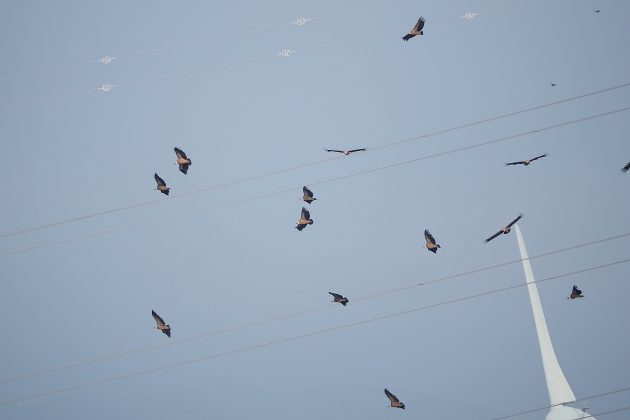
Finally the weather cleared, and they all took wing to the south.
Also, compared to last year’s rain-soaked attempts, Cazalla was a worthwhile place to bird this year. I saw a respectable 18 species, including my second Spectacled (I think) Warbler, and a nice showing of European Goldfinches.
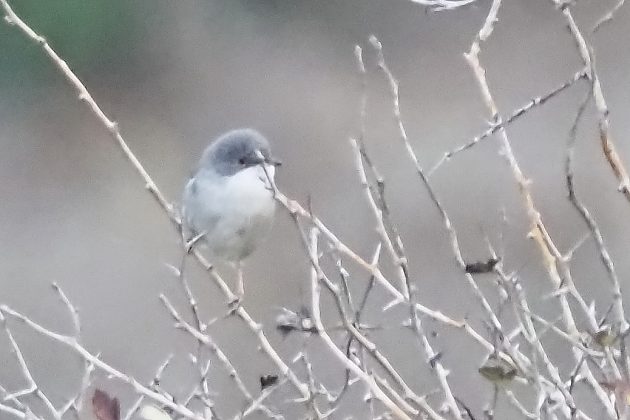
Spectacled? Dartford? A Sardinian Warbler that uses eyedrops?

This Warbler, however, was definitely Sardinian.
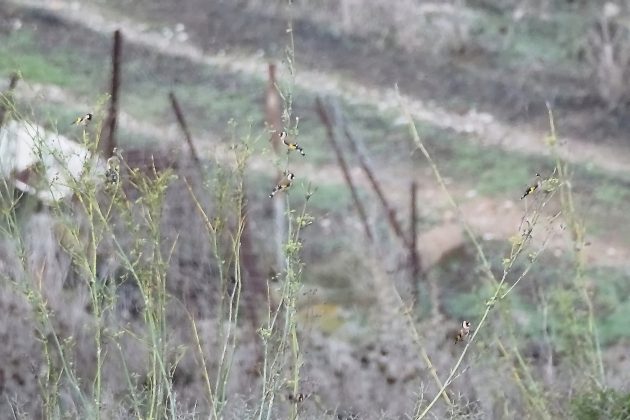
Although I have yet to get really great photos of the species, any sighting of European Goldfinches is still a thrill for this New World birder.
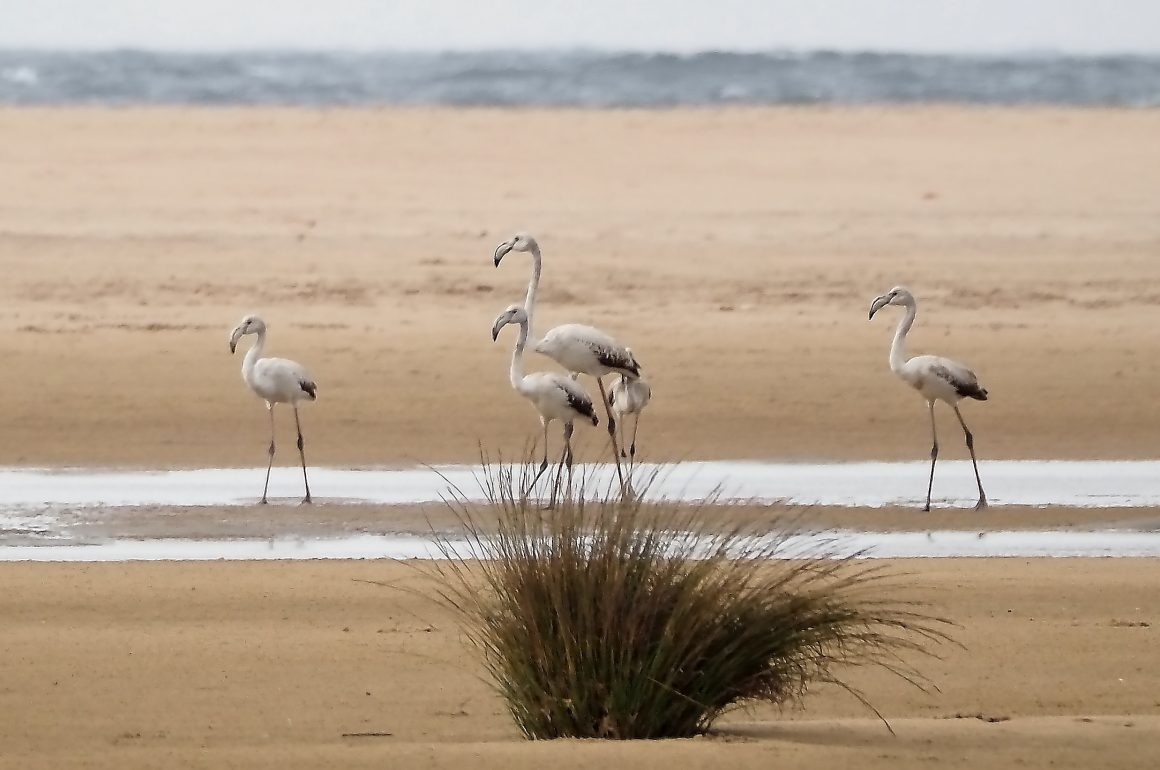
But eventually I felt I had seen what I could at the Observatory, and so I moved on to the nearby Playa de los Lances (Beach of the Spears) on Tarifa’s Atlantic coast. This coast is world-famous for its wind-surfing conditions, so you can always count on a steady, driving wind. And yet, the first thing I saw upon arrival was a sight that, like those Goldfinches, warmed my New World heart: a family of Greater Flamingos. Flamingos are decidedly tropical birds in the New World, so I never tire of seeing them along the shores of the temperate Mediterranean Sea.
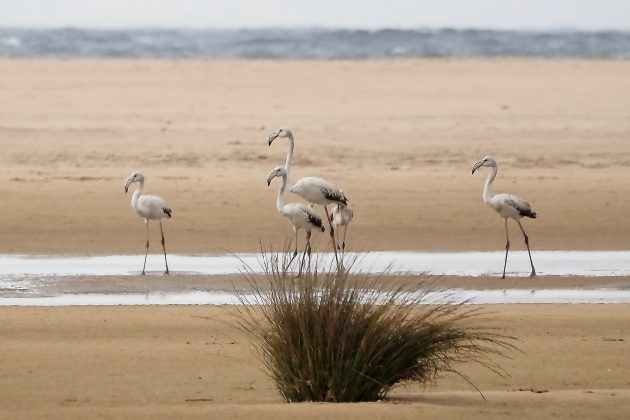
These Flamingos were decidedly un-pink.
In contrast, much about birding this beach seemed strangely familiar. The Dunlins, Black-bellied Plovers (called Grey Plovers, in Europe) and Sanderlings there could also be seen on the beaches and mudflats of central Mexico, halfway across the world. Kentish Plovers stand in for our Snowy Plovers, while Little and Common Ringed Plovers make convincing substitutes for our Semipalmated Plovers. Little Egrets are dead ringers for the New World’s Snowy Egrets. Little Stints kept me from missing our Western and Least Sandpipers.

It was nice of this Dunlin to hold onto its dark summer belly a bit, just for me. That’s a Kentish Plover in the back.
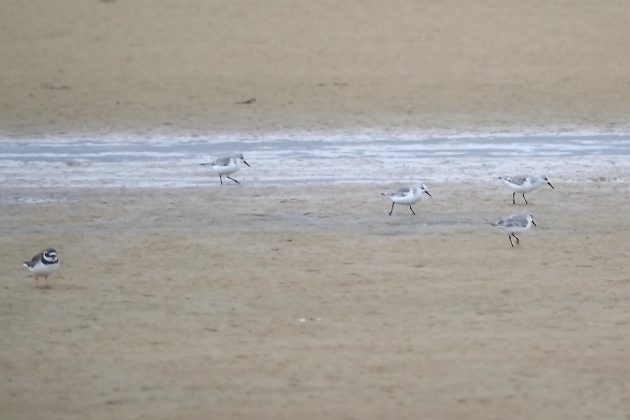
A Common Ringed Plover and lots of Sanderlings
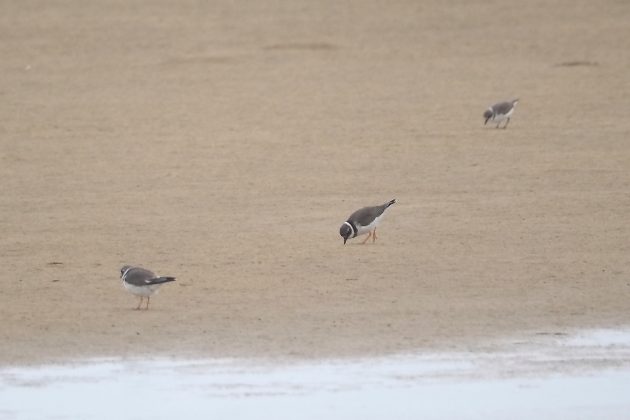
Or sometimes the Common Ringed Plovers and the Kentish Plovers mix it up, and hang together.
After several visits to southern Spain, I feel increasingly confident about my ability to identify many of the birds there. Still, I have not gained this confidence when it comes to Europe’s many Pipits. I’m glad that my section of Mexico only receives American Pipits in the winter.
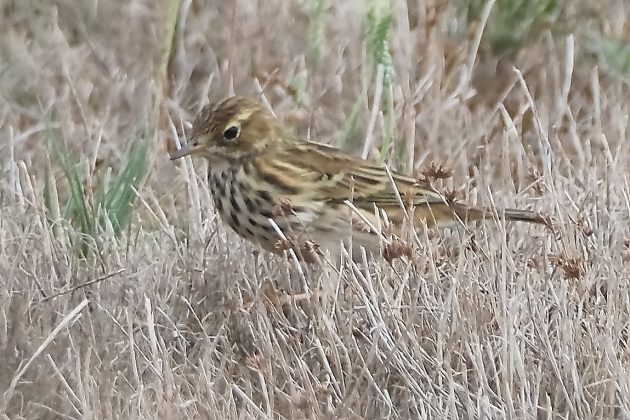
The Pipits that preferred feeding in coastal grasses were browner, and I went with Meadow Pipit for my ID.
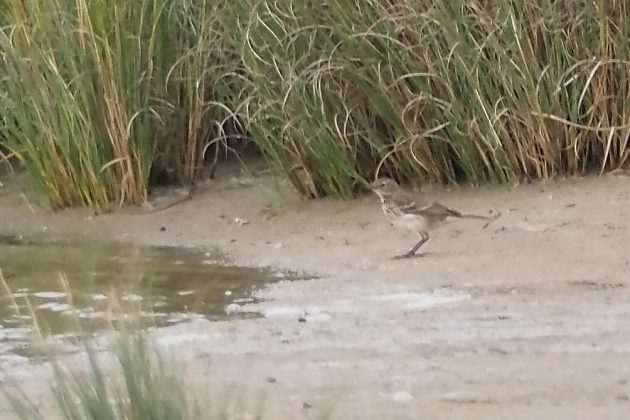
The Pipits that stayed on sand were grayer, and I suspect they are Water Pipits. Perhaps someday I’ll know for sure.
All in all, I would recommend the Playa los Lances as a birding site if you are near Tarifa. One thing I learned this trip is that the sand there is very fine and firm; while it can be difficult to reach the beach without stepping through some standing water, one does not sink into this wet sand. Cross with confidence.
I also learned last year that a quick detour to the Isla de Tarifa, also known as Isla de las Palomas, is an easy and productive addition to a single day’s birding around Tarifa. While I have not yet managed to tour the island itself, the causeway that approaches it is an easy place to see Northern Gannets and Ruddy Turnstones. This trip I was lucky to also see a Sandwich Tern and my first Spanish Alpine Swifts, making their way to sub-Saharan Africa.
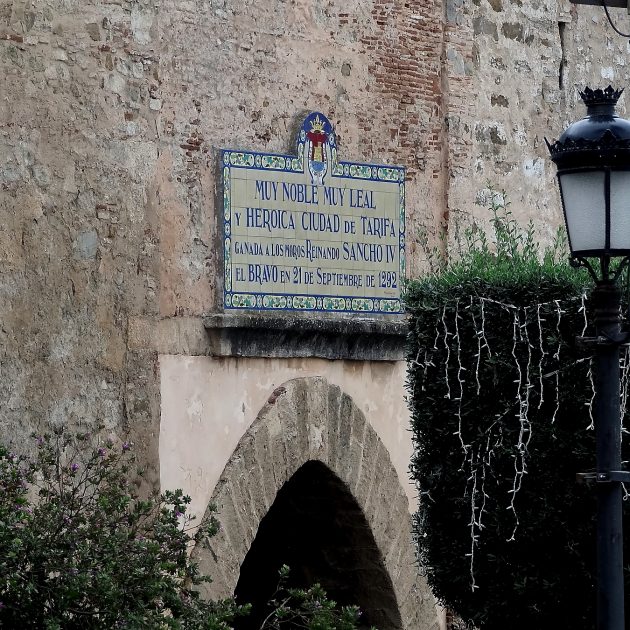
Very noble, very loyal and heroic city of Tarifa, won from the Moors during Sancho IV the Brave’s reign, the 21st of September of 1292.









That warbler could be a Lesser Whitethroat. Dartford doesn’t have a white throat and belly. Spectacled has a spectacle… Meadow pipit and Water pipit, I concur.
Yet another benefit to writing for 10,000 Birds: free consultations with local experts on one’s IDs! The Lesser Whitethroat’s more easterly range kept me from considering it as a possibility for this list. But my other photos did confirm that the bird has no eyering (Sardinian) or brown on wings (Common Whitethroat). And eBird shows that this species has definitely turned up in southern Spain over the years, always in winter. Thanks, Peter!
Looks like a Spectacled Warbler to me (most definitely not Dartford), while the pipits are as you suspect. I once saw a Richard’s Pipit at Tarifa which was a surprise (March 2019).
2019 saw multiple Richard’s Pipits across Iberia – they took a wrong turn (more likely one of those tropical storms)