

Ten years ago, around this time of year, I had a cataract removed from my left eye and my cloudy lens was replaced with an artificial lens. Three years earlier, I had the same procedure on my right eye. This is a common procedure and many reading this may also have had cataract surgery. It is wonderfully astonishing to have vision restored with a 15-30 minute procedure. On one of my follow-up visits after my left eye procedure, I was found to have an epiretinal membrane and drusen bodies. An epiretinal membrane is a thin layer of tissue that forms over the retina and drusen bodies are soft, “lumpy-bumpy” spots that form behind the retina and are the first sign of macular degeneration. All three of these conditions—cataracts, epiretinal membranes and drusen bodies—are primarily age-related eye diseases, although other factors may also be involved. Macular degeneration is commonly referred to with the acronym AMD for age-related macular degeneration. It’s not important to reveal my age here, but all three of these occurred for me on the younger side what might be considered common.
Some risk factors for AMD are not under anyone’s control. Age is one of those factors; the older a person is, the more likely he or she is to have AMD. However, genetics — that is, a family history of macular degeneration — is universally believed to be the primary cause of AMD. Again, other factors may also play a role. I thought of all the times I was out birding in bright, hot sun. At a young age, and even now, I have never been a person who likes wearing sunglasses because they interfere with my vision. Ha! I think this is a common experience, especially for birders; other birders have also expressed this to me. After seeing my retinal specialist for the first time, I remember leaving the exam room feeling defeated and disappointed in myself for not taking better care of my eyes and I expressed this to him. My retinal specialist is not the most empathic individual, but he may have noticed my dejection. I remember his exact reply: “I wouldn’t beat yourself up about it. Someone in your family had this.”
I recalled my maternal grandmother who died in 2007, the day after her 101st birthday and, in her elder years, her long struggle to care for and maintain her vision. In addition to having 27 grandchildren and over 50 great-grandchildren, she loved watching hockey and baseball on TV. First came her cataracts (when removal was possible, but implanted lenses did not yet exist, she put in contacts each day), followed by glaucoma and eye drops, and then finally, at the end of her life, complete loss of her vision. Her ophthalmologist was a cataract specialist, not a retinal specialist. I don’t recall that she was ever told she had AMD—probably because, at that time, there were no treatments. Now, her daughter (my maternal aunt), has the wet form of AMD and receives eye injections. If anyone else in my once very large family—age and death have dwindled us—had or has AMD, I am not aware of it. I have the dry form of AMD. For this I take a twice daily eye vitamin tablet called AREDS2 (for age-related eye disease study. The “2” stands for the second age-related eye disease study that replaced beta-carotene with lutein and zeaxanthin in the formula). This study was conducted by the National Eye Institute and is the only clinically studied and over-the-counter oral medication for dry AMD. The dark red, American football shaped tablet is a combination of commonly known vitamins with lutein and zeaxanthin added. The goal with this tablet is to thwart the conversion of dry AMD to wet AMD. I see my retinal specialist annually and have annual eye scanning to follow progression. Finally, especially for wet AMD, there is a documentation tool called the Amsler Recording Chart. I should use this daily but don’t. This can only be complacency on my part. Now, as I write this, I realize that I need to make it a daily habit. No excuses; it’s on my refrigerator with magnets!
All this may be too “in the weeds” for many readers. Bear with me. I could be helpful to others. Approximately 1 in 10 Americans over age 50 have early stage AMD and 1 in 100 have advanced, vision-threatening late stage AMD. This accounts for about 20 million Americans. Globally the burden is estimated to be 200 million worldwide. Non-Hispanic, white individuals have a higher prevalence when compared to other racial/ethnic groups. In North America about 200,000 new cases of wet (advanced) AMD are diagnosed annually. Women have a distinctly higher prevalence for having advanced AMD; this is partly due to longer life expectancy. AMD is not a rare disease.
I saw my retinal specialist yesterday and, again, his diagnosis was, “well, you’re a year older so your disease is a year worse.” It’s like that. He seemed more relaxed yesterday (i.e. friendlier—he’s not a warm-fuzzy doctor). Somewhat self-consciously I revealed to him that I was a birder, that I traveled for birding and that I noticed, on my January trip, that I seemed to have more difficulty seeing and photographing the birds. I can’t help it, but I am always testing myself by observing my birding companions. I shouldn’t do this, but I think it’s natural. No one wants to hold up the group. I remember my skill level when I was a younger and pre-AMD birder and recognize and feel the loss. I should be clear, I can still see the birds and they are beautiful. But it might take me longer and, it is more difficult when I must see and follow movement. I explained these barriers to my doctor as best as I could. His response was that my corrected vision when looking at a lighted eye chart in a dark room is 20/20. But real world vision is more dynamic than looking at an eye chart on the wall. He’s right, of course. Of all people, birders will know this.
My January trip to Puerto Rico was a quickie. I enjoyed the island, the weather and the birds so much and It was over before I was ready to stop birding. I should have added on an extension, but other factors prevented this. At the start of the trip we were standing around the hotel lobby making introductions while waiting for our local guide to arrive with the van. People were opening up about things that I can’t recall now. As I listened, I thought about my Finland/Norway trip when I had spoken to the leader to explain that I had difficulty with my distance vision. Later, and through the van’s dirty windows, I saw something and called it out. The leader found my something in his bins and announced—a bit too derisively for me and I noted a hint of irritation, even after I had spoken with him—”that’s a stick!” I called him out on this and he immediately reversed himself; “no, no, no, please call out everything. Just in case.” I thought, yeah right. Another day we were slowly driving along a road that traversed huge, snowy tundra on both sides searching for a, hoped for but not promised, snowy owl. To my left, and way in the distance, peeking out from a large rock formation I saw something white. I have seen a snowy owl with a similar presentation before. I looked again. I hesitated. Should I call it out? What the heck. “To the left, peeking out from the huge boulder, something white …”. I don’t know if these were my exact words, but close enough. The van stopped and we looked. It was not a snowy owl, but it was our first Rock Ptarmigan for the trip. Later, Rock Ptarmigan would become a dime a dozen. But, that was our first.
Standing in the hotel lobby, my turn came and I introduced myself and included that I had trouble with my distance vision, etc., etc. I requested my companions’ patience. As it turned out, I did irritate the trip leader because I was always moving and angling for a sighting. He scolded me in front of the others. This triggered me. Later, I asked to speak with him alone and we hashed it out. He thanked me for speaking with him and said that he learned from our discussion. I don’t know if he learned or not. Would he remember this if the same thing happens with another birder? Who knows? He was an excellent and, in many ways, a fun guide—as was the Finland/Norway guide, also. It was impossible to stay mad at him.
I hope I still have a few birding trips left in me. For as much as I love international birding, I have considered doing fewer, instead focusing more on U.S. birding. For example I have not visited most of our national parks. Here I could do my own transportation, stay in the few clean and family-owned motels that might still remain and would not require a guide. I have seen a lot of the U.S. birds, but there are many important birds I would still like to see. Bicknell’s Thrush (very hard), Lewis’s Woodpecker (shouldn’t be hard but I have already missed twice), Sage Sparrow (must be in the right habitat and location). I could take my time and take pleasure in the birds and all wildlife I see. Without pressure.
Time will tell.
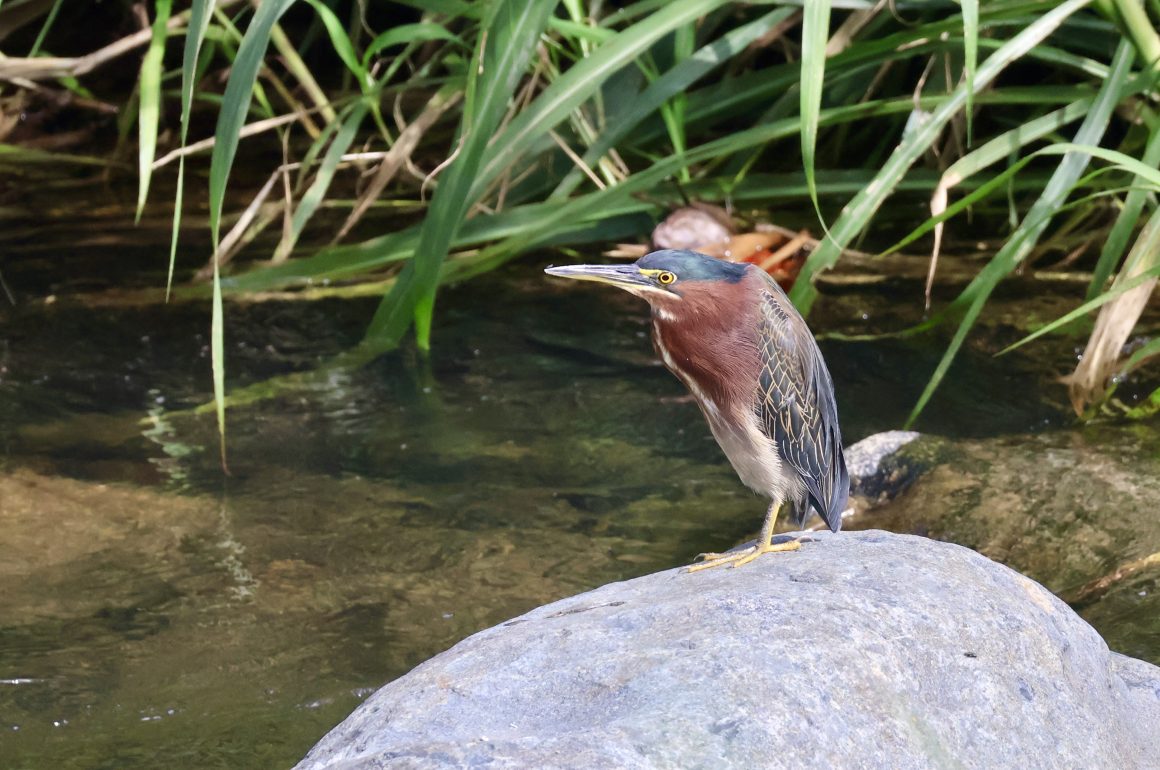
Cover photo: Green Heron (Butorides virescens) perched on a rock in a fast moving creek at our first stop in Caguas, Puerto Rico. Easy to find, easy to see and easy to photograph.




Cathy, thank you for sharing this. Pay no mind to those who become irritated and please do not let them relegate you to a point where you avoid doing something you love.
Over the years, my birding style has changed. I no longer chase birds themselves (I wish I had that wisdom when I started), but rather regularly visit the best preserved habitats nearby. Both forests, and without too many birds in winter, but it matters not, I enjoy being in the forest, however few species I see and hear. And the spring is on its way!
What I mean is, try finding a birding style that suits you and your preferences and needs. Adapt. And overcome.
I feel a little embarrassed about making this comment. I am grateful for Faraaz’s and Dragan’s comments and recognize their kindness and support. To clarify, my purpose for writing this piece, was not because I am confused or conflicted about my own birding. Rather, it was to alert or inform or educate (not sure of best word choice here) about macular degeneration. Not all, but many birders are aging individuals. I used my own birding experiences for description and explanation. Plus they were real examples that actually occurred, so they had some salience. I meant this piece to be about birding, of course, but more about aging vision and its importance to birding. I didn’t wait to write this comment because I don’t want others to misunderstand and feel compelled to feel sorry for me. It’s not about that and I don’t feel sorry for myself. After all my own vision, in a non-dynamic situation, remains 20/20. I hope the title attracts a lot of readers because it’s an important topic, and not just for birders, (if any non-birders read 10,000 Birds).
About a decade ago my retina came loose and I lost the sight in my right eye. Two operations were needed to restore my sight. The retina was attached through “spotwelding” which left the eye less light-sensitive but almost as good as new in terms of vision (the brain makes most of the image anyway). During the recovery my birding improved because I started listening and even though I am a visual being again, I listen more and better now. I have since met birders with serious visual impairments who could list every bird in earshot. None of these people seemed to be enjoying themselves less than I was. As John Cleese said when he robbed the lingerie shop: adopt, adapt and improve.