

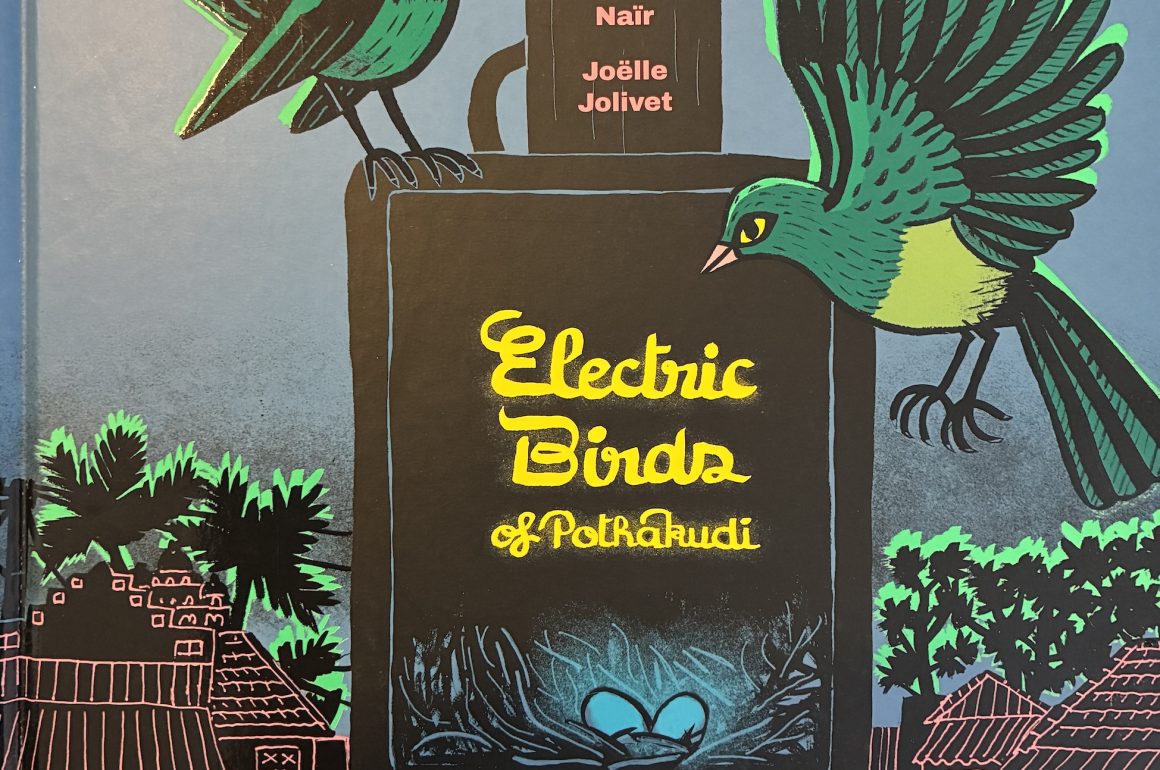
Electric Birds of Pothakudi: A KidLit Bird Book Review
In 2020, the local volunteer in Pothakudi, India, stretched his hand into the electric box to flip on the village streetlights—and stopped. The box had become the nest for a pair of vannathikuruvi birds (Copsychus saularis, aka Oriental Magpie-Robin). To save the nest, village chose to spend each night in darkness until the chicks had fledged.
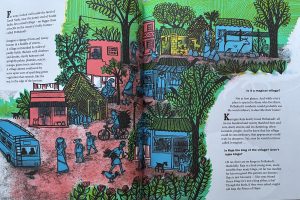
The village of Pothakudi as depicted by illustrator Joëlle Jolivet in ELECTRIC BIRDS OF POTHAKUDI, written by Karthika Naïr
In the picture book Electric Birds of Pothakudi, author Karthika Naïr shares the story. The book was originally published in 2022 in France, with an English language edition published in late 2025. It’s an ecological story of compassion and community, and has won the 2023 Prix Felipé for “ecological children’s literature,” as well as being shortlisted for the 2023 Prix Franco-Allemand de la littérature de jeunesse prize for young people’s literature. This year, it has been selected as one of the United State’s Outstanding International Books (USBBY).
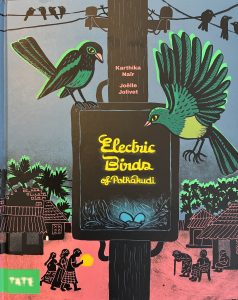
Electric Birds of Pothakudi opens in Paris, with a child and her mother sitting in museum gardens, watching birds. The book’s beginning is simply glorious to read, and a testament to Karthika’s poetry background: “It was hot, unseasonably hot, even for those of us who love to feel the sun’s fingers running through our hair, its palms warming our backs. So hot the air shimmered, and the outlines of building and trees began to blur like melting ice.”
The pair spot a crow stealing food from a girl’s lunchbox, which begins a discussion of the challenges birds now face finding shelter and feeding their young: “We don’t realize how tough our actions make it for them to survive.” The mother tells of receiving a news article from her Uncle about a young man who saved a family of birds—and promises to borrow some magic yarn to spin a story.

Illustration in the initial spread in Electric Birds of Pothakudi, written by Karthika Naïr, illustrated by Joëlle Jolivet
Pothakudi is a village in the south Indian state of Tamil Nadu, with about 120 families. Their electric streetlights are controlled by a single switch in the electricity control box, which was turned on each night by a volunteer Karuppa Raja. But when Raja spotted the beady eyes of a female songbird, a vannathikuruvi, in the box, he paused. “Mrs. VK” was quickly joined by her mate, and Raja realized that he could not reach in to turn on the power without destroying the nest they were building. He took photos to share on the villager’s WhatsApp group.
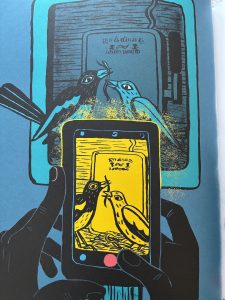
Karuppa Raja taking a photo of the nest to share with the villagers
The decision to leave the lights off wasn’t easy. Older inhabitants wanted to know why they should remain in the dark for birds. Women couldn’t go out at night. But birds had become rare in the village. In the story, Raja is reminded that not every battle can be fought alone, and that he comes from the land of the great Vel Paari, a king known for his compassion. When the young of the village take a stand against those who want the lights turned on, Raja notes that “At least we have memories. But these children don’t. Couldn’t we help them discover what they birds sound like and what their nests look like?”
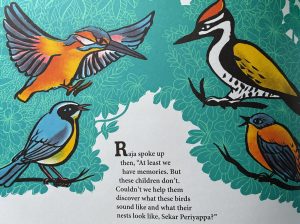
Raja asks whether the children can discover what these birds look and sound like.
Together, the villagers watch as eggs are laid. They protect the nest from a rat snake, then follow the process as baby chicks hatch and eat develop feathers and open eyes — and then fledge and fly away.
But the child at the beginning of the story wants the big magic that was promised, so author Karthika Naïr—who is also a fabulist (one who creates and tells fables)—does indeed spin a yarn, weaving a fable of Pothakudi during a time drought and isolation, when the rains fail to come to ensure the rice harvest. And in the midst of the burning sun, when hope had failed, the sky darkens with waves of birds, each bringing a single grain of rice.
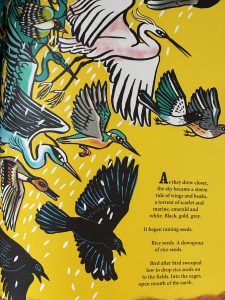
The fable ending of ELECTRIC BIRDS OF POTHAKUDI, with waves of birds bringing rice seeds to the village
In the backmatter, “Tales Behind the Tale…” provides additional details about the incident on which the book is based, vannathikurui birds, the rat snake, and Vel Paari, the long-ago king whose kindness is still remembered. There is also a small glossary of Tamil words used in the story.
Note that this book will not make a good read-aloud for most schools and libraries. It is longer and far more text-heavy than the average room of wiggly kids (at least those in the US) could sit still for. That said, Karthika’s writing is so evocative, and artist Joëlle Jolivet’s illustrations surge with such power and energy, that I would not want children to miss this incredible story.
Electric Birds of Pothakudi, written by Karthika Naïr, illustrated by Joëlle Jolivet
Tate Publishing, 2025; ISBN: 978-1-84976-915-0
Original French edition published by Hélium, 2022
52 pages, age 8-10













Sounds like a lovely fairytale-like story. Thank you, I enjoyed reading this review.