


I recently returned from a tour that took me to the northernmost end of the Lesser Antilles – to the twin-island nation of Antigua & Barbuda. I was reliably informed, however, that there are actually three main islands that comprise this country, but the third – Redonda – is uninhabited and therefore unspoken for at the point in time when the nation’s name was being finalised. Redonda is a success story of regreening and rewilding, having spent decades being ravaged by invasive rats and goats. You can read more about this rare contemporary success story here.
As for me, I had been to Antigua a couple times before, but never to the nearby island of Barbuda, as ocean conditions refused to facilitate either attempt in January and February of last year. This time, we actually made it across – but more on that later. On the main island of Antigua, I enjoyed sightings of the usual suspects: Bananaquit, Green-throated Carib, Antillean Crested Hummingbird, Caribbean Elaenia, Grey Kingbird, Zenaida Dove, White-winged Dove, an occasional American Kestrel, and the very noticeable White-crowned Pigeon. These large, Near Threatened pigeons mostly replace the similar-sized Scaly-naped Pigeon that is much more common in some of the other islands in the Caribbean.
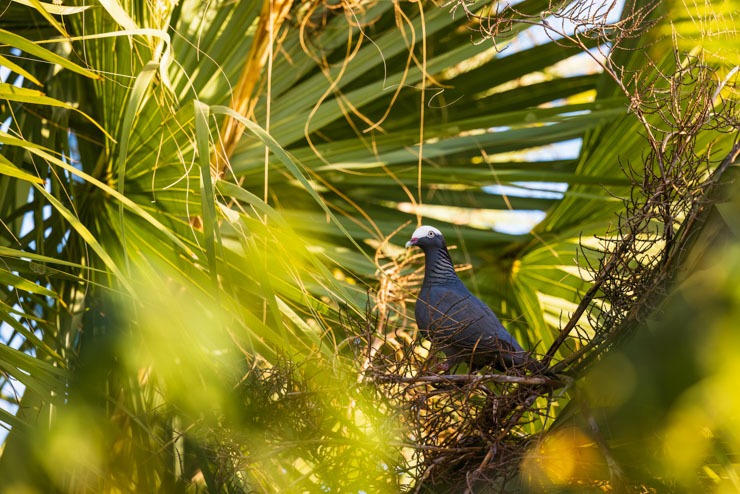
White-crowned Pigeon
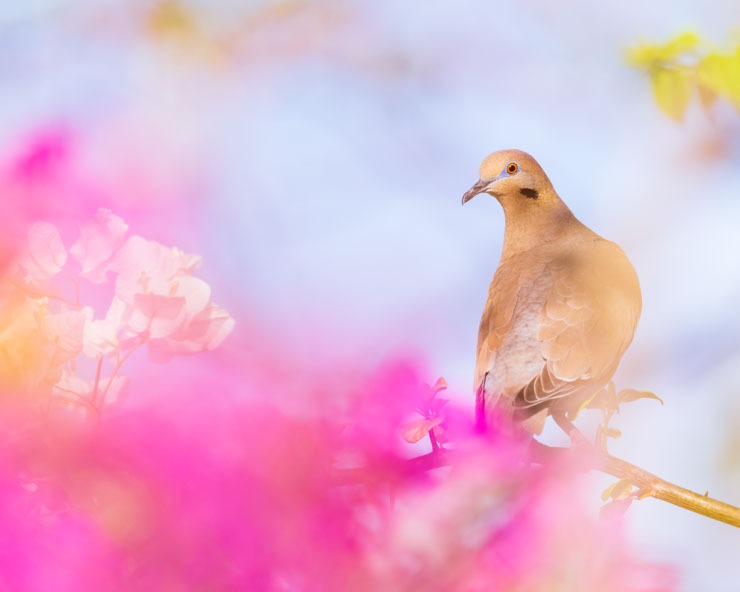
White-winged Dove
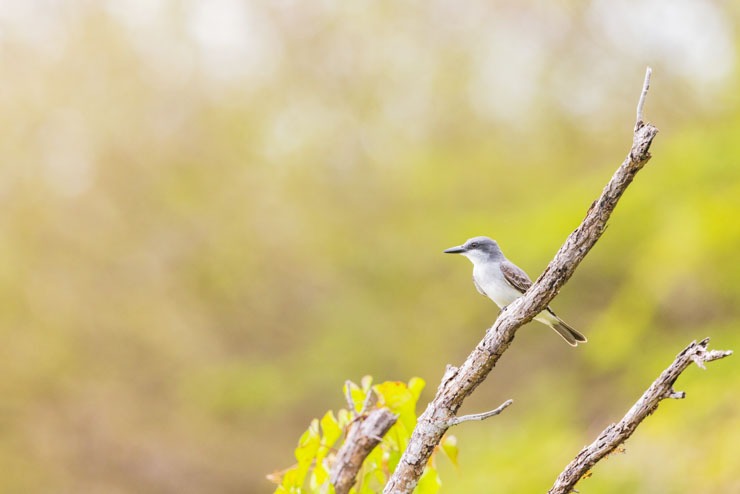
Grey Kingbird
From my research, I knew there were a couple bodies of water around the island that attracted considerable numbers of waterfowl – both resident and migratory. I enlisted the help of local birder extraordinaire Jermaine Jarvis who took me to scope out some of these small inland ponds with the hope that I’d be able to photograph some of the migrant waterfowl for a project I’m working on. Jermaine is the source of much of the information presented in the opening paragraph of this post, and is currently heavily involved in nature conservation in Antigua & Barbuda. He is a veritable fountain of knowledge, as well as the eBird reviewer for the country – we were thrilled to be in his presence despite our time together spanning only a few (very pleasant) afternoon hours.
As birding goes, none of the species I was hoping to find and photograph were present in any of the areas we checked. The final pond for the afternoon bore fruit in another form, however. As soon as we got to a point on the trail where there was an unobstructed view of the pond, Jermaine looked at me and said with a smile “here’s your lifer”, while motioning to the forested edge of the water. Sat perfectly and ever so casually on the shore was a small flock of West Indian Whistling-Ducks. I ogled at them through my bins, they are intricately adorned creatures with scallops, streaks, and speckles throughout.
As we walked around the pond, I eventually was afforded better views. Either way, it was an absolute pleasure to spend some time with one of the rarest ducks in the western hemisphere.
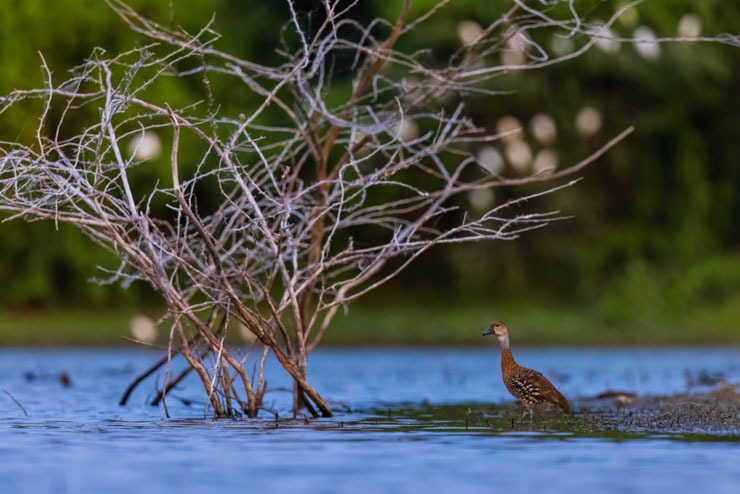
West Indian Whistling-Duck
On our circumnavigation of this particular pond we had several distant sightings of another bird I had never seen before: Sora. I have since retired the extremely tired quip of I never saw a Sora – only to replace it with the equally trite I finally saw a Sora. This little rail vocalised in a previous location that same afternoon, but there was no visual. Eventually, one of my clients-turned-friends found a Sora in the open and directed me to have a look through his scope at the furtive creature on the opposite side of the pond. I was over the moon. Sora is listed as an annual migrant to T&T, and I have been in many places where they are supposed to be reliable yet had never been able to cross paths with one.
Observing a Sora move effortlessly through the reeds made me feel a little less embarrassed for never seeing one. With the sun already past the treeline, I was sweating bullets as I feverishly attempted to track a couple individuals foraging along a slim, vegetated waterway. My camera consistently thought I was hoping to photograph reeds and not the obvious bird skulking behind, and while I am thankful for the consideration, I confess I had many an obscene utterance during that session.
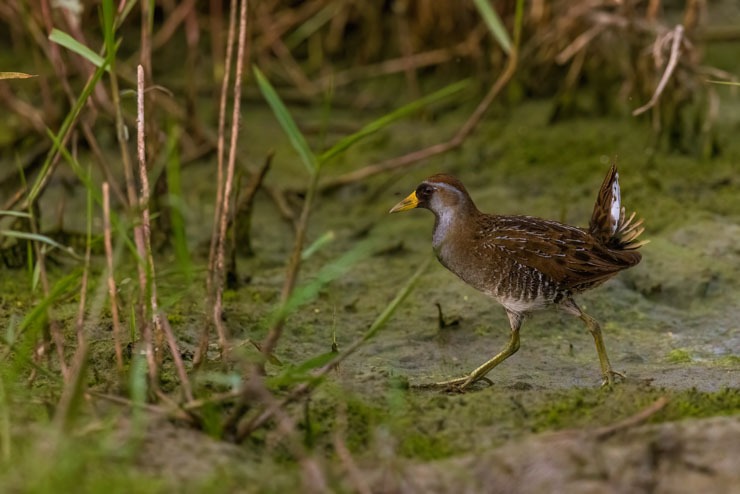
Sora
Two unexpected lifers are very much a boon; the third lifer involved a deft balance between guarantee and chance. As mentioned, we had made a couple attempts to head across to Barbuda last year but each time were thwarted by weather conditions. The wind was the culprit both times, whipping up the sea into a collection of whitecaps. Last February I remember listening to a report on the radio while on Montserrat (expecting a sailing to Barbuda the following day) that made mention of 11-foot swells. Not ideal in a 30-foot speedboat! This time, we got to the dock at 5:30am, submitted our information at the kiosk, and boarded the ferry by 5:45am. We sat nervously, arriving that early enabled us to wisely* choose our seats.
There was “some wind”, but nothing to be alarmed about, we were told. This was the larger of the two ferries running that morning, and so we expected at least a moderately smooth sailing. As the sky turned pink and flocks of egrets began their daily commute to the nearest cricket field, we floated off the dock. I made myself comfortable, stashed my packed breakfast next to me on the bench, and covered my camera bag with its protective “rain guard”. Gradually, the captain raised the power of the engines as we left the harbour, and the crisp morning air began to tickle us as we increased our speed. Once we were fully into the open ocean, however, it was full throttle. Despite the wind, despite the waves. Turns out that my decision to sit on the starboard side of the vessel was perfect for sea spray.
*Wisdom is a relative thing, and maybe if the wind was coming in from the opposite direction I could have touted myself as being one with the elements but alas, I was drenched within ten minutes of departure, and the vessel was ruthlessly leaping over the waves by this point so I made the decision to affix myself permanently to the bench, for fear of being tossed overboard. I somehow managed to pull my rain jacket on, that did much to convince onlookers that I was prepared but little to actually keep me dry.
It took more than an hour to start being able to perceive Barbuda on the horizon. After all, it has the basic topography of a pancake. All this time I was being generously sprayed at an approximate frequency of once every four or five seconds. That crisp wind I mentioned previously had turned into another beast that was rattling my bones. Once we slowed on approach to Barbuda’s western harbour, the warmth of the morning sunshine helped dispel the chill I felt. I noted that during the voyage, my sandwich leapt off the bench and rolled away. I managed to corral the rogue munch, but eventually it somehow managed to escape its confinement in cling-wrap and entertain considerable seawater.
Nevertheless, thankfully, we were finally on Barbuda. I squelched my way off the boat and within five minutes we were walking along a sunny track surrounded by notes of liquid sunshine: the song of the endemic Barbuda Warbler.
A low-effort lifer? Once you get to Barbuda, sure. Word on the street is the ultra-rich are buying up land in Barbuda with the intention of putting up their second homes at the expense of the only habitat in the world for this single-island endemic. For now, these charismatic warblers are thriving in the scrub, chasing spiders and other tiny invertebrates in between belting their sweet song from exposed perches.
Barbuda Warbler
Amidst the relief and excitement from finally getting eyes on what eluded us in previous trips lurked the final piece of the puzzle: the return voyage. I will spare you the details, but let’s just say that the wind tends to pick up in the afternoon.







Thanks for this entertaining account of your adventures! Sadly, I have never seen a Sora.
Wonderful story, thanks! However, please show a Bananaquit next time you mention them. The sheer variety of these birds is fantastic. Guess where? is a nice game to play.
Dear Kendall, I feel your pain. Soon, I’m sure, your fortunes will change!
Peter – this is a wonderful idea, perhaps my next post will be about the spectacular Bananaquit. I have photographed more than a few…
So first, I didn’t know you’d never seen a Sora until now! I thought you’d just gotten some bad views!
And second, this might be the most entertaining piece I’ve read from you! The boat experience – sorry to say that I laughed a lot! Already looking forward to your next entry!
Haha, many thanks, Preeti! Yup, never a Sora for me until now. Happy you enjoyed it!