

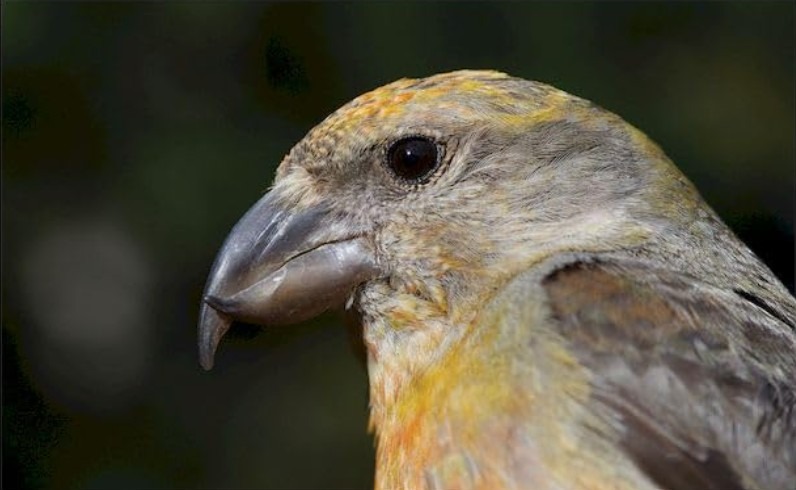
With reports of Common Crossbills now being widely recorded across the UK as part of their irregular, resource-driven irruptions, there has seldom been a better time to reflect on the remarkable and unique ecology of this fascinating group of finches. What drives these sporadic movements, and why has the Crossbill’s beak evolved into such an extraordinary instrument?
Craig W. Benkman’s book, Crossbills and Conifers, provides the definitive and deeply personal answer. Benkman is an eminent evolutionary ecologist who has dedicated over 40 years of his career to studying these birds, and this volume serves as a comprehensive account of his lifetime’s work. Rather than being a dry, purely academic text, it is written in an accessible style, blending engaging natural history with profound insights into evolutionary biology.
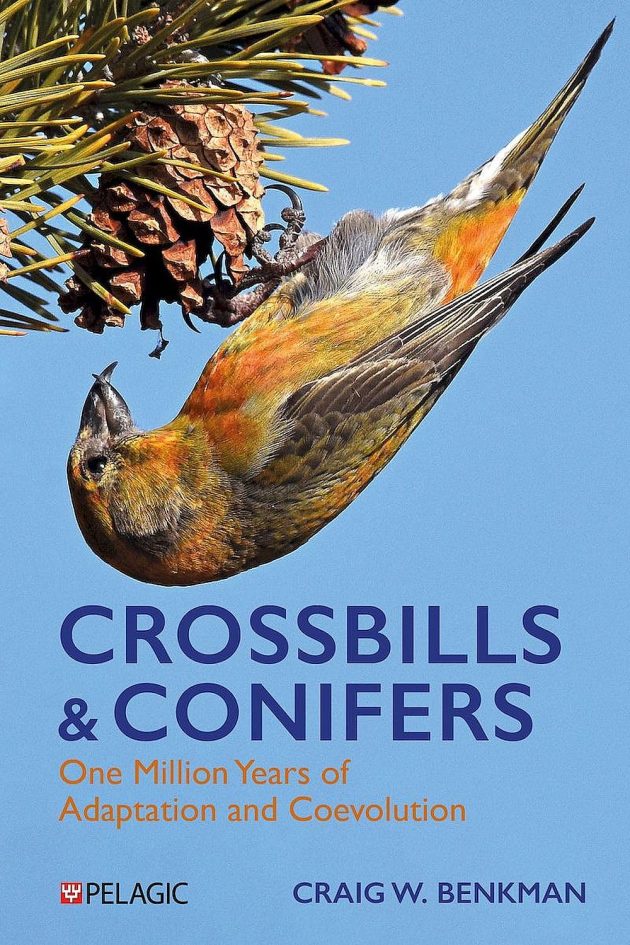
The core of Benkman’s research lies in the quantifiable relationship between the Crossbill’s bill and the structure of the conifer cones it feeds on. He demonstrates precisely how variations in bill depth, length, and the degree of the crossed-tip relate directly to the efficiency with which a bird can extract seeds from different species of cones. This consumer-resource interaction is rarely so clear-cut in nature, but Benkman’s meticulous field observations and elegant experiments lay bare the mechanics of their survival.
The real heart of the book is the concept of co-evolution. We learn that Crossbills and conifers are locked in a perpetual, reciprocal evolutionary arms race: the cones evolve features (such as thicker, harder scales) to protect their seeds from the bird, while the Crossbills evolve bill structures to counteract those defences. This leads to a spectacular discussion of speciation, including the compelling story of the newly recognised Cassia Crossbill in the American West. This species evolved solely to exploit a local population of Lodgepole Pine cones in an area where the cone’s main seed predator, the Red Squirrel, is absent, a compelling illustration of how the removal of one factor can completely change the evolutionary trajectory of two others. We in the UK can also see this with our only true endemic species, the Scottish Crossbill (Red Grouse is found in Ireland too).
The book is handsomely illustrated with photographs and clear diagrams that help the reader visualise the mechanics of bill use and the differences between conifer cones. While the focus is global, exploring types of crossbills beyond our native species (Scottish, Parrot, and Common), the underlying principles are completely transferable and fundamentally enhance one’s understanding of our own local populations.
Crossbills and Conifers offers birders far more than just a life history of a bird; it uses the Crossbill as a lens through which to explore the major themes of ecology, diversification, and conservation. It’s a rewarding read that gives a fresh appreciation for the familiar sight and distinctive call of a Crossbill high up in a pine or, more typically, flinging over, reminding us that we are watching a tiny, perfectly adapted product of millions of years of evolution. Highly recommended for anyone who has ever marvelled at the sight of a Crossbill extracting a seed.
Crossbills and Conifers: One Million Years of Adaptation and Coevolution – by Craig Benkman
Publisher: Pelagic
Publication date: July 15, 2025
ISBN-13: 978-1784275525







Leave a Comment