

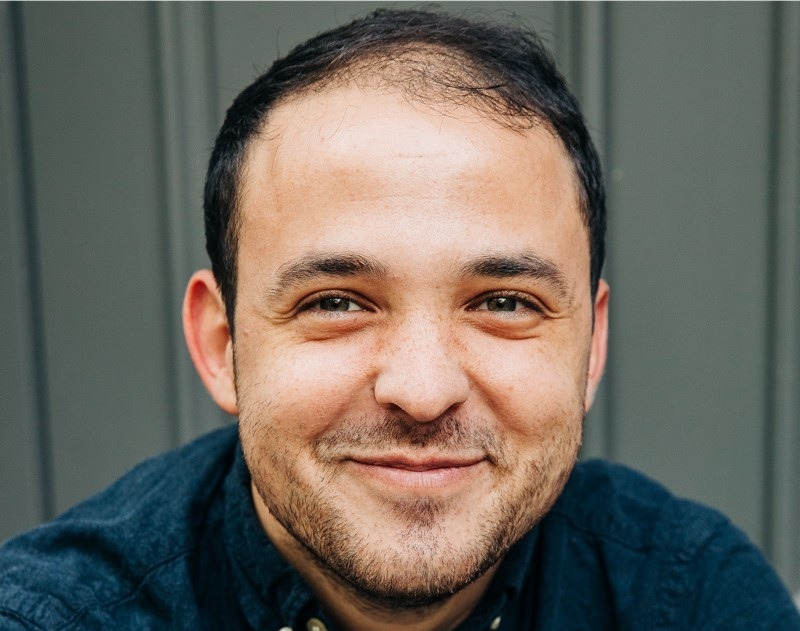
Most birding apps teach you to look first; Wings and Whistles teaches you to listen. Created by musician-turned-birder Nick Paolino, it helps users learn birds through calls and songs rather than checklists or field marks. We asked Nick about learning birds by ear, welcoming newcomers to birding, and the app’s past and future.

Many birders remember the first bird they really noticed rather than just saw. What was yours?
The first time I heard a Wood Thrush. I was taking a jog in the woods at Rockefeller State Park in New York, and I’ll never forget when I heard it. Its song reverberated through the woods in this magical way, and I stood there quietly for at least half an hour listening to it.
You came to birding through music – can you explain how?
As a trained musician, I listen for melodic phrases or motifs when I listen to a piece of music. As soon as my ear latches onto a clear phrase, I hear it woven through again and again. The same thing happened when I started really listening to birds. I realized I was able to pick out the clear two-tone whistle of the chickadee, even long before I visually ID’d it, and then I seldom ever take another walk in my neighborhood without hearing it. As my ear for birds developed, every walk became a performance. I’d hear the common phrases, then pick up new phrases from the same bird. I tuned in to the timbre and phrase structure that became my personal soundtrack. Birding is often portrayed as a visual pursuit. What changes when listening becomes the starting point instead?
Birds are, by and large, musicians, and there aren’t many other animals that can claim that title. There is so much information in each song. I just think of how every time I hear a Northern Mockingbird practicing its repertoire, it’s reciting an autobiography of every other bird it has encountered. I’m in awe of the complexity of each call, and I’m happy to listen every time.
Can you give an example of a bird species that illustrates the importance of birding by ear particularly well?
Red-eyed Vireo. A bird I’ve heard countless times but never actually seen. They stay hidden in the canopy and are very tricky to see (at least in my experience). One of the most persistent summer singers in my area, and if I wasn’t actively birding with my ears, I don’t think I’d even know how often they’re around!
Beginning birders often feel overwhelmed by bird sounds. What do experienced birders know about listening that beginners don’t?
Learning to listen to the shape, timber, and pitch shifts of the bird sound rather than focusing on identification. Learning to describe what you’re hearing before ID’ing is important. Once you build that vocabulary, it makes hearing new species much easier. Another thing I’d add is that you can never get too familiar with your backyard birds. The number of times I’ve been fooled by a Starling or a Blue Jay into thinking I was hearing a new lifer. Learning to listen from right where you are, right here and now, is the most important thing.
Some birders worry that apps make birding too easy. What do you think?
If by birding, we mean ID’ing birds, then yeah, it does make it easier. But I think of ID’ing as the starting point to learning more about the birds you hear, rather than the end goal. The real question is what happens after the ID. Most apps stop there–you get the name and move on. That’s where the “too easy” concern has more merit because it turns birding into a transaction and a conversation. With Wings & Whistles, we want to push past stopping at the ID and want you to get familiar with your birds and learn their songs. This was the main point of our learning journeys, a guided in-app ear training experience that teaches the user to listen.

Your app emphasizes learning gradually. Is this approach shaped more by your birding experience or your background as a musician?
A bit of both, but the musician in me has more to do with it. When I was younger, I had to learn how to ID each note. Then I became familiar with each phrase until I internalized it. That’s how I think about birdsong. You learn the phrases, understand the shape of the sounds, the cadence, the pitch, the timbre, and then it starts to become familiar.
What mistake do people most commonly make when trying to learn bird vocalizations?
Memorizing a specific song or call rather than the quality and timbre of the voice. I did this many times at first. The most familiar backyard birds still surprise me with their creativity. They don’t follow our field guides.
Has developing the app changed the way you listen to birds in everyday life?
Absolutely. To design these experiences, specifically the Learning Journeys, I had to break down each bird’s song the way I’d break down music for a student. I also had to challenge myself to stop listening as someone who already knows the bird’s song and as someone hearing it for the first time. And most of all, designing how others learn through the app has shaped how I learn new bird songs. Do we start with sound shape, a mnemonic, or the rhythm? These questions are still unanswered for me, and every time I work on improving our in-app learning journeys experience, I’m taking these into account. It also helps challenge the way I learn and how that might be different from others, so feedback has helped me to expand my thinking here.
Building and maintaining an app requires significant resources. How is Wings and Whistles funded, and what does a sustainable future for the project look like to you?
It started as a side project almost 2 years ago, shortly after my daughter was born. It’s been self-funded this far, but we will soon be introducing a small subscription to sustain development and fund recordings from our growing network of recordists. A sustainable future to me means building something that has a positive impact on people, not necessarily through a massive reach, but by providing a fun, meaningful way for people to connect to the natural world through sound. If the app helps someone stop on a trail and actually listen to a bird, then that’s the whole point. The business side is there just to support that mission.
What does the team behind Wings and Whistles look like today? How many people are involved, and what kinds of backgrounds do they bring?
It’s a small team. I handle product, design, and engineering. Jess is our director of marketing and outreach. We work with two field recordists now who are providing original recordings to power our Learning Journeys content. We would like to expand intentionally and build a team that’spassionate about the mission to cultivate attention to the natural world through technology.
How does Wings and Whistles try to make birding more inclusive or accessible, and what barriers still exist for newcomers?
I find one of the biggest barriers to birding is the assumption that you need to know what you’re doing. I’ve always been intimidated by that personally and oftentimes still feel like an imposter birder. Wings & Whistles starts from the simplest possible moment. Whether you’re recording a bird with the app or training your ear with a Learning Journey at home, the starting point is simply listening. It’s low commitment, and you don’t need any gear. I find that the jargon can still be a barrier for newcomers. I try to reduce that as much as possible in the app while also keeping room for those who want to dive deeper into the language around birds, sound, and behavior.
Where do you hope the app will be in five years — and what would success look like beyond download numbers?
Success is about cultivating attention to the natural world around us through birdsong. I believe attention is the first step towards conservation, and I’d like to drive more people to make an impact through noticing. On the product side, I’m excited about the learn-and-record loop we’re building. I’d like the app to start building a map of how people actually hear and describe birdsong, not just one field guide’s mnemonic. How do people across different backgrounds and experiences perceive the same song? And how are birds themselves shifting their songs to an ever-changing climate–and can that unlock more understanding about how ecosystems themselves are responding to environmental change? That’s the kind of question I’d love Wings & Whistles to be in a position to help answer.
Nick Paolino is a software developer with a classical music background. He first fell in love with birds by learning to distinguish their songs. With over a decade of building software, he’s always been drawn to making complex things learnable, a passion that led him to start a coding program at a youth center. Now he’s focusing that energy on Wings & Whistles: an iOS app that teaches people to tune in to the birds around them, one song at a time.








Leave a Comment