

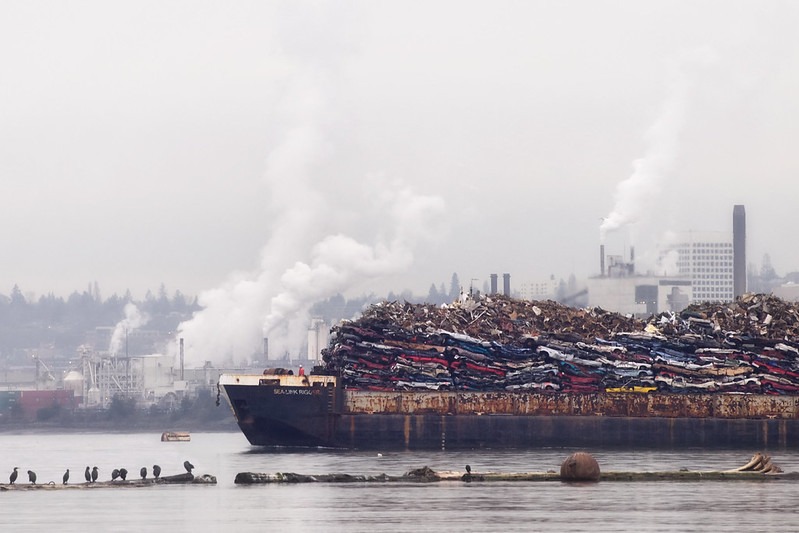
Urban environments expose birds to chemical pollutants. The most important ones are heavy metals and organic pollutants, produced by traffic, industry, energy production, waste processing, and agriculture. As many bird species live close to people, they are vulnerable to these pollutants.
What kinds of pollutants are urban birds exposed to?
Heavy metals: These occur naturally at low levels, but urban activities greatly increase their concentrations. Important ones are lead, cadmium, zinc, copper, iron, and chromium, which are set free by human activities such as the burning of fossil fuels, mining, metal processing, traffic, and industrial production. Some metals (for example, zinc and copper) are essential in small amounts but toxic at high concentrations. Others, including lead and cadmium, have no biological function and are harmful even at low levels. As chemical elements, they do not degrade but accumulate in soil and water and may end up in birds through the food chain.
Organic pollutants: Urban birds are also exposed to a wide range of synthetic organic compounds. Persistent organic pollutants (POPs) such as DDT and its breakdown products (PCBs), polybrominated diphenyl ethers (PBDEs), and hexabromocyclododecanes (HBCDs) are especially problematic as they are persistent and fat-soluble. Unfortunately, these chemicals have been widely used as pesticides, industrial fluids, flame retardants, and in manufacturing. Even when banned or restricted under international agreements, they remain in soils, sediments, and food chains for decades. Birds are exposed through diet—for example, by eating contaminated invertebrates, fish, or other prey.
What are POPs?
Persistent organic pollutants share some features, as the table shows. PCBs, PBDEs, and HBCD, the ones most relevant for birds, are all heavily halogenated. That means that chlorine and bromine atoms replace hydrogen atoms on carbon frameworks, creating molecules that only degrade very slowly and accumulate in fat tissue.
Comparison of different POPs (* generalised comparison only)
| Substance | Core Structure | Halogen | Aromatic? | Oxygen Bridge? | Relative Persistence | Bioaccumulation in Birds |
|---|---|---|---|---|---|---|
| PCB | Biphenyl (Ph–Ph) | Cl | Yes | No | Very high | Very high |
| PBDE | Diphenyl ether (Ph–O–Ph) | Br | Yes | Yes | High | High |
| HBCD | Cyclododecane (12-membered ring) | Br | No | No | Moderate to high | Moderate to high |
Polychlorinated biphenyls (PCBs) are built on a biphenyl backbone: two benzene rings joined by a single bond. Their general formula is C??H(10?n)Cl?. Up to ten hydrogen atoms may be replaced by chlorine. The aromatic rings provide rigidity and chemical stability; chlorination increases fat solubility and resistance to metabolic breakdown. In birds, PCBs accumulate in fatty tissue.
Polybrominated diphenyl ethers (PBDEs) are structurally similar but contain an oxygen bridge between the two phenyl rings (Ph–O–Ph). Their general formula is C??H(10?n)Br?O. Bromine atoms, larger than chlorine, enhance flame-retardant properties but also increase persistence and bioaccumulation.
Hexabromocyclododecane (HBCD) has a different structure. It is not aromatic but based on a saturated 12-carbon ring (cyclododecane) with six bromine substituents (C??H??Br?). Despite lacking aromatic rings, the bromination still adds persistence and lipophilicity.
What are the effects of this exposure?
Pollutants can affect birds at multiple biological levels: physiology, behaviour, reproduction, immunity, and genetics. In addition, there are indirect effects.
Physiology: Heavy metals can cause anaemia, reduce growth, damage organs, and alter behaviour. Lead exposure, for example, has been linked to weakness, poor development, and behavioural issues. Cadmium can damage kidneys and bones. In many urban studies, adult birds show elevated metal levels, and nestlings seem to be particularly likely to suffer from poor health due to metal exposure.
Behaviour: In heavily polluted areas, male songbirds showed reduced song repertoire size, indicating impaired brain development or reduced overall condition.
Reproduction: Organic pollutants are strongly associated with reproductive problems. DDT (via its metabolite DDE) causes eggshell thinning and reproductive failure in birds of prey. PCBs and PBDEs have been linked to reduced clutch sizes, lower hatching success, delayed breeding, and less viable offspring. In urban river systems, nestlings exposed to PCBs and PBDEs had a reduced body mass.
Immunity: Pollutants may weaken the immune system and increase damage from parasites. For example, high heavy metal levels increase the intensity of diseases in urban pigeons.
Genetics: At the molecular level, some pollutants are genotoxic. Higher levels of DNA damage markers have been found in urban birds compared to rural populations, suggesting long-term genetic stress.
Indirect effects: Pollution can also reduce food availability. Heavy metals and air pollutants may decrease urban insect populations, limiting food for birds. In some cities, reduced nestling survival has been linked not only to contaminants in tissues but also to poorer diet quality associated with polluted habitats.
How does exposure differ between urban and rural birds?
Pollutant levels are generally higher in urban birds than in rural ones. Urban soils contain more lead and other metals, and birds feeding in cities often show elevated concentrations in blood, feathers, liver, or eggs. Eggshells from large industrial cities typically contain higher metal levels than those from rural areas. Similarly, concentrations of PCBs, PBDEs, and other organohalogens are often greater in urban birds, though certain pesticides may be present at higher levels in agricultural areas.
However, not all elevated concentrations of pollutants are equally damaging, and urban birds may partly compensate negative effects through an altered diet. Nevertheless, the elevated level of chemical pollutants in cities adds to the stress placed on urban birds.
Cover Photo “What We Are*” by Ingrid Taylar is licensed under CC BY-NC 2.0.











A very interesting and important read. Many of us enjoy birding in cities and urban parks, but it is easy to forget that birds living close to us are constantly dealing with pressures created by human activity. Pollution is one of them, and the effects described here show how complex and far-reaching it can be.
Here in Panama we see other urban impacts as well. The bright lights of the city can affect birds during migration, especially species that travel at night and become disoriented by artificial light. Fireworks are another disturbance. During celebrations the sudden noise and flashes can cause birds to panic, abandon roosts, and fly into buildings or other hazards. It is a good reminder that the urban environment we create has consequences for the birds that share these spaces with us.
Interesting read, thank you for this. Pesticides and other related chemicals continue to be sprayed ad infinitum throughout much of the Caribbean, including in areas designated as reserves as well as within areas where food is grown. I continue to be baffled by this, how have we been lulled into such a complacent and trusting state that we believe – okay I’ll stop here.