


If all had gone to plan, you would now be admiring my photographs of the Hume’s Leaf Warbler that I encountered at Holkham, on the North Norfolk coast, at end of last month. Well, I did manage to see the warbler, but it was the most challenging and elusive bird that I have looked for since trying to see a White-tailed Alethe in a Ghanian forest 14 years ago. After a brief but quite satisfying sighting, it took me another 30 minutes to relocate the bird. I saw it again clearly, at close range, but for no longer than two seconds, before it dropped back into thick cover, never to be seen (by me) again. Photography was out of the question.
Hume’s Leaf Warblers are real rarities in Britain, with around six to seven records a year. Their rarity is hardly surprising, for these birds breed in central Asia and normally winter in southern Afghanistan and northern India, so birds that reach Britain are thousands of miles off course. I’d last seen this species on its breeding grounds in Kazakhstan back in 2005. Most British records are in November, but very occasionally individuals over winter. This autumn has been exceptional for them, with more sightings than usual.
By late November the emphasis when birding in North Norfolk isn’t on finding rarities, but enjoying the great flocks of wildfowl and waders birds that come to spend the winter here. Perhaps the most obvious are the Pink-footed Geese. These birds breed in Central Iceland: it was less than 100 years ago that it was definitely established that was where they bred: the only other nesting areas for the species are Greenland and Svalbard.
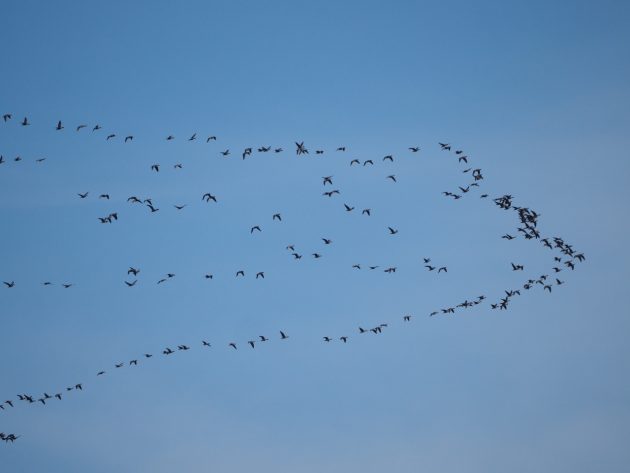
You usually hear the skeins of Pinkfeet before you see them
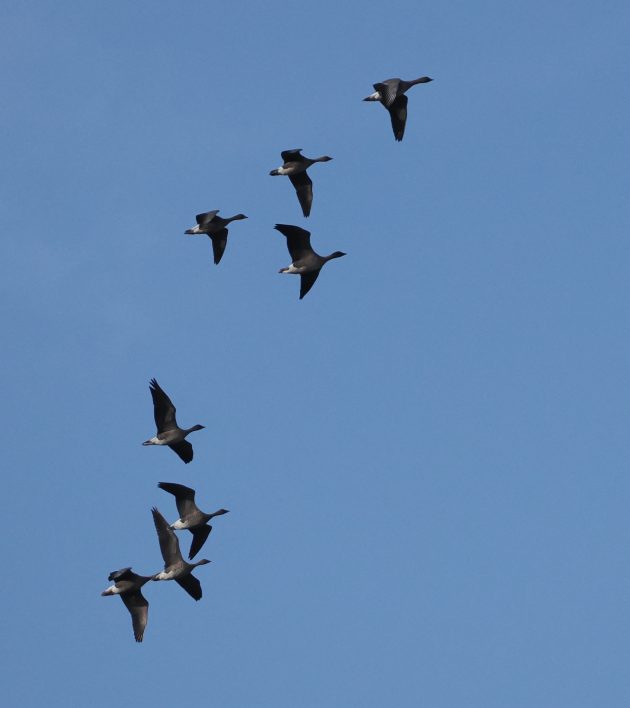
Dr David Bannerman, writing in Volume VI of his major work The Birds of the British Isles (1957), describes perfectly the delight in encountering these geese: “To watch the skeins of geese passing across the autumn sky is a wonderful sight of which a naturalist can never tire. As they fly with regular wing beats the geese call loudly to one another, and so far does the chorus travel that one’s attention is often drawn to a passing flock long before it comes into view.”
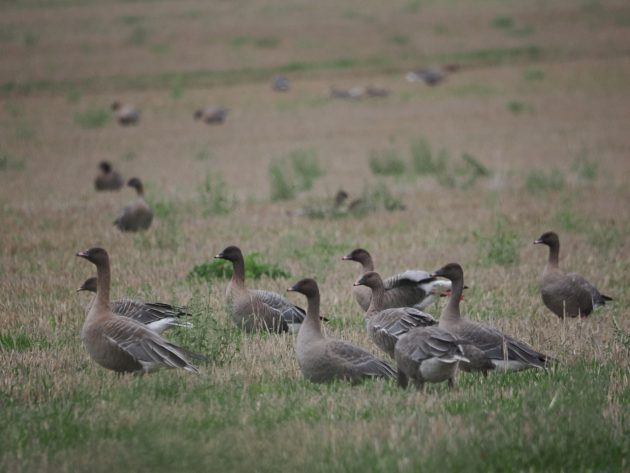
Pinks in the stubbles
I’ve seen a lot of skeins of Pinkfeet (or Pinks, as they are colloquially know) this autumn and winter, and almost every time I heard the birds before I saw them. The wink-wink calls of the Pinkfeet are distinctive, and quite unlike the more nasal cackling calls of Greylags. On one November evening the entire eastern sky was filled with skein after skein – long, wavering lines etched against the darkening sky. Estimating how many birds were involved was impossible, but my guess would be well in excess of 10,000, possibly twice that number. They were at least two miles away, but the wonderful goose music still reached me.
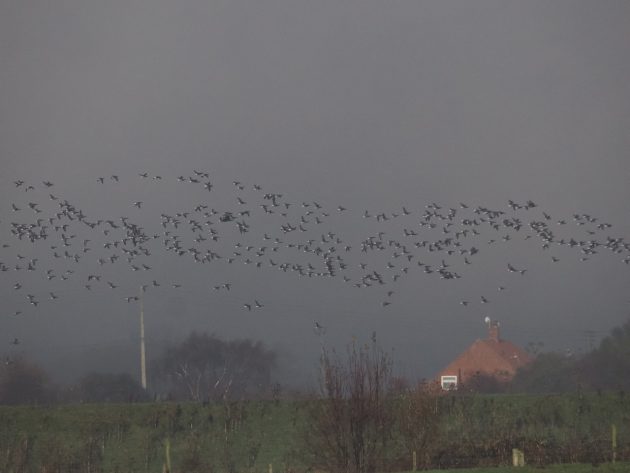
Brent Geese on a foggy Lincolnshire morning
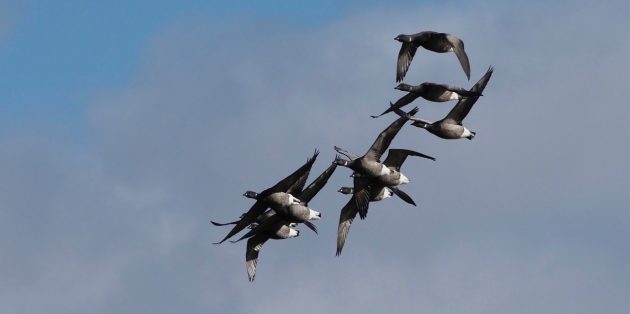
Brents typically fly in tight packs
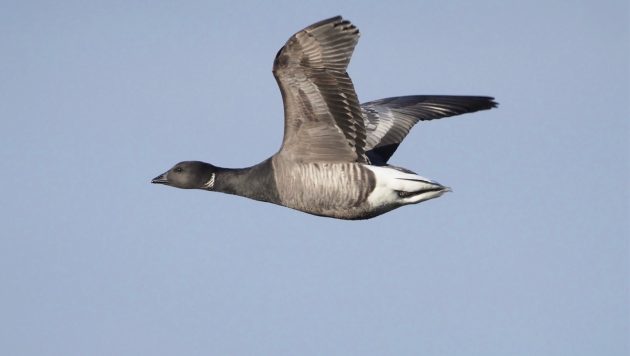
The Brent Geese we see in Eastern England are migrants from Russia
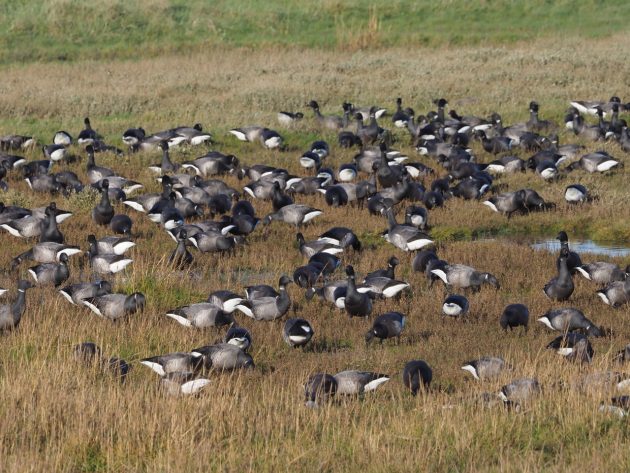
Feeding Brents: they rarely move far from the coast
Compared with the Pinks, Brent Geese are decidedly unmusical, their guttural calls just as distinctive but not nearly as far-carrying. Unlike the Icelandic Pinkfeet, these Russian birds (they breed in Russia and Western Siberia) seldom fly as high, nor do they ever venture far from the coast. However, you can encounter them in huge flocks. Earlier this month I watched a flock that must have numbered close to 2,000 birds at Frampton on the Lincolnshire coast of the Wash.
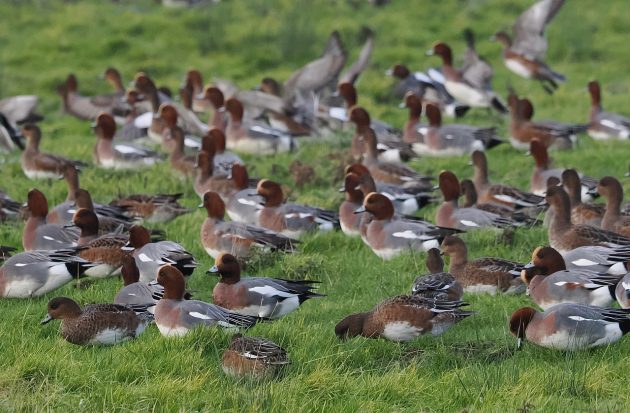
Wigeon – a highly social duck
Many species of ducks winter in North Norfolk, some in considerable numbers, but it’s the great packs of Wigeon that are the most spectacular. These ducks are highly sociable, at their most happy when grazing in company with hundreds of others of their kind. Wigeon are unusual in that they prefer to graze grass rather than forage in water, though they are rarely found far from ponds or pools, for whenever they are disturbed they lift as one, with much whistling, settling again on the nearest body of open water.
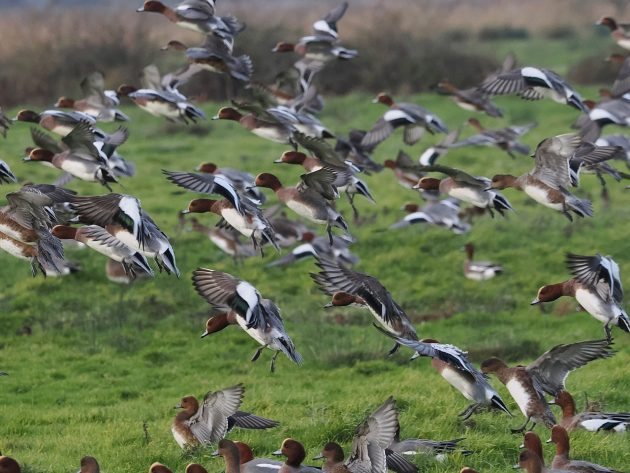
Wigeon are often to be found feeding in fields in company with Lapwings and Golden Plovers. Both species winter in Eastern England in large and often spectacular numbers, and the two will often roost together on the ground. When they first take off the two species remain mixed together, but it doesn’t take long for the faster-flying Golden Plovers to separate, usually flying higher than the Lapwings.
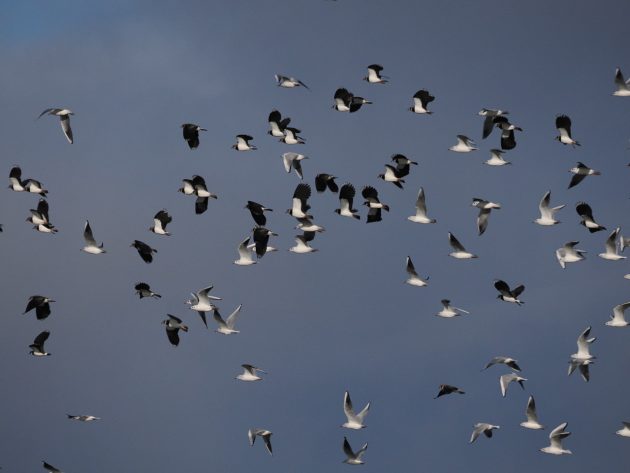
Lapwings and Black-headed Gulls
Earlier this week, at Frampton Marsh on the Lincolnshire coast of the Wash, I enjoyed the spectacle of hundreds of Lapwings and thousands of Golden Plovers flying overhead, then circling and landing on the marsh. The Golden Plovers communicate with each other with a soft but plaintive whistle, but when two or three thousand birds are overhead the sound you hear is the whisper of their wings. In contrast, the Lapwings are relatively quiet when flying, but are noisy when they land again, their calls a characteristic sound of the marsh in winter.
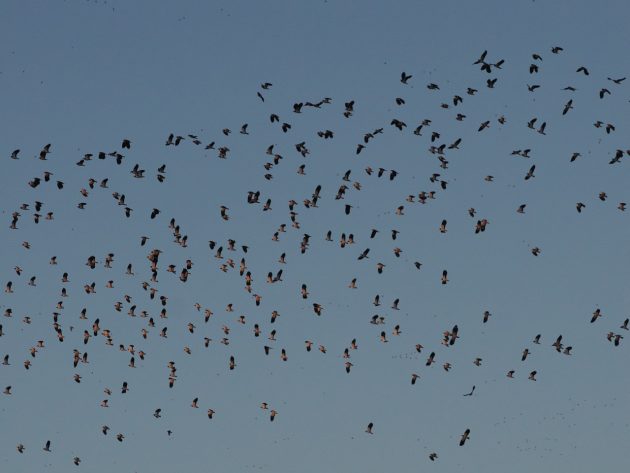
Big flocks of Lapwings are a feature of winter in North Norfolk
Lapwings have declined dramatically in Britain in the past 50 years, and the wintering flocks that we see here are partly made up of birds that have bred in North-East Europe or even as far away as Russia. Intriguingly, though ringing recoveries have shown that most British-bred Lapwings return to nest close to where they were hatched, individuals will sometimes pair with birds they have met on their wintering grounds. This is thought to explain why birds ringed as chicks in the UK have subsequently been found nesting as far away as Russia.
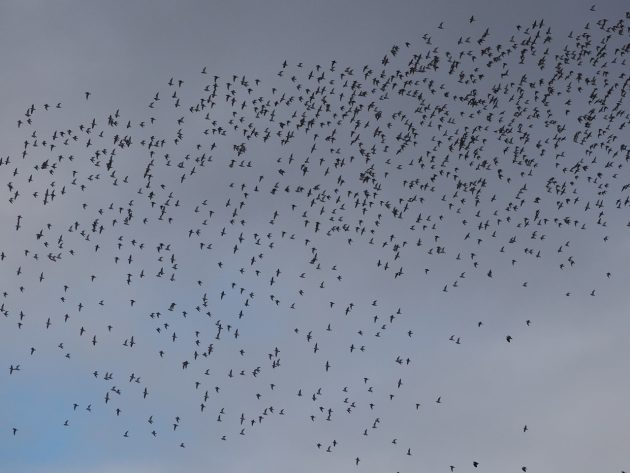
How many birds? Golden Plovers looking rather like Starlings
Most of the Icelandic population of Golden Plovers winters in the British Isles, but ringing suggests that the great majority head for Ireland or western Britain. The birds we see here in East Anglia are from Scandinavia or even Russia. Where ever they come from, they are always delight to both see and hear: watching the great flocks is a real winter treat, and one which I can’t get enough of.
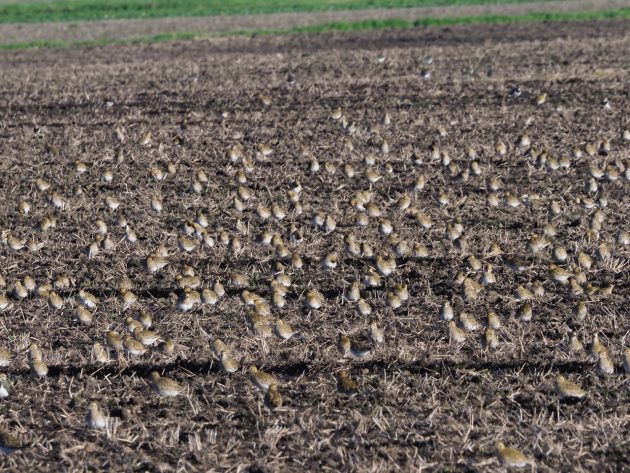
Golden plover










Wonderful flocks. Great pictures – much better than the Hume’s, no doubt.