

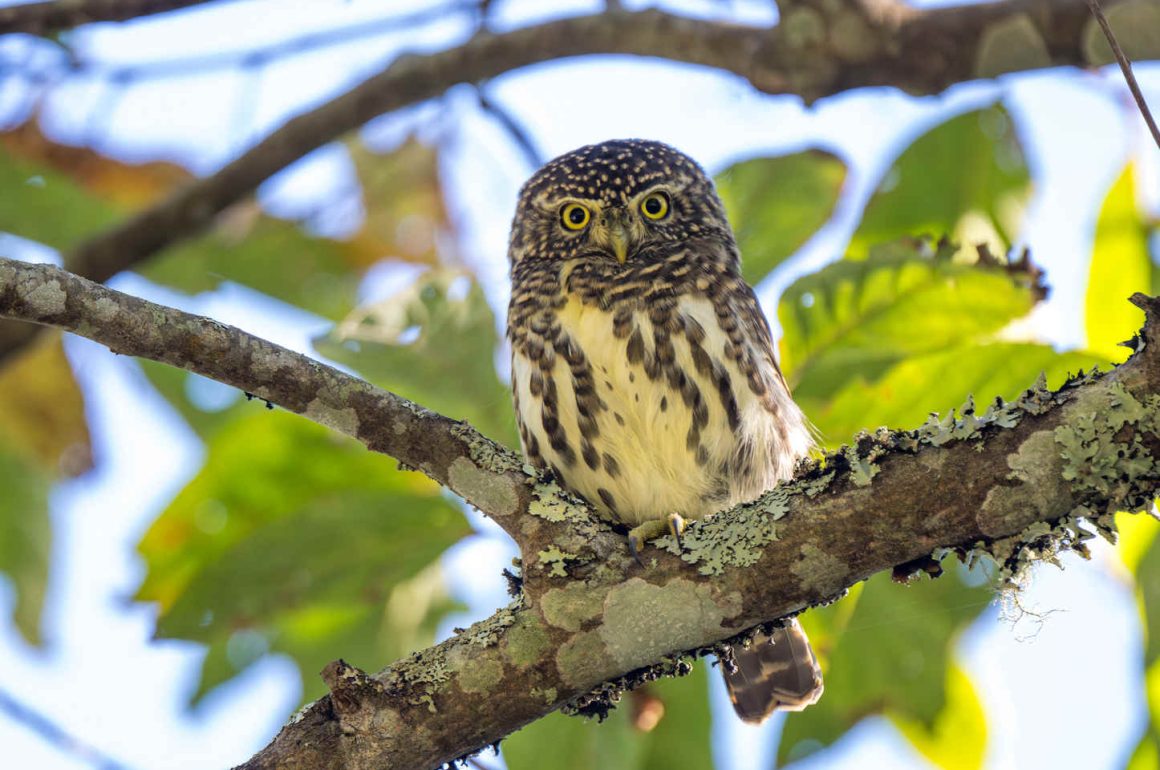
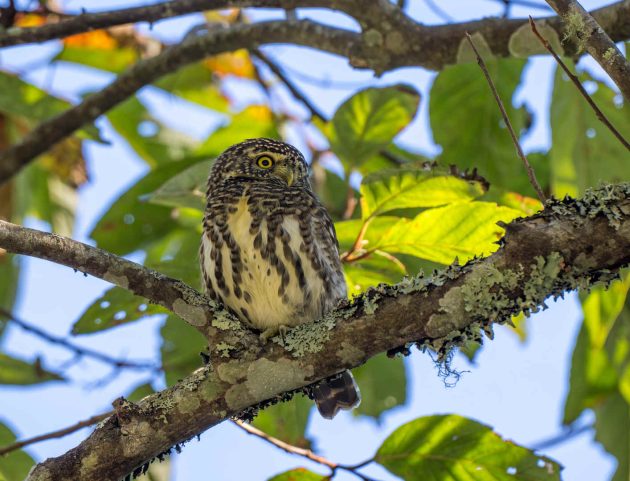
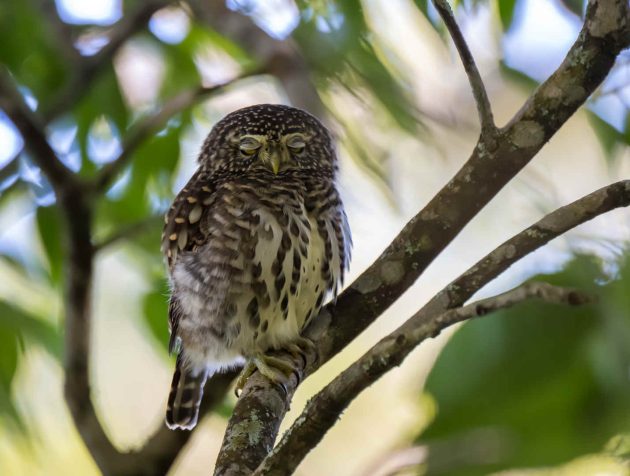
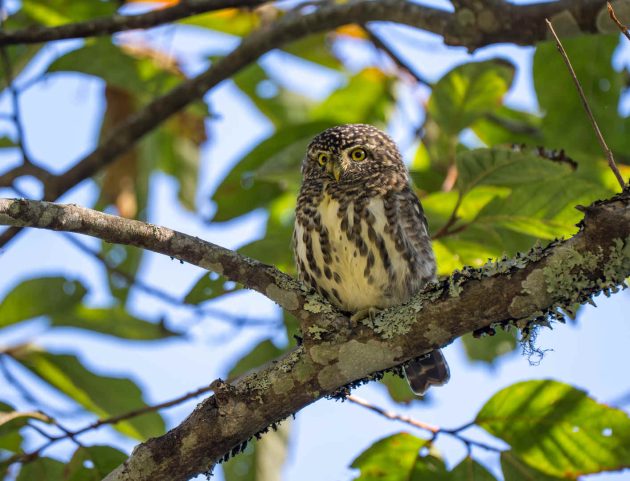
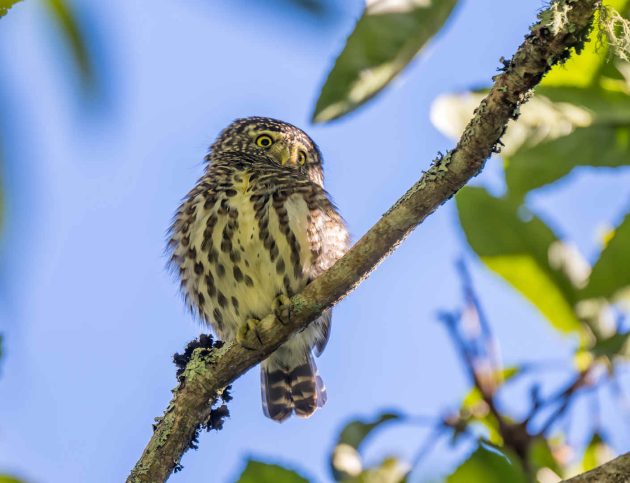
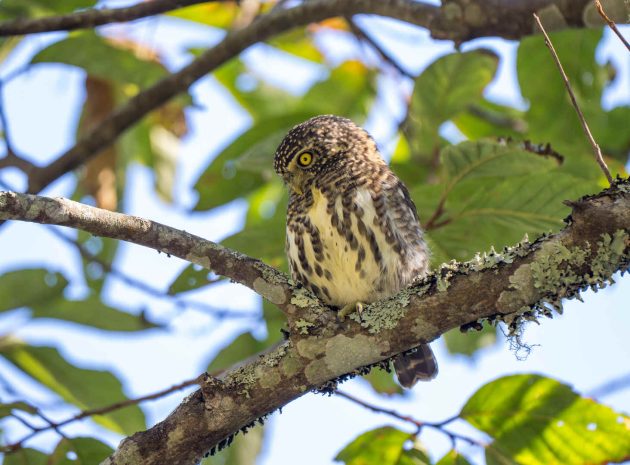
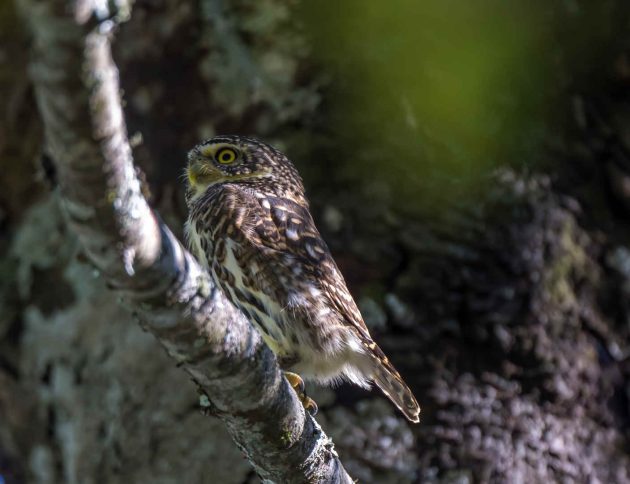
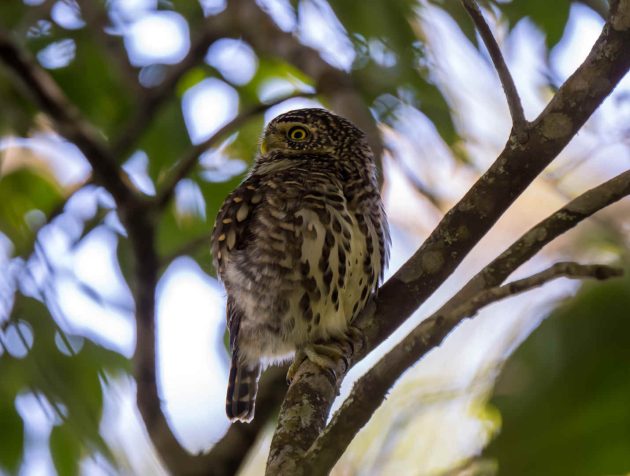
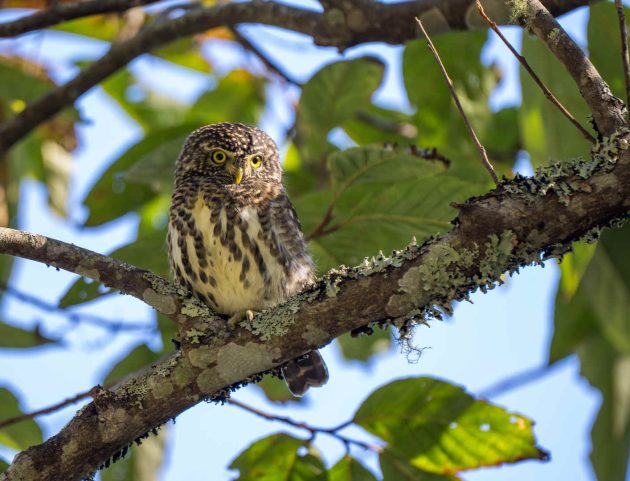
For a long time, before I finally saw it in Yunnan, the Collared Owlet was the one species I wanted to see most. Both for its appearance and also because it often seemed to be tantalizingly close, as it is a species that can be heard very frequently.
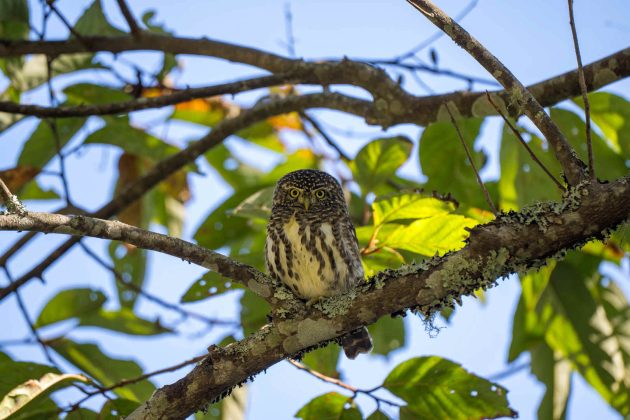
So, even though I have seen it a few times by now, I was still very happy about a new encounter at Dasyueshan, Taiwan. And for a photographer, this particular owl species comes with the added bonus of being active (though not always visible, see above) at daytime.
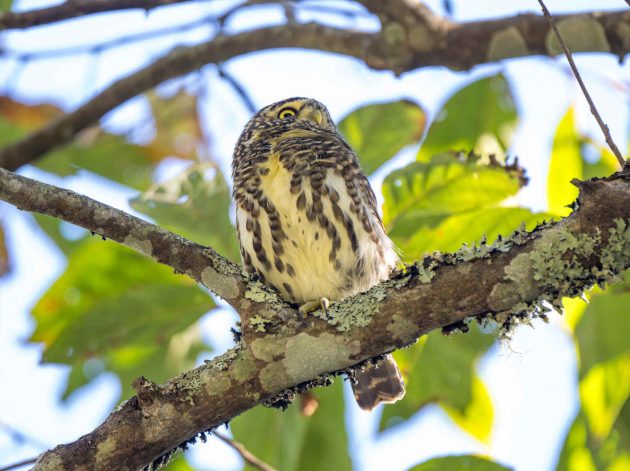
Here is the usual semi-boring paragraph on the scientific name of this owl. Taenioptynx brodiei indicates that this is an owl (“ptunx”, Greek, which should be quite difficult to pronounce properly, but then again, my own last name by that measure is not any easier), which is banded or striped (“tainia” band, stripe) and which was named after Sir Benjamin Collins Brodie (1783-1862), an English physiologist and apparently quite celebrated surgeon as he was the Sergeant-Surgeon to William IV and Queen Victoria, the President of the Royal College of Surgeons, and the President of the Royal Society.
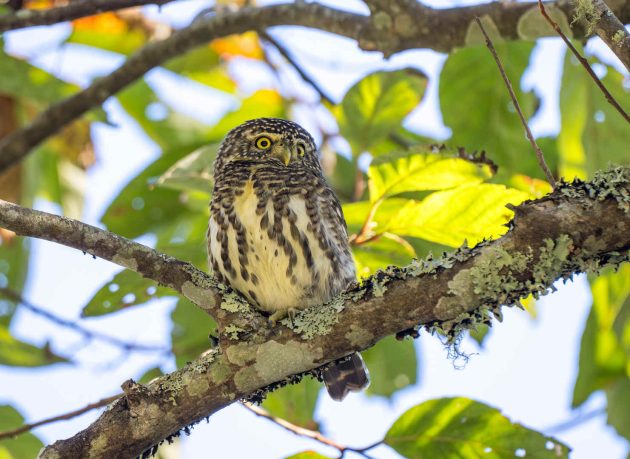
(I assume he is not in any way related to Ian Broudie of the Lightning Seeds – I still recommend listening to “Marooned”, particularly the last approximately 40 seconds when the track already more or less fades out, but reaches new heights. I am well aware that nobody ever follows my music recommendations anyway, but that will not stop me from putting them into my posts.)
Coming back to the more relevant (for the owl) Mr. Brodie, an 1862 obituary of the man starts with the question that we all ask ourselves, namely, “In writing the life of such a man as Sir Benjamin Brodie, that which affords most ground for reflection and comment is the question – By what means did he gain and maintain that exalted position both with the profession and the public which he enjoyed without interruption for so many years?”
To be fair, I think they did not have ChatGPT at that point, instead trying to make their written sentences sound like the equivalent of the elaborate but uncomfortable furniture they presumably used at that time as well.
Coming back to the first part of the name, I was actually quite surprised to hear it is Taenioptynx rather than Glaucidium. Well, at least on the Cornell website, it is – admittedly not always a truly reliable source but … Anyway, ChatGPT explains that the Cornell Lab of Ornithology’s “Birds of the World” database (and some of their other resources) sometimes retain older names or synonyms for clarity, historical context, or because not all taxonomic authorities update at the same pace. Sounds stupid to me, but then again, a lot of what is happening in the US these days sounds stupid to me, or worse.
Ok, for all three remaining (presumably all non-US) readers, a bit more about the owl.
One 2025 paper examining the number of birds in Guangdong, China, claims that there are 33,769 in that province (admittedly, they also indicate a margin of error). That indicates that the estimate in the HBW (10,000–100,000 breeding pairs each given for China and Taiwan) might be on the lower end. Good for the owl.
The owl – or better, its vocalisation – is also a good test case to examine mobbing of owls by smaller songbirds. In one study, the researchers played the owl call in Sichuan and observed the reactions: a total of 28 species of birds participated in mobbing behaviour, mostly from the Phylloscopidae (leaf warblers) and Paridae (tits) families.
Another paper gives a rationale for such mobbing behaviour: “Three cases of green-backed tits being predated by Collared Owlet (Glaucidium brodiei) were confirmed by the video recordings”.
Attacking green-backed tits is not the only way Collared Owlets can get noticed by researchers. Another is to be present on university campuses such as that of Government Serchhip College Campus in Mizoram, India. Interestingly (well, maybe), the local Mizo name for the owl is Phawngphawsawt, which (apologies for the crude and culturally insensitive joke) seems to imply that it is advisable to keep some distance or even an umbrella between you and the person saying this owl name.
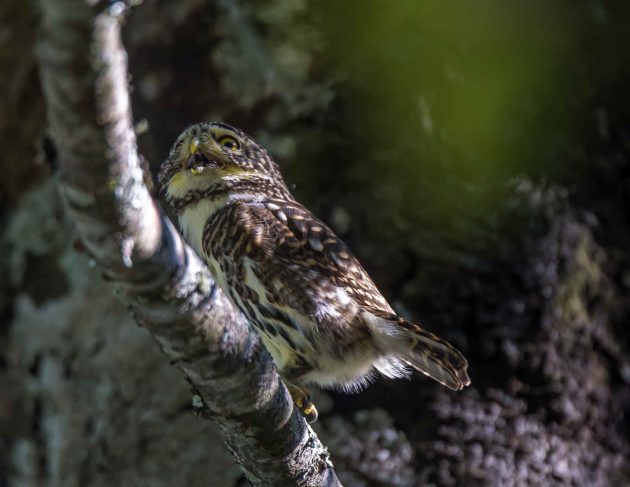
Finally, something about leadership. Apparently, in mixed flocks in Taiwan, the leader species were always the first to initiate mobbing calls in response to predator calls. And of course, the predator calls used in this study were those of the Collared Owlet, a “diurnal owl that preys on small passerines and is commonly found in forests … the owlet poses a significant threat to small birds.”
Photos taken at Dasyueshan, Taiwan, November 2025.







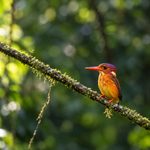
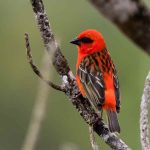

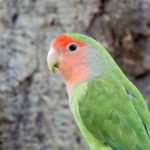

No surprise about that mobbing behavior. Here in Michoacán, the call of the Ferruginous Pygmy-Owl, Glaucidium brasilianum, is always our go-to call when we want to see whatever small birds might be around. With the added benefit of it being one of the few bird calls I can whistle convincingly. Convincingly to the little birdies and the owls themselves, that is.
Imitating any small owl’s call will bring in the feistier of the songbirds. I am always surprised how poor imitations have this effect while playing a relative species has none or little effect.