

The Italians call it antipasto: it’s the traditional small starter served before the main meal. Last month I visited Morocco on a birding trip, and our avian antipasto was a visit to the ski resort of Oukaimeden in the High Atlas Mountains. We drove there straight from Marrakesh airport: it’s a distance of only 80 kilometres (50 miles) or so, much of it on a flat, straight road south. Then, quite abruptly, you reach the mountains, and a winding road takes you higher and higher into the spectacular, snow-covered Atlas. Oukaimeden is at 2600m (8500ft), but the peaks around reach to over 4000m (13000ft), so it’s seriously high.
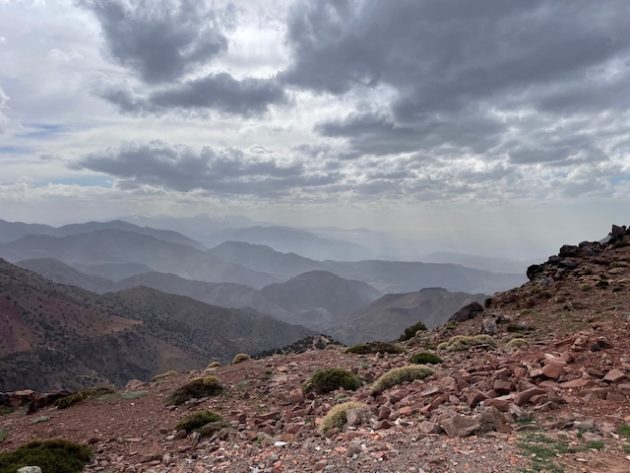
Morocco’s High Atlas are a mighty range of mountains
I’d be interested to visit Oukaimeden during the ski season, which extends from December to early April, but out of season it’s distinctly unglamorous, and hardly North Africa’s answer to the swish and fashionable ski resorts of the Alps. Apart from choughs, we had seen few birds on our approach to Oukaimeden, which is where the road ends abruptly in a large and unlovely gravel car park. The Chough flocks included both red-billed and yellow-billed (Alpine). The former are more usually found at lower altitudes, so it was intriguing seeing the two closely related species feeding side by side. What, I wonder, are the ecological differences between them, and how do their diets differ? Sadly, during this brief visit, there wasn’t time to find out.
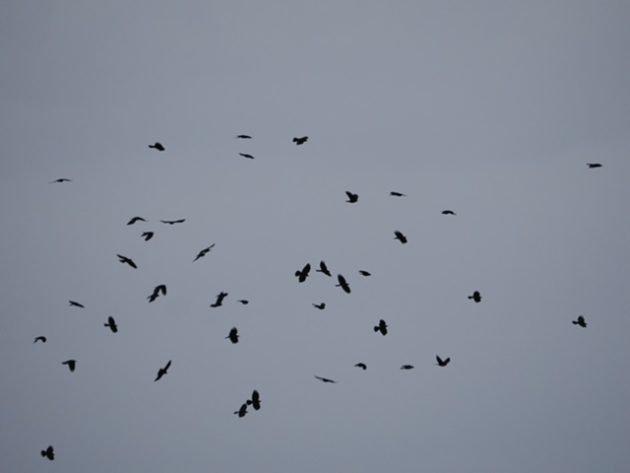
A tumble of Choughs
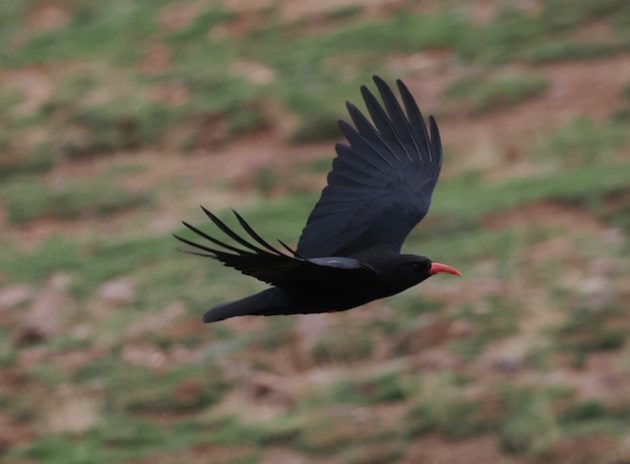
Red-billed Chough
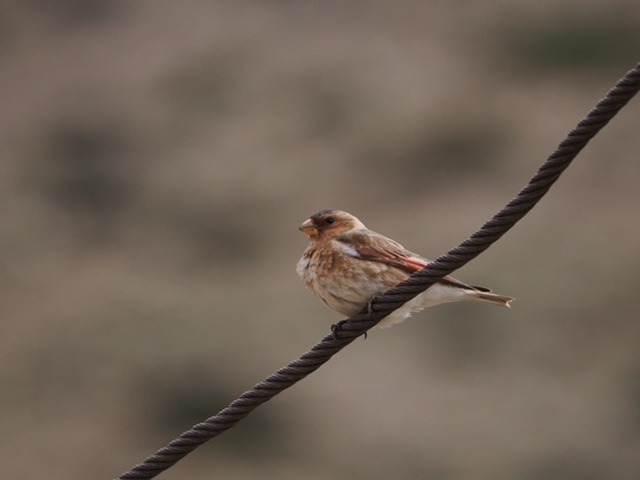
Our local guide, Omar, had brought us to the car park to find one bird in particular: African Crimson-winged Finch. Though I’d seen the very similar Asian Crimson-winged Finch in Kazakhstan, the African bird would be a lifer for me, and also my three companions, Martin, Chris and Mike. The chances didn’t look good. There was a biting wind blowing down from the mountain tops which sent us reaching for more clothes, while there wasn’t a bird to be seen or heard anywhere. A man with a gaily-saddled mule approached in the hope that we might want a ride. We didn’t.
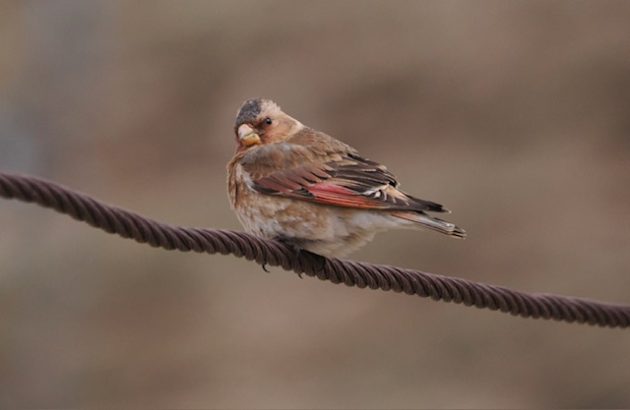
African Crimson-winged Finch, looking slightly grumpy. My first lifer of the trip
Then, suddenly, a bird appeared from nowhere and landed on the wires above us. Binoculars up, and we were focussing on a big, chunky finch. And yes, it did have crimson primaries: we’d found our target bird without hardly trying. What was more, our grumpy-looking finch was quite happy to have its photograph taken. This was a minor triumph, and proved to be the first of over a dozen lifers I scored on this trip.
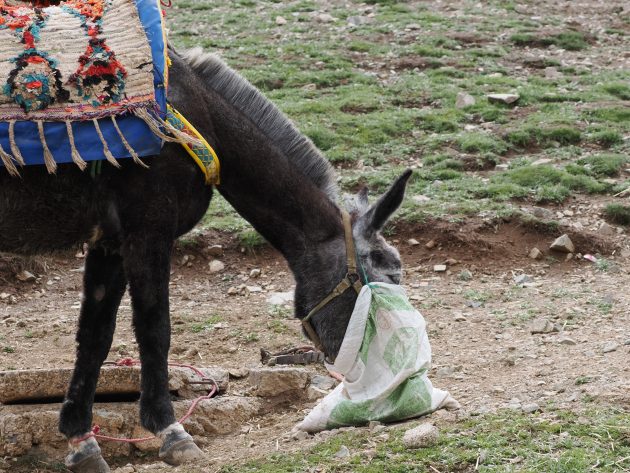
Lunch for a hungry mule
Tearing ourselves away from the finch, we started to get our eyes in, finding a few more birds. A single Mistle Thrush flew past. At home in England I see these big thrushes regularly; here in North Africa they are mountain birds. Then a Little Owl started calling, and after a while, scouring the rocky hillside in an effort to see it, we finally spotted it perched on a rock. We do have Little Owls at home in England, but this individual was the first one I’d seen this year.
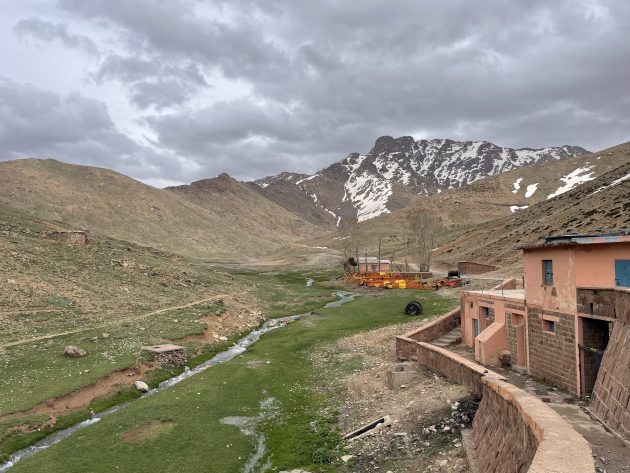
The end of the road: there are birds out there somewhere
We were working on a tight schedule, as the afternoon was pressing on and there were birds that Omar wanted to find, so we climbed back into our black Toyota 4×4 and set off in search of Horned Larks (or what we Brits call Shore Larks). The Horned Lark is the most widely distributed of the world’s 100 lark species, while the birds here in Morocco are of the race Eremophila alpestris atlas, endemic to Morocco. They are vertical migrants, which means that in winter they don’t really go anywhere, just descend to a lower altitude.
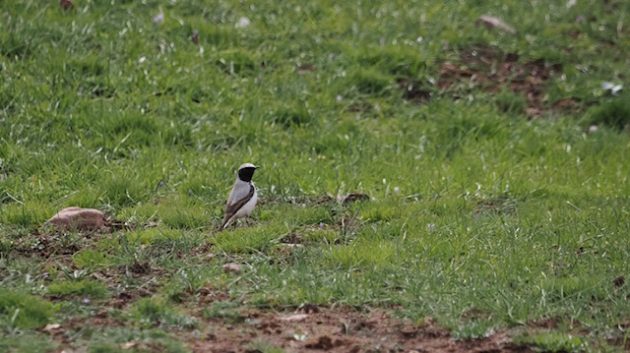
Seebohm’s Wheatear: another lifer
As we drove the short distance to the next site, we spotted a couple of wheatears from the car. They proved to be Seebhom’s Wheatears, a distinctive black-throated wheatear which is only breeds here in the Atlas Mountains. Often treated as a race of the widespread Northern Wheatear, the Collins Bird Guide regards it as a full species, as does the latest AviList world list. My second tick of the afternoon.
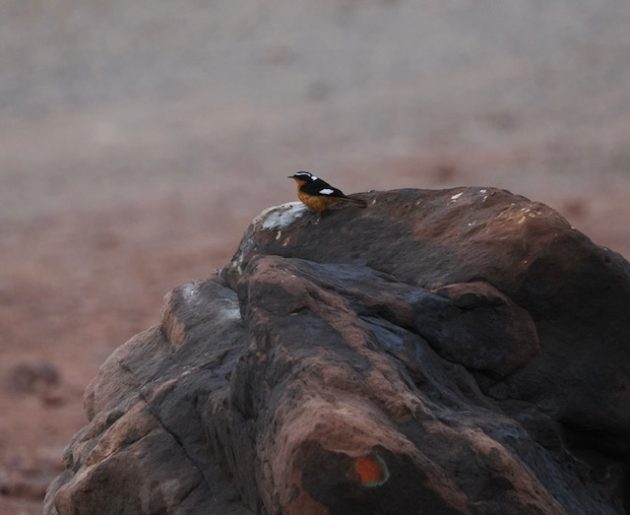
Moussier’s Redstart (male above and female below)
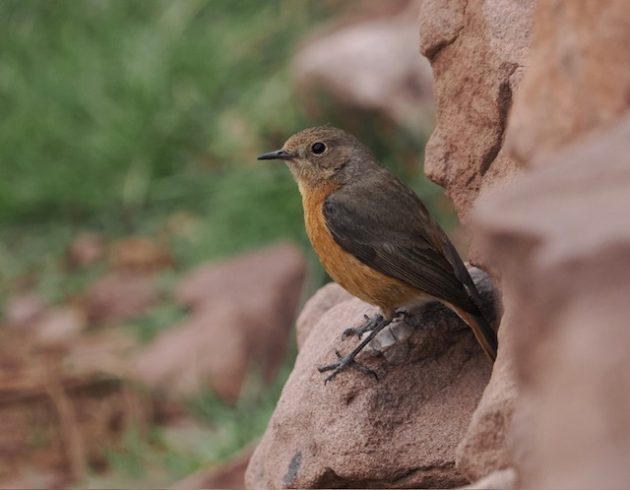
Omar parked the car at a site where he expected to see the larks, but finding them proved, at first, a challenge. There were, however, distractions, including a stunning male Moussier’s Redstart, together with his rather more dowdy mate. This handsome redstart is another North African endemic. Sadly, we weren’t to see any more. (Little is known about Jean Moussier, the Frenchman after whom the redstart is named. He is known to have served in the French Foreign Legion in Algeria, and probably collected the type-specimen of this redstart in about 1845).
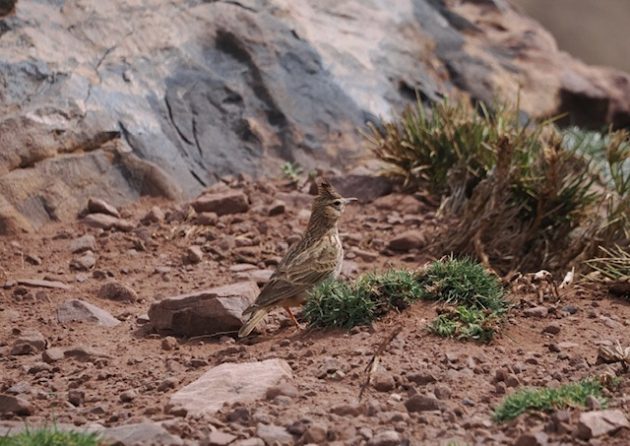
Thekla’s Lark.
After the diversion for the redstart I resumed lark hunting, finding first a Thekla’s lark. This is a large lark that can be difficult to distinguish from the very similar Crested Lark, but it favours more rugged, mountainous territory than the latter. It’s a bird I know well from Spain.
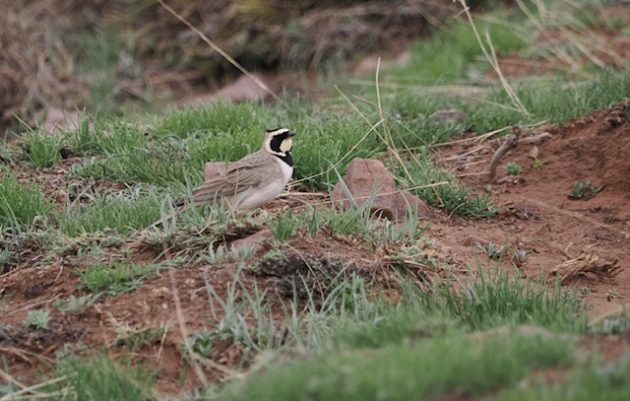
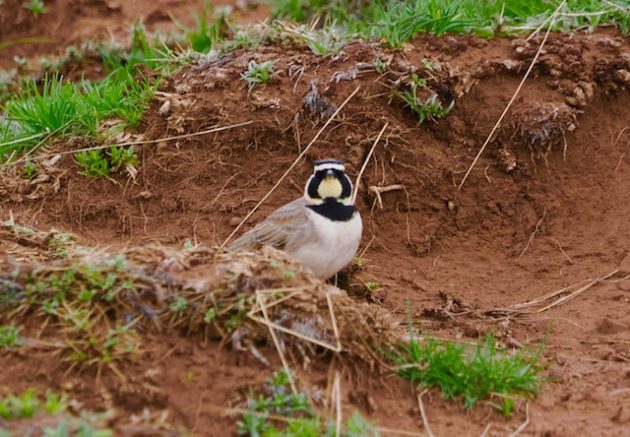
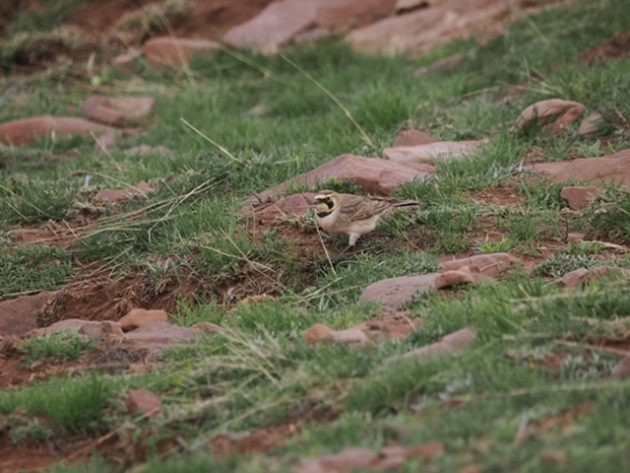
Atlas Horned Lark
Then the cry went up – Horned Lark! Our quarry had been found, and we were all able to enjoy prolonged views of a fine pair of Atlas Horned Larks. This is a species I know well in winter, when we find individuals from Scandinavia wintering on the coasts of Suffolk and Norfolk, but to see these birds (of a different race) on their breeding grounds high in the mountains was a pleasing experience.
With our target birds in the bag, it was time to descend from the mountains, but before we left Oukaimeden we did add a few more alpine species to our (so-far) modest list: Rock Sparrow, Rock Bunting and Black Redstart. Our Moroccan adventure had begun. We toasted the Crimson-wing Finch, the Seebom’s wheatears and the Horned Larks with a glass of red wine that night in our pleasant little hotel, the Auberge de Maquis at Sti Fadma. It was to be the our last drink for a week, as none of our subsequent hotels served alcohol. We’d enjoyed our avian antipasto, but the main meal – all the desert birds – was yet to come.
To be continued.








Lovely piece. Brought me back to Morocco.
The same for me, although I have yet to make it to the heights of the Atlas Mountains. I have only seen the Thekla’s Lark and Moussier’s Redstart from your list, so far.