

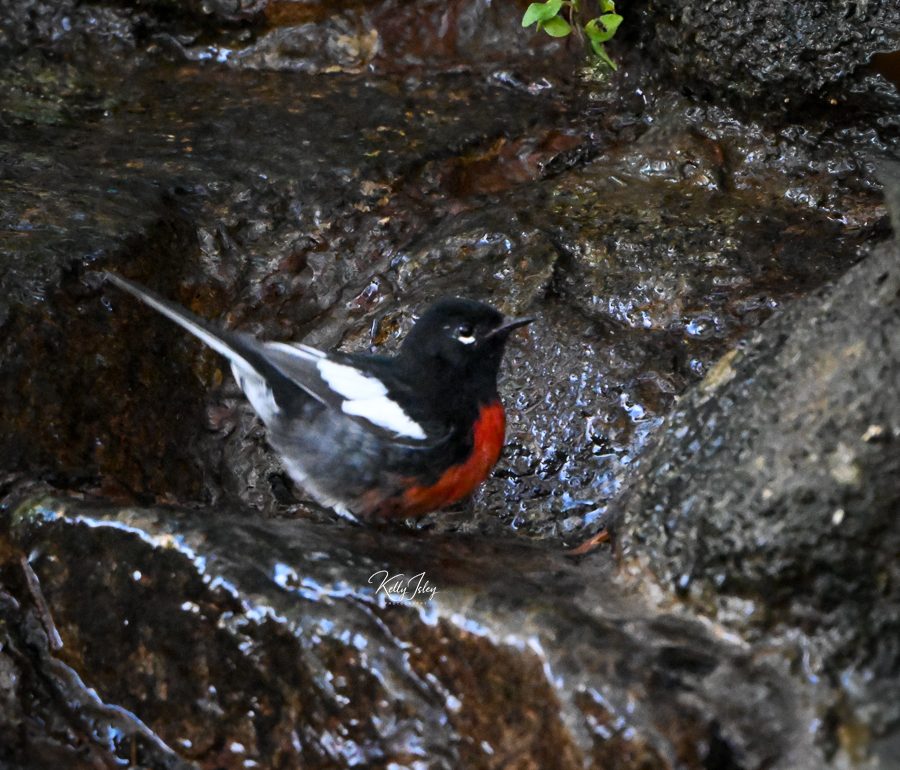
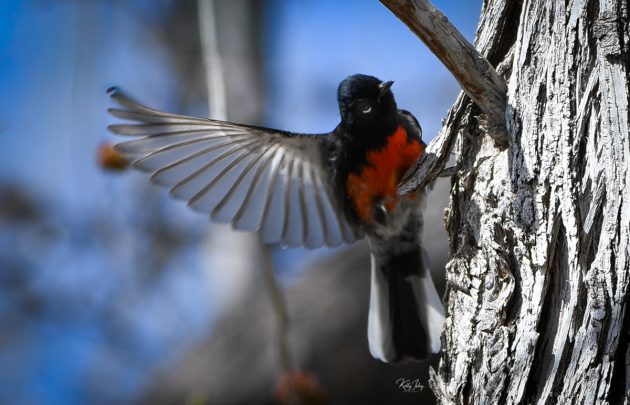
The Painted Redstart (Myioborus pictus) is one of the Southwest’s most striking songbirds. With its velvety black plumage, bright scarlet belly, bold white wing patches, and white markings around the eyes and tail, this small warbler looks almost as though it were painted by hand. Found in mountainous pine-oak and oak woodlands, particularly in the southwestern United States and Mexico, the Painted Redstart is a memorable sight for anyone lucky enough to encounter one.
One of the most fascinating things about the Painted Redstart is the way it forages. Rather than quietly picking insects from leaves like many small songbirds, it actively hops and pivots along branches while repeatedly flashing its wings and tail. Those sudden flashes of white can startle insects out of hiding, giving the redstart an opportunity to catch them. It may glean insects from vegetation, hover while feeding, or even dart through the air after prey.
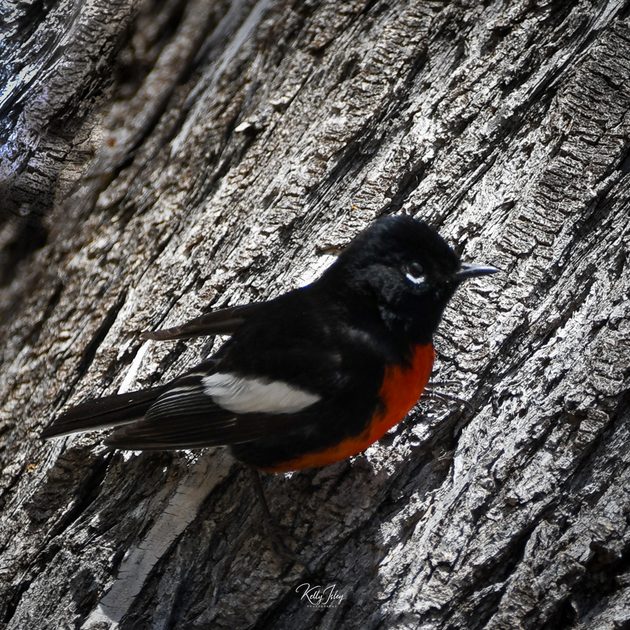
Then there’s the nest. While many songbirds nest in trees or shrubs, Painted Redstarts typically build their nests on the ground. They favor protected spots in steep, shady mountain canyons, often near streams and beneath natural cover. The female builds the nest, while both parents care for their young.
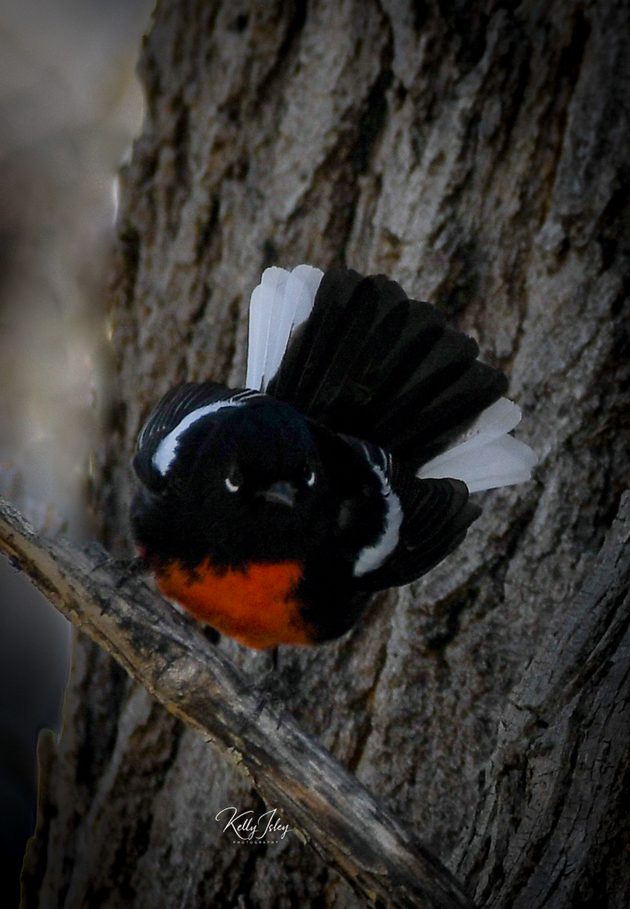
Their tail is far more than a beautiful feature. Painted Redstarts regularly fan their tails and flash their white outer tail feathers while feeding. This behavior appears to help flush insects from hiding. Tail fanning also plays a role in courtship and communication between parents and newly fledged young. Remarkably, young Painted Redstarts begin practicing this behavior before their tails are even fully grown.
Photography Tip
Painted Redstarts are active, quick-moving birds, so the key is to anticipate rather than simply react. One strategy is to watch for the tail flash. Instead of waiting for the bird to become perfectly still, pre-focus on a likely perch and use a fast shutter speed to capture the bird’s movement. Switching to burst or continuous shooting can also help you capture that split-second moment when the tail fans open, and the red belly is fully visible.
What’s in a Name?
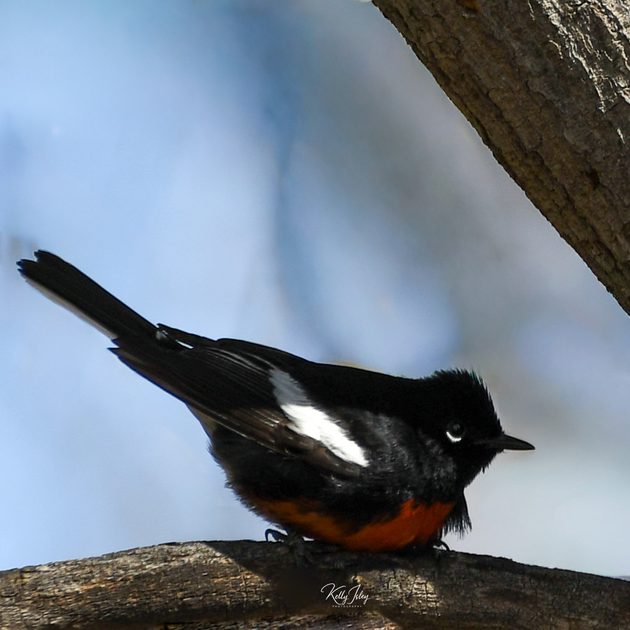
Despite its common name, the Painted Redstart is not closely related to the American Redstart. The two birds share a name and some similar foraging behaviors, but they belong to different evolutionary lineages. The Painted Redstart belongs to the genus Myioborus, a group of birds sometimes called “whitestarts” because of their prominent white markings.
For birdwatchers, finding a Painted Redstart can be exciting. In the United States, Arizona’s mountain ranges are among the classic places to look for them. Listen for the distinctive song or call inside shady mountain canyons and watch carefully for a sudden flash of white as the bird moves through the branches.
Small, energetic, and extraordinarily colorful, the Painted Redstart is proof that some of the most fascinating birds are also the most unique. From its unusual ground nests to its insect-flushing tail displays and singing females, Myioborus pictus is a warbler with plenty of surprises.








Leave a Comment