

Yesterday, lured out by the first sunshine for a fortnight, I visited the Wildfowl and Wetlands Trust refuge at Welney, on the Norfolk/Cambridgeshire border. This is one of the best sites for wildfowl in the country, as it hosts flocks of thousands of wildfowl throughout the winter. Unfortunately due to extensive flooding the big flocks of ducks were all very distant, making me wish that I hadn’t been lazy and left my telescope at home.
These days telescopes, or so-called spotting scopes, are standard kit for most serious birders, but this is a relatively recent phenomena. Fifty years ago it was rare to see anyone with a scope, with the exception of avid sea watchers who would use wonderful old brass-bound draw-tube scopes to search for distant skuas and petrels. These ex-naval telescopes were so long that watchers would lie on their backs to use them, with the objective-end of the scope resting on their feet. You had to be keen to use one, but to do so marked you out as one of a select band of dedicated birders (though the term birder was then rarely used).
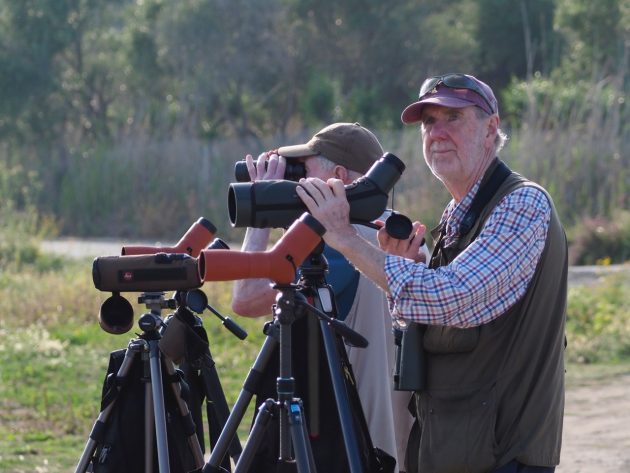
Spotting scopes are now standard kit for most serious birders
However, by the early 1980s the introduction of small, compact spotting scopes led to many more people using these devices. I remember that the first scopes I looked through weren’t really very good, but they soon started to improve. My first-ever scope, acquired in 1982, was a Bushnell Spacemaster. It was heavy but compact, with a distinctive grey-metal body. If I remember rightly, it had a 50mm objective lens, while mine was fitted with a 20x eyepiece – zoom eyepieces were also available. It was tough and weatherproof, with surprisingly bright optics.
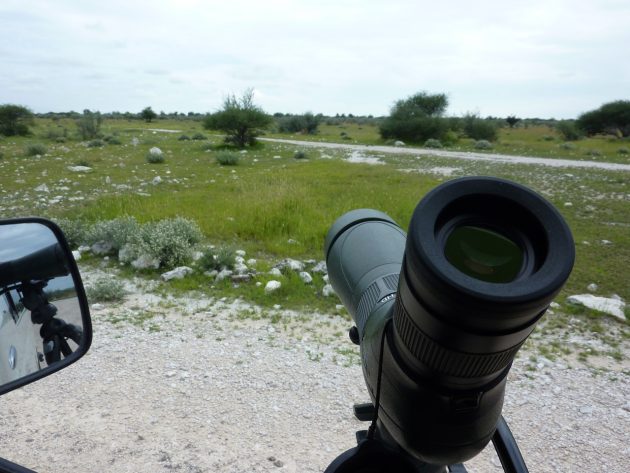
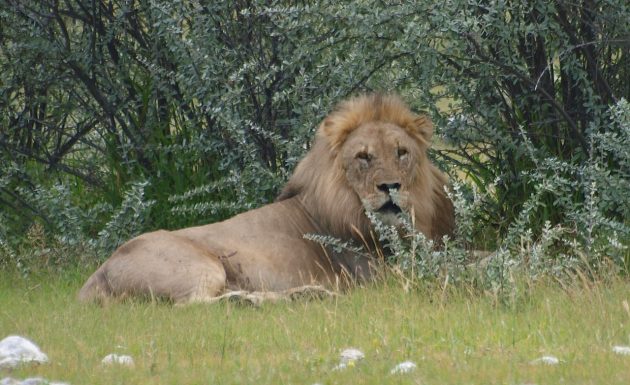
Here my scope is set outside my car to allow me to digiscope the Lion (below) from the driver’s seat. This was in Etosha National Park, Namibia, where it is forbidden to get out of a vehicle
I took the Spacemaster on a trip to Kenya, where one of the leading local birders scornfully told me that “We don’t use scopes here in Africa. We find we can get close enough to the birds without such things.” I wanted to ask him about viewing birds on the far bank of a river, or the wrong side of a pride of lions, but resisted doing so. On that Kenyan trip I even had a local guide carrying my scope for me – his choice, not mine. I felt rather like an old colonial hunter, though with my bearer carrying my scope rather than a double-barrelled elephant gun.
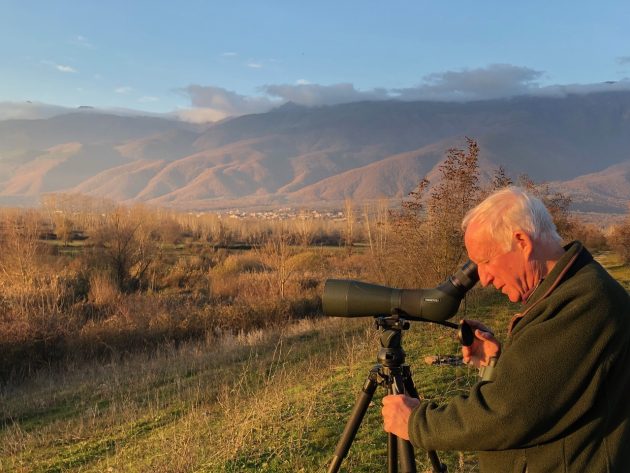
My Swarovski ATS 80 served me for nearly 20 years. Here I am using it during a trip to northern Greece in December 2021
Scopes had to have tripods, and in those days they were usually made from aluminium, with twist-grip legs and non-fluid heads. They were horribly cold to the touch on a winter’s day. I insulated the legs of my tripod with foam pipe lagging, which worked remarkably well. The lagging also had the advantage of making the scope more comfortable to carry on my shoulder. The twist-grip legs were a weak point, generally wearing out over time. There was nothing more frustrating than setting the scope up on a good bird, only to have one of the legs collapse.
At that time I was leading birdwatching holidays, and I found the scope invaluable for showing people birds. I became adept at quickly setting it up and pointing it at a bird, often before my clients had found the bird through their binoculars. Just occasionally this could be frustrating, as my rule was always to let members of my group look at the bird before I did myself.
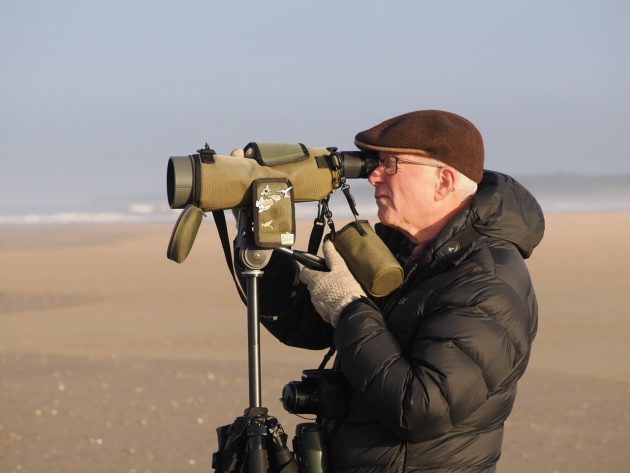
Straight-through telescopes, such as this Kowa, usually require a tripod to be fully extended for comfortable use, with a loss in stability
On one memorable occasion I was leading a group in Poland’s Bialowie?a forest. I found a Three-toed Woodpecker, the first I’d ever seen, and instantly set up the scope so my group could view it, though I was really keen to see it myself. Each member of my group enjoyed a lengthy look: it eventually flew before I could view it again. There was compensation, as one member of the group was bird artist Martin Woodcock who later presented me with a sketch of the bird. It remains a treasured possession, while I have seen Three-toed Woodpeckers on several occasions since that first encounter.
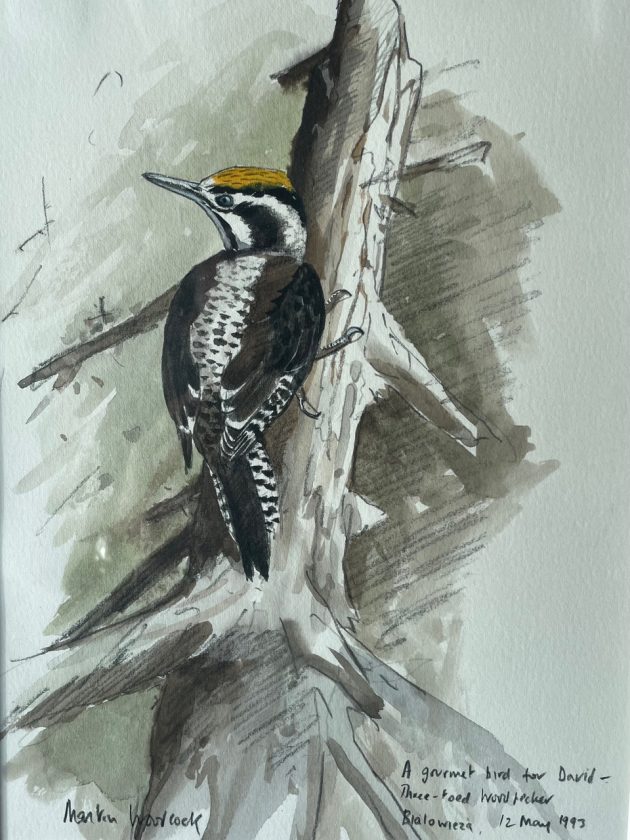
Martin Woodcock’s watercolour sketch of my first Three-toed Woodpecker
I’m not sure when I retired the Spacemaster, or even what happened to it, but it was succeeded by a succession of Kowa scopes. Kowa was one of the first of the optical manufacturers to produce really good spotting scopes, and it still does today. I was friendly with Kowa’s UK importer, and he kept me supplied with the latest model. Kowa scopes accompanied me on trips around the world, from Argentina to Australia. They proved tough and reliable.
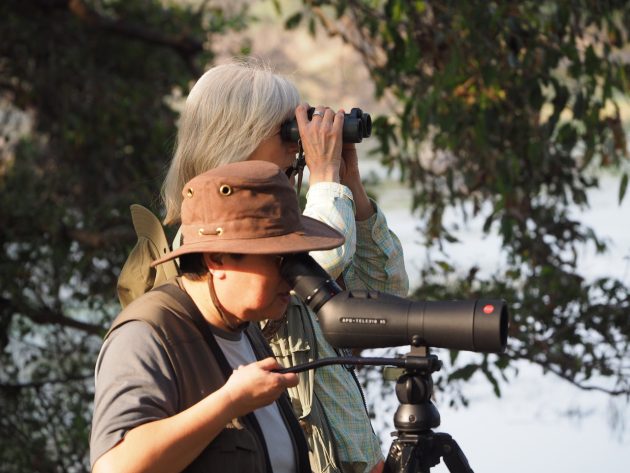
Angled scopes (this is a Leica Televid), allow observers of different heights to view a bird without altering the position of the scope
My first Kowa was a straight-through, but the later models I used were all angled. It didn’t take much practice to become as quick pointing the angled scope at a bird as it did with a straight-through, while the angled scope had the great advantage that it was much more user-friendly. Both tall and short people could use it without adjustments to the tripod, something that’s impossible with a straight-through scope. If it’s rare for you to share your scope that’s not important, but it is for a tour leader. I have now used an angled scope for so long that I’m much quicker finding a bird through it than I am with a straight-through, though it is a matter of what you get used to.
The major European binocular manufacturers – Leica, Zeiss, Swarovski – were all slow in producing scopes for birders. Swarovski’s first scope was an impressive beast for its time, but it was big, heavy and ugly. It was eventually replaced by the current ATS/STS scope, with a choice of angled (ATS) or straight (STS) design and a wide selection of interchangeable eyepieces. A handsome and attractive design, it was the new standard setter.
A friend bought one of these new scopes, and after looking through it I realised that I had to have one. I initially coupled it with a 30x fixed eyepiece. My new scope, and the 30x, accompanied me on a trip to Kenya where it acquitted itself admirably. I mounted it on a Swarovski carbon-fibre tripod with a fluid head, an impressive combination. Swarovski’s original zoom eyepiece was a 20-60x, which I didn’t like as the field of view was too narrow. This eyepiece was soon superseded by the current 25-50x, which I used exclusively on my scope.
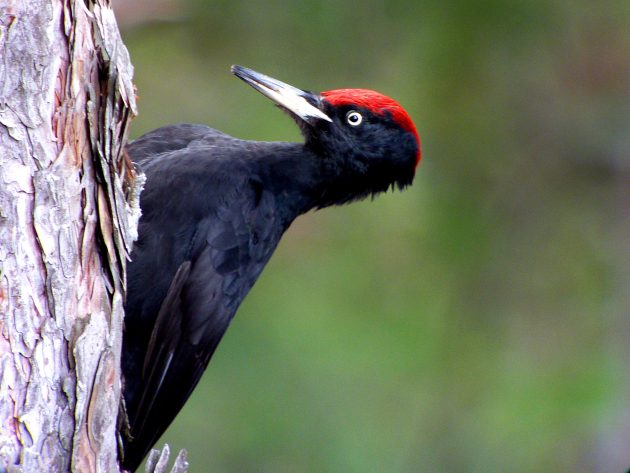
Black Woodpecker (above), and Black-naped Woodpecker (below), both digiscoped using a Swarovski ATS 80 telescope and a Lumix camera. The Black Woodpecker was photographed in Greece, the Black-naped in northern India
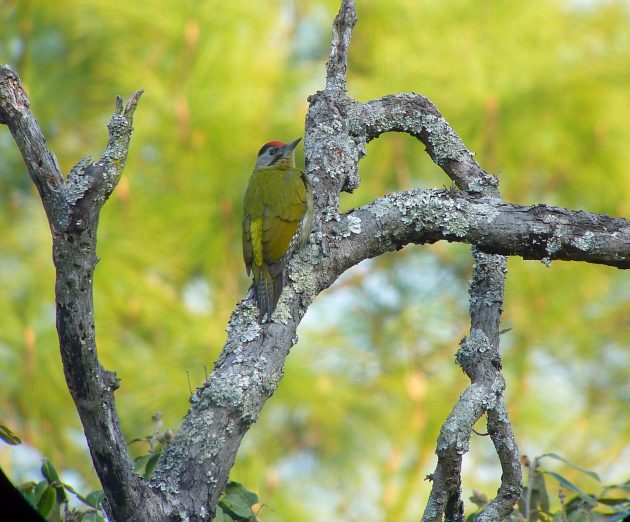
I bought my Swarovski ATS 80 in 2004, and it served me faithfully for nearly 20 years. I’m not sure how many species of birds it was pointed at during this time, but it must have been many hundreds. I also used it extensively for digiscoping, and the sharpness of my photographs reflected the quality of the scope’s optics.
In recent years Swarovski has widened its range of scopes, with its ATX spotting-scope system particularly innovative. There’s a choice of four objective modules (65, 85, 95 and 115), each of which can be used with the same eyepiece module. It’s a clever system. A friend has the 95 and I’m always impressed whenever I look through it. However, it has one major disadvantage: its weight.
I was also starting to find my ATS 80 rather heavy, so three years ago I replaced it with Swarovski’s ATC 17-40×56 travel scope. With its compact dimensions and a weight of just 970gm (34.2oz) it was just the device I was looking for. It also allowed me to swap my heavy tripod for a much lighter model, with no loss of stability. The ATC isn’t as good in poor light as the ATS, but you can’t expect it to be, and I’m more than prepared to swap a little loss in performance for portability.
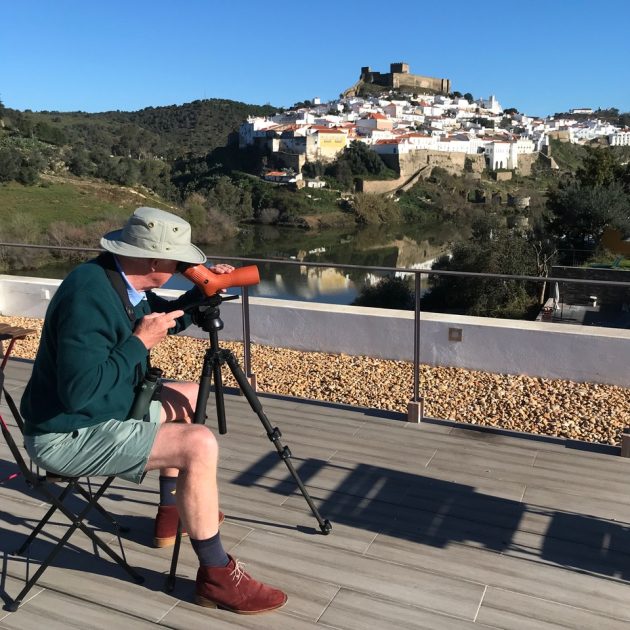
Watching Lesser Kestrels over the town of Mértola in Portugal’s Alentejo region with a Swarovski ATC travel scope
The ATC is expensive (like all Swarovski products), but there are number of much cheaper alternatives – here in the UK the buyer can choose from compact models from Hawke, Vortex, Optician and Kowa, with prices starting as low at £205. Kowa also offers a direct rival to the ATC – the TSN-55A / TSN-55S. With a similar price to the Swarovski, plus an almost identical specification (17-40x zoom, a 55mm objective lens and a weight of 965gm), it’s aimed at exactly the same market. I’ve yet to have the chance to compare the two side by side, but I would expect the same brilliant optics in both scopes.
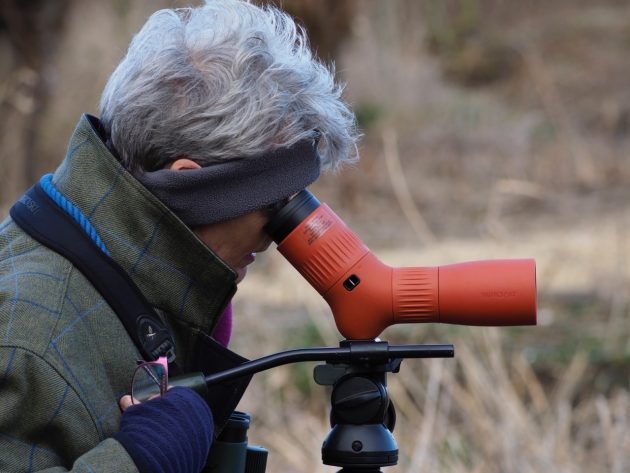
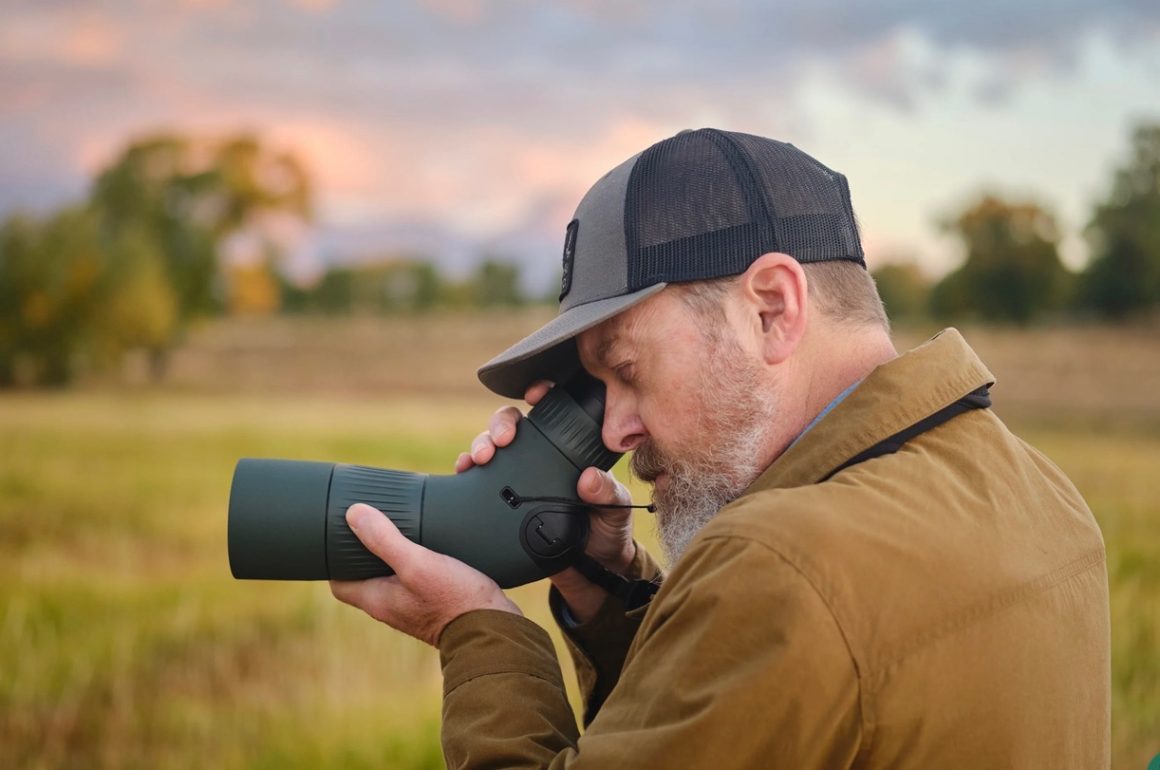
Technology never stands still, and the scope buyer now has the option of Swarovski’s new AT Balance 18-45×65 (see header photograph). It’s innovative, as it features an image stabiliser that makes a tripod unnecessary. A friend who has tried one was most impressed: I’m looking forward to getting the chance to test it myself. At 1470gm it’s considerably heavier than my ATC, but then there’s no need for a tripod. It is, naturally, expensive (£2,980 in the UK), while demand is such that Swarovski Optik UK has none in stock at the time of writing. However, I suspect that it’s going to be a game changer.



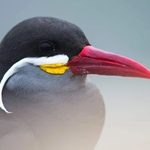



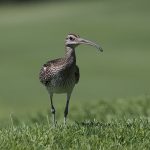

For the last 7 weeks, I tested the image stabilising Swarovski ST Balance 14-35×50 spotting scope, will be publishing my impressions soon.
Spotting scopes are a powerful and versatile tool for anyone who wants to observe nature, wildlife or even their hunting grounds with greater detail and accuracy. Spotting scopes are a type of telescope specifically designed for looking at far-off objects and providing a detailed view. They have two main components: an optical system consisting of lenses, prisms and other optical elements and a mount which allows the scope to be pointed in a particular direction. Spotting scopes usually feature high-quality optics with long focal lengths and magnification ranges of up to 80x.