

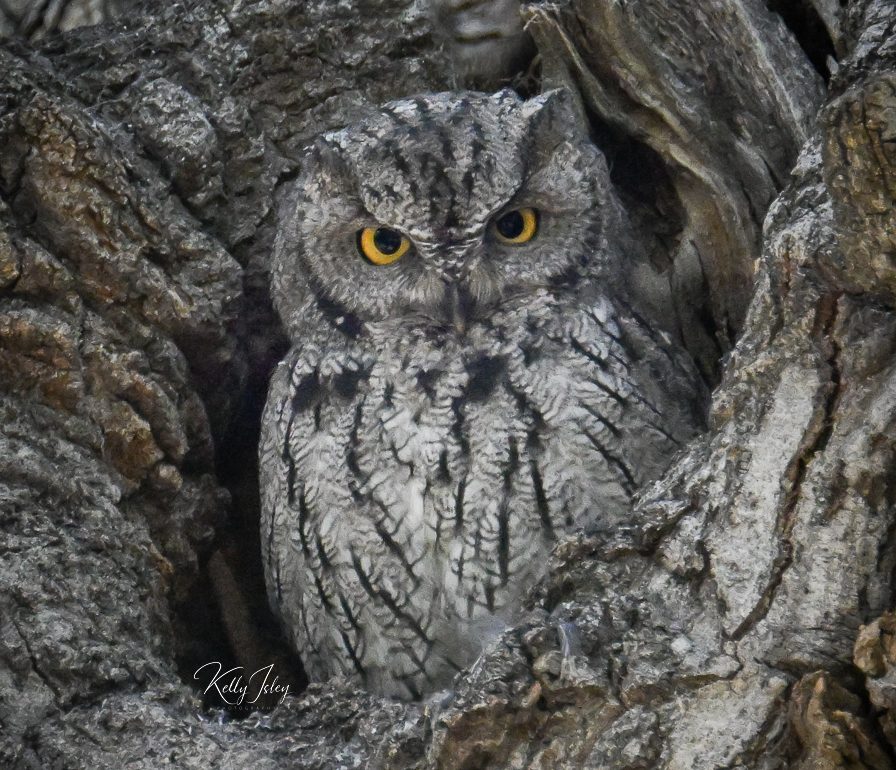
The Western Screech Owl (Megascops kennicottii) is a fascinating but mysterious North American bird. Secretive, smaller, and remarkably adaptable, this compact hunter thrives in environments ranging from desert canyons to leafy suburban neighborhoods. Though petite in size, it proves you don’t have to be large to be powerful.
Slightly larger than its eastern relative, the Eastern Screech Owl, the Western Screech Owl has carved out an impressive range across the western half of the continent. If you are ready to find one—or relocate a familiar resident—you’ll need patience, sharp ears, and a few tips on their behavior.
Listen First, Look Second
Ironically, the Western Screech Owl doesn’t necessarily screech. Instead, they produce a variety of vocalizations, such as a soft series of whistles that sound like a bouncing ball fading into the night. These calls are most common at dusk and after dark, when the owl is most active.
Your best chance of locating one is to head out just after sunset or just before sunrise. Pause often. Turn off flashlights. Let your ears adjust. If you hear a gentle, rhythmic whistling coming from the trees, you may be closer than you think.
Once you’ve identified the sound, scan nearby tree trunks carefully. A trunk that can bring us to the owl’s greatest defense.
A Master of Camouflage
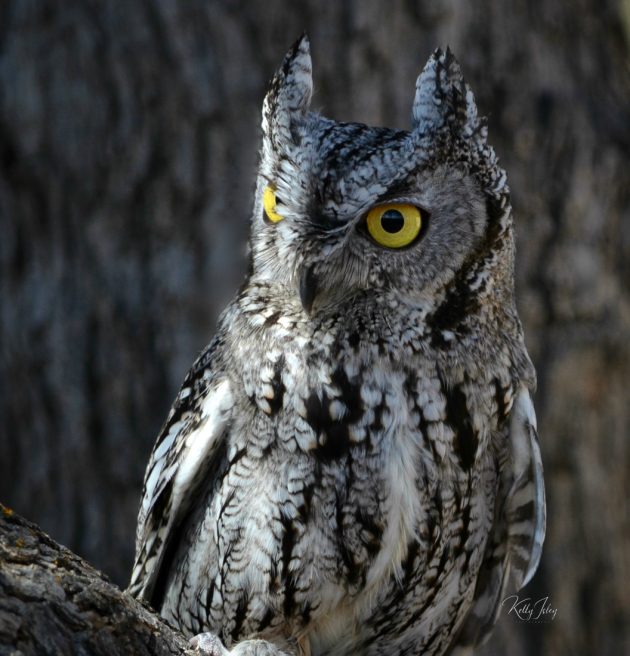
At first glance, a Western Screech Owl may look exactly like a small chunk of tree bark. Its mottled gray, brown, or even reddish plumage blends seamlessly with tree trunks. This camouflage is so effective that even experienced birdwatchers sometimes walk right past one.
During the day, these owls roost in tree cavities or press themselves tightly against a trunk, remaining perfectly still. Look for subtle shapes: a slight outline, closed eyes, or small ear tufts that resemble broken branches. Another clue that they’re near is the presence of other birds (e.g., bushtits, et al.,) swarming and calling around their perch. This behavior, which I have observed, is a form of mobbing used to warn other wildlife of the owl’s presence. Early morning and late afternoon light can also make them slightly easier to spot before they fully settle in or begin hunting.
Know Where to Look
One reason the Western Screech Owl is easier to find than many other owl species is its adaptability. Unlike owls that require deep wilderness, this species is comfortable living near humans. While they occupy a wide variety of wooded habitats, they are especially common in areas dominated by cottonwoods, oaks, and willows — trees that provide ideal nesting cavities and hunting perches.
You might find one in Parks, Orchards, Coastal forests, riparian woodlands, and Desert edges.
They range from southern Alaska through the western United States and into Mexico. As long as there are trees for nesting and a steady food supply, they can thrive.
Check old woodpecker holes, natural tree cavities, or even installed owl boxes. Field organizations such as the Owl Research Institute emphasize boots-on-the-ground research and monitoring, helping expand our understanding of owl populations that, in many areas, are more widespread than people realize.
Small but Mighty
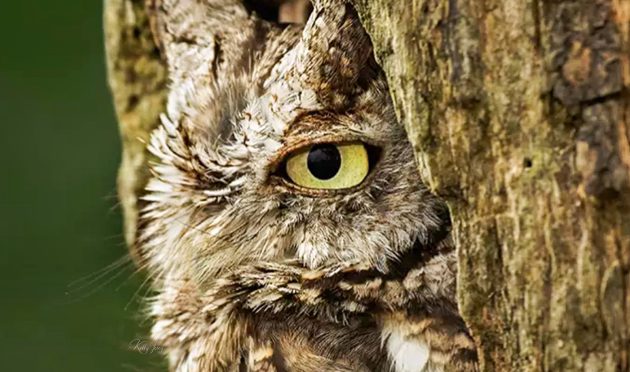
Standing just 7 to 10 inches tall with a wingspan of about 20 to 24 inches, the Western Screech Owl is compact but formidable. Though small, it is slightly larger than the Eastern Screech Owl, a subtle distinction that reflects their evolutionary separation.
It feeds on insects, small mammals, reptiles, birds, amphibians, and, in certain locations, fish.
This petite owl’s hunting style includes perching silently on a low branch, waiting patiently before swooping down with significant precision. Remarkable night vision and asymmetrical ears help it pinpoint prey in darkness. The slight difference in ear placement allows it to pinpoint the location of a sound. A finely tuned adaptation that makes it a formidable hunter.
Hidden in Plain Sight
Color variation can make identification challenging. Certain Western Screech Owls are gray, others brown or reddish, depending on regional habitat. Although these differences help them blend into local environments, they are all the same species.
Interestingly, the Western Screech Owl was once grouped with the Eastern Screech Owl as a single species. Scientists later separated them based on differences in calls, genetics, and geographic range. Another reason that listening carefully is so important.
A Backyard Ally
Finding a Western Screech Owl isn’t just exciting — it’s beneficial. These owls consume large numbers of insects and rodents, naturally helping control pest populations. Farmers and gardeners often benefit from their quiet presence without ever realizing it.
Monogamous pairs nest in cavities, where the female lays two to five eggs and the male brings food. If you discover an active nest, please observe from a distance to avoid disturbance.
Camouflaged, quiet, and surprisingly resilient, the Western Screech Owl rewards those who move with purpose but pay attention. Whether hidden in a forest hollow or perched silently above a neighborhood garden, this fierce hunter reminds us that sometimes the most extraordinary wildlife is right outside our door. If we know where to look.











My first Eastern Screech Owl ( I will need Kelly’s tips to find the Western) sat on a branch looking at me when I alighted a car. Sometimes all you need is luck.
Fascinating insight into the Western Screech Owl. Thanks, Kelly!
Superior photos of Western Screech Owls. The display of camouflage evolution is amazing!
I’m inspired! I’m hoping these tips work for Eastern Screech Owls as well. Love this post!
If you’ve ever walked past a tree and been outwitted by a seven-inch hunter, this article explains why. The Western Screech Owl emerges here as a pint-sized “screech,” more soft, bouncing-ball whistle – with camouflage so good it could win awards for Best Supporting Bark. I especially appreciated the practical tips: listen at dusk, scan trunks slowly, and follow the drama of mobbing songbirds. The piece balances field-guide precision with genuine wonder, reminding us that extraordinary wildlife isn’t always remote. It might be blinking at us from the nearest cottonwood. Small, fierce, and hiding in plain sight indeed.