

By Tania Dey
Tania Dey is a Professor and Senior Researcher in the area on chemistry and materials, with 20 years post-PhD experience from North America and Europe, currently relocated to India. She is also an amateur photographer with great passion for nature. She can be reached out at taniadey@hotmail.com
Abstract:
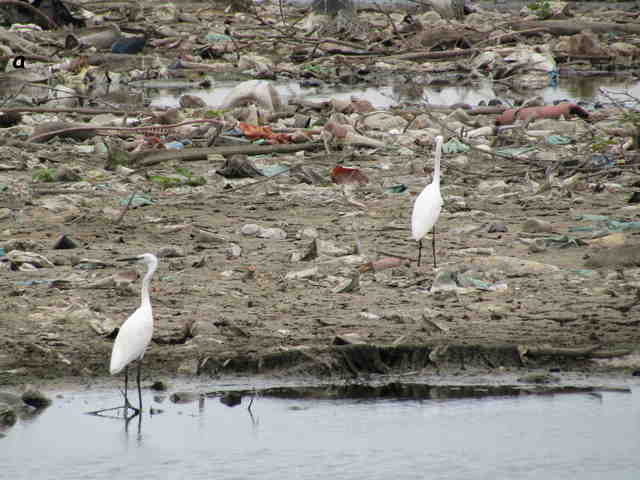
Several rare species of water birds and fishes can be spotted at Singanallur lake in Coimbatore. This includes a bunch of Spot-billed Pelicans, Painted Storks, Black-winged Stilt, Grey Heron, Grey-Headed Swamp Hen, Little Cormorant, African Great Egret, and common carp fishes, among which the first two species are ‘near threatened’. Simpson’s index was calculated to be 0.67, indicating moderate to moderately high biodiversity. However the ambience remains neglected and full of plastic pollution. More diligent regulation to improve the habitat is being proposed to preserve this invaluable biodiversity.
Keywords:
Simpson’s biodiversity index, spot-billed pelican, Singanallur lake, water birds, plastic pollution.
Article:
Coimbatore is a city in Tamil Nadu, southern India and is full of lakes (called ‘kulam’ in local language). However there is one lake that stands out from the rest. It is called Singanallur lake (10°59’42″N, 77°00’18″E, coverage area 1.153 km2) (Jencipriya & Meiaraj, 2020). Approaching the lake through an obscure hidden entrance, one will get amazed by the number and species of water birds found over there. A bunch of spot-billed pelicans (Pelecanus philippensis), painted storks (Mycteria leucocephala), black-winged stilt (Himantopus himantopus), grey heron (Ardea cinerea) [Photo 1], grey-headed swamp hen (Porphyrio poliocephalus), little cormorant (Microcarbo niger) [Photo 2] and African great egret (Ardea alba melanorhynchos) [Photo 3] can be spotted and identified over there on a regular basis. And if that is not enough, one can get surrounded by a shoal of water gobbling fishes with orange mouths floating over the water, they are common carp (Cyprinus carpio) [Photo 3]. Fishing is prohibited in this lake, at least theoretically.
According to IUCN (International Union for Conservation of Nature) status, the first two species of water birds are Near Threatened (NT) (Kannan & Manakadan, 2005), whereas the rest are of Least Concern (LC). The one-hour sighting on a sunny day dated 2-Oct-2025 is summarized in Table 1.
Point count method is a standardized survey technique to estimate the population and diversity of wildlife, most commonly birds. In this method, observer stands in a fixed location for a set period of 3-10 minutes and records individual animal seen or heard from all possible directions (Fonturbel et al. 2020). This method was used in this study and observations were made from three locations that are 200 m apart.
Table 1: Species identification, sighting numbers and IUCN status of water birds and fishes at Singanallur lake.
| Name of species | Scientific name | Number in a sample | IUCN status |
| Spot-billed pelican | Pelecanus philippensis | 25 | Near Threatened (NT) |
| Painted stork | Mycteria leucocephala | 2 | Near Threatened (NT) |
| Black-winged stilt | Himantopus himantopus | 1 | Least Concern (LC) |
| Grey heron | Ardea cinerea | 2 | Least Concern (LC) |
| Grey-headed swamp hen | Porphyrio poliocephalus | 4 | Least Concern (LC) |
| Little cormorant | Microcarbo niger | 1 | Least Concern (LC) |
| African great egret | Ardea alba melanorhynchos | 2 | Least Concern (LC) |
| Common carp | Cyprinus carpio | 9 | Least Concern (LC) |
Simpson’s index is often time used to calculate biodiversity, which is given by:

where n is number of individuals for each species and N is total number of organisms in a sample. It takes into account both the richness and evenness of the species present in a sample. Simpson’s index calculated from the data in Table 1 was found to be 0.67, which is close to 1, indicating moderate to moderately high biodiversity (Ramchandra, 2013).
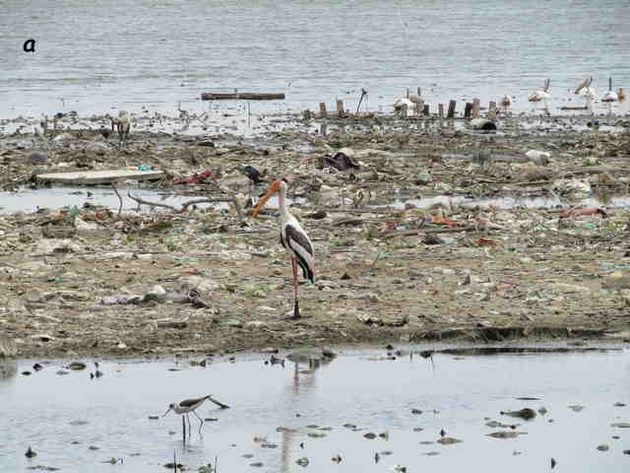
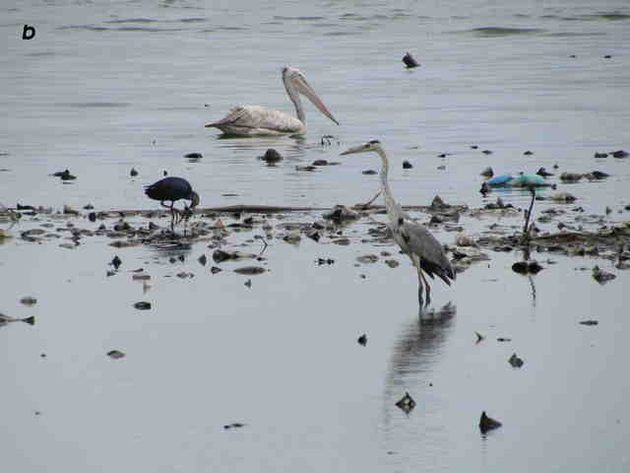
Photo 1: (a) Bunch of spot-billed pelicans, painted stork and black-winged stilt (b) Spot-billed pelican and grey heron, in Singanallur lake.
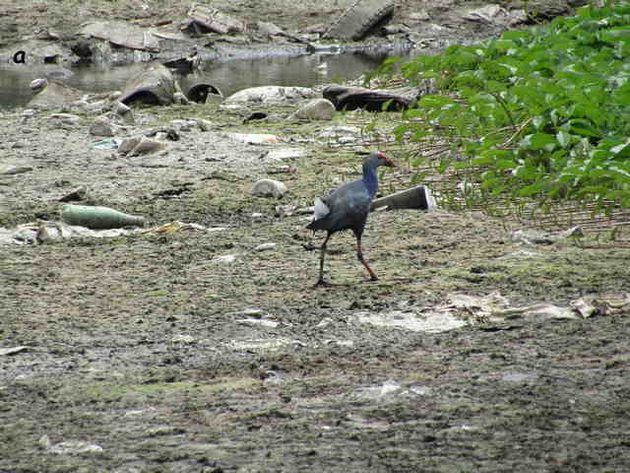
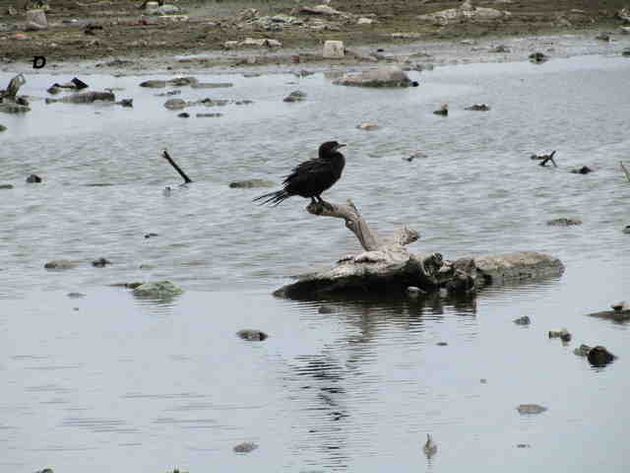
Photo 2: (a) Grey-headed swamp hen (b) Little cormorant, in Singanallur lake.
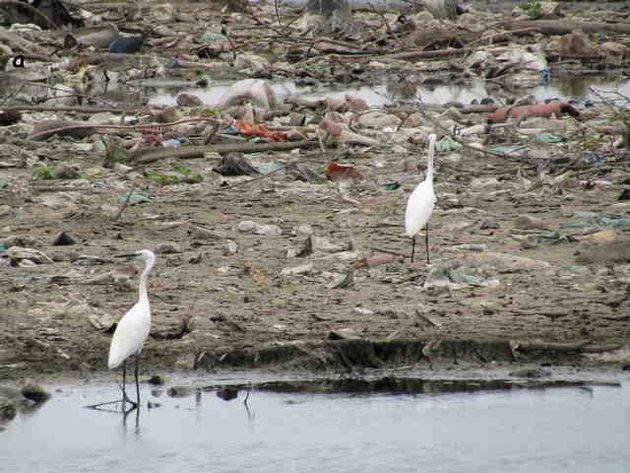
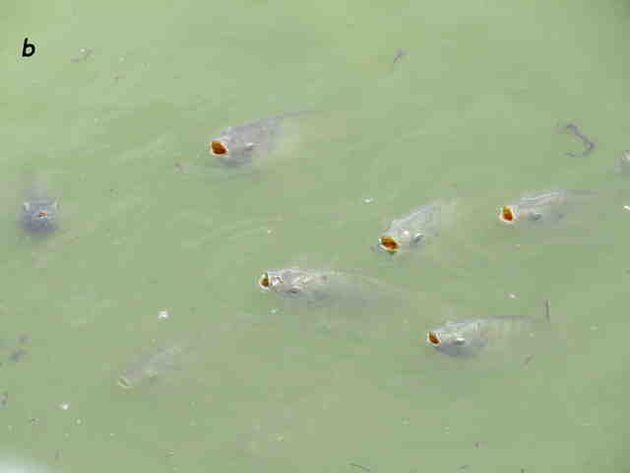
Photo 3: (a) African Great egrets (b) Shoal of Common carp fishes, in Singanallur lake.
This place is away from the hustle and bustle of the city and many may not even know about it. Because nothing succeeds more than hands-on learning and connecting with nature, this spot can serve as an ideal location for outdoor education.
Paying a close attention to where the birds are sitting or what they are trying to eat, one can see the staggering amount of plastic and garbage dumped over the lake [Photo 1 and 3a]. And this is where the real-world problem comes in. The primary cause of waterbird mortality from plastic intake are gastrointestinal tract blockage, stomach rupture, and false satiation; not to speak of the adverse effects from persistent organic pollutant (POP) accumulation on plastics and leaching of plastic additives. Consuming just one plastic debris item poses a 20.4% chance of lifetime mortality in waterbirds (Roman et al. 2019). Furthermore, 36% of seabird species are known to be entangled in plastic litter (Ryan, 2018).
The combined effect of untreated sewage and runoff, heavy metal, microplastic, industrial effluent, algal bloom and oxygen depletion, causes remarkable decrease in wetland biodiversity (Zhang et. al. 2023). Waterbirds are often time used as biological indicators of wetlands, as they respond to short-term environmental changes and fluctuation to food resources (Tallei et al. 2021). Yet urban wetlands has the potential of cleaning up our water, protect us from floods, cool down our cities during heatwaves, and provide habitat and breeding ground for 40% plants and animals (Bassi et al. 2014). Large interconnected wetlands are found to support higher richness and diversity of wintering waterbirds than isolated fragmented habitats (Hamza et al. 2024).
A lake like Singanallur demands much more attention for conservation. The species of birds and fishes found over here are invaluable. Awareness needs to be generated among public. Without spoiling their peaceful habitat, something needs to be done from the municipality to conserve the nature.
References:
Bassi N., Dinesh Kumar N., Sharma A., Pardha-Saradhi P. (2014). Status of wetlands in India: A review of extent, ecosystem benefits, threats and management strategies. Journal of Hydrology: Regional Studies 2, 1-19. DOI:10.1016/j.ejrh.2014.07.001
Fonturbel F. E., Rodriguez-Gomez G. B., Fernandez N., Garcia B., Orellana J. I., Castana-Villa G. J. (2020). Sampling understory birds in different habitat types using point counts and camera traps. Ecological Indicators 119, 106863. DOI: 10.1016/j.ecolind.2020.106863
Hamza F., Abdi A. M., Chokri M-A., Yacoubi L., Dlensi H., Hammouda N., Ghlis A., Jemaa B., Elghoul M., Hedhili A., Hanane S. (2024). Landscape context and wetland attributes influence wintering waterbirds in important bird and biodiversity areas: implications for conservation and management. Landsc Ecol 39, 151. DOI:10.1007/s10980-024-01942-9
Jencipriya A., Meiaraj C. (2020). Analysis of groundwater quality mapping using GIS around Singanallur lake located in Coimbatore. International Research Journal of Engineering and Technology 7(7), 4767-4773.
Kannan V., Manakadan R. (2005).The status and distribution of Spot-billed Pelican Pelecanus philippensis in southern India. Forktail 21, 9-14.
Ramchandra A.M. (2013). Diversity and richness of bird species in newly formed habitats of Chandoli National Park in Western Ghats, Maharashtra State, India. Biodiversity Journal 4(1), 235-242.
Roman L., Hardesty B. D., Hindell M.A., Wilcox C. (2019). A quantitative analysis linking seabird mortality and marine debris ingestion. Sci Rep. 9(1), 3202. DOI: 10.1038/s41598-018-36585-9
Ryan P. G. (2018). Entanglement of birds in plastics and other synthetic materials. Marine Pollution Bulletin 135, 159-164. DOI:10.1016/j.marpolbul.2018.06.057
Tallei E., Benavidez A., Schaaf A., Isola P., Zanotti M. (2021). Seasonal dynamics of waterbirds from a relict wetland in the central Monte Desert, Argentina. Neotropical Biology and Conservation 16(2), 333-349. DOI: 10.3897/neotropical.16.e61672
Zhang H., Yang J., Zhang L., Gu X., Zhang X. (2023). Citizen science meets eDNA: A new boom in research exploring urban wetland biodiversity. Environmental Science and Ecotechnology 16, 100275. DOI: 10.1016/j.ese.2023.100275





Leave a Comment