

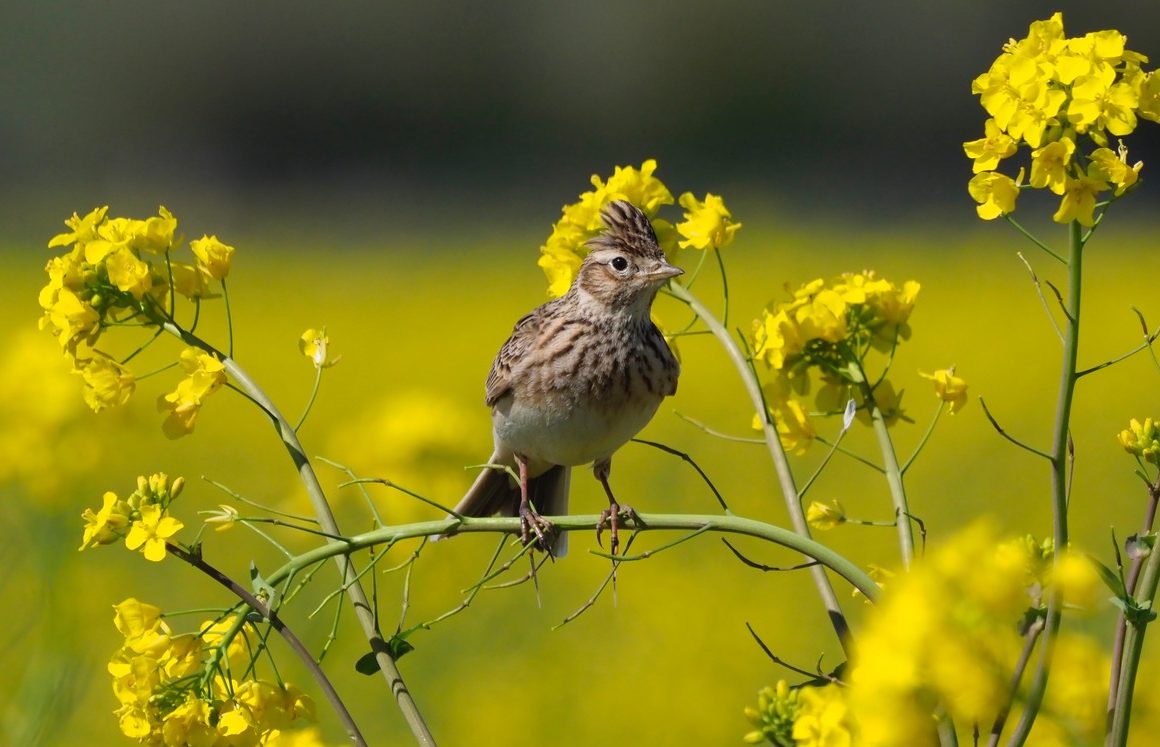
There’s a long history of British poets enthusing about Skylarks. One of the best known is Percy Shelley, who wrote To a Skylark.
Hail to thee, blithe Spirit!
Bird thou never wert,
That from Heaven, or near it,
Pourest thy full heart
In profuse strains of unpremeditated art.
Higher still and higher
From the earth thou springest
Like a cloud of fire;
The blue deep thou wingest,
And singing still dost soar, and soaring ever singest.
That is just the beginning, as it continues with a further 19 verses on the same theme. Shelley is mainly concerned with the bird’s wonderful song, which is usually delivered in an impressive soaring song flight. The average duration of a Skylark’s song is 2 minutes, but individuals not infrequently continue for much longer, while some have been know to sing non-stop for over an hour. When they are establishing their territories the average length of song is 3.4 minutes.
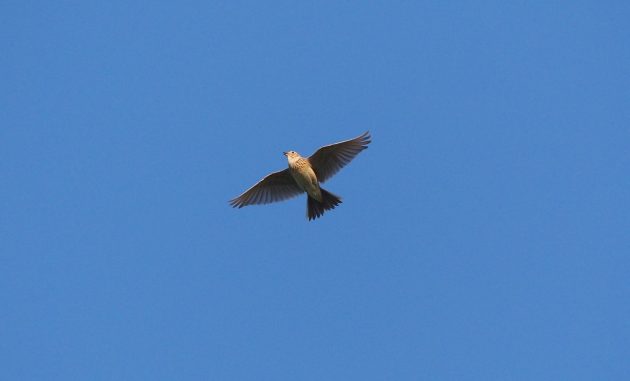
Though some birds will sing from the ground, the song is usually delivered from the air, the singer often performing so high that he can be difficult to see from the ground. In areas with dense populations, the sound of many birds singing together is magnificent. My house adjoins fields where several pairs of these larks breed, so at this time of the year I can sit in my garden, serenaded by lark song. Though you can hear them singing in every month of the year in Britain, song activity peaks in March.
We have a saying here in the UK of “up with the lark”, a reminder that Skylarks are invariably one of the first birds to sing in the morning, always before the sun has risen. When the first lark rises to sing, he invariably rouses his neighbours into doing exactly the same. Paul Donald, in his fascinating book The Skylark (Poyser, 2004) writes: “In extreme cases, a silent and apparently empty field can erupt into song if just one of the birds present starts to sing. This behaviour is in fact typical of a number of species of lark, but the reasons for it are unknown.”
There are 100 species of larks in the world, split into 23 genera. Their distribution is mostly Africa and Eurasia, and the only species native to North America is the widespread Horned Lark, which also occurs in Europe and Asia. The early settlers to the USA missed their lark song from home, so numerous attempts were made to try and establish Skylarks in the country. The first release was in Ohio in 1851, with many more to follow. Some enjoyed brief success, with birds breeding and apparently flourishing, but all died out in the end.
The only successful North American introduction took place on Vancouver Island in Canada, with the first release in the autumn of 1903, when 100 pairs were released; this was followed by further releases in subsequent years. The population survived for many decades, and as far as I am aware a few birds can still be found around the southern tip of the island, though they may well have died out.
Curiously, introductions elsewhere were far more successful, and today you can still find populations in south-east Australia and Tasmania and the Hawaiian islands, but it’s New Zealand where the birds have been particularly successful. I well remember getting off a plane at Christchurch, on New Zealand’s South Island, having just flown from the UK. The first birds I heard were Skylarks, singing over the airfield.
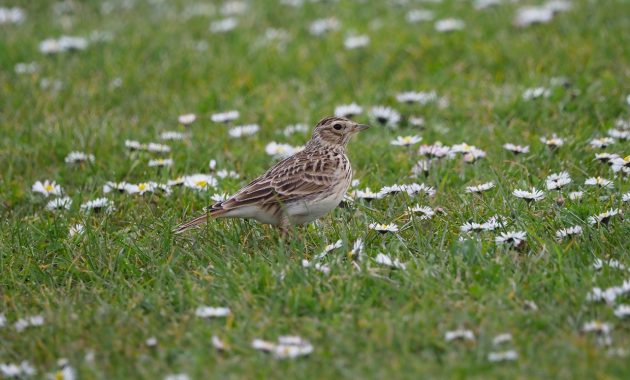
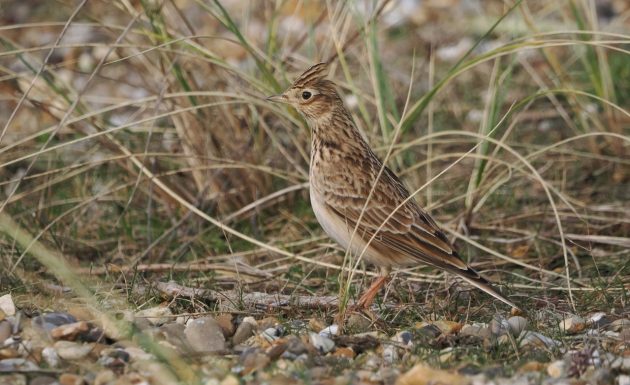
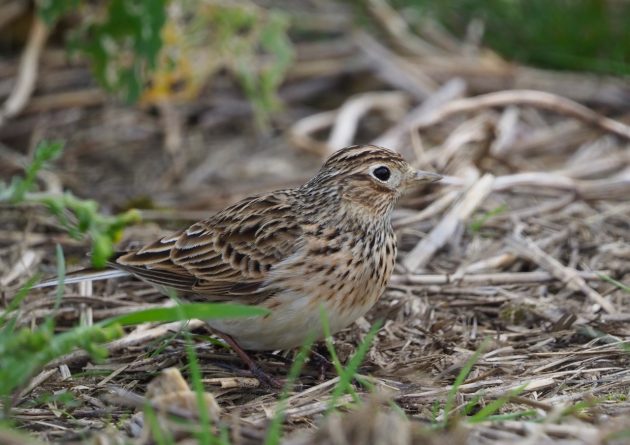
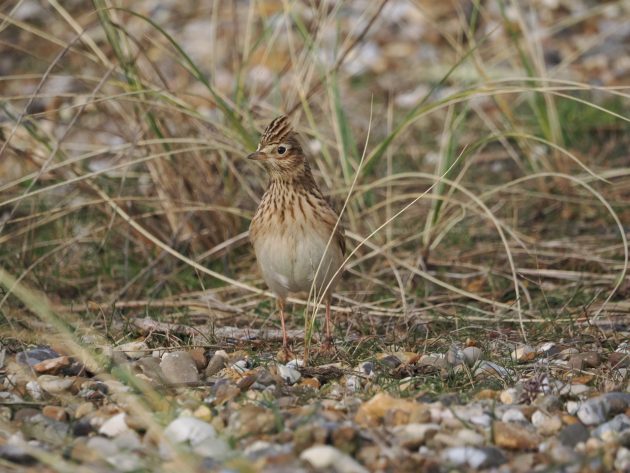
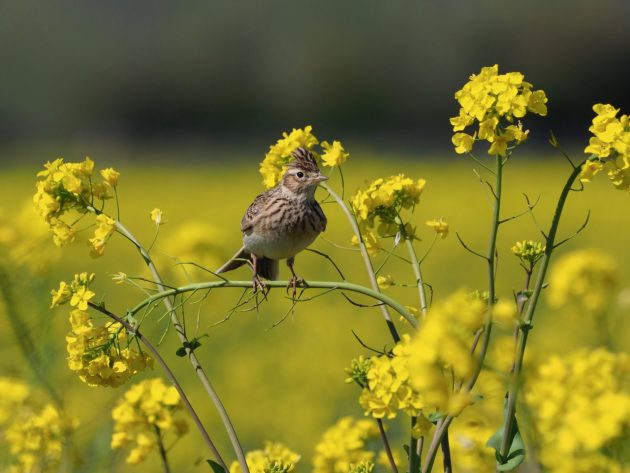
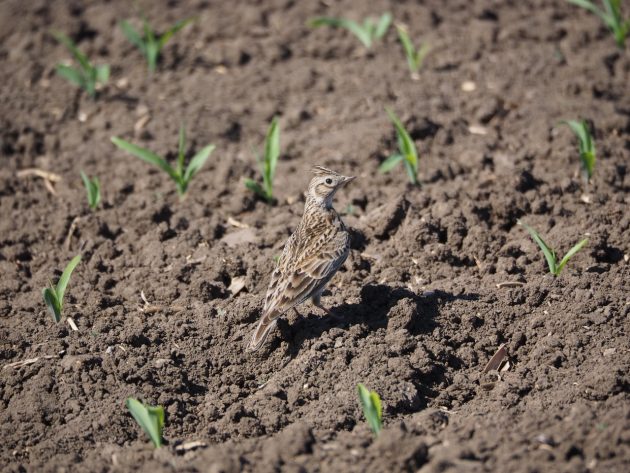
If it wasn’t for the Skylark’s beautiful song, the bird itself would probably be largely overlooked, for few birds are better at merging into their landscape, their streaked brown plumage offering highly effective camouflage. One of the bird’s most obvious features is its pointed crest, but it can, and frequently does, lower its crest flat on top of its head, giving it a quite different appearance.
The Eurasian Skylark has a huge range, extending from Ireland and Portugal in the west all the way to Japan in the east, while in India and parts of south-east Asia its place is taken by the very similar Oriental Skylark. It’s a bird whose song must give pleasure to millions of people, though how many of them could recognise the bird itself is debatable. Here in the UK the population has declined in recent years, largely due to intensive agriculture, so the bird has become a symbol of nature-friendly farming. There are still thought to be 2 million territories, but there’s been a worrying 9% decline since the 1990s. Hopefully the decline has been slowed, if not reversed, so future generations will still be able to delight in the song that so inspired Shelley over 200 years ago.









This was fascinating! It must be really something to hear such spectacular birdsong.
In 2004, I got my lifer Skylark in Victoria, BC. I checked and there are still some seen around the Victoria airport, but their numbers are declining.
Plucky little bird and a favourite of mine since my granddad pointed one out to 5-year old me. It was so high up but loud as can be.
Delighted to hear, Leslie, that Skylarks are still hanging on in Victoria.