

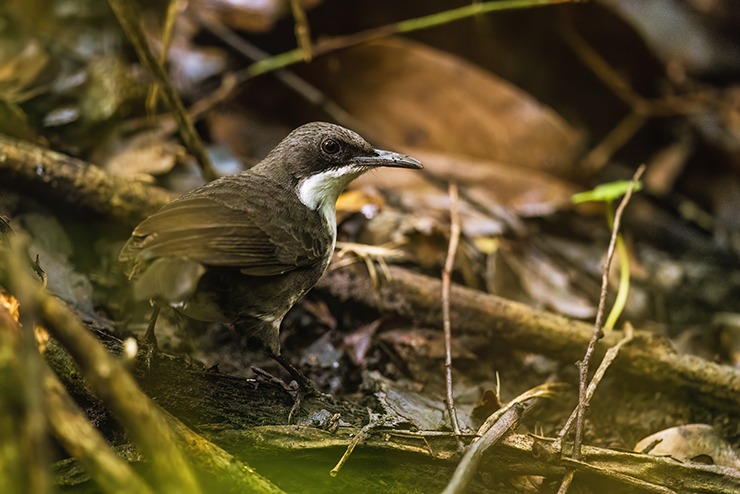
I remember the first time I laid eyes on a White-breasted Thrasher, in the dimly lit, leaf-litter strewn understory of Martinique’s excessively dry Presqu’île de la Caravelle – a small peninsula on the island’s northeastern end. The day was already a scorcher, the unforgiving sun comfortably hovering in a cloudless sky. As we pulled up and alighted from our van, there was a small movement in the bushes that beckoned us off the trail, a move that would prove potentially disastrous as it attracted the attention of one of the uniformed rangers. He spoke to me threateningly in French, when I motioned that I did not understand French and would please prefer English, that only served to increase his ire.
Thankfully, we escaped the wrath of the ranger, who ultimately decided that our group of mostly American birders were innocently uninformed. He assigned one of his colleagues who promised us views of at least a few White-breasted Thrashers; we would just have to follow him closely, and most importantly, stay on the marked trails.
Our views that day were not fleeting, but consistently obfuscated by the dense foliage. The heat was overwhelming, and the walk back up to the top of the hill to the car park seemed to last forever. Bent over, we plodded on, occasionally being overtaken by annoyingly fit hikers who seemed to relish the oppressive conditions.
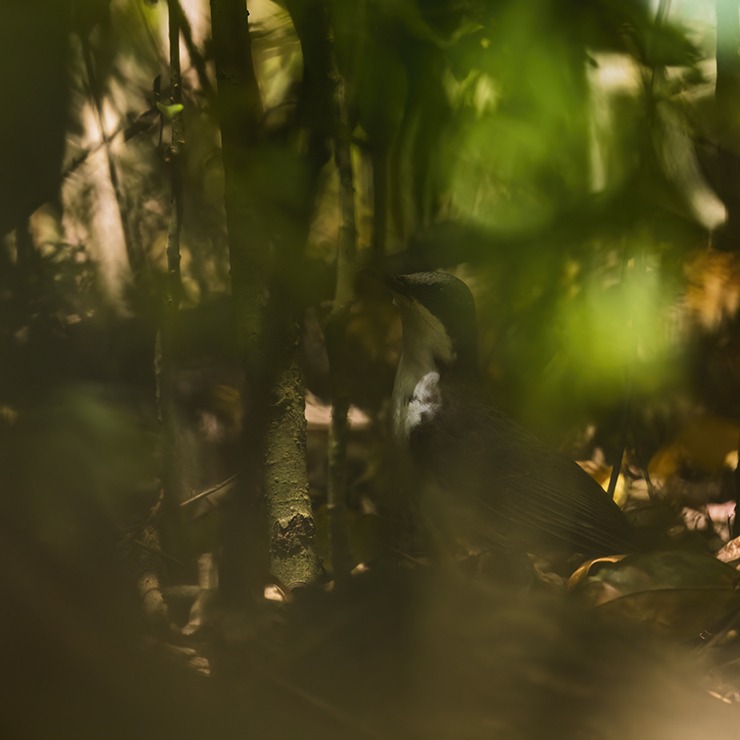
I didn’t have a winning image on this day, but at least I had seen a White-breasted Thrasher.
On neighbouring St. Lucia, we embarked upon a futile quest to see more White-breasted Thrashers in similar dry forest there. We poked around, and saw only a brief flash of what may have been a thrasher. Similarly sized and proportioned Lesser Antillean Saltators would often cause aching arms to be jarred into suddenly raising binoculars, but the thrashers were much less forthcoming. On a subsequent stop along the road, there was one apparently sitting on an open branch no more than ten metres away. I got a decent look at the stark white and dark coffee brown bird, but as soon as I began to raise my camera it disappeared, never to be seen again.
The following year, the White-breasted Thrasher was split into Martinique Thrasher and St. Lucia Thrasher. Differences between both newly declared species were marginal, but the new conservation status awarded to each species greatly overshadowed all other associated aspects of the split. On St. Lucia, the St. Lucia Thrasher exists in a couple coastal locations where dry forest persists – ideal habitat for hotels, marinas, and other attractive developments. Forest clearing for construction has greatly reduced their available habitat, but there are still tracts of intact dry forest where these birds are protected by the prevalence of the St. Lucia Lancehead. This viper is greatly feared by locals, so much so that a prison sits within this habitat, a natural deterrent for potential escapees.
The Martinique Thrasher, on the other hand, is confined to a single peninsula that spans all of five square kilometres. Not a lot of available habitat, but the French government has implemented a strict management policy across that peninsula (please refer to my earlier account of the interdiction) that undoubtedly is tied to the entire island of Martinique being declared a biosphere reserve. From extensive signage to numerous traps deployed throughout the peninsula to eradicate the invasive mongoose population, it is clear that all hands are on deck to preserve the last remaining Martinique Thrashers on the planet.
Thankfully, I have since been able to lay eyes on both newly declared species several times since that first encounter. Each time it is different, and the conservation efforts in the confined space in Martinique have made seeing the Martinique Thrasher marginally easier. For the St. Lucia Thrasher, however, the expansive areas of dry forest make sightings unpredictable, and arguably, that much more treasured when they do occur.
Martinique Thrasher
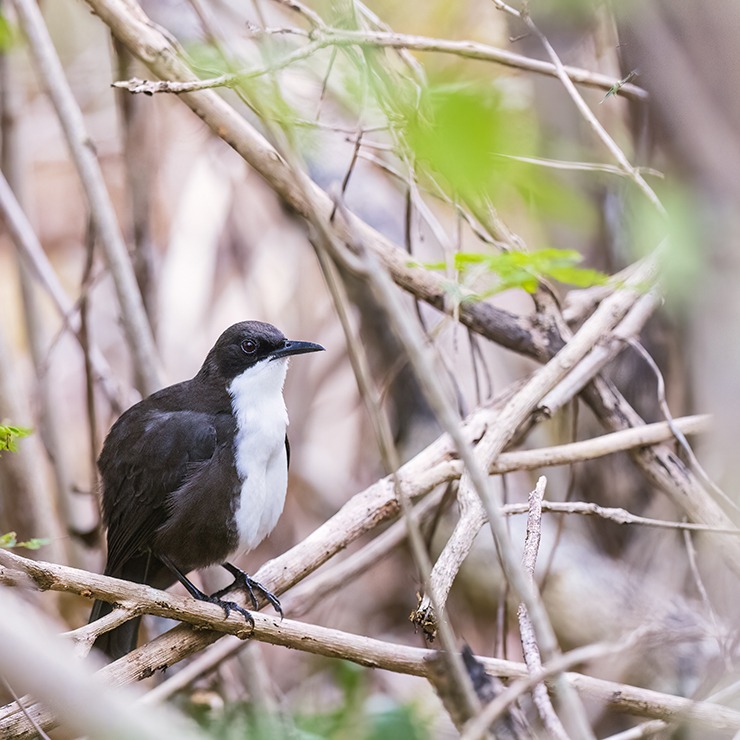
St. Lucia Thrasher






Great post—Loved that bit about the prison!
Excellent photos! Thanks.