

By Sudheesh Thattekad
Sudheesh Thattekad is a birding and herping guide based in Kerala, India. The insights in this post are based entirely on personal field observations as a resident naturalist in Thattekad, rather than academic texts. He is always happy to learn and correct any errors.
For birdwatchers around the globe, Thattekad Bird Sanctuary is nothing short of a pilgrimage site. Spanning a mere 25 square kilometers, this lowland forest patch holds a legendary reputation, primarily because it is home to an astonishing ten species of owls. But among all these nocturnal wonders, there is one ultimate prize that every birder dreams of ticking off their checklist: the Sri Lankan Bay Owl (Phodilus assimilis), locally known in Kerala as the Ripley Moonga.
A Territory Built on Secrets
Finding a Bay Owl is an ultimate test of patience and fieldcraft. Unlike some owls that return to the exact same roosting branch day after day, the Bay Owl is a restless wanderer within its massive territory.
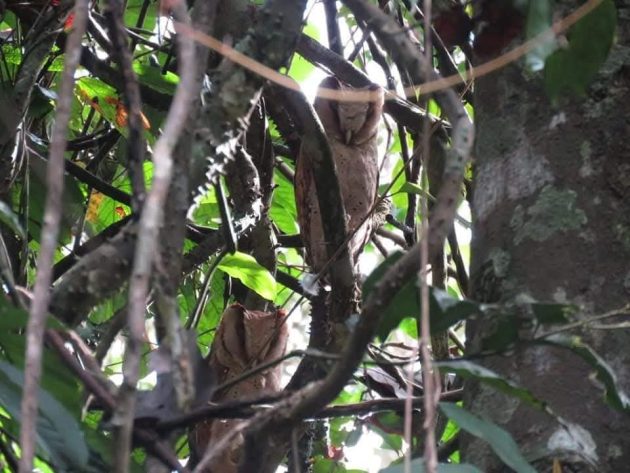
Over my years of tracking them in the dense foliage, one peculiar behavior has constantly amazed me: they rarely use a permanent roost, yet they will return to the exact same twig on a specific tree at least once a month. They heavily favor the tangled vegetation lining the banks of forest rivers and streams. There are simply no shortcuts to finding them.
How do you find a bird that doesn’t want to be found? I always tell people there is only one mathematical way to spot a Bay Owl:
Scan the forest section by section. As you eliminate the empty branches, the vast wilderness gradually shrinks until only one single branch remains—the one with the owl on it. To find it, you must conceptually shrink the entire forest down to the size of the owl itself.
Insights from the Field
During the day, these owls typically roost at heights ranging anywhere from 5 to 30 meters above the forest floor. While their primary diet consists of small terrestrial rodents and insects, the forest always springs surprises; I once observed a Bay Owl patiently sitting by a forest stream, successfully hunting and feeding on a frog.
Nesting habits remain highly secretive, but they are known to favor tree cavities. On one memorable night trek, I witnessed an individual emerging and taking flight directly from a deep tree hollow.
While the species can also be found in other southern strongholds like Thekkady, Top Slip, Parambikulam, Arippa, and parts of Sri Lanka, Thattekad remains the undisputed capital for photographing them. This isn’t just a matter of luck—it comes down to the sharp eyes and dedication of local guides who know the pulse of this forest.
Courtship and the “Ace of Spades” Face
For most of the year, the Sri Lankan Bay Owl is a solitary daytime roosting bird. However, as night falls, pairs often unite to hunt.
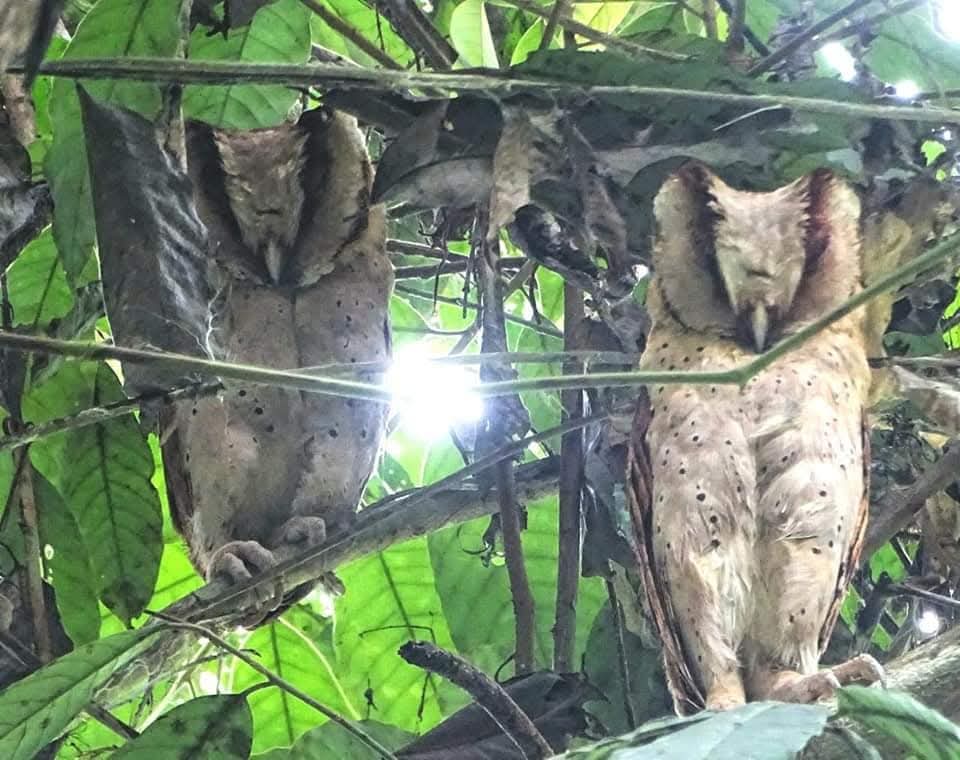
Their breeding season begins around January, and this is the magical window where luck swings in your favor. During this period, you can occasionally spot a pair roosting tightly together on the very same tree during the day.
Visually, they are spectacular. With a distinct, heart-shaped facial disc that strongly resembles the Ace of Spades playing card, they look almost regal. If you look closely at the males (as seen in Photos 1 and 2), you can distinguish them by the prominent black, whisker-like facial bristles framing both sides of their faces.
Unpredictable as always, these forest dwellers occasionally venture out of the deep canopy to visit the agricultural fringes bordering the sanctuary, surprising lucky onlookers. For any serious birder, a gaze into the dark, soulful eyes of the Bay Owl is an encounter that stays with you forever.








Reading this fascinating piece makes me realise how lucky I was to see one of these owls during a trip to south-east India. It was found for us by a local guide. I wrote in my log ‘ Quite how he had found it must remain a mystery, but we had a good view of it roosting – a very interesting owl. However, it didn’t bother to open its eyes to look at us and was very difficult to photograph.’ I did get a poor photograph, a reminder of a memorable encounter.