
Every birder has probably heard the – most likely untrue – story about starlings being introduced to the US by some Shakespeare fan who wanted to bring all birds appearing in Shakespeare’s world to the US.
Interestingly, starlings play only a very minor role in his works – they get mentioned exactly once, in Henry IV, Part 1. So, not really the ideal candidate for a culturally motivated introduction program.
And only one species out of about 60-65 species mentioned in all of Shakespeare’s work – the exact number is not easy to specify, as Shakespeare seems to have been more of a lumper than a splitter, thus speaking of herons, buntings, or owls rather than (as the archetypal splitter would nowadays) specify the bunting as a Long-crested Northern Reed Bunting (a name I just made up, of course – no worries, Peter, you did not miss another reed bunting species).
Listing 60-65 species in a blog post is generally considered boring. However, there are some birds that are a bit more prominent in Shakespeare – and add a bit more meaning – than others. And thanks to ChatGPT (hey, do you think I would work on a post like this for three or four hours knowing that about 12 people will read it, and of these, 5 just to show me that I am wrong), here is a simple table with such “meaningful” birds and their meaningful meaning.
| Bird | Typical Shakespearean associations |
|---|---|
| Raven | Death, evil omens, battlefields, prophecy |
| Owl | Night, doom, ill omen, secrecy |
| Eagle | Royalty, power, nobility |
| Falcon / Hawk | Aristocracy, hunting, control, passion |
| Crow / Rook | Bad omens, commonness, carrion |
| Dove / Turtle Dove | Love, fidelity, gentleness |
| Swan | Beauty, music, death (“swan song”) |
| Lark | Morning, joy, lovers separating at dawn |
| Nightingale | Poetry, music, melancholy, love |
| Cock / Rooster | Dawn, vigilance, masculinity |
| Goose | Foolishness, cowardice, comic insult |
| Sparrow | Smallness, vulnerability, everyday life |
| Peacock | Vanity, pride |
| Cuckoo | Adultery and cuckoldry |
| Wren | Small but spirited; humility |
| Kite | Predatory greed, scavenging |
| Pelican | Self-sacrifice (medieval symbolism) |
| Starling | Mimicry, chatter |
| Heron | Falconry imagery, aristocratic sport |
| Woodcock | Foolishness, gullibility |
And that is it. I am just reading a wonderful series of mysteries (the Charles Paris series by Simon Brett, which I can recommend wholeheartedly), and that made me think of Shakespeare and birds. Interestingly, some of the observations in Shakespeare’s plays are surprisingly accurate. Apparently (of course, I am relying on secondary literature here), he knew of crows and ravens scavenging, cuckoos laying in other birds’ nests, falcon training, larks singing at dawn, and wrens aggressively defending nests.
And (again, a different topic at the end) a music recommendation – the rather wonderful (I think this is a John Peel expression, but that is fine with me) song “Free from the Guillotine” by Ryan Davis & the Roadhouse Band. Which starts with the wonderful line “You got a new tattoo of an old tattoo” and gets better from there, though in a very relaxed way (the song duration is 8 minutes and 23 seconds, and I wish it were longer).
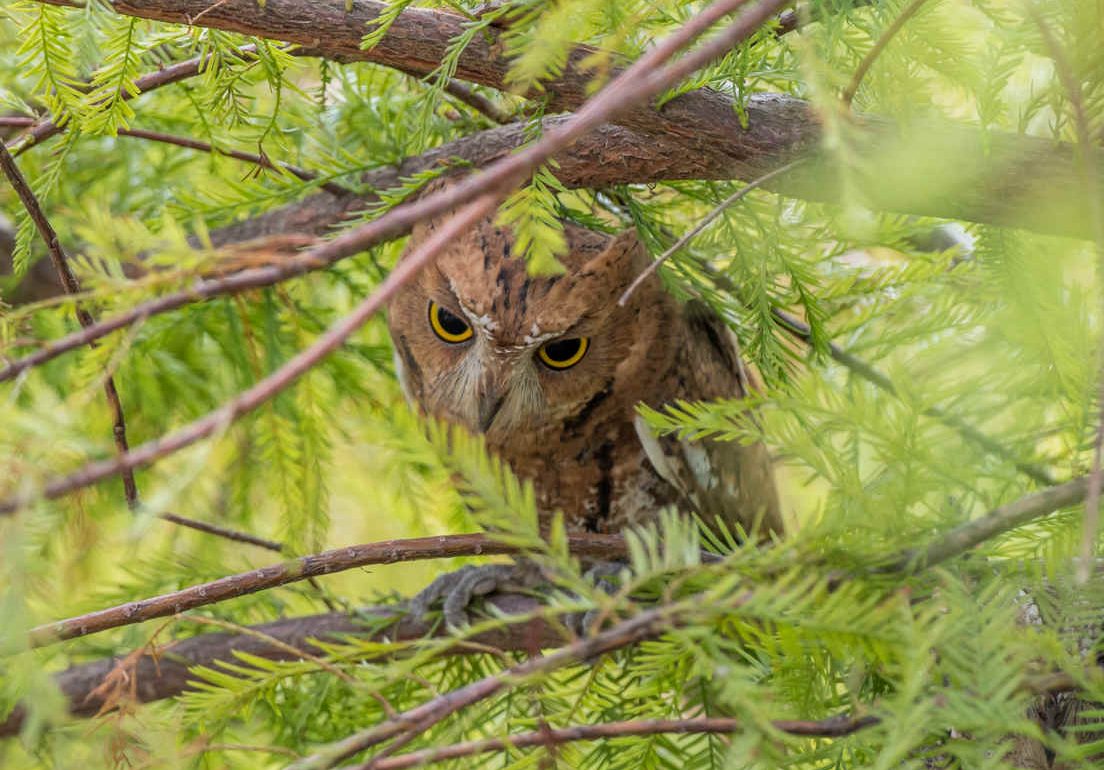
Illustration: Oriental Scops Owl. The author acknowledges that this owl is entirely out of place and has decided to proceed anyway.



Wonderful song
Thanks so much, Gary! I do put these references into my posts because there are some songs I feel so strongly about, and want to share them – but at the same time, I am fully aware that most people will think that adding non-birding-related songs to a birding post is weird and mildly stupid.
So, thanks again, it is very much appreciated.
Also, I just remembered that the song actually has a wonderful reference to birds:
“Soon I’ll be seen as a problem or the neighbors
Soon l’Il be seen as a trophy for the precinct
Soon I’ll be seen as a willingly endangered bird
About to fly south”
“A willingly endangered bird” is a great line.