
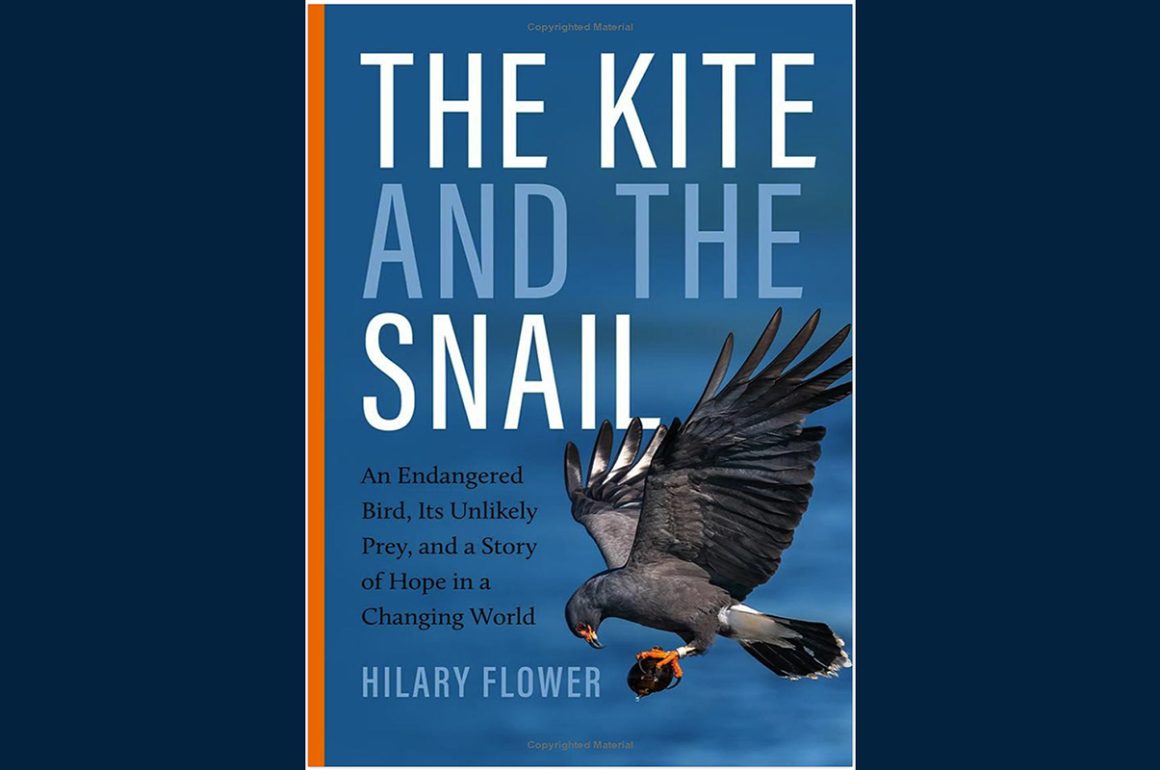
In a world of controversial and misleading bird names, Snail Kite, Rostrhamus sociabilis, stands out as the perfect appellation for this handsome, highly specialized specialist raptor. Snail Kites eat snails, specifically freshwater apple snails. Their numbers increase and decrease depending on the abundance or dearth of apple snails, and even though they are known to occasionally, very occasionally, eat other items, without apple snails the Snail Kites dies. This is what seemed to be happening with the Everglades Snail Kite, Rostrhamus sociabilis plumbeus, the Florida subspecies (which also lives in Cuba), in 1967, leading to its listing as endangered under the then-new Endangered Species Preservation Act. Population plunged again in 1981 and in 1985 and as recently as 2007, all years of drought. Because you can’t have snails without water.
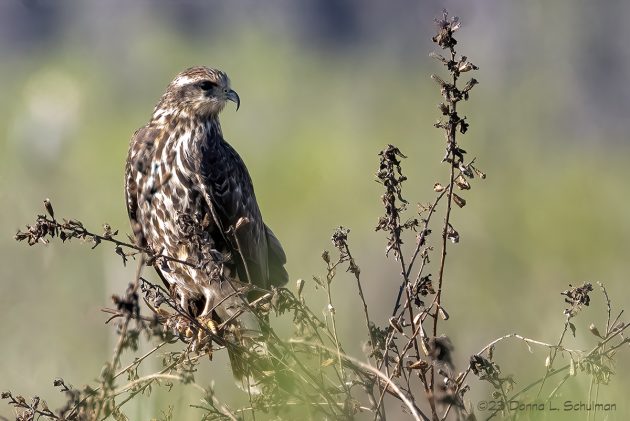
©2023, Donna L. Schulman, female Snail Kite at Sweetwater Wetlands, Gainesville, FL
Snail Kites have been a treasured inhabitant of the Everglades for many years, sought out by birders like me who knew that even though the kite could be seen in Central and South America, if you wanted one for your ABA List, you had to go to Florida. Their charm lies not only in their restricted locality, but also in the way they have physically evolved to eat the apple snail: a bill whose curvature matches the curves of the snail shell, wide wings that enable it to hover over water to search, long legs and talons that allow it to reach below the water to grab a snail and carry it to a nest or perch (Corey did a great job describing these features in his post “Snail Kites at East Lake Toho“). My first sighting was in April 2005 at Loxahatchee National Wildlife Refuge, 226 square miles of Everglades ecosystems in western Palm Beach County. Hilary Flower’s first sighting was around 2010, when her child pointed to the medium-sized raptor as they were bicycling through Everglades National Park, far south of Loxahatchee. An ecohydrologist, Flower regularly brought her family and students to the Everglades, and she noted her last sighting there in 2013, wondering why the hawk had seemingly disappeared just when restoration of Everglades National Park had reached a peak of clear, clean beauty. It turned out the Snail Kite had not disappeared, it had moved north, following the path of the apple snail–not the small native Pomacea paludosa species the bird has historically feasted on, but the large, invasive South American apple snail Pomacea maculata. Native apple snails were disappearing, the invasive apple snails were spreading–fast–and although they were way bigger than the snail the raptor had adapted to, it seemed like the Snail Kite had managed to find a way to eat it. Hilary Flower was intrigued and decided to find answers. Her journey of discovery, education, and wonder is recorded in The Kite and the Snail: An Endangered Bird, Its Unlikely Prey, and a Story of Hope in a Changing World.
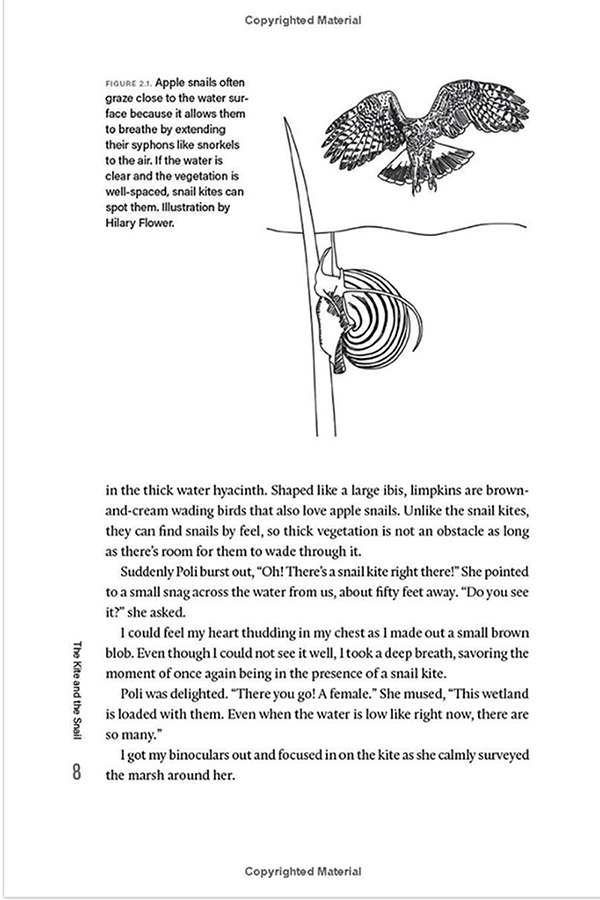
© 2026, Hilary Flower; page 8, illustration of apple snail and Snail Kite by Hilary Flower
The Kite and the Snail is a case study in ecological complexity, field research, and the intersecting spheres of conservation policy and water politics in Florida. I loved it. Hilary Flower is a story teller. Writing about these challenging subjects in terms of her own personal quest, she breaks down the relationships between bird and snail, snail and snail, snail and water, water and agriculture, water and agriculture and politics, researchers and bird and snail and alligators and water, into short, approachable chapters–each chapter part of a puzzle which eventually interlocks as a whole, more or less. There will always be loose ends and more questions. As an ecohydrologist, a scientist who studies the relationships between water and ecological systems, Flower is the perfect person to investigate and explain Snail Kite research and conservation policies. She brings to the journey knowledge of things like periphyton, an organic material made up of “hundreds of types of microalgae, cyanobacteria, diatoms, miniscule animals, and microbes” (p. 61) which acts as an indicator of healthy water (and which is also a favorite food of the native apple snail), curiosity, and an enthusiastic love of exploring snail kite habitats (basically, land next to still waters) in kayaks, airboats, and squishing about in the water itself. Although she clearly is interested in birds, she is not an avian expert and so asks a lot of questions. She analyzes the answers, or lack of answers, from an ecological perspective infused with surprise, affection, frustration, and wonder. I did at some points get a little impatient with Flower’s method of creating narrative continuity (there’s a lot of comments about needing another piece of the puzzle), but overall, this is a wonderful approach.
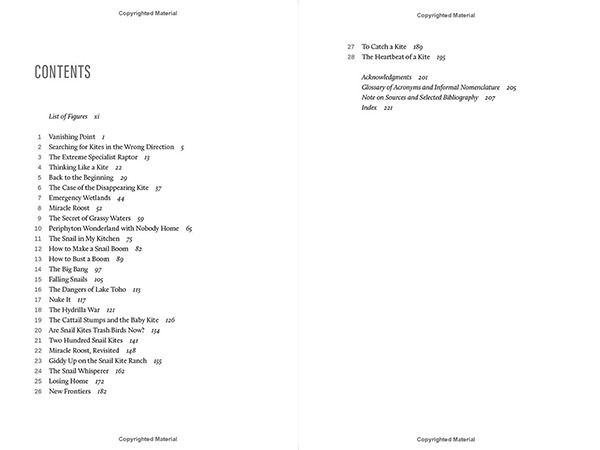
© 2026, Hilary Flower. Table of contents of The Kite and the Snail
Many of the chapters are accounts of Flower’s interviews with the field scientists and researchers who have done the hard research on the Everglades Snail Kite: Steve Beissinger, who did groundbreaking research on Snail Kite behavior in the 1980’s, including the discovery that they engaged in ambisexual mate desertion; Jean Takekawa, a wildlife biologist for the U.S. Fish and Wildlife Service who discovered an unknown roost of hundreds of Snail Kites near West Palm Beach during the 1985 draught; Wiley Kitchens, for many years director of the University of Florida Snail Kite Monitoring program; Brian Reichert, who put in hundreds of hours of field work collecting Snail Kite data for Kitchens’ studies and later his own; Caroline Poli, who also worked on the Snail Kite Monitoring Program and who, present day, shows Hilary Flower the nesting Snail Kites of the Alachua Sink in the Paynes Prairie Preserve; Phil Darby, the “snail whisperer” who has written extensively on the snail-kite relationship and is considered THE expert on the native apple snail. Some of these conversations take place over the computer, some in the field; Flower is adept at making the computer conversations almost as lively as the treks through Florida’s bays, sinks, canals, and lakes.
Flower also talks to advocates, government biologists, and caretakers: Paul Gray of Audubon Florida and Steve Schubert, a retired USFWS biologist to get insight into the workings of enforcement (or non-enforcement) of the Endangered Species Act (ESA); Lauren Butcher, environmental educator at Grassy Waters Preserve, a pristine wetland that provides water to West Palm Beach and hosts native apple snails; Eric Crawford, vegetation management scientist for South Florida’s Stormwater Treatment Areas (STAs), who had to figure out how to deal with the deadly invasive apple snail boom of 2013; David Broten and Mandy Krupa, who count the Snail Kites now coming in to roost at the wetlands found decades ago by Jean Takekawa, the area is now surrounded by a landfill, but the roost site is protected and monitored by the Solid Waste Authority of Palm Beach County. One of her most touching interviews is with Michael Frank, an elder of the Miccosukee Tribe who once lived with his family on tree islands in the Everglades, an area now known as Water Conservation Area 3A. Frank was a witness to the habitat degradation of the Everglades and loss of the Snail Kite; the Tribe sued the federal government on behalf of the Snail Kite in 2005 and lost.
Published by University Press of Florida, The Kite and the Snail has all the things I like in the back of a book: chatty Acknowledgments, a Glossary of Acronyms and Informal Nomenclature, discursive Note on Sources and Selected Bibliography, and an Index. The Index was very helpful in writing this review; it lists names (though not every single name, it does nicely give subtopics to the names though), places, concepts such as biodiversity and critical habitat, flora and fauna, and even has references to related topics. It’s great seeing such a detailed index (though the listing of Brazilian pepper at the top of the B’s should be fixed in future printings, sorry, I know this is minor but it’s bothering me).
Author Hilary Flower is an associate professor of environmental studies at Eckerd College, a small liberal arts college located in St. Petersburg, 6.6 miles away from birding hotspot Fort De Soto. She has an undergraduate degree in English Literature, a doctorate in Geology, has co-written scientific papers on topics such as “Saltwater intrusion and phosphorus desorption: The first geochemical model of seawater-induced phosphorus release from calcite” and “Concern for and perceived impacts to the Everglades: The role of environmental knowledge and cultural worldviews,” and teaches courses on Global Environmental Change, Wetland Environments, and the Everglades. Her students accompany Flower on several of the excursions detailed in this book, sharing the excitement of learning about snail kites, acting as sounding boards, and even teaching her Emily Dickenson’s poem “Hope is the Thing with Feathers.”
In chapters that begin and end Flower’s quest, Gina Kent, senior conservation scientist for the nonprofit Avian Research and Conservation Institute (ARCI), takes Hilary out to kayak the canals of Loxahatchee Slough Natural Area to trap Snail Kites for banding and to be fitted with a GPS transmitter. This is the epitome of Flower’s emotional journey. When they finally successfully trap a female, she is overwhelmed with wonder as she holds the bird: “Kent ushered me to the shady side of the truck and whispered to me, ‘Lower your hands.’ She had to repeat it because my brain was not functioning. I existed solely to hold this snail kite in my hands. Awash with sensory input, I had no thoughts. The most prominent feeling was that her body was warm and light….Up close I was struck by how perfectly each feather was shaped and colored, each one a work of art, mostly brown and black, with little white wispy feathers close to her skin” (p. 197).
The resolution of Flower’s informational, analytic journey is not so simple. What starts out as a couple of simple questions–How has the Snail Kite adapted to the invasive apple snail? Is there hope for its future?–becomes more complex as we learn about the push and pull of the Kite, the native snail, the invasive snail, and the water. Ultimately, it all comes down to the water and how Florida employs mechanisms to raise and lower water levels for agriculture, drinking water, and biodiversity. The water levels affect the growth of cattails and hydrilla, plants that can enrich or suffocate a habitat. The plants affect the growth or dearth of the snails. The interplay of factors has led to unintended consequences, some dire, some wonderful. Part of that wonderful is the unexpected survival of the Snail Kite, who has managed to find roosts in places no one knew existed, adapted their bodies and feeding practices to feed on invasive creatures, change nesting sites and breeding practices to produce as many chicks as they can. It’s in this resilience that Flower, and at least one of her experts, finds hope for their future.
The Kite and the Snail: An Endangered Bird, Its Unlikely Prey, and a Story of Hope in a Changing World
by Hilary Flower
University Press of Florida, March 2026
246 Pages; b/w illus., 6 maps, bibliography
Paperback, $28; also available in eBook formats
9780813081496; 9780813075327 (ebook)



Thanks, Donna. A very thorough review. (Am a retired librarian as well. Worked in public libraries in Knoxville, Milwaukee and mostly Indianapolis.) Saw several Snail Kites when I retired initially to Sarasota FL. Now in Redlands CA. No Snail Kites here, but you’ve sold me on the book. Thanks!
I am thrilled to read blog about the Snail kite.
Donna, This is an incredibly thorough and thoughtful review. Thank you for taking the time to write it, and for reading the book with such an open heart and discerning eye. I had to smile at your astute and gentle criticisms, I can’t disagree, I think you got me there. When I found your review I read it aloud to my daughter. I am truly honored! (PS I told my publisher about the index error, that was my mistake!)