

Highlights
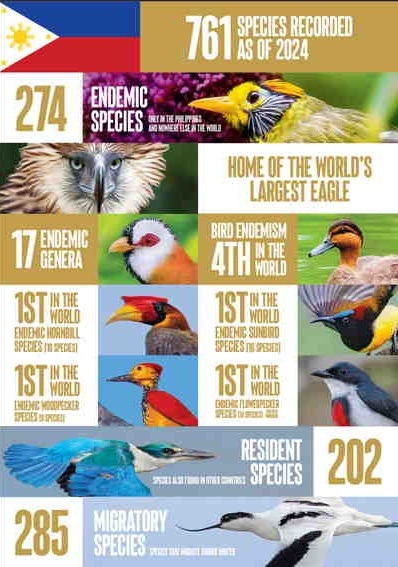
- 761 Bird species (2024)
- 274 endemic species (36%)
- 17 endemic genera
- 4th in the world in avian endemism
… and …
- Largest number of endemic hornbill species in the world – 10 species
- Largest number of endemic woodpecker species in the world – 9 species
- Largest number of endemic sunbird species in the world – 16 species
- Largest number of endemic flowerpecker species in the world – 14 species
Key Bird Species and Families
- The Great Philippine Eagle (Pithecophaga jefferyi) – the World’s Largest Eagle
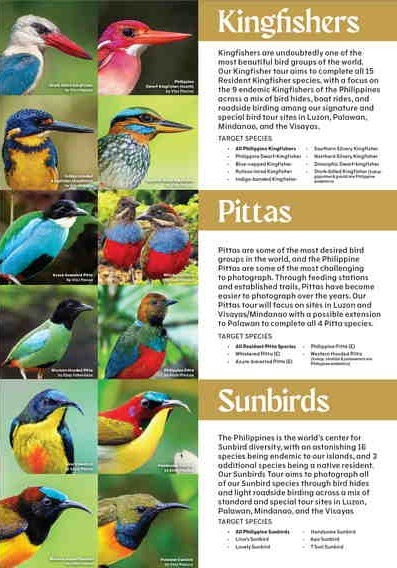
- Hornbills (Family Bucerotidae) – there are 10 species of hornbills in the Philippines, all of which are endemic to the country.
- Woodpeckers (Family Picidae) – the country hosts 11 woodpecker species, 9 of which (82%) are endemic.
- Sunbirds (Family Nectariniidae) – 19 species of sunbirds and spiderhunters are found in the Philippines, 16 species are endemic.
- Flowerpeckers (Family Dicaeidae) – 16 species of flowerpeckers are found in the Philippines, 14 of which are endemic.
Best Regions for Birding
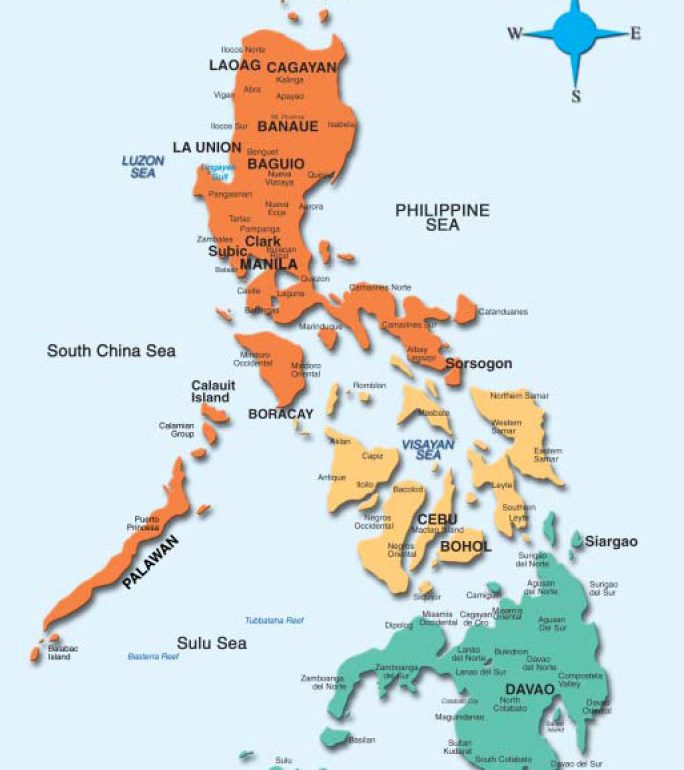
The Philippine islands are so rich in diversity that each region hosts its own unique set of island (or island group) endemics aside from Philippine country endemics. Here are the major regions in the Philippines for birding tours.
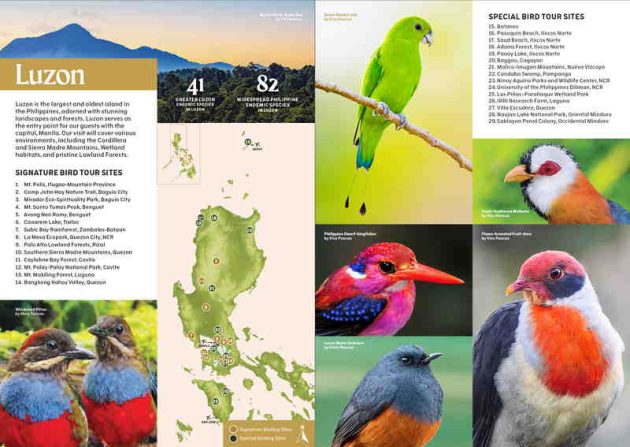
Luzon is the largest island in the Philippines in terms of land area. It is adorned with stunning landscapes and forests. Luzon serves as the entry point for our guests, with the capital, Manila. Our visit will cover various environments, including the Cordillera and Sierra Madre Mountains, wetland habitats, and pristine lowland forests.
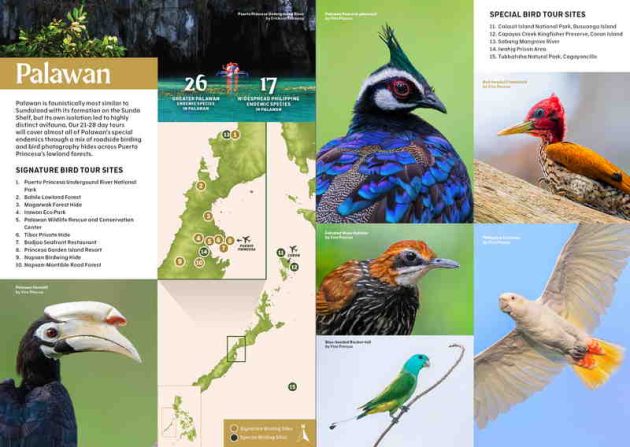
Palawan is faunistically most similar to Sundaland (Borneo, Java, Sumatra, and Malay Peninsula) with its formation on the Sunda Shelf, but its own isolation led to a highly distinct avifauna. Bird Finder Philippines’ tours will cover almost all of Palawan’s special endemics through a mix of roadside birding and bird photography hides across Puerto Princesa’s lowland forests.
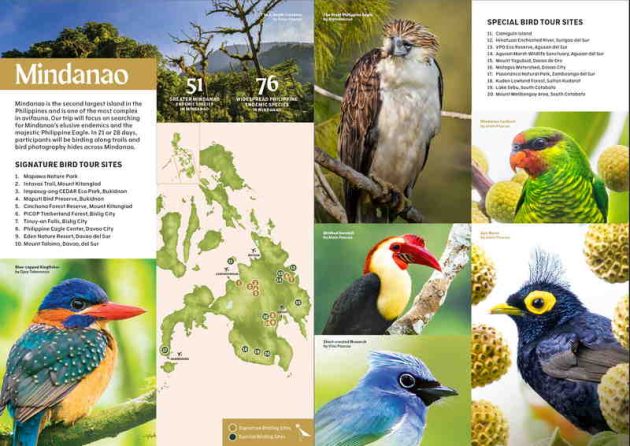
Mindanao is the second-largest island in the Philippines and is one of the most complex in avifauna. Bird Finder Philippines’ trip will focus on searching for Mindanao’s elusive endemics and the majestic Philippine Eagle. Guests will be birding along trails and bird photography hides across Mindanao.
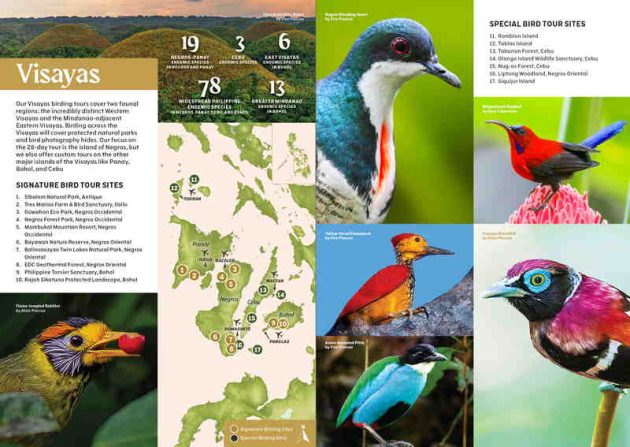
The Visayas Islands comprise two faunal regions: the incredibly distinct Western Visayas and the Mindanao-adjacent Eastern Visayas. Birding across the Visayas will cover protected natural parks and bird photography hides. The main tour focuses on the island of Negros, but Bird Finder Philippines also offers custom tours on the other major islands of the Visayas, like Panay, Bohol, and Cebu
Best Birding Season
The Philippines has good year-round birding, the best months to go birding are during the dry season from January to April. The driest part of the year is between March and April, with significantly less rainfall and rainy days allowing more time for birding in the field. This is also the time when many birds are in their most vibrant breeding plumage. However, the heat and humidity are also very high during this time. The cooler period between January and February is more appealing to some visiting birders, with migratory species mixed in along with resident and endemic bird species.
Birding Trip Suggestion(s)
See the site recommendations for the individual islands.
Practical Tips
- Plan to arrive on the earliest available flight to maximize birding time on the first day.
- Pack light, breathable clothing suitable for birding, as daytime temperatures typically range around 30°C, while nighttime temperatures may drop to approximately 18°C, especially in higher elevation sites.
- Bring along rain protection gear as light drizzles to heavy downpours can occur in forested sites, especially towards the rainy season.
- Insect repellent is recommended in forested sites.
- Bring along hiking shoes with appropriate soles for trekking to ensure comfort and safety during outdoor activities.
Books
A Naturalist Guide to the Birds of the Philippines
By Maia Tanedo, Adrian & Trinket Constantino, and Robert Hutchinson
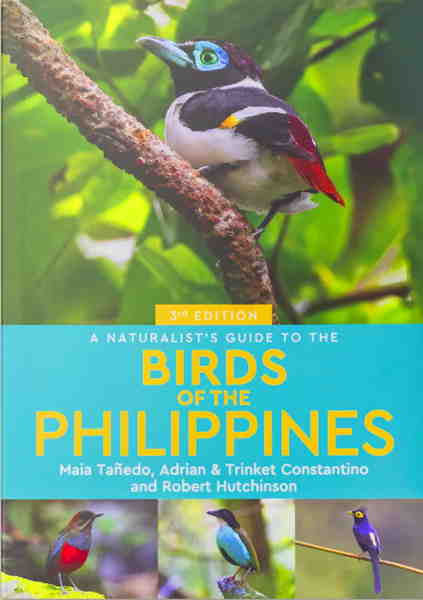
Now in its 3rd edition, this compact photographic identification guide features over 280 bird species most commonly seen in the Philippines. High-quality photographs from some of the Philippines’ top nature photographers are accompanied by detailed species descriptions, which include nomenclature, length, plumage, distribution, habits, and habitat. The user-friendly introduction covers geography, climate, habitat types, biogeography, the main sites for viewing the listed species, and tips for identifying birds in the field. Also included is an all-important checklist of all of the birds of the Philippines, encompassing, for each species, its common and scientific names as well as vernacular names, and its global status.
Birds of the Philippines
By Desmond Allen
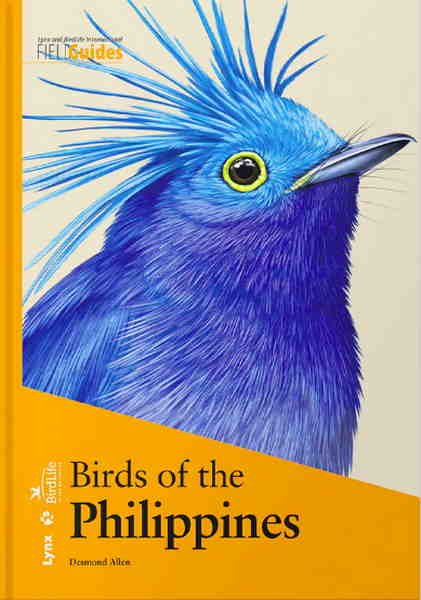
This book is a long-awaited up-to-date field guide for Philippine birds. It comprehensively covers over 700 bird species recorded in the country, with almost 300 species that occur nowhere else on Earth. Each species profile comes with a QR code, which takes readers to its online counterpart on the Birds of the World website. The book title comes in 2 cover options – a handy flexicover version for the field and a hardbound version for your library or coffee table.
Links
By Djop Tabaranza
Djop was fascinated with wildlife at an early age. He joined his parents, who are both biologists, during their fieldwork. This led to a 20-year career as a wildlife biologist in the country working for conservation organizations such as Haribon Foundation and Mindoro Biodiversity Conservation Foundation. His photos have been featured in numerous scientific, online, and printed media publications. Djop is a founding member and a current officer of the Wild Bird Photographers of the Philippines. Djop won several prestigious birdwatching and bird photography races, including the Puerto Princesa Underground River International Bird Photography Race in 2023, 2024, and 2025, and was awarded Birdman of the Year 2023.
Djop can be reached at djoptabaranza@birdfinder.ph
“map_philippines” by joelogs is licensed under CC BY 2.0.







Leave a Comment