
Birders love language. We’re fascinated by bird names, pepper conversations with terms of our ‘sport’ (twitching, dipping, listing, splitting, and lumping), and gleefully use nicknames or invent new ones for our birds (Maggie, Sharpie, Coop, Gyr, ButterButt, MoDo immediately come to mind; a creative friend coined “cootamungus for American Coots and “Howard Sternaday” for European Starling, whose scientific name is Sturnus vulgaris). Most books and articles on birds and language have focused on the derivation of bird names–their history, etymology, and more recently, the problems with that history. Jeremy Withers comes to birds and the English language from a different perspective. An English professor at Iowa State University who teaches History of the English Language and whose academic interest previously focused on science fiction representations of a post-automobile world, Withers became a serious birder during the Covid-19 period and quickly found himself thinking about the language of birding and ornithology: how bird names (common names, collective nouns) developed from the diverse linguistic streams that make up the English language; the roles writers like Chaucer and Shakespeare played in creating and integrating bird language into English; the various linguistic forms that have been applied to bird names and birding phrases. The process works two ways, Withers observes both how birds and birding have influenced our language and how “avian language” has affected “important debates and shifts in English” (p. xiii). This sounds like erudite, intellectual stuff, but Withers understands his audience well and has written a fascinating book that offers many tidbits of knowledge for those of us intrigued by the connections between birds, birding, and language and which, I think, adds to the small but growing knowledge base on this topic.
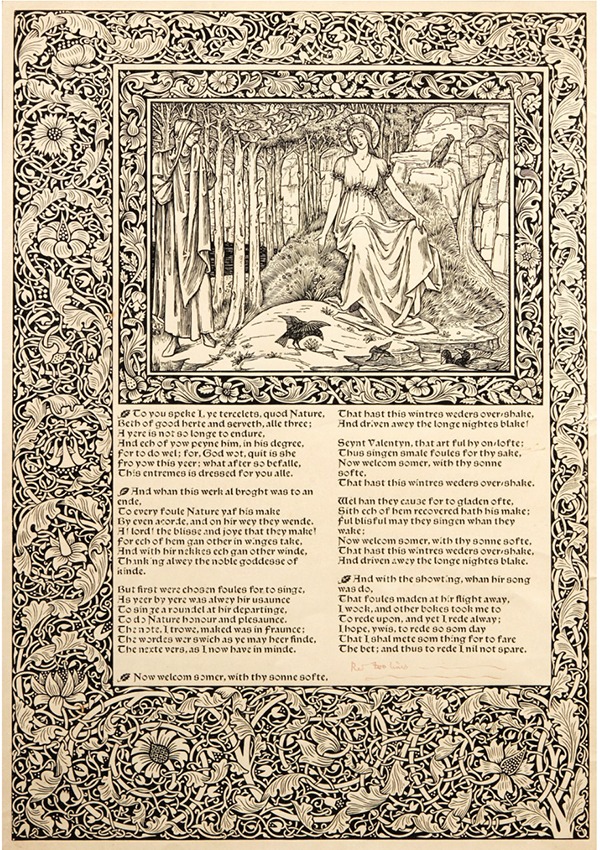 A proof sheet from the Kelmscott Chaucer showing the final page of the Parliament of Fowls, with a half-page woodcut by Burne-Jones and a woodcut border design by William Morris. The illustration is of Nature awaiting the arrival of birds for the Parliament. In Chaucer’s time, “fowl” was much broader in meaning, denoting a bird in general; its current definition as a domestic chicken is a result of semantic narrowing. [This illustration is NOT in the book.]
Withers has smartly organized Birding English into 50 easily digestible chapters, each three to four pages long, organized along chronological events or linguistic themes. Reading it is an adventure through world history with a British/U.S. focus. Each chapter headlines a bird species (usually North American, sometimes British/European) that represents the language feature being highlighted; Withers also talks about the bird itself, sometimes briefly, sometimes very personally. Chapter 1 starts with “Graylag Goose: Proto-Indo-European,” an account of attempts to reconstruct Proto-Indo-European, the antecedent of the West Germanic languages brought to England in the fifth century and, in fact, almost all European and some Asian languages. How does this relate to birds? One of the ancient words scholars have been able to reconstruct is ghans–the root of the word for “goose” in German, Dutch, Greek, Latin, Sanskrit, and many other languages. More proof that “goose”–probably Graylag Goose–is the oldest of our bird names, as stated by two of Wither’s major sources, Susan Myers’ The Bird Name Book: A History of English Bird Names (PUP, 2022) and Stephen Moss’s Mrs. Moreau’s Warbler: How Birds Got Their Names (Guardian Faber, 2018). In chapter 50, “Common Murre: The Future of English,” Withers makes a case for looking at the future of both birds and the English language in positive terms after going through all the reasons why we shouldn’t, focusing on the 2015 catastrophic die-off of Common Murres in Alaska. It’s a flimsy case for both, but you have to admire his optimism.
In-between are discussions of Old Norse influences on English (Great Skua); the Norman Conquest (Black-billed Cuckoo); falconry (Gyrfalcon); the first dictionary of English words (Northern Saw-whet Owl); Chaucer, of course, (Golden Oriole); collective nouns (Black-capped Chickadee); Shakespeare, of course (European Starling); the history of punctuation (Red-winged Blackbird); indigenous influences (Canada Jay); British vs. American English (Common Merganser/Goosander); portmanteaus (Bearded Reedling); eponyms (honorifics) in bird names (Ross’s Goose); use of mnemonics to remember bird song (White-throated Sparrow); vulgar language, or not (Dickcissel and ‘jizz’); African-American English (Blackburnian Warbler); insults (Florida Scrub Jay and domestic chicken); social media (Anna’s Hummingbird); racist language (Long-tailed Duck), and more. Withers throws a wide net over the concept of the English language, aiming to cover topics beyond the popular bird names and collective nouns. He looks at our terms of bird vocalizations and terms used for bird study. Though early chapters focus on early language influences, later chapters examine the role of dictionaries through the years (Henry Cockeram’s English Dictionarie, Samuel Johnson’s Dictionary of the English Language, Francis Grose’s Classical Dictionary of the Vulgar Tongue, Noah Webster’s American Dictionary of the English Language, The Oxford English Dictionary, subversive dictionaries); the diverse ways words are created through subtracting, adding, or combining word parts (reduplication, back-formation, rhyming slang, portmanteaus, mnemonics); the influence of specialized bird ‘sports’ like falconry and game hunting; and current bird-language usage as influenced by modern technology. Some connections come more naturally than others. For example, the inclusion of “schmalts” (or “schmaltz,” as it is spelled in my circle), a Yiddish word for chicken fat, in the chapter on lesser-known influential languages, seems a little far-fetched. But I admire the effort at inclusivity and Withers’ obvious passion for the ‘mongrelism’ of our language. I particularly enjoyed the linguistic-oriented sections, where I learned the names of bird language tricks and customs, some familiar, some new, like onomatopoeia (try spelling that without a dictionary!) and back-formation. As an English literature major, I’m familiar with Chaucer and Shakespeare’s use of bird characters and imagery, but know little about the study of language itself. It’s good to learn new stuff.
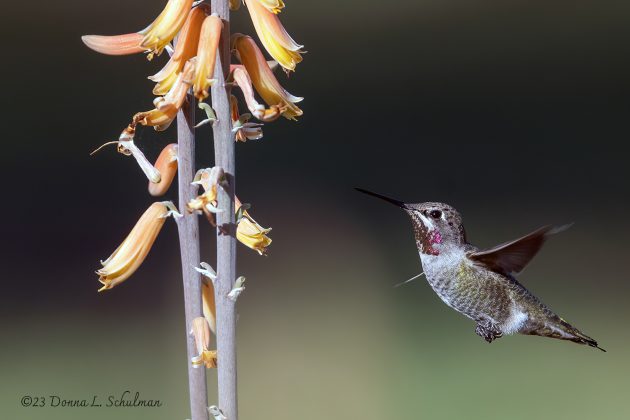 Anna’s Hummingbird, California. In the chapter on social media, Withers mourns the loss of the friendly, hopeful bird logo of Twitter. Though the graphic looks just like a bluebird, one of the designers apparently said he was inspired by a flying hummingbird, which Withers thinks might have been an Anna’s Hummingbird, commonly seen around the site of the social media platform’s former headquarters. [This illustration is NOT in the book, © Donna L. Schulman]
On the university web page describing the research project that resulted in Birding English, Withers states, “I hope that my book will be deemed interesting and useful by both professional and amateur birders, as well as by teachers and students of English. I want to turn bird nerds into word nerds and word nerds into bird nerds!” His statement encapsulates the book’s informative, accessible content and personal, friendly tone. The text is as non-academic as you can get when talking about the origins and nuances of language in linguistic, historical, and cultural contexts. There are times when details and research, by necessity compressed and simplified to fit into three pages, are difficult to track (the first chapter on Proto-Indo-European, the hypothesized first language, is a good example), but more generally this is fun reading. There are a couple of curious omissions. Though Withers talks about different bird terms used in the United State and Great Britain (Common Merganser/Goosander, Loon/Diver), and frames this discussion with the long-time universal search for a common language, he doesn’t write about the work of the IOC (International Ornithologists’ Union) to produce a standardized list of “Recommended English Names” (published in 2006), nor is there mention of the “English Names Committee” established by AviList in 2025, whose purpose is to produce a list of English bird names that would complement AviList, the recently completed synthesis of the world’s major checklists. Withers does discuss the AOS (American Ornithological Society) English Common Names Pilot Project (you know, the initiative to change eponymic common bird names) in the chapter on racist language, though his source is the Washington Post, not the AOU. It’s possible the latter two projects were announced after or just as the manuscript was going to the publisher, since 2023 appears to be the cut-off point for articles and sources. Also, these are organizations searching for commonality, not people. Wither is more interested in people than institutions. And as he points out, people will talk the way they want to talk, not the way they are directed to by organizations or governments.
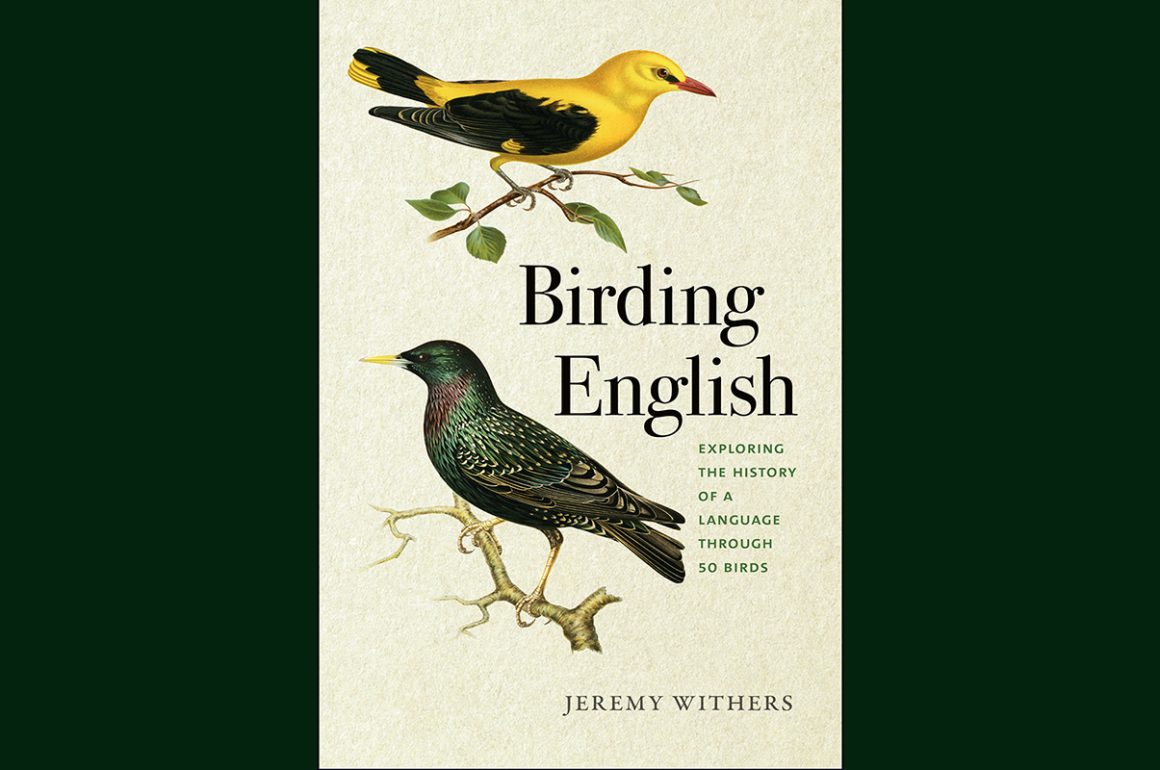
Although Withers draws on scholarly books and articles, many of the most cited sources are not academic. In addition to Myers and Moss, he repeatedly refers to the thoughtful writings of Helen MacDonald (H is for Hawk, Vesper Flights), and two birding podcasts–Nature Guys and the American Birding Association Podcast hosted by Nate Swick. “A Bibliographic Essay” discusses notable sources chapter by chapter (not all chapters are represented, as he explains in the Introduction, because he did not feel it was necessary–an unusually honest declaration). The notes also offer additional information to the text, which makes for interesting reading. I would have liked an additional formal bibliographic listing of selected sources (so much easier when you want to find titles and dates), but eliminating this feature appears to be the price these days for publishing non-scholarly books, even when the publishing is by university presses. There is an Index to names and topics, which is very helpful. There are no illustrations other than the striking cover paintings of a Golden Oriole and European Starling by the 19th-century Finnish Von Wright brothers, which is a shame because the content fills one’s head with images of literary books, historical events, and birds, and I’m sure it wouldn’t be hard to find public domain drawings to illustrate them (see my contribution of a page of Chaucer above).
Birding English: Exploring the History of a Language Through 50 Birds is an imaginative look at the intersection of language and birding, smartly constructed as a unique overview of the development of the English language from earliest times to the last few years. Most of this review has focused on the birding material, but there are also interesting observations on how birds and birding have enriched the English language. Withers challenges critics who think that current changes in pronouns and bird names denigrate English; he sees linguistic expansion, word loss and gain, influences from diverse cultures and groups as healthy, boding well for the future of the language and the people who speak it. It’s a positive view that underlines the book as a whole, paralleling his understanding of how birding can allow us to live in the moment, beyond the rules of language. Birding English may not be a book for every birder, but I think birders who enjoy inventing new bird names while on a twitch, who marvel at the comedy of bird names that echo their calls, who know that the term “birdbrain” is a misnomer, and “Red-winged Blackbird” is sexist will enjoy the version of English language history presented in these pages.
 Author Jeremy Withers. © Iowa State University of Science and Technology.
Birding English: Exploring the History of a Language Through 50 Birds
by Jeremy Withers
Bur Oak Books, Univ. of Iowa Press, June 2026
242pp., 6 x 9 inches
ISBN-10 : 1685970699, ISBN-13 : 978-1685970697
$39.95 (discounts from the usual sources and from publisher till June 2027, see https://uipress.uiowa.edu/books/birding-english)





Enjoyed your review of this book very much and I appreciate so much the details you delved into to bring out the themes in the book. It’s piqued my curiosity!