

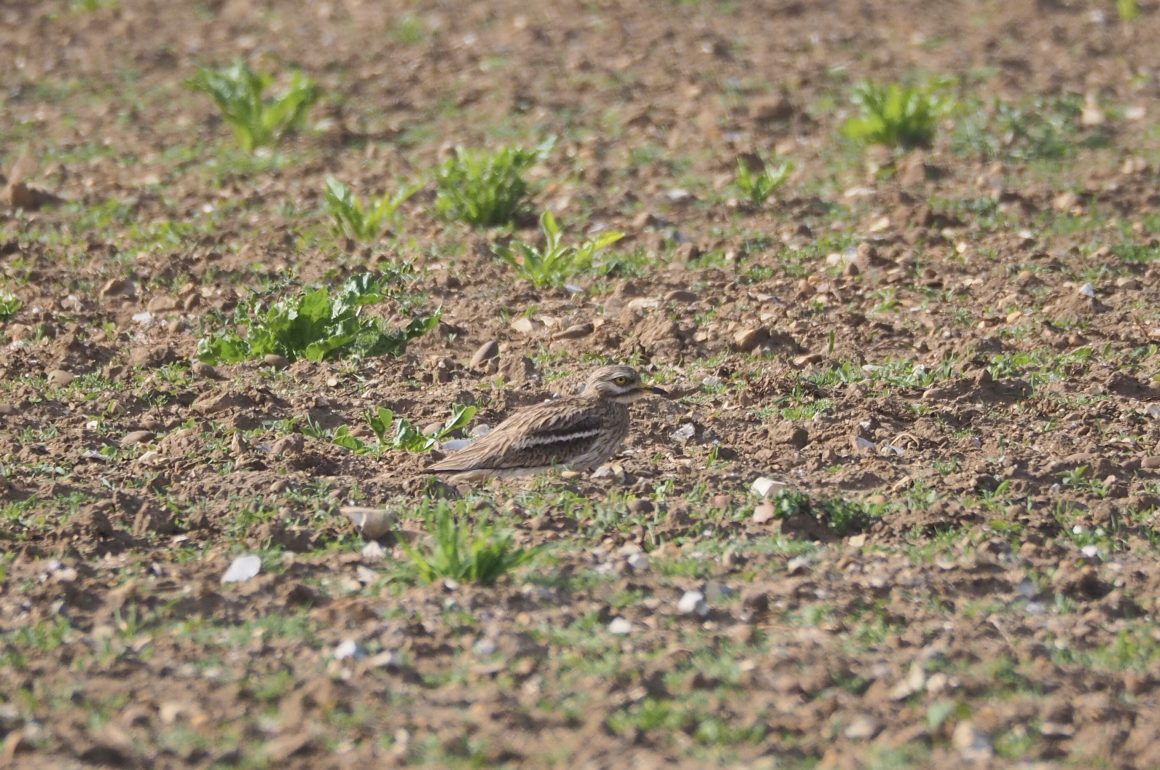
Latin was not, I’m afraid, one of my stronger subjects at school, but when it comes to Latin bird names I do have a handy book I can consult entitled Birds – their Latin names explained. It was written by A.F.Gotch, a retired teacher (though surprisingly Latin wasn’t one of the subjects he taught), and published in 1981. It has just come in handy for researching the origin of the word Burhinidae, which is the family name for the 10 species of thick-knees, one of the most unusual families in the order Charadriiformes (wading or shore birds). Burhinidae is a combination of three Latin words, and it combines to indicate that members of the Burhinidae are birds with relatively large heads and short, thick bills.
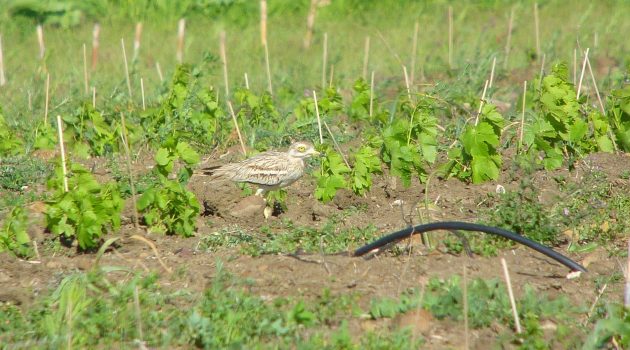
A Stone-curlew photographed in a young vineyard in Scilly in April. These birds are found on all the major Mediterranean islands
That’s certainly true for eight of the 10 members of the family – the exceptions are the Great Thick-knee and the Bush Thick-knee, two closely related species. They both have hefty beaks, but are clearly first cousins of all the other thick-knees. My curiosity about the name Burhinidae was kindled by a day spent watching flocks of Stone-curlews (also known as Thick-knees and Norfolk Plovers) here in the Brecks of Eastern England.
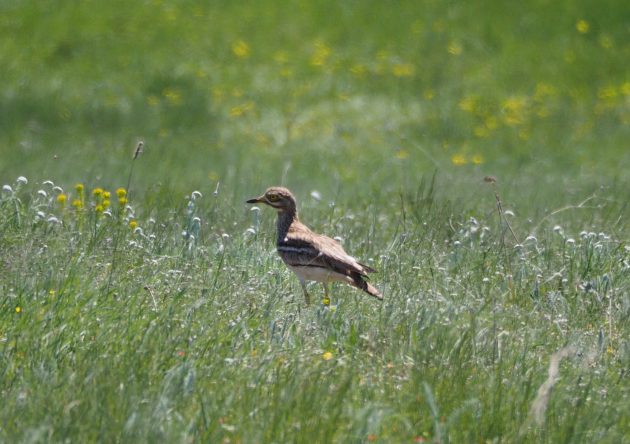
This bird was photographed in Bulgaria in April
The Stone-curlew is the only migratory member of the family, which perhaps explains why it has by far the biggest range of any of its members, extending from the Canaries in the west all the way to the Caspian Sea in the east. It’s predominantly a southern species, as it favours hot and arid habitats; here in the Brecks it reaches the northernmost point in its vast range. It’s always been a rare bird in Britain, but thanks to conservation efforts numbers have doubled in the last 40 years, and there are now around 350 nesting pairs, with the great majority in the Suffolk and Norfolk Brecks.
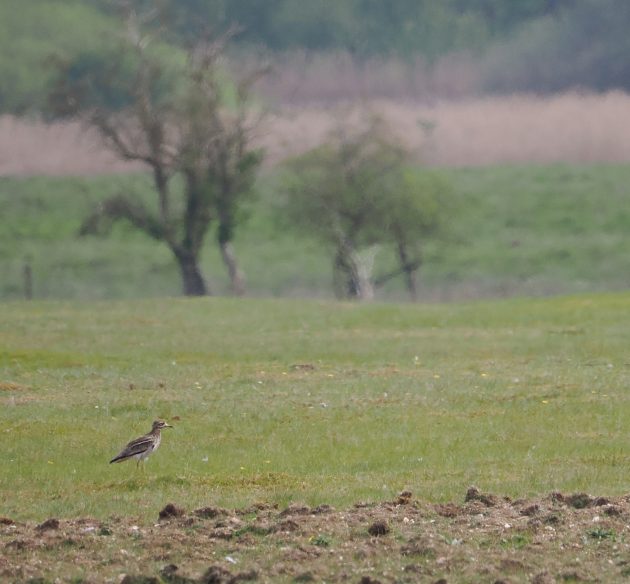
A Stone-curlew on Weeting Heath, a Norfolk Wildlife Trust reserve managed specially for this species. (Photograph by David Addy)
In the spring, when they are nesting, they are tricky to find, and are best located at dusk, when their noisy, Curlew-like calls reveal their presence. There is one Breckland nature reserve – Weeting Heath – managed specially for these birds by the Norfolk Wildlife Trust, and it’s a reliable place to see them in every month from March to October. The reserve is invaluable, as it enables anyone who wants to see a Stone-curlew to do so without disturbing the birds, and takes the pressure off sites where these shy birds would be vulnerable to disturbance.
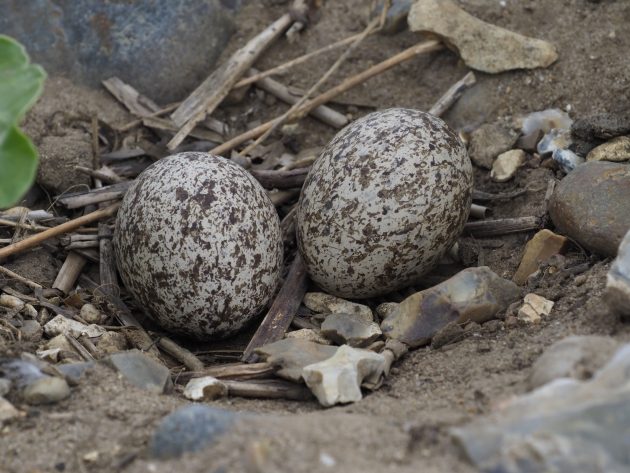
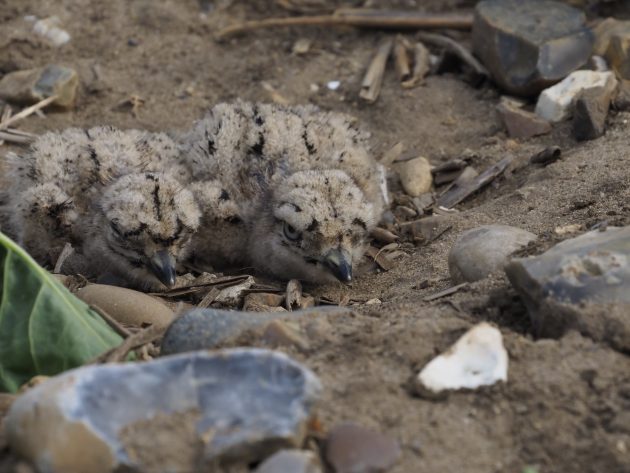
A clutch of Stone-curlew eggs, and (below) two day-old chicks hatched from this clutch. The nest was on a farm two miles from my home, and I photographed it under the supervision of a licensed Schedule I species worker
Though at least one pair nests on a farm close to my house they are so secretive I seldom see them – I have had just one sighting (of a pair with young) this year. However, in August the scores of breeding pairs that are scattered throughout the Brecks start to gather together at traditional sites, and here they will remain until they migrate south (to Spain and North Africa) in October.
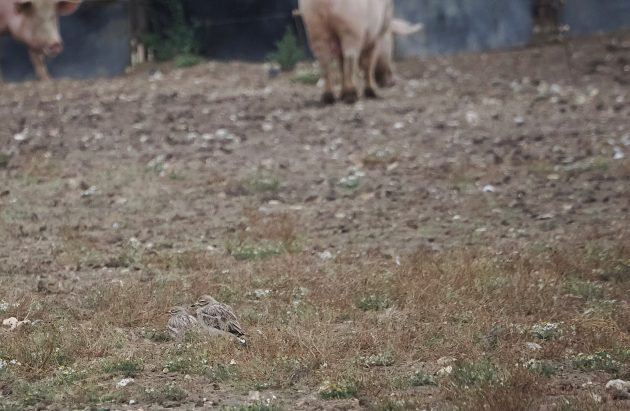
Spot the birds. Stone-curlews are masters at disappearing despite being in full view
I visited two of these sites yesterday. The first was on farmland where outdoor pigs are raised. The Stone-curlews like the bare but weedy ground created by the pigs, so pigs and Stone-curlews are often found together. At the time of my morning visit there was a couple of people working with the pigs, so the flock of Stone-curlews had all withdrawn to a quieter corner of the field. Few birds have better camouflage than these, so they were a challenge to find.
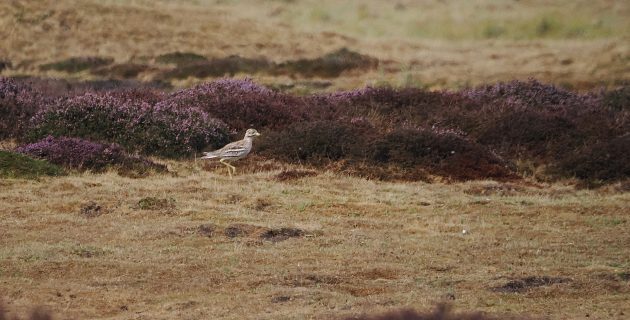
Stone-curlew on Cavenham Heath, August 2026
Eventually we spotted four, then five, then another group of 12, followed by a further trio. It was a case of the more we looked, the more we found. The most we had in view at the same time was 59, a good count, though I have since heard reports of over 100 birds at this site. During the day these birds are generally inactive, sitting down, perhaps preening, but doing very little except trying not to be seen. They are crepuscular, so it’s not until the sun has set that they really become active.
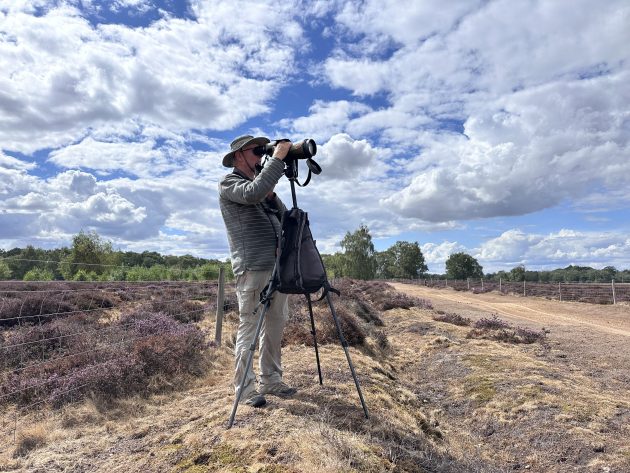
My companion Andrew counting Stone-curlews on Cavenham Heath NNR
The second site we visited was Cavenham Heath National Nature Reserve, the best known of the autumn gathering grounds, and where most people go to see them. Here the birds collect on a gently undulating Suffolk heath, resting among the heather. Though they do nest here, they are challenging to spot in the spring. In August it’s much easier to find them, though typically they are scattered in pairs and small groups across the heath. We arrived just after a thunderstorm, and the first significant rain for three months. It had stirred the birds into action, and there was a lot of calling, and some birds even flew as they moved to different pieces of ground.
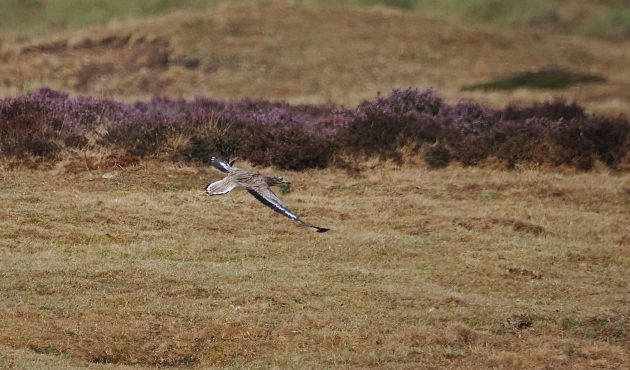
In flight, Stone-curlews display distinctive black and white wing bars
Visually, Stone-curlews are curious-looking birds. They do have noticeably large heads, with big, staring yellow eyes. Their legs are long and yellow, but they often sit resting on their ankles (the name thick-knee is misleading, as the bulging joint – the so-called thick-knee – between the tibia and the tarsus is in fact the ankle). Their beak is also yellow, with a black tip, while the plumage is best-described as cryptic. Resting individuals typically look hunched and miserable, but they come to life when they fly, revealing strikingly patterned long wings.
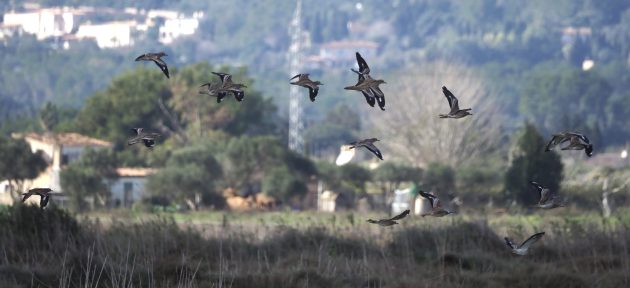
Our warming climate suits Stone-curlews, as they favour dry, open habitats and are happy when it doesn’t rain. The evidence suggests that during the long hot summer of 26 they have enjoyed fine breeding success. This is good news, as this bird is amber-listed in the UK as a species of conservation concern. In recent years there have been an increasing number of records of birds over-wintering here in the Brecks. Migration is a risky survival strategy, but the over-wintering birds are vulnerable to prolonged spells of freezing weather, and especially snow, so remaining here is a gamble. Our recent winters have been relatively mild, so it will be interesting to see how many birds remain with us in the coming months.
(Next week I will take a look at the nine other members of the Burhinidae family)
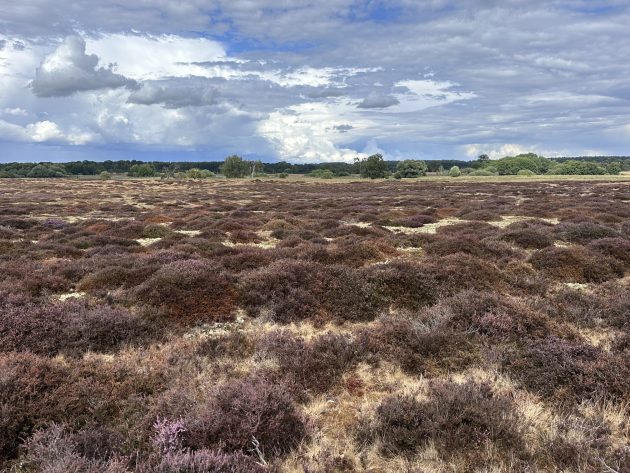
Cavenham Heath NNR









Very interesting article David. Thoroughly enjoyed the read as this is one of my favourite birds