


As the host of For the Birds on Amherst Island Radio (101.3 FM, Ontario), Anthony Kaduck brings his long-standing interest in birding to community radio. In our interview, he speaks about his background as a birder, the creation and focus of For the Birds, and his experience of talking about birds on the radio.
How did you first become interested in birding, and what continues to draw you to it after all these years?
I am a “late-onset” birder – I didn’t really pay much attention to birds until I moved to England in 2005. All the backyard birds were unfamiliar, so I had to get a book and look them up. I then started going farther afield to find birds, met some birders, and fairly quickly got hooked.
I still enjoy seeing familiar birds as they come and go on migration, and I like the sense of being in the moment, watching birds and not thinking about all the negative things that are going on in the world. In the last few years, I have expanded my own migration range to include Central and South America and parts beyond, where there are whole new families of birds to enjoy.
How did you get the idea to start a radio show, and what was your motivation behind this?
The show started when one of our morning shows invited Janet Scott to talk about local birds. This generated a lot of interest, so it became a regular guest spot, and fairly quickly it was spun off into its own show. Janet hosted For the Birds from about 2010, but a few years ago, she decided it was time for a change and asked me to take over.
Not all our readers may be familiar with community radio. Can you briefly explain what it is, and what the implications are for your radio shows?
In Canada, community radio stations are non-profit, volunteer-led organizations that exist to provide local news and general interest programming to communities that are not well-served by commercial broadcasters.
The roots of the movement started with university campus radio. The first station of its kind, Queen’s University’s CFRC, went on the air in 1929, in my hometown of Kingston, Ontario. Over the years, more campus radio stations were established, but in the 1970s, regulations were changed to allow community groups outside of the university system to apply for a radio license.
Since then, a number of community stations have been set up, mostly serving remote areas and often providing programming in indigenous languages. Island Radio (CJAI) is a bit of an anomaly: it is well within the main population belt of Canada, and its catch basin includes rural/agricultural areas, villages and towns, and a medium-sized city.
In the past few years, major corporations have acquired most of the commercial radio stations in Canada, centralizing broadcasting and closing local outlets. In our area, Island Radio is now the only radio station that provides local news and community voices.

Many readers of 10,000 Birds probably have not listened to your radio show yet. Can you explain the concept and the setup?
For the Birds is a 30-45 minute show that goes out live every Monday afternoon and then is rebroadcast on Wednesday and Saturday. Each show starts with a roundup of local bird activity over the previous week and predictions about what birds to expect over the next few weeks.
The remainder of the show will be taken up by one or two main topics. These can be anything bird-related: recent examples include how resident and migratory birds survive the winter, the latest taxonomy changes, interviews with birding guides and notable local birders, deep dives into a species or genus, and stories of my own birding adventures.
Has For the Birds ever gone unexpectedly off-script?
I don’t really have a script for the shows, just a set of notes. Often, when I am talking about a particular subject, I think of some interesting bird-related tidbit and go off on a tangent. So yes, it regularly goes off script, but regular listeners know to expect the unexpected.
How much time does it take to produce a typical show? Are there any sponsors, or are all costs borne by yourself?
A weekly show takes a couple of hours to put together. I normally have a good handle on local sightings and trends, so the majority of the preparation time is spent researching and summarizing the main topic of the week. If the show has to be recorded in advance, includes a recorded interview, or uses a lot of sound files, then it takes a bit longer to tie everything together.
We are fortunate to have an exclusive sponsor for the show. Urban Nature is a chain of nine stores in southern Ontario that offer everything a birder needs: top-quality bird seed, bird feeders and baths, optics, field guides, and bird-related gifts.
When you are not preparing a show, what does your everyday birding look like?
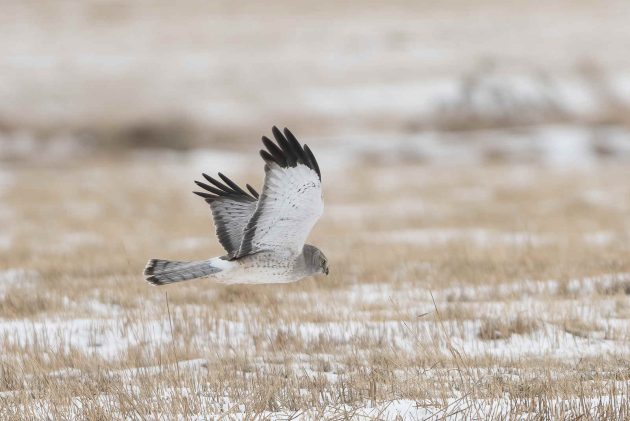
I am fortunate to live on a major migration flyway, where each season has its own set of target birds. At the time of writing, winter has set in, so the focus is largely on two large islands in Lake Ontario (Wolfe and Amherst) that have the wide-open fields favoured by winter migrants: Snowy and Short-eared Owls, Rough-legged Hawks, Snow Buntings, Northern Shrikes, Horned Larks, and the occasional Lapland Longspur. This year, it looks like there may be an irruption of winter finches, so we will all be on the lookout for Evening Grosbeak, Pine Grosbeak, Redpoll and two crossbill species.
During Spring and Fall migration, I focus on a couple of nearby spots where warblers, vireos, flycatchers and sparrows stop to feed on their way north.
I also lead birding field trips for the Kingston Field Naturalists.
You’ve travelled widely in pursuit of birds. Do you have any favourite places you would like to highlight?
My favourite place is often the last place I visited. On that basis, Colombia’s La Guajira Department is at the top of the list. But other favourite spots include Skomer Island in Wales, Fair Isle in Scotland, Vietnam’s Central Highlands, and a number of other places in Colombia, especially Ecolodge La Minga (Valle de Cauca), El Color de mis Reves (Caldas), and Mountain House Lodge in the Sierra Nevada de Santa Marta.
If you could give any bird species its own radio program, which would you choose, and what kind of show would it host?
The Canada Jay would be a fine choice: its curiosity, inquisitiveness and feistiness would make it a great investigative reporter on issues that concern birds.
Finally, is there anything you would like to share with the readers of 10,000 Birds, or is there a question you think we should have asked you?
Are there any other radio shows out there featuring birds? If so, I would love to hear about them.
For the Birds is broadcast every Monday at 1500 Eastern Time (UTC -5) and rebroadcast at 1200 each Wednesday and 0800 on Saturdays. It can also be accessed online at https://www.cjai.ca/





Good to be in touch.