

This is a collaborative post in two parts. In this, the first one, our writers share their all-time favourite birding destination – a place to which they have actually been. In the second one, we dream about a destination we have not been to yet, and may never be able to go.
Kerkini, Greece
I’ve been lucky enough to travel the world in my quest for birds, so I have many favourite places and locations that I like, or I’d really like to visit again. As a keen young birdwatcher, it was my dream to visit Spain’s Coto Doñana and the marismas of the Guadalquivir River. I drove there at the age of 18, together with two companions in a 1956 Morris Minor car. Doñana was magic. I saw my first sandgrouse and bustards, not to mention Spanish Imperial Eagles and even the almost mythical Iberian Lynx. It became my No. 1 birding destination.
Sadly, half a century on, the Doñana has, for me, lost much of its appeal. It’s now easy to get to, has a huge and ugly tourist town on its southern boundary (Matalascañas) and the wonderful marismas that stretched as far as the eye could see have been largely drained and turned into wheat fields. Tractors have replaced mules, and the locals now drive cars rather than ride horses. If you have never been there before, you will enjoy a visit, but if you knew how wonderful it once was, you will be disappointed.
Since my first visit in 1982, Kenya has been my favourite birding destination, due to the richness and variety of species, and the fact that so many are easy to see. But I haven’t been back for nearly 20 years, in which time its population has increased hugely. Would I still find it so wonderful?
For nearly 20 years, I have been visiting Kerkini in northern Greece in search of birds (and butterflies). This has now become my go-to destination, thanks to a combination of great wildlife, quiet, unspoilt countryside and a wonderful family-run hotel. It’s my current favourite destination.
(David Tomlinson)
Socotra
My favourite birding destination is the Island of Socotra, which I visit annually with guests. This is especially because of its endemic bird species, plants, and reptile species. It was impossible to visit the island for a long time, so there are still new things to discover. On my first visit, I was able to record a first record (Booted Eagle) and a first breeding record (Crested Coot) for the island.
(Rolf Nessing)
Kruger Park (South Africa)
Not to choose South Africa again…but Kruger National Park is probably one of the most amazing places I have ever been. I have written about our experience there (https://www.10000birds.com/theres-so-much-to-see-in-kruger-national-park.htm), and I think about it often. It’s one of the few places I have been where we could drive for hours without seeing a (human) soul. There are endless places to explore and possibilities of what you could see. I am not sure my husband enjoyed it as much as I did, since it was all car-birding, and he likes to hike. For me, it was exciting to see what we would find around each corner.
(Hannah Buschert)
Colorado (USA)
After 85 posts, one would assume I have written about my favourite birding destination already. I have. Still, for a collaborative post, I can pretend to have a new favourite (I do this with my family members all the time – picking new favourites to keep them on their toes). My favourite destination is Colorado. I have been birding in Colorado with my two birding buddies, Laura and Brad, who erroneously claim “it is all my doing” that they are avid birders. I am certain there was a pre-existing condition, psychological for sure. Either way, going out with two very nice people scores a lot of points on the favouritism scale. Additional points come from Colorado’s geographical diversity. The whole “mile high” concept has already been sufficiently lampooned, but there are indeed mountains, rather big ones. The state also features prairies, deserts, lakes, rivers and quite a few wetlands. Colorado even has two officially recognized endemic bird species: the Gunnison Sage-Grouse and the Brown-capped Rosy-Finch. The state bird is the Lark Bunting, which can be found on the prairies, a biotope that includes fluorescent nuclear waste dumps.
(Peter Penning)
Bulgaria
My favourite birding destination goes back to June 2011, when I went to Bulgaria on a trip sponsored by the Bulgarian Society for the Protection of Birds (BSPB). At the time, the BSPB had a chapter in the United States that was led by Yoav Chudnuff, then living in Philadelphia. I don’t think the U.S. chapter remains active, but I hope I am wrong. Preparing to write this piece, I was pleased to see that the BSPB remains active in Bulgaria.
I recall seeing the trip advertisement in the American Birding Association magazine. I was intrigued but anxious. Never having traveled on my own to a place like Bulgaria before, I felt unsure. The BSPB advertisement gave the website and also provided a contact phone number. I called the number and spoke with Yoav, and was reassured. Yoav’s reassurance turned out to be the best reassurance I have ever had going into a trip.
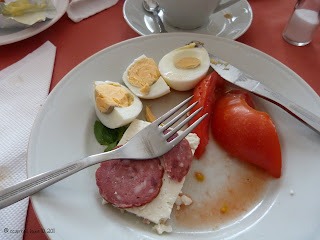
I remember arriving at Vasil Levski Sofia Airport. I remember being picked up and driven to a small and charming European-style hotel (American description; Europeans don’t say this) in a suburb of Sofia. The evening meet and greet meal was comfortable and fun. I remember how red and flavorful the tomatoes were, the crispness of the cucumbers and the sharp tanginess of Bulgarian cheese was like no other cheese I had ever tasted.
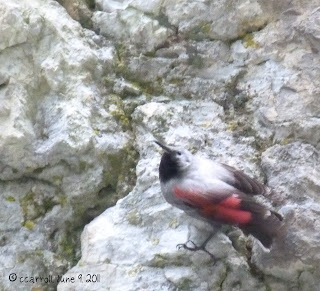
But what about the birding? It began the next day as the trip started its route toward Trigad and the Rhodope Mountains, where we saw White-throated Dipper and none other than the highly sought after Wallcreeper. I remember that in the mountains it was cold, but I left my room window open because the air was so fresh and the blankets were warm and cozy. This was also the first time I had ever taken a shower in a space without shower walls or a shower curtain. It took me a while to wrap my brain around this setup but I figured it out.
Bulgaria is a country uniquely situated for many kinds of bird species and for excellent migration birding. The Eastern border enjoys a long stretch of the Black Sea. Our trip took us in a big circle all around the country. We travelled along the Black Sea and the borders of Turkey and Romania. We passed through villages with just a few people remaining and villages that had been abandoned altogether. One of our accommodations was an empty ski lodge where, in summer, the slopes were occupied by wildish horses belonging to gypsies. At every stop we saw buntings, wagtails, pipits, vultures, storks, Little Owls and other owls, shrikes, waterfowl and many other species—all new birds for everyone. Many of the transfers were quite long, but the stops along the way for birding made the time spent in the van less annoying.
The day I remember most easily was Trigrad to Madzharovo. En route, we saw a Little Owl perched on the chimney of an abandoned building. Madzharovo is a former USSR village with decrepit Soviet-style apartment blocks. But in the middle of all of this was a very nice little hotel with wonderful rooms and food. The hotel had been built in the home village of a man who had left his family behind and lived and worked in Chicago for many years, saving every penny he had made in the States. When he returned home, he built the hotel for his family to have a business. The hotel was now run by his daughter and her husband. To write that the food was excellent sounds trite; it was plain, flavorful, fresh and normal good food—my favourite kind of food. The rooms were spotless and comfortable, containing only the needed things. There was a small Catholic shrine built for the owner’s father on the property. We stayed here two nights, and our daytime birding took us in every direction from Madzharovo.
For me, the thing about a birding destination is the full package. The accommodations, food, scenery, people met along the way. The birding fits snugly inside the full package. This leads me to the crème de la crème of any trip: our field guide. I have enjoyed many trips with good field guides, but on this particular trip, our guide, Mladen Vasilev, was one of the best—a consummate professional in all things birding. In addition to knowing the birds and where they were, he knew every mile and corner of his country, and he let us know that he loved Bulgaria. As a teenager, he had spent a few summers in coastal Maine working in the tourist industry. He spoke excellent English and told good birding stories about his time in Maine. To me, one of the most important skill sets for any field guide is people management skills. This is essential on any birding trip, and our group was mildly to moderately unruly. This was no problem for Mladen.
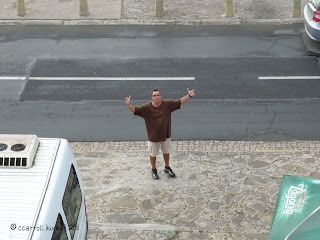
Mladen in Nessebar, a World Heritage site on the Black Sea. Mladen’s current tour group is Neophron Birding Tours. You can connect with him for your own birding trip to Bulgaria.
One final note is that, in June, the weather was superb. It rained once, briefly, while we were travelling in the van.
Obviously, there is much missing from this ten-day trip, but I wrote from memory and fondness—even though the trip occurred fifteen years ago. It is a trip I would take any time again. So much has changed in Europe and the world; I wonder how this has impacted a small country like Bulgaria. Bulgaria joined the EU in 2007—18 years go by in a flash. I hope those years have been good to Bulgaria.
(Catherine Carroll)
Obedska Bara Reserve, Serbia
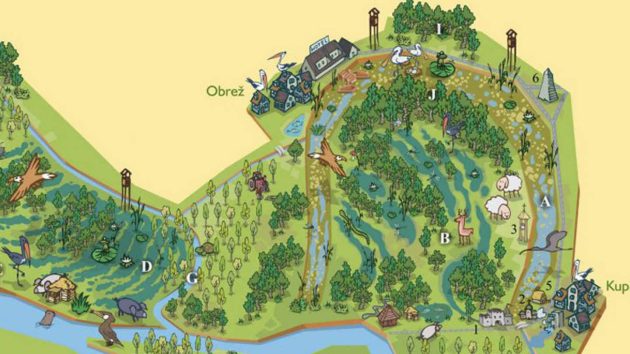
Winter is a wildfowling and gulling, and down here, an owling season, everybody knows that. I used to follow that rule for the better part of my birding life. For example, visiting winter wetlands, I am certain of 30 plus species, while in the winter forest, I’ll get close to 20. So, who in his right mind would waste time in forests? Well, that would be me.
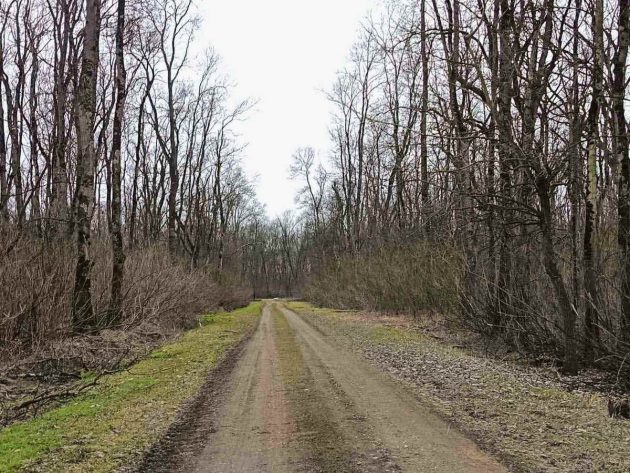
The other day, I visited the Obedska Bara Wetland Reserve. Hey, you’re cheating, it’s a wetland! Well, yes and no. Yes, the area I am visiting can end up under several feet of water when the nearby Sava River swells, true, but I am focusing on the swamp forest of mostly common oak. No waterbirds, only woodpeckers and songbirds.
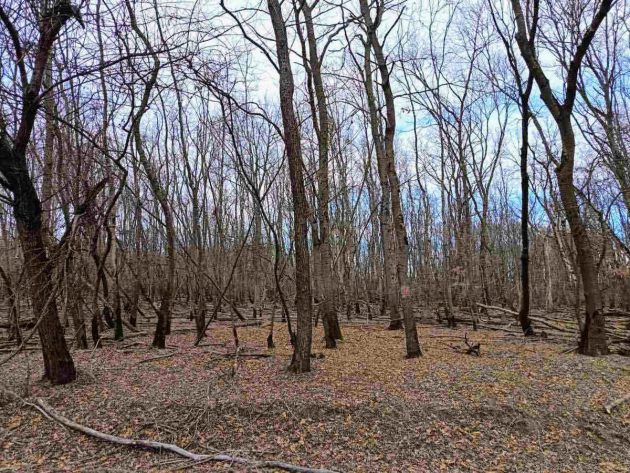
Located an hour west of the capital of Serbia, Belgrade, Obedska Bara Reserve is a seasonally inundated area of the Sava River floodplain. Habitats include marshes, ponds, wet meadows, and forests. Among the over 220 bird species recorded in the reserve are Black and White Stork, Lesser Spotted, and White-tailed Eagle, woodpeckers, Icterine Warbler, Collared Flycatcher, etc., most of them not around in winter. And yet, I especially like the area in winter, when woodpeckers become visible.
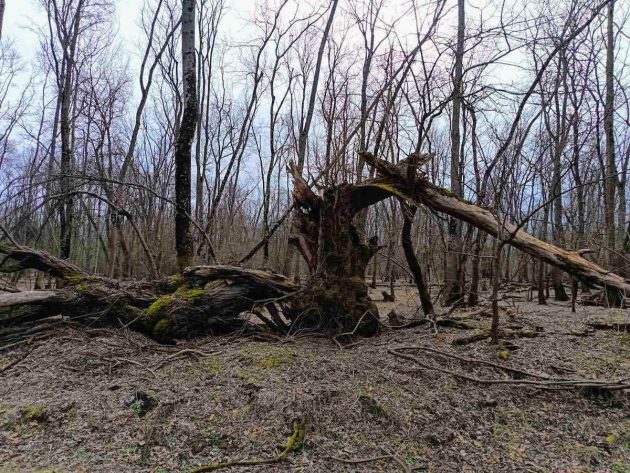
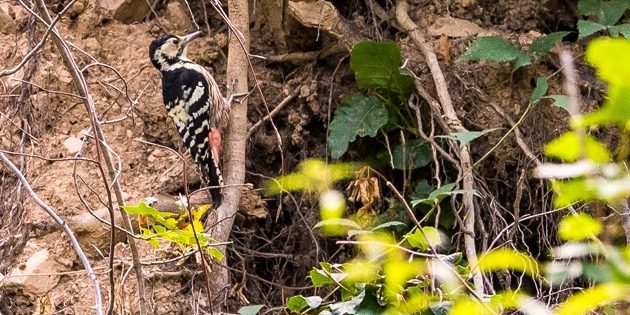
Driving through the forest at my own pace, and not meeting another soul for a dozen kilometres, I observed (or just listened to) the Grey-headed, Black, and half a dozen Middle Spotted Woodpeckers, one Eurasian and a dozen Short-toed Treecreepers, Coal, and numerous Marsh Tits, Goldcrest, Nuthatch, Wren, etc. What little sanity I have kept, I owe to this kind of “forest bathing”.
(Dragan Simic)
Greifswald, Germany
My favourite place to go birding is, maybe surprisingly, located in my own country, Germany: the surroundings of the city of Greifswald, on the Greifswald Bay.
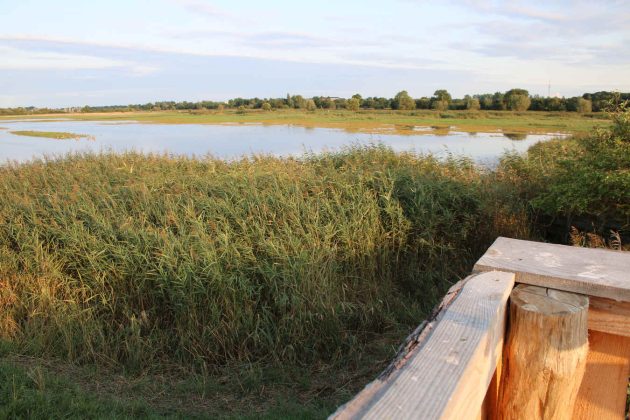
Exploring within a radius of roughly 8 km (5 miles) around the city centre will take you through a remarkable diversity of bird habitats: there are salt marshes right at the edge of the city and – more famously – near the village of Karrendorf, a few kilometres to the North. These are, without a doubt, the most rewarding spots to go birding. But there’s more: a few old-growth forests, freshwater meadows along the river Ryck, ponds resulting from former peat harvests, and large sand banks on the coast near Wampen. As expected, this habitat diversity directly translates to species diversity. It requires relatively little effort to see more than 300 species a year just within this 8 km radius, something you can cover by bicycle.
White-tailed Eagle
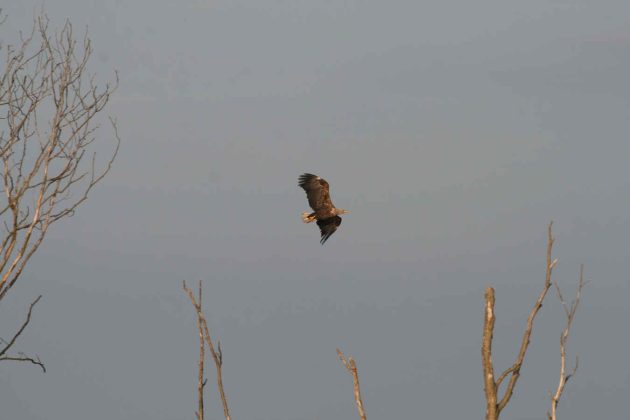
The main attraction to most birders will be waders (or shorebirds for American readers). On a good day, this area will easily produce 20 to 25 species, and these can sometimes be encountered in the salt marshes from a single spot in one scan of the scope. The highest count that I know of is 31, but that’s outstanding. It’s just about the only area in Germany where your chances of finding Broad-billed Sandpipers and Red-necked Pharalopes in August are close to 100% (with flocks of Caspian Terns added to the mix), and Marsh Sandpipers are very realistic in April. Autumn and winter are – of course – the prime seasons for waterbirds, with all regular goose species migrating through in large flocks, including Taiga Bean Goose and a Red-breasted Goose or two each year. Late winter / early spring can be breathtaking when Greater Scaup and Long-tailed Ducks will form flocks several tens of thousands strong far out on the bay. This is also an area where White-tailed Eagles are a regular and common sight – there’s never a day without seeing a few. Raptors in general are rather common, and 10-species days are easy to achieve. Another highlight next to the White-taileds are Lesser Spotted Eagles breeding in forests west of the city. Those forests (including the famous one of Eldena) also have breeding Black, Little and Middle Spotted Woodpeckers, as well as Red-breasted Flycatchers. Songbird variety is significant as well, especially during the breeding season. The highlights amongst the breeding birds from a central/western European perspective are species more readily seen further East: Greifswald has all three Locustella warblers – yes, including River Warbler – and all five Sylvia warblers – yes, including Barred Warbler. Add to this Crested Larks, both Nightingale species, Bluethroat, Bearded Reedling and Corn Bunting, and there’s never a dull moment.
When to visit? Well, as you’ve surely been able to discern so far, there is always something to do and birds to see year-round. Personally, I love spring from mid-March to the end of May, and autumn from the beginning of August to the end of September. If your main interest is waders/shorebirds, August is a strong recommendation. Spring migration for some reason is much weaker, and the salt marshes may appear nearly empty in May, even with ideal water levels. But no matter the season, birding around Greifswald is always like opening a box of chocolates: you never know what you’re gonna get, and anything and everything is always a real possibility.
(Jochen Roeder)
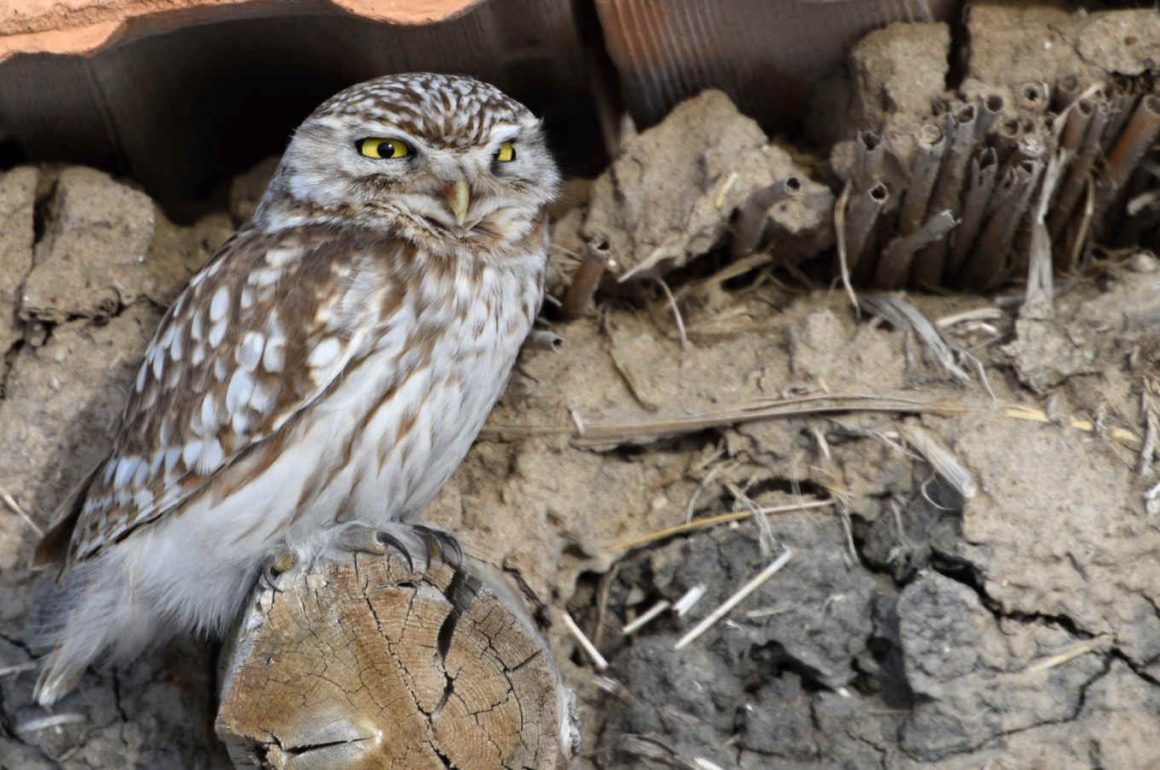
Photo: Little Owl






I want to go to every place. Will I? No. But this is precisely the great thing about this post and about 10,000 Birds. We now know about all of these places. Sometimes, when you know you won’t see every bird or go to every place, just knowing that they are there and that someone is birding in them is very reassuring.