

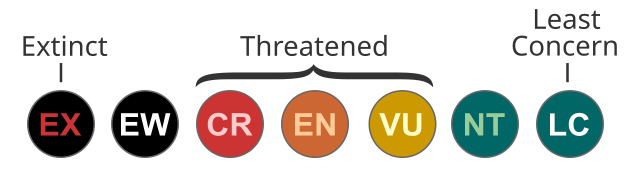
The IUCN Red List of Threatened Species categorizes species based on their risk of extinction, using criteria including population size, population trends, and geographic range.
The Red List categories for birds (and for all other species) are – from lowest to highest risk:
| Threat Category | Explanation |
|---|---|
| Least Concern (LC) | Species that are widespread and abundant. |
| Near Threatened (NT) | Species that are close to qualifying for a threatened category in the near future. |
| Vulnerable (VU) | Species are facing a high risk of extinction in the wild. |
| Endangered (EN) | Species are facing a very high risk of extinction in the wild. |
| Critically Endangered (CR) | Species are facing an extremely high risk of extinction in the wild. |
| Extinct in the Wild (EW) | Species only survive in captivity or outside their natural range. |
| Extinct (EX) | No known individuals remain alive. |
| Data Deficient (DD) | Not enough information exists to assess the species’ risk of extinction. |
These categories are regularly reassigned based on new developments in the population of individual species. For example, in 2023, 11 species were genuinely uplisted (moved to a higher threat level) while 4 species were genuinely downlisted (i.e., they are now considered less endangered than previously). The “genuinely” in the sentence above reflects the fact that other changes in the number of threatened species may come from splits and lumps of species.
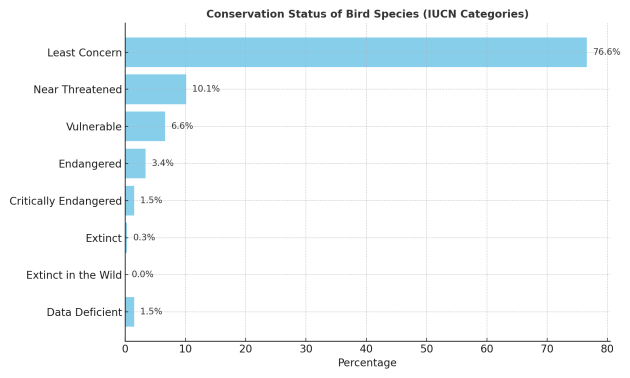
The majority of bird species are still classified as Least Concern (76.6%). However, nearly 22% fall into threatened or near-threatened categories, with Vulnerable, Endangered, and Critically Endangered species accounting for about 11.5% combined. And a small number are already Extinct or Extinct in the Wild.
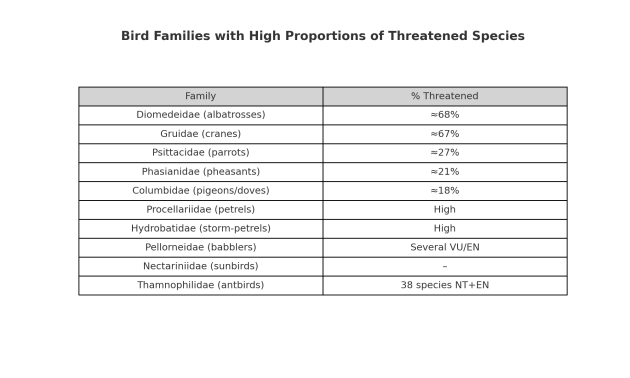
Some bird families are more threatened than others. Seabirds and large terrestrial birds like cranes, parrots, and pheasants are among the most endangered. Several forest-dependent or island-endemic passerines such as babblers, sunbirds, and antbirds are also facing risks from habitat loss.
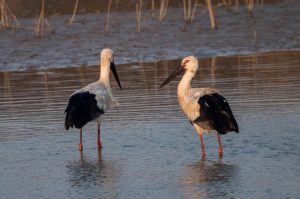
Cover illustration taken from Wikimedia Commons







I must admit I have been tempted to start separate lists for each IUCN category… SPEA in Portugal managed to get the Priolo (Azores Bullfinch) moved to a “better” category which was really cool. Some of the seabirds still have the wrong label though.
A useful summary! I did used to get confused by IUCN in the Australian context, because a bird will show up as Least Concern on it, but be threatened locally due to state-wide/regional differences. It’s been very helpful to cross-reference though and have a bit more of an understanding of the variations in populations.