

Chris Gooddie describes them as “the ultimate forest prize” – and this couldn’t be a more apt description of members of one of the most reclusive families of birds in the Great East. Scattered across rainforests of Asia, Africa, Australia, and several islands in between are forty-plus members of the pitta family. True gems, found mostly in the understory of mosquito and leech infested ancient forests, these plump, small-to-medium-sized birds are dabbed in crushed ruby, emerald, sapphire, saffron, and so many other fantastical colours. Mr. Gooddie is the author of “The Jewel Hunter“, the cover of which is a photo of a single azure feather resting atop the leaf litter – the tell-tale sign of a nearby pitta. His tome describes his quest to see all (then) 32 species of pitta in the world, which (spoiler alert) he did, but only barely.
A couple years ago, a friend lent me this book to enjoy while on a couple long-haul flights en route to the Solomon Islands. A single island in this archipelago nation is home to Black-faced Pitta, and my dear friend thought that reading about the horrors involved in searching for pittas would suitably prepare me for that trip. Back then, our itinerary did not have room for a pitta hunt, but maybe on our next visit…
The following year I had another opportunity with another pitta, the Green-breasted Pitta of west and central Africa. We roused at the usual ungodly hour and drove the short distance to a discrete roadside trailhead within Uganda’s Kibale Forest. Known for its population of Chimpanzees, we were here before dawn to try for the pitta. When we gathered to enter the trail, we were a motley crew of different tour groups: myself and my wife, an American family, a Belgian couple, and a single male birder. Accompanied by an armed ranger and a couple of local guides, we began marching into the jungle.
Within about half an hour, we began hearing a very distinct bonk resonating through the forest. The tolling of the bell is the sound of the Green-breasted Pitta, adding further to its mystique. However, no sooner had we heard it did one of the guides start up the bluetooth speaker. Those who know me well would know that I’m not a fan of using playback, but I was in another land so I kept my mouth shut. Maybe this is how things are done here, I thought. Onward we strode.
Suddenly, our guide stopped and turned around, wide-eyed. It’s there.
I raised my binoculars and focused on the thick, wooded vines, twisted upon one another – sat upon this was indeed a bird that I had previously read about. As Chris Gooddie did, I ogled at its cream eyebrow, black face, and a neon blue, the likes of which I had never seen before or since. It perched facing away from us, proud, upright. And then it flew. It didn’t hop down onto the ground, it disappeared. I had only just touched my camera and there was no bird in sight. Looking to the left of where the bird was, however, I noticed a couple of our guides alarmingly close to the perch. Coincidence, maybe.
I was wrong. Over the following two to three hours we trod through the forest, occasionally coming close to a pitta. The speaker was never turned off. Each time, I could barely get a view before it’d dematerialise again. Throughout our journey, that solo traveller was consistently at the front of the line. Even when we’d advance through a tight corridor to then reverse out, he’d muscle past everyone to return to the front of the line. Everyone grew more exasperated with not only his actions, but those of the guides as well. Apparently there was a pair of birds we were tracking all morning, and once located, all eleven of us would descend upon these two birds, with the two local guides actively making attempts to separate the pair.
Naturally, I questioned this. The response was “if we separate them, then it is more likely that one bird will perch on a visible branch to display to find its mate”.
I was appalled – and I felt quite sick to know that I was a part of it. I mentioned to one of the guides that it seems as though we’re stressing the birds, but the response was “no, they’re fine”. Alright then.
We left the forest that day with a fairly decent workout under our belts, but only a few sniffs of a truly wonderful and gorgeous creature. Despite not having a photograph, I was happy to leave.
This year, we returned to the same jungle, again with the goal of seeing a Green-breasted Pitta. I expected frustration, but when I realised that it was only myself, one of my clients, and three guides with a ranger – I figured the odds were decisively in our favour.
Such is the lottery of birding. The previous year, we walked and walked. We hunted for around three hours and barely got a view. This time we were not walking for more than twenty minutes when we came upon a Green-breasted Pitta on the trail. Ahead, in view, on a root. No bushwhacking, no playback. Sounds perfect, but there must always be a catch. To see a pitta, one must begin before sunrise. Seeing one this early meant that the sun hadn’t yet touched the leaves of the trees, getting light on the ground was still at least an hour away. It was so dark that I was having trouble seeing the bird despite it being in full view in front of us. Pushing the limits of my camera, I made my first image of a Green-breasted Pitta.
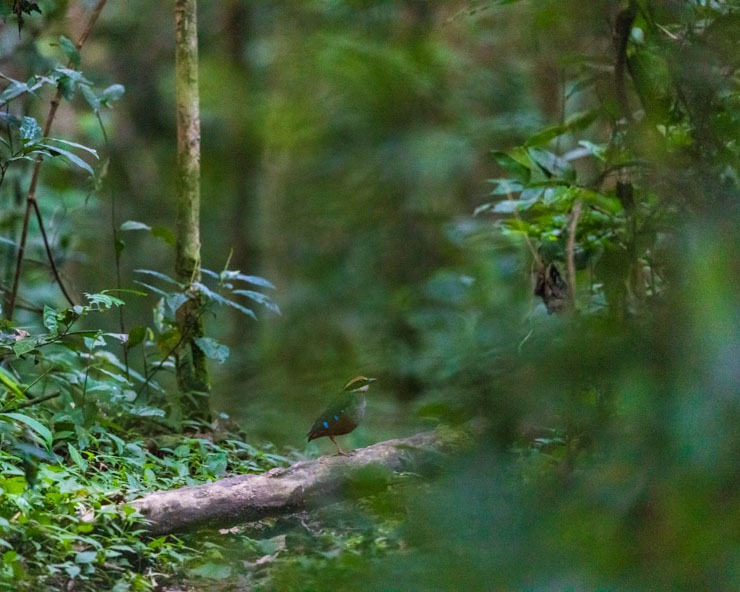
Grainy and terrible, but it’s there: Green-breasted Pitta
In the half hour or so that followed, we tracked this single bird quietly as it moved through the understory. If some time elapsed with it being out of sight, the guides would use playback on low volume, for a short duration, and then we’d wait for movement. Maybe they were briefed on my comments from the previous year, or maybe they were well aware of how to use playback judiciously. Either way, the bird certainly knew where would be the most frustrating perches for it to pose on, as there was always something in the way between myself and it. In the cold, damp darkness of Kibale, I was sweating, trembling, trying to photograph this creature. At times, I felt as though I had to bend light around branches, other times I wished I had the power of teleportation.
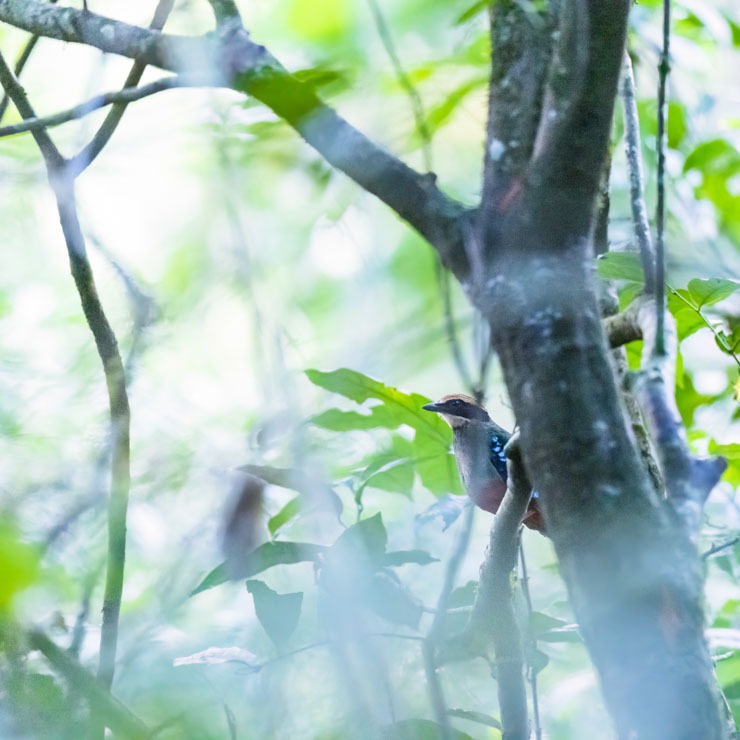
Green-breasted Pitta, peering at the photographer from a comfortable perch.
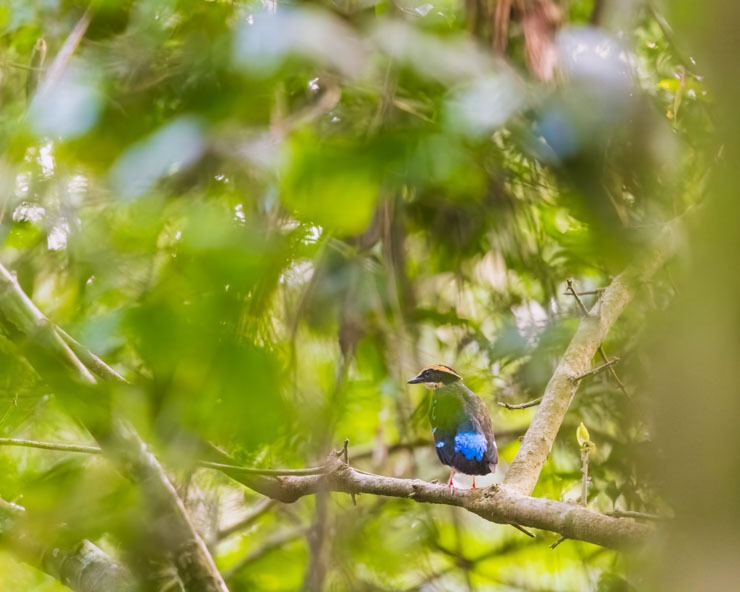
As the sun continued its upward trajectory and the light began to warm the setting, the Green-breasted Pitta gave me one final look – flashing that bright azure rump that captivated me a year prior – before slipping beyond the dense green curtain.
The last view of that Green-breasted Pitta, still behind vegetation.
I showed the guides the back of my camera, and they all commented on the intruding piece of vegetation that was obscuring part of the bird. They felt I deserved better, and offered to call it back from the great beyond such that I’d be able to photograph it on a “clean perch”. Respectfully, I declined. It’s certainly not the image of a magazine cover, but I was thrilled to come away with something usable. Besides, I knew that the bird had business to attend to, and I wasn’t intent on preventing it from doing so.













Leave a Comment