

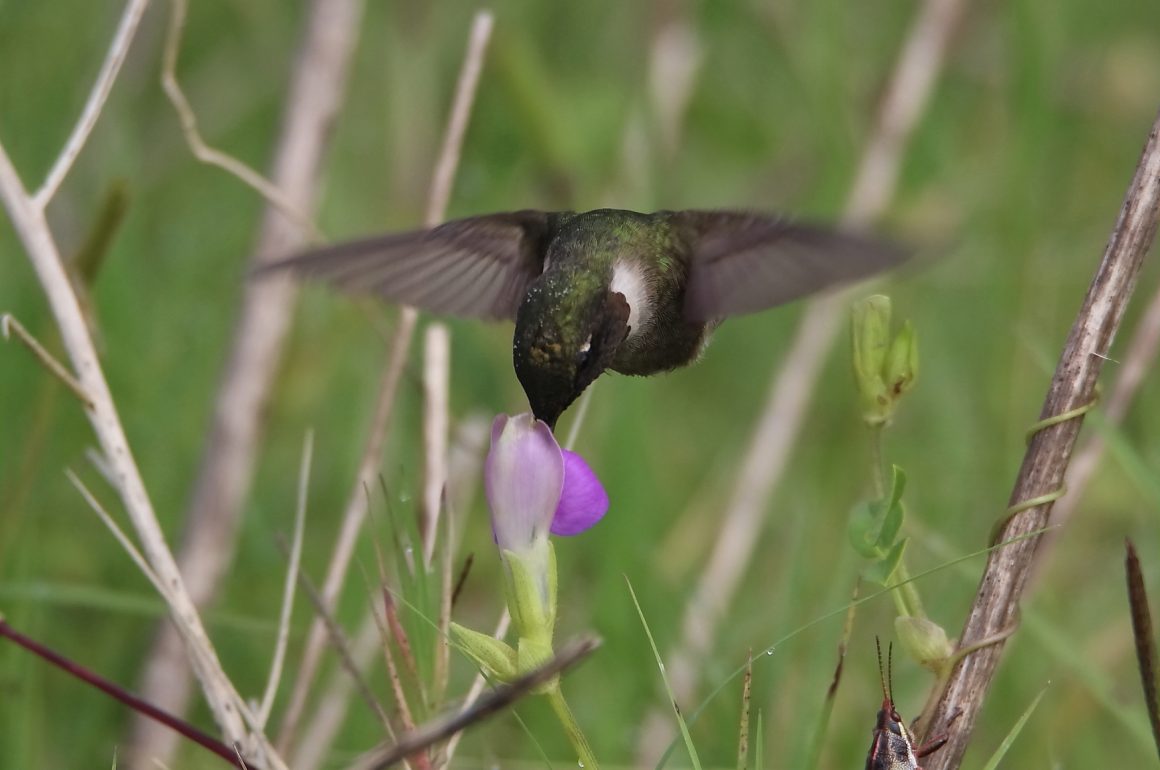
Central Mexico is a great place to get to know lots of hummingbirds. I have seen 19 hummingbird species within an hour of my home in Morelia. Thirteen of those species can be seen year-round here, but we look forward to the winter season when we host the other six species as well. The resident species range from the comparatively large Rivoli’s, Amethyst-throated, and Blue-throated Hummingbirds, to the Bumblebee Hummingbird, one of the world’s smallest birds, and the spectacular Sparkling-tailed Hummingbird and Golden-crowned Emerald, also tiny but with tails that double their length.
My birding buddy Nacho lives the dream when it comes to hummingbird observation. He is a university professor of botany, so he oversees many field trips to different parts of Mexico, which allow him to also visit many different habitats for birding. But even when he is home he has unusual birding opportunities. This is because he lives on a 7 hectare (17 acre) property on the edge of Morelia, with a mix of pine-oak forest, recovering pastureland, and a unique large marshy meadow. Two years ago lots of Calliope Hummingbirds stopped for a few weeks at this meadow on their way from the Pacific Northwest and British Columbia to Mexico’s southwest coast., I have only seen this species in 4 of my 14 years of birding Michoacán, so that was quite an event.
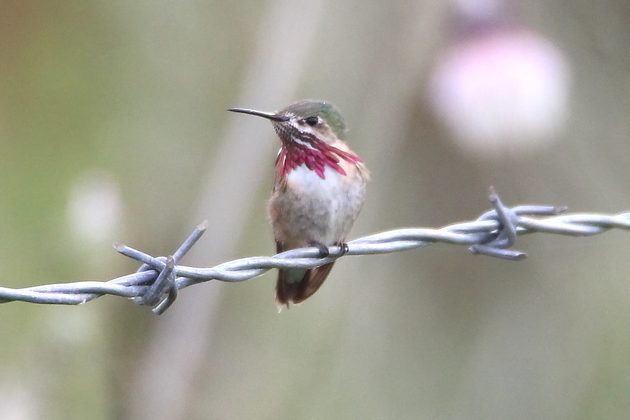
And this is why the Calliope is worth looking for.
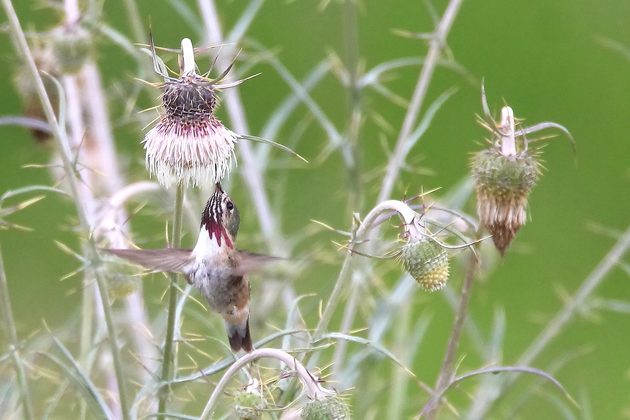
This mid-September, Nacho invited three of us to bird his lot, in the hopes of locating more Calliopes. We failed to find that species. But his meadow is still a unique and wonderful habitat for many kinds of hummers, so we were not disappointed.
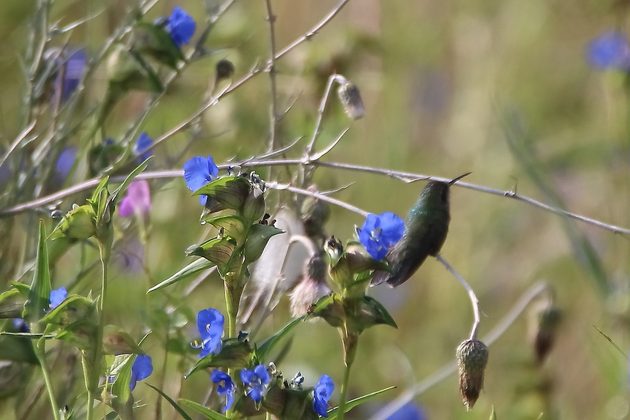
This one was a Broad-billed Hummingbird.
The main attractions in his meadow are the wild sweet peas-type flowers and small nodding thistles that grow there. They not only attract lots of hummers, they also make very photogenic perches for them. Even without the Calliopes, we saw four different species of hummingbirds on this trip, with a total of at least 15 individuals. The wildflowers also made for nice photos of other birds and insects.
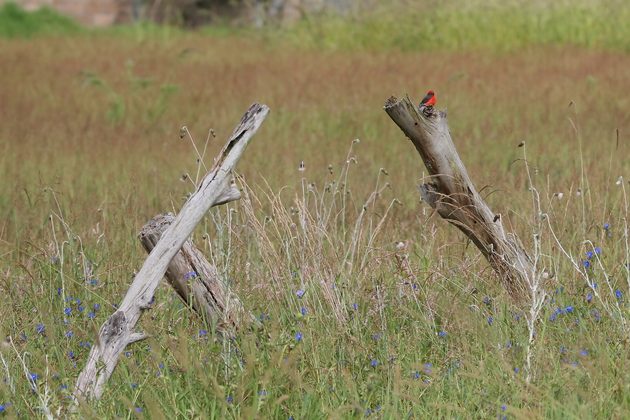
There is a Vermilion Flycatcher above this section of Nacho’s marshy pasture.
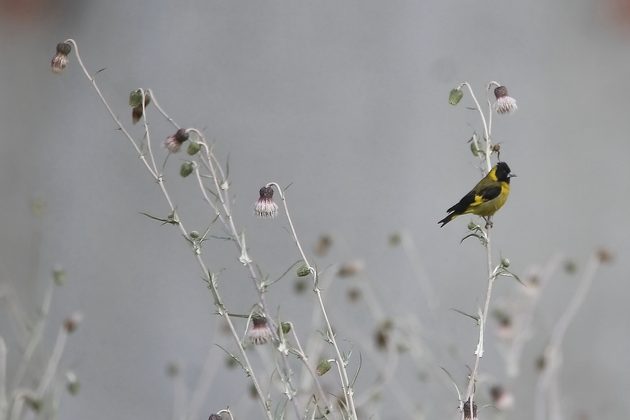
Black-headed Siskin
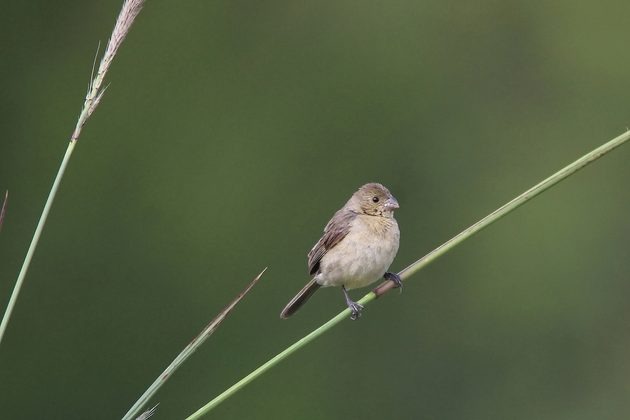
a female Cinnamon-rumped Seedeater
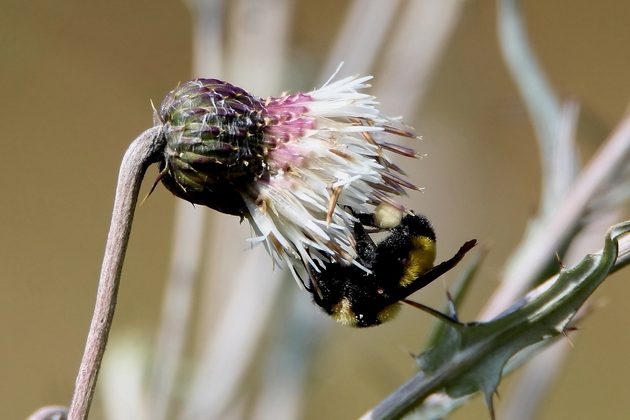
Not a bird.
But the true belle of the ball (well, technically, beau of the ball), was a single male Ruby-throated Hummingbird. Female Ruby-throated Hummingbirds and their close relatives the Black-chinned Hummingbirds both may spend their winters in the Michoacán highlands, although they are not all that common here. But for some reason the males of these species almost always fly down to the coast for the winter, leaving only the almost indistinguishable females to confuse us from September to March. So we were very excited to see this male with its brilliant red throat.
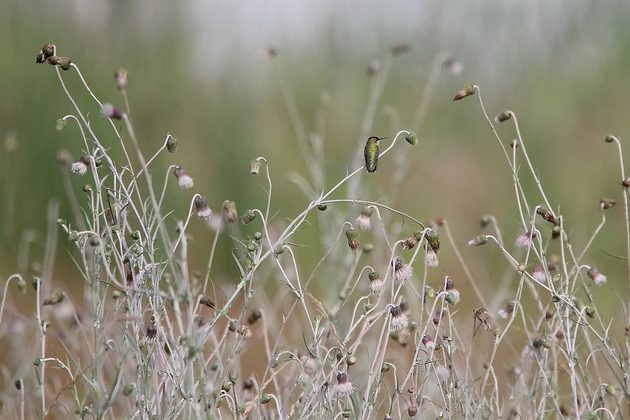
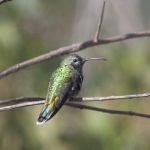
A female Ruby-throated Hummingbird. Or is it Black-chinned?
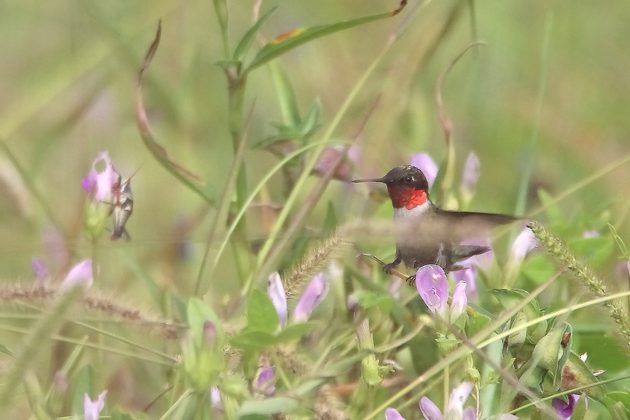
But there is no doubt with a male. This one is definitely Ruby-throated.
Of course, we first took photos from quite a distance, in case our subject suddenly decided to flee. Then we walked a bit closer and tried for better shots. This pattern continued for several minutes. (You probably know the drill.) Finally, we had gotten close enough to hope we might actually have taken some really good images, although photographing hummingbirds is always quite a challenge. (They are very small and extremely hyperactive. Their irridescent colors only show when the angle of the light is just so. And when they do flash their colors, it usually happens so quickly that the camera cannot adjust in time to the sudden brightness, producing an overexposed, fuzzy image.)
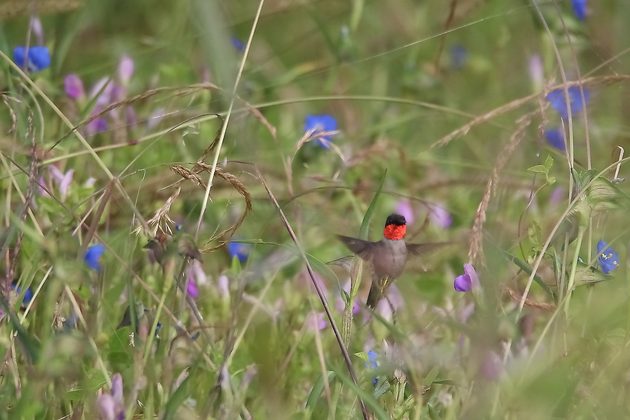
An overexposed, fuzzy image.
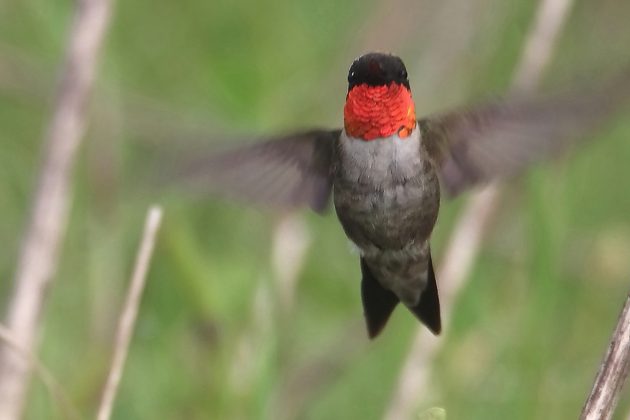
And then something happened that I’ve only ever experienced with hummingbirds: The male decided to get a good look at us. There were four of us, standing in a straight line. And he flew to about four meters (12 feet) from us, stared at us with his gorget blazing, while hovering (as only hummers can) for what seemed like a very long time. Then, his curiosity satisfied, he flew away to sit on a rather distant twig.
We, of course, all froze during this encounter. We would have loved to attempt to photograph him as he stared. But we were afraid any movement of our arms and cameras might spook our new friend, and doubted that he would stay as long as he did. Which may have been a good thing, as it forced us all to be entirely focused on our very special meeting.
I love watching hummingbirds. Who wouldn’t? But it is always a surprise to be reminded that hummingbirds may also love watching me.







Leave a Comment