

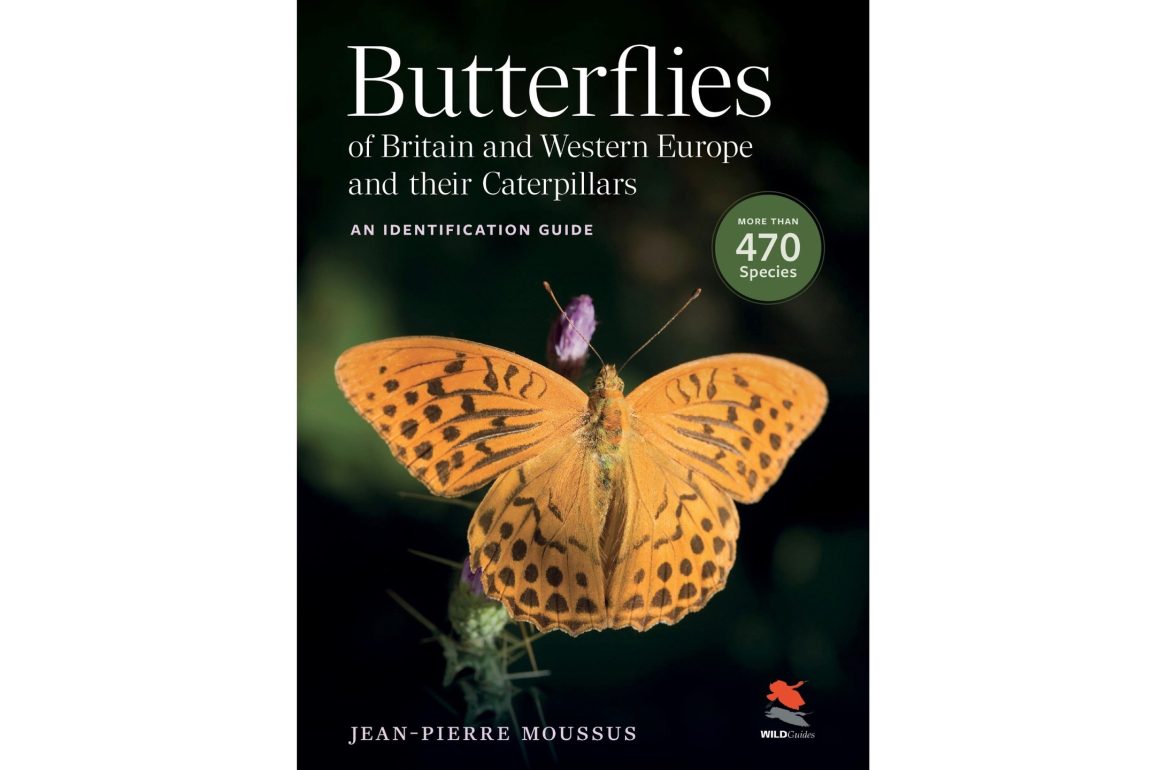
I’ve quite a collection of butterfly field guides on my shelves, and I’ve even written one myself, so the arrival of a completely new book on the subject is intriguing: what does it offer that the others fail to do? (I should point out that it’s not a rival to my guide, which deals only with the British Isles.) The answer is in the last three words of the title – and Their Caterpillars. None of my other books attempt this.
This guide deals with more than 470 species, with each one granted a full page to itself. At least half of each page is taken up with illustrations (or in some cases, illustration) of the adult butterfly, while the lower half gives information on habitat, hibernating stage, elevational range, egg-laying, flight period, host plants, plus diversity and systematics. In addition there is a key to the imagos (adult butterflies) and to their larvae. A map is also provided that’s about the size of a large postage stamp. Lastly, there’s a little Did you know? Box containing a gem of information. The text is dry and factual, leaving one wanting more information, such as abundance, or how easy, or difficult, it is to see a particular species.
This is a heavyweight guide – it weighs a whopping 1391gm, compared with the 408gm of my favourite guide, Butterflies of Britain and Europe, a photographic guide. This weight, plus its size means, that this isn’t a guide that will accompany me on my next bird-and-butterfly trip into Europe. (There is, however, a PDF version available.) The question is whether I will consult it when I come home.
The answer is that I probably will, for it is a comprehensive guide that covers ground that my other guides don’t even venture onto. Written by a Frenchman, Jean-Pierre Moussus, it’s an impressive work, featuring more than 1,500 colour photographs. The great majority of these are of pictures taken of live specimens, but there are a number of photographs where pinned specimens were clearly used. Some butterflies, such as the clouded yellows, never settle with their wings open, so I believe this to be quite acceptable.
Curiously, and to my mind a flaw for a field guide, no attempt has been made to illustrate the butterflies to scale. Thus the skippers appear bigger than the swallowtails, while the Monarch, the biggest butterfly to occur in Europe, is depicted as a smaller butterfly than a Holly Blue. True, the wingspan is clearly provide beneath the illustrations, but it’s still confusing.
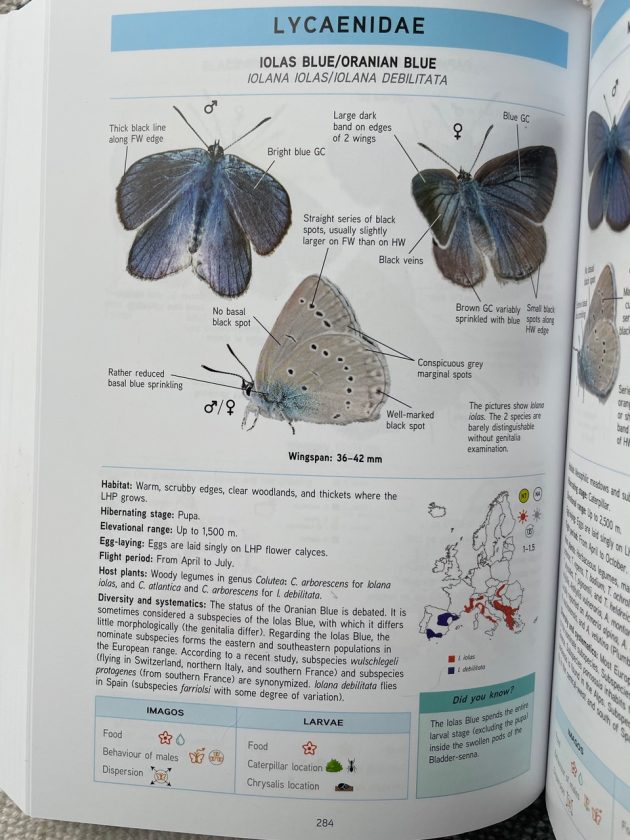
The text for the Iolas Blue, and (below) my photograph of an Iolas Blue taken in Greece last year
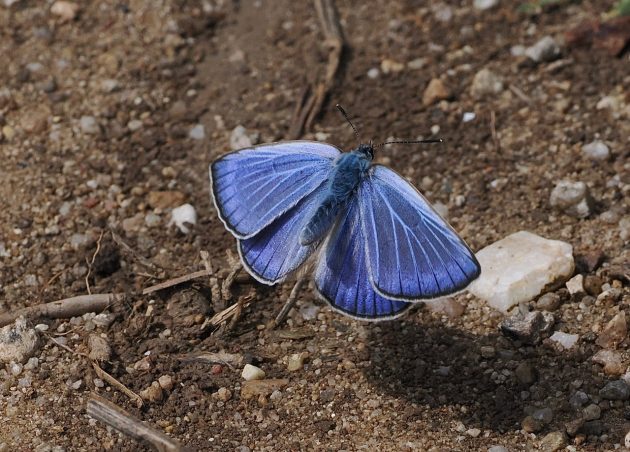
Butterflies are such bright, often iridescent, insects that top-quality reproduction of photographs is essential to see them at their best. This the guide doesn’t quite manage, for the reproduction is good, but not great. You never feel that the butterfly is going to fly off the page. I don’t think that I would have ever identified the Iolas Blue that I photographed in Greece last year simply by comparing my shot with the picture in this guide.
Providing accurate maps for such a guide is a real challenge. I checked out the maps for a few species that I know well. Large Tortoiseshell is shown as occurring throughout much of England and Wales, despite the fact that it’s been extinct here for over 50 years. Similarly, the Swallowtail’s map suggests that it is widespread throughout southern England and Wales, yet it can only be found in one small area of Norfolk. Such mistakes suggest that the mapping for other species may not be reliable.
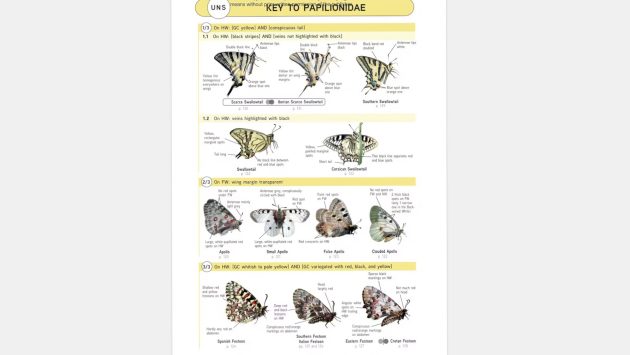
Where this guide does excel is in the comprehensive identification keys provided at the front of the volume. Butterfly identification is often far more difficult than bird identification, and using the keys here should certainly help separate all but the most difficult species. However, some species are so similar that the only way to tell them apart is by looking at their genitalia – the guide includes a 15-page guide as to how to do this. This is something that I’ve never attempted, but the guide assures us that “it can be done in a harmless manner so that the individual can be released safely”.
No caterpillars are illustrated in the species accounts, but again there’s another useful and practical key to caterpillar identification included at the back of the volume. It’s a handy guide, if not quite as comprehensive as the book’s title might suggest.
Authoritative and wide-ranging, this book will make a fine addition to any butterfly aficionado’s library. But for a birdwatcher with an interest in butterflies there are several less expensive and more portable guides that I would recommend.
________________________________________________________________________________________
Butterflies of Britain and Western Europe and Their Caterpillars: an identification guide.
By Jean-Pierre Moussus
WildGuides – Princeton University Press. ISBN: 9780691271798
Paperback. 640 pp. Also available as a PDF.
£35 in UK; $39.95 in USA.
_________________________________________________________________________________________








David, this is a beautiful review. Thank for writing it. I love the illustrations and the range maps appear to be very clear. To your observation that the range maps might not be entirely accurate, I have also found to be true for other field guides. I have wondered if this is to recognize historical range or possible range. I would also add that the color of the Iolas Blue in the guide suggests a more worn appearance. Your photo is bright blue. I have an upcoming trip to the England and I want to purchase this book, but based on weight, I am warned by your caution. I usually take just a bag to fit in the overhead luggage and a camera/bin bag for under the seat. As an aside: are you able to recommend a good dragonfly book for the UK?
Field Guide to the Dragonflies and Damselflies of Great Britain and Ireland. By Steve Brooks and illustrated by Rochard Lewington. (British Wildlife Publishing). We haven’t got a lot of species in the UK. This is a slim and beautifully illustrated volume.
Permit me to echo Cathy’s praise for a very fair and balanced review. I have only recently heard of this title but I rapidly realised that to be exhaustive it would have to be a ‘door-stopper’. Perhaps it is time to invest in Kindle and acquire the text that way – especially if it can be enlarged on the screen. What a pity tho’ about the deficiencies that you highlight: it seems difficult to justify a 5 star rating when the range maps show signs of having been compiled without due attention to detail.
Rather long in the tooth now, my ‘go to’ book on European butterflies is still the large format, hardback edition of the book by Paul Whalley and illustrated by Richard Lewington, which most people know only as a breast pocket guide published by Mitchell Beazley.