

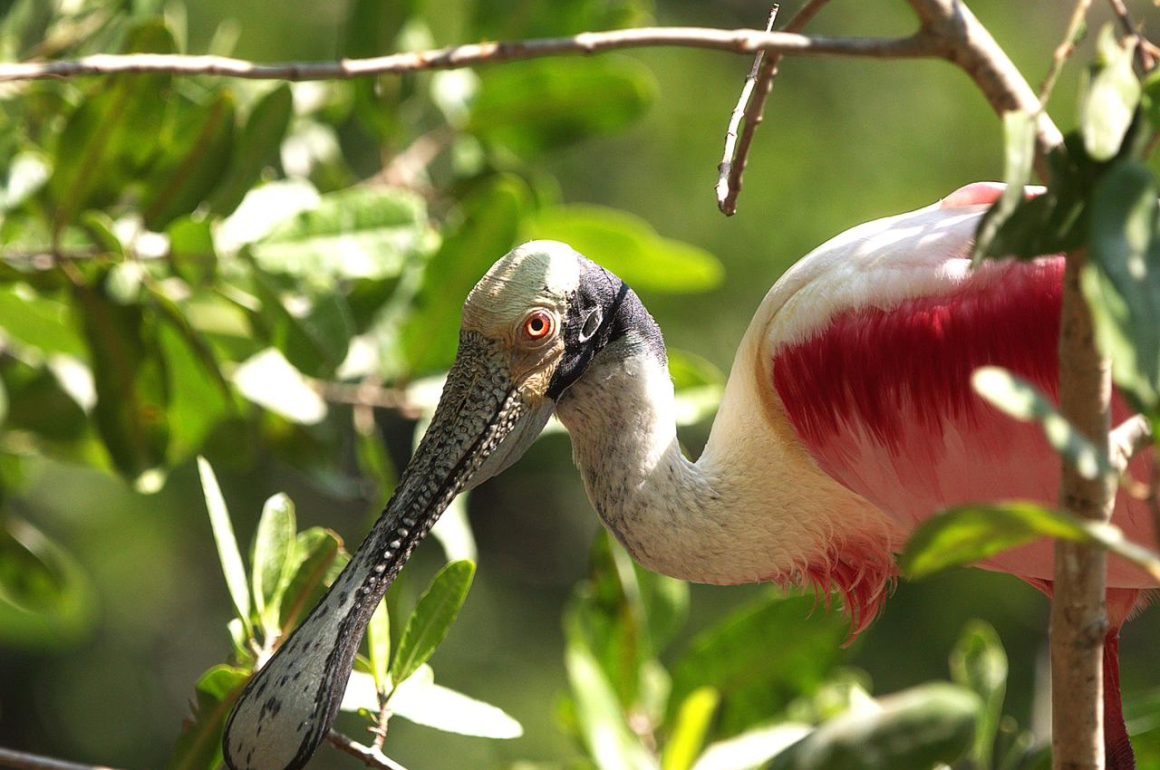
In the waning days of March, my wife and I drove downhill from Morelia to the coastal town of Ixtapa. Ixtapa is a tourist town created by the Mexican government back in the 1970s, right next to the preexistent fishing town of Zihuatanejo. If you have seen the classic movie The Shawshank Redemption, you may have noticed that the protagonists find their ultimate freedom in Zihuatanejo — although the final scene was actually filmed in the U.S. Virgin Islands. How American of them.
Anyway, my wife and I are not really big fans of tropical beaches. But our extended family is, so downhill we drove. She consoled herself with our room’s air conditioner. I consoled myself with birds, and the fact that I recently got to know a birding guide from Zihuatanejo. Santiago Baltazar Castro Gutiérrez (yes, all that is his name) had participated in both of our Christmas bird counts this winter. And when I told him I would be going to his towns, he insisted on setting all his own concerns aside and taking me birding all three days. Which would have been quite a trick, considering we would only be in Zihuatanejo for less than 48 hours.
In the end, we only had one morning available to spend together, but it was a great one, made even better because my son went along. Unfortunately, I had left the backpack with my camera and binoculars at home. So all the closeups in this post were taken by Santiago, although a few wider shots came from my mobile phone.
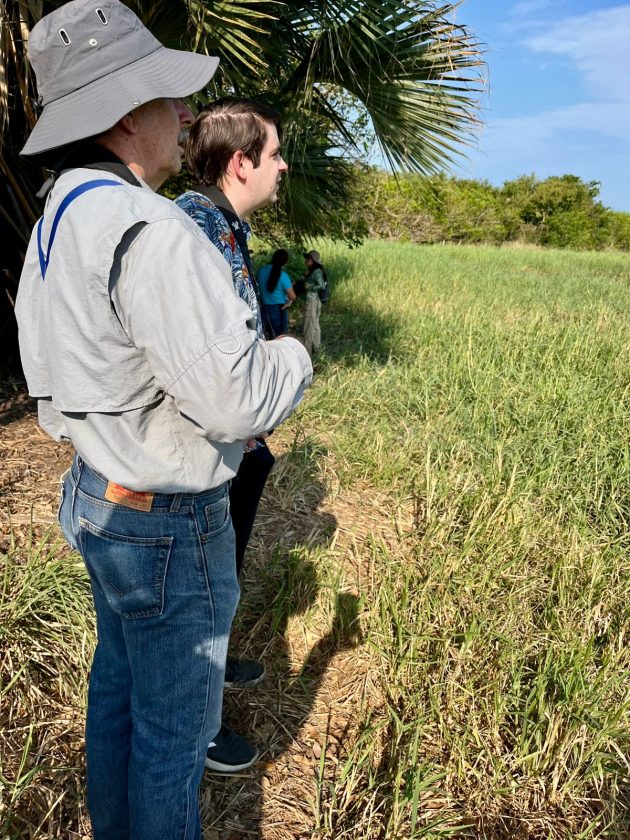
My son is the one not wearing a goofy hat. But he got sunburnt, and I didn’t. My only excuse for that hat is that is is UV resistant.
I felt an odd satisfaction from the fact that Santiago took us to exactly the same spots I had found on my own in a previous visit. Apparently, I know how to pick good spots. But he took us off the beaten track of the bicycle path I had visited then, to show us some real gems. The best of all for me was a Black-collared Hawk. I had seen these tropical raptors before in the southeastern Mexican state of Tabasco, where they are still rare enough to be quite special. But the Zihuatanejo Black-collared Hawks were only recently discovered, and you would have to drive 800 km (500 miles) east to see their nearest relatives. Or 1100 km (685 miles) south to see the nearest ones also on the Pacific coast.
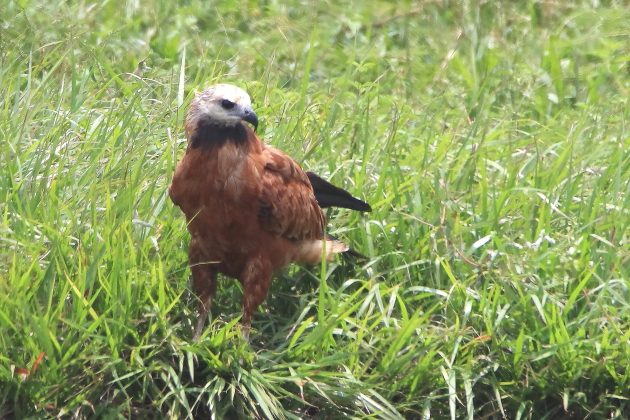
I did not receive any photos of our Zihuatanejo Black-collared Hawk. So here’s a photo of mine from Tabasco of this unusual-looking bird of prey.
The same marshy habitat served up a good number of Snail Kites, with their wildly hooked beaks made for prying snails from their shell, and some lovely Purple Gallinules and Black-bellied Whistling Ducks. And along the bike path Santiago pointed out my very first Flammulated Flycatcher. Without his help, I would undoubtedly have mistaken this for one of the several Myiarchus flycatchers that I often see at higher altitudes. A black and yellow Citreoline Trogon was another other lifer for the day.
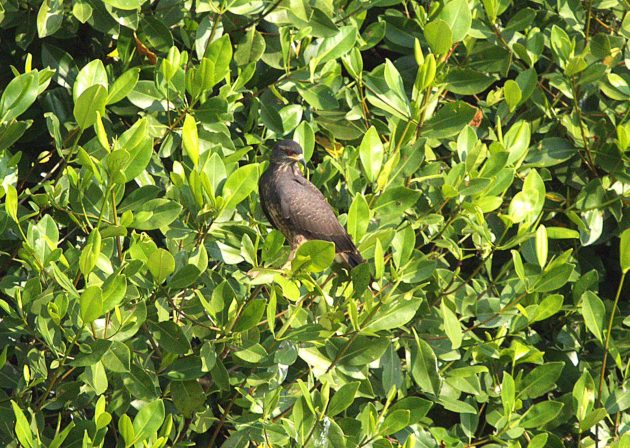
A juvenile Snail Kite
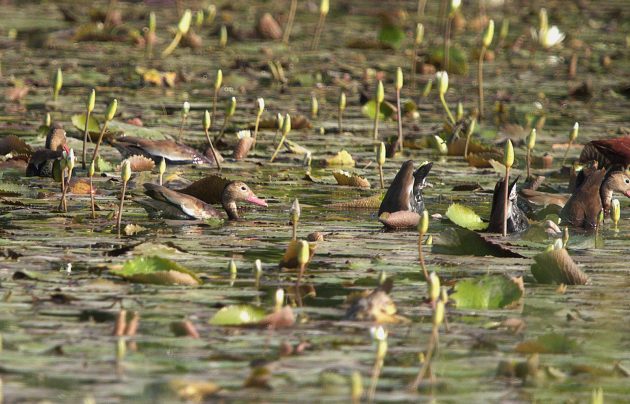
This photo of the Black-bellied Whistling-Ducks gives an idea of the swampy habitat off the dry main trail.
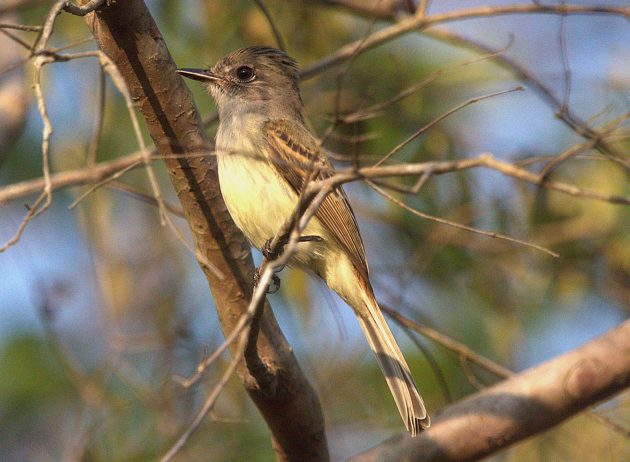
Santiago managed some great photos of our Flammulated Flycatcher. Although I absolutely cannot figure out what makes this flycatcher “flammulated”, which means “having flame-shaped or flame-colored markings”.
After our very enjoyable two hours along the bike path, we headed down to Playa Quieta (“quiet beach”) for one hour of mostly coastal birds. Many of these are birds that I can also see nearer my home, on Lake Cuitzeo. But others remind me that I was along tropical saltwater. For example, the pelicans in Zihuatanejo are Brown Pelicans, while those near my home are all American White Pelicans. The ibises were White Ibises, rather than White-faced Ibises. A pair of beautiful Roseate Spoonbills flew overhead… But I’ll leave those for later, when we saw many more.
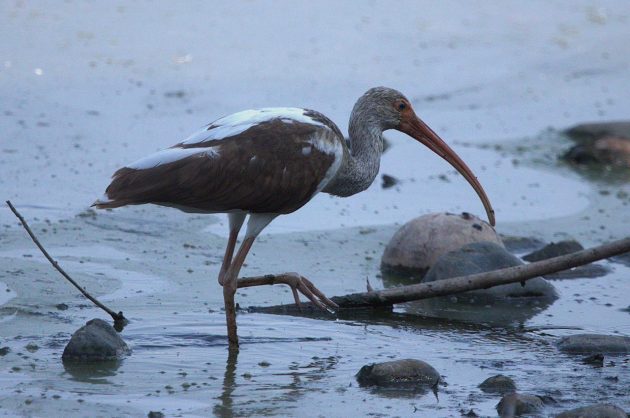
This immature White Ibis hadn’t quite grown into its name.
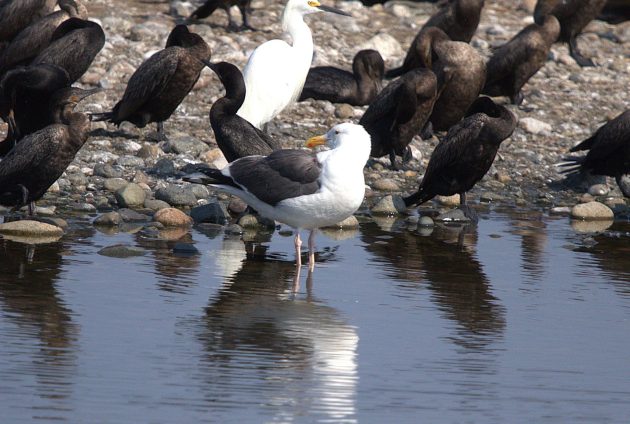
Oddly enough, Playa Quieta’s most unusual sighting wasn’t tropical at all, but a Western Gull that had somehow found its way well south of its normal winter range. As far as I could determine, this was only the third registry for the state, although a few individuals have been reported as far south as Central America, even to Panamá. It was hanging out with a great number of Neotropical Cormorants, with not another gull in sight.
And then we went to our third site, the provocatively-named Cocodrilario Tamakún (Tamakún Crocodile Reserve). And here’s the thing if you are a birder and you wish to go to Ixtapa/Zihuatanejo: You really need to go to the Cocodrilario, and you need to do so in in the month of March. The reserve does have a good number of American Crocodiles, of course, but they are behind fences and so packed together that it feels like you are in the crocodile display of a zoo. (The same holds true, though to a lesser degree, for the very large iguanas that hang out right next to the fences.) But the real draw, in and around March, is that the trees above the crocodile canals are packed with an amazing number of nesting birds, most of them large and impressive. Why they have chosen to nest in a space with so many people around, I can’t imagine. But I can enjoy it. I counted a full nine species nesting, all packed together.
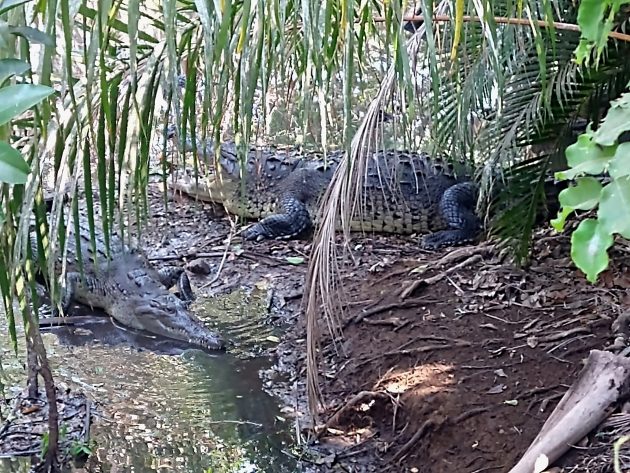
Those crocodiles, photographed with my mobile phone
The greatest numbers of nests belong to the largest birds of all there, the pterodactyl-like Wood Storks. While fully wild, they nest so close to the roads and pathways that you feel like you could reach out and pet them.
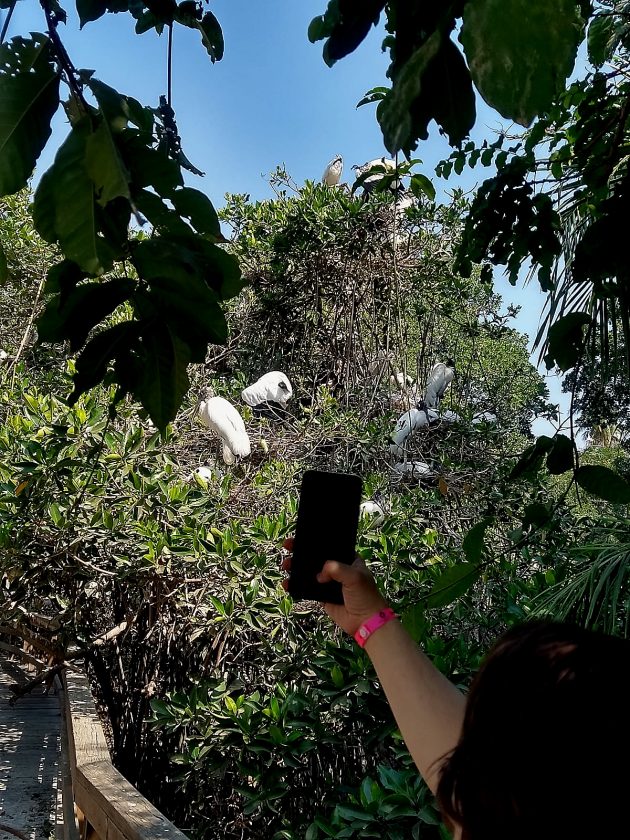
Wood Stork nests, photo taken with my mobile phone
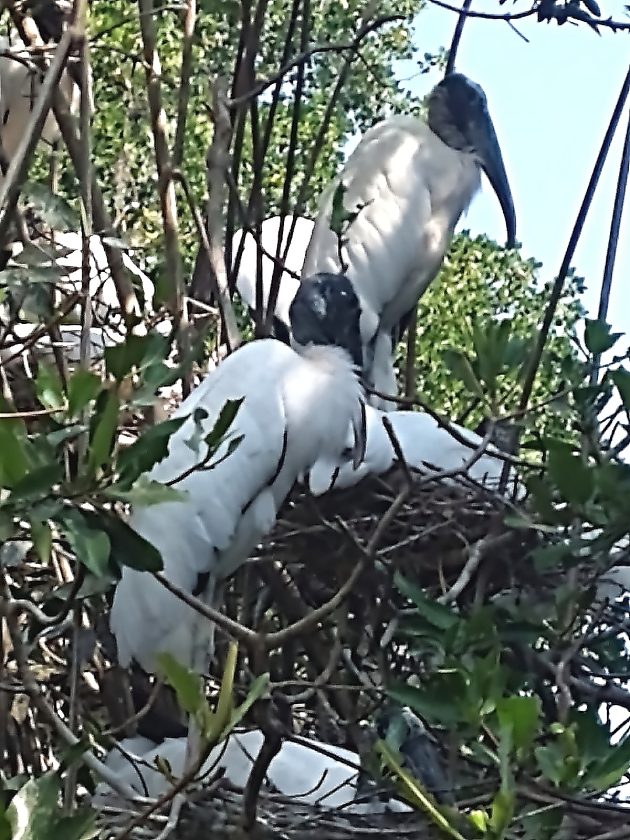
Also a mobile phone shot
But the second-most common nesters are equally impressive, as you can get multiple closeup views of gorgeous Roseate Spoonbills. These birds look all-pink from a distance. But close up, you can appreciate their unique blend of soft pink, hot pink, yellow, orange, black, and gray.
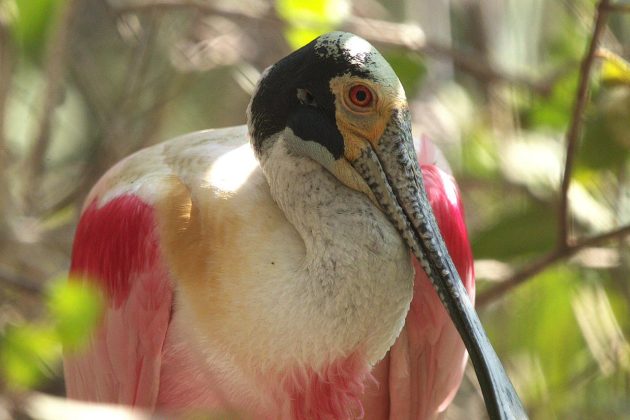
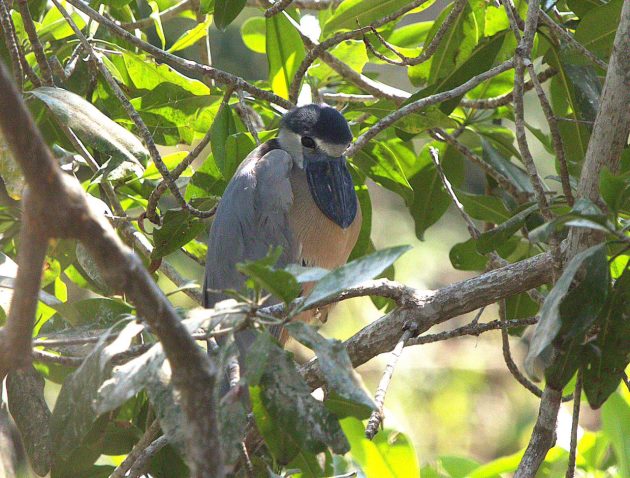
These birds were so numerous and showy that we took our five non-birding family members back the next morning to see them. Even my 2-year-old granddaughter was impressed. (Until she wasn’t, of course.) But my personal favorite, and my third lifer for the day, was a nesting Boat-billed Heron. I was so happy that Santiago took and sent me a decent photo of it. I am a sucker for birds that look like muppets.
Between the three sites, we saw 71 species that morning, plus a couple more that I saw around our all-inclusive hotel. So I would definitely recommend a beach trip to Ixtapa/Zihuatanejo that includes a good dose of birding. And I would also recommend the services of my new friend Santiago Baltazar Castro Gutiérrez.
If you would like to contact Santiago, you can do so at chago_castro@hotmail.com, or on Facebook at Aves de Guerrero.











Leave a Comment