

I am a terrible beat writer for 10,000 Birds. Not only do I regularly fail to produce a weekly post, I also failed to add any Mexican birds to the 10,000 Birds Writers Team total for the May 9th Global Big Day.
But I did, in fact, participate in that Global Big Day. What I failed to do was share my 96-species total for the day with the 10,000 Birds Writers Team. Selfish man that I am, I kept it all for myself — and for the three friends with whom I actually birded.
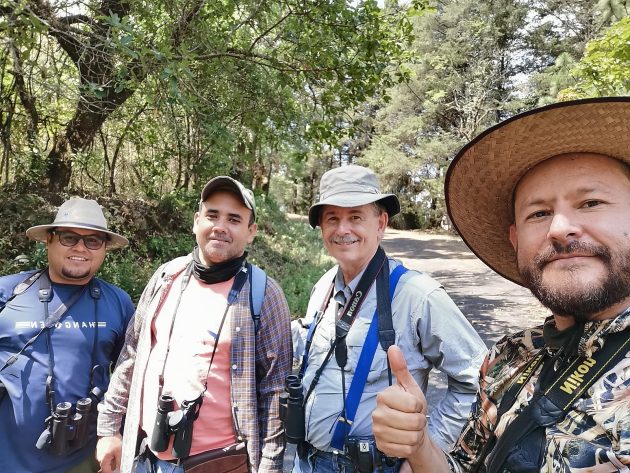
I’m the very white old dude towards the right.
These same friends also did a true Big Day on March 28th, an outing which travel prevented me from joining. That was a true big day, in which they started in tropical lowlands, stopped at three highland forest sites, and also birded the wetlands around Mexico’s second-largest lake. Not only did they bird as aggressively as possible, they took advantage of our winter migratory season, which offers a much larger number of potential species. This resulted in a one-day count of almost 200 species. (You can read their report here.)
Our official Global Big Day was a more relaxed affair. We got started quite early, by my standards, but we did not overnight in the lowlands to go owling before first light. Even so, my first photos definitely show the orange tones of the early-morning light.
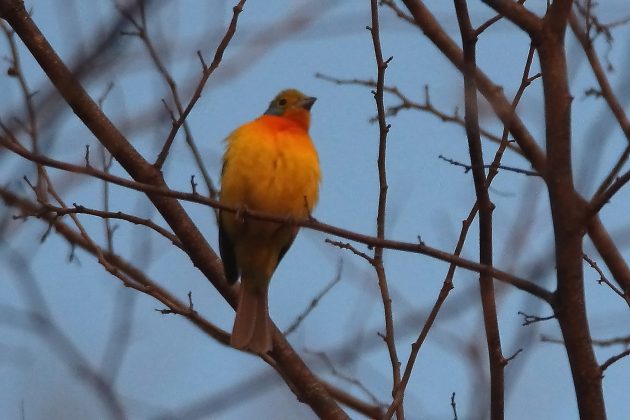
Yes, I know this was an endemic Orange-breasted Bunting. But only the dawn light could make it look that orange.
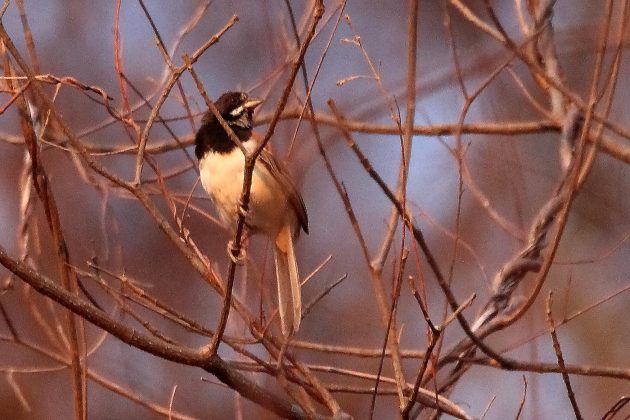
Even the equally endemic Black-chested Sparrows looked somewhat orange.
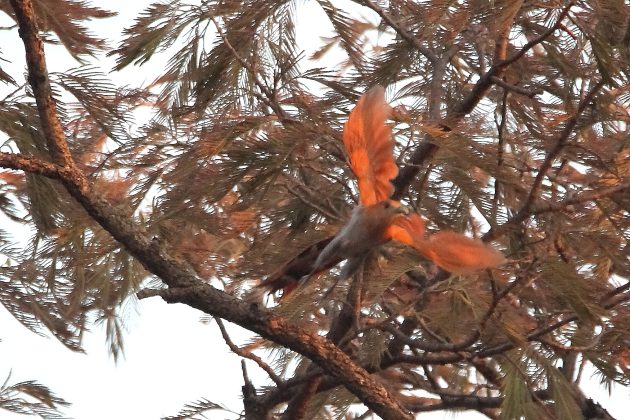
Squirrel Cuckoos are especially orange birds. But this one looks a bit like an apparition with this low-light photography.
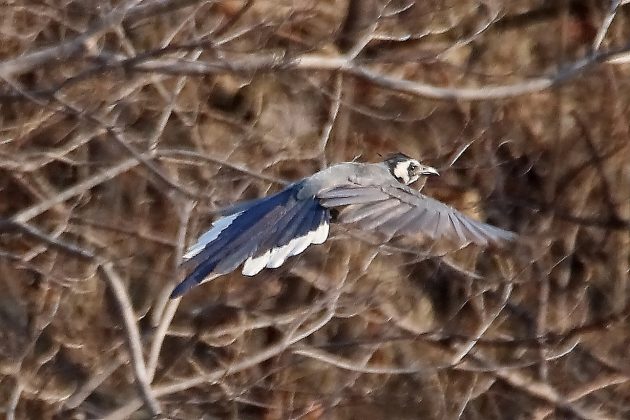
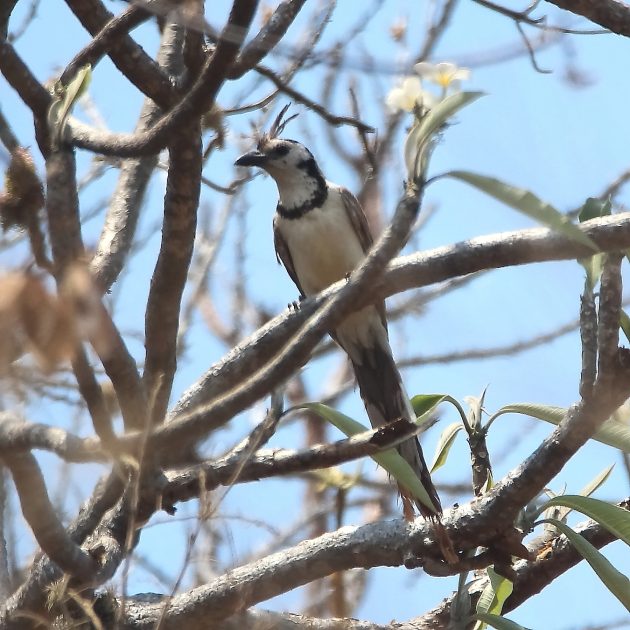
Of course, with three obsessed biologists and yours truly in a car, and only one of us driving, we had already seen or heard 41 species before we even reached our official starting point. Some were even pretty special, such as a Mexican Whippoorwill that we heard, a Common Nighthawk that flew in front of our car, and a Lesser Ground-Cuckoo that whistle-trilled in the distance. Colima Pygmy-Owls and Red-breasted Chats are the stars of the show on the dirt road which was our destination, and they did not disappoint. A Military Macaw that showed up there once unfortunately did disappoint me. But we had lots of fine encounters with White-throated Magpie-Jays, a spectactular west-Mexican species. Copuyo is the spot nearest to Morelia that we have found for reliably seeing these birds.
One bend in the road led us to a gulch with a bit of water falling. We watched as a beautiful male Golden-crowned Emerald rubbed up against the wet rocks in its own version of bathing, its long bisected tail opening and closing.
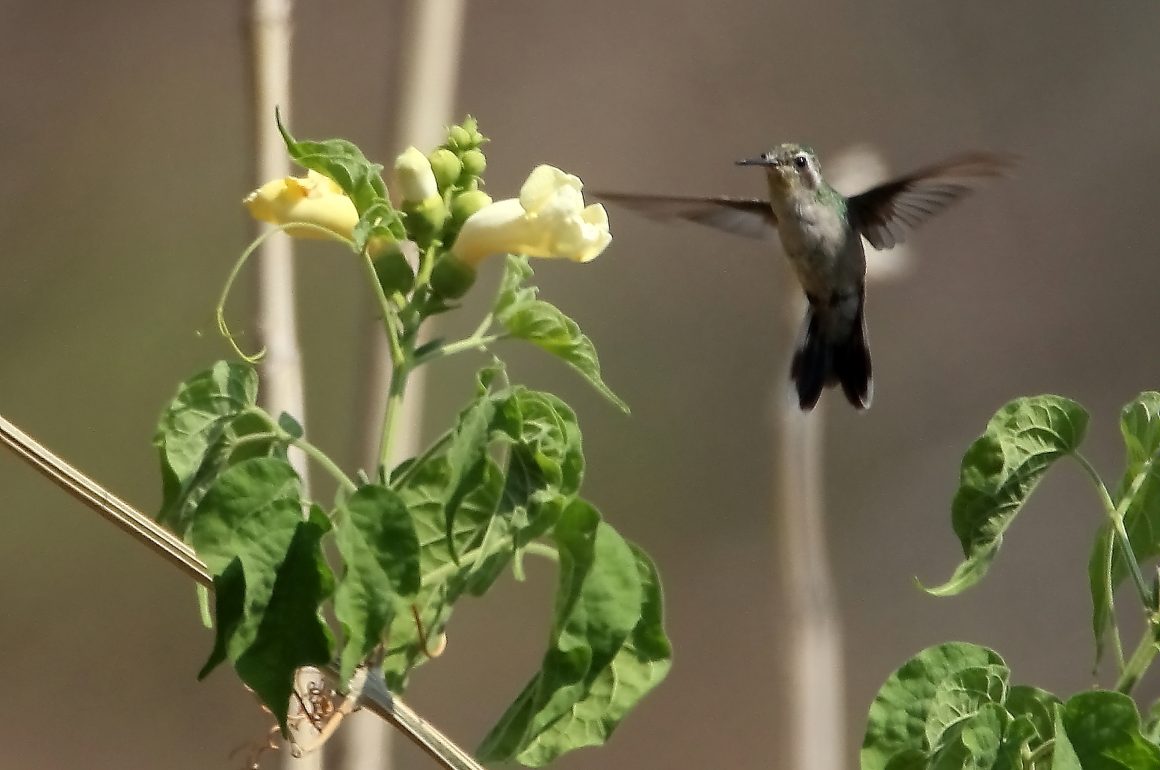
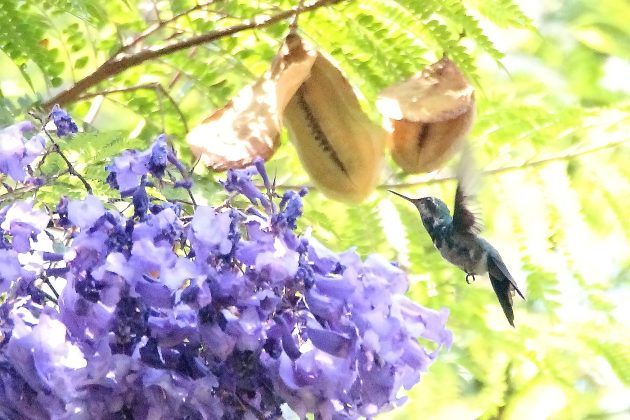
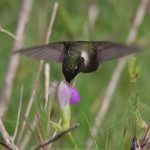
You can see a female Golden-crowned Emerald, in a much better photo, at the top of this post. It’s tail is shorter, but still somewhat split.
Later on, we got much better looks at several females. These also have bisected, but much shorter, tails. To our suprise, we would see yet another female Emerald much higher in pine-oak forest before the day was done.
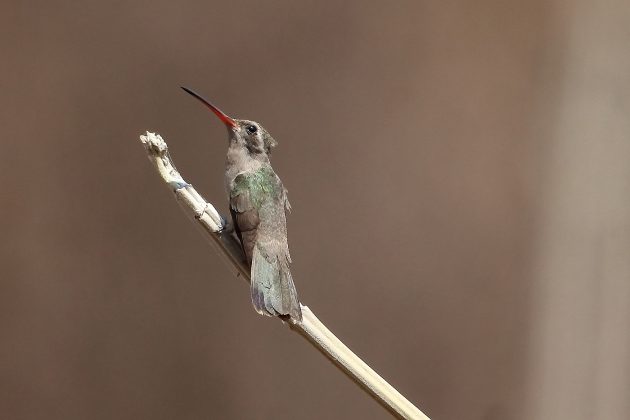
An endemic Dusky Hummingbird gave us good views as well.
By the time we left the Copuyo area, we had racked up 68 species. On the way back, we stopped at one spot at an altitude of 1900 m, almost twice that of Copuyo itself. This site only added 3 species to our Big Day list, but one of them was a real treat. The extremely endemic and handsome Slaty Vireo, it turns out, is a reliable resident there.
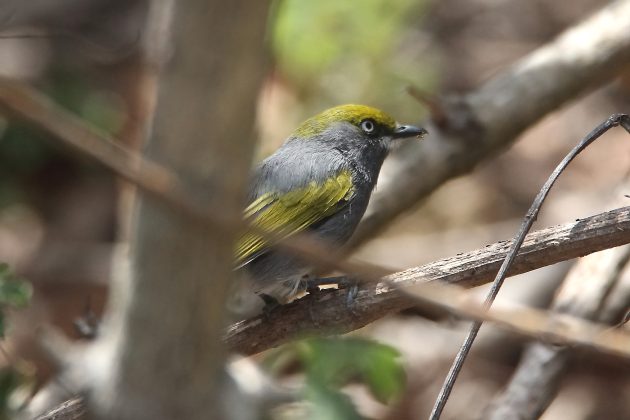
I have yet to take a great picture of the Slaty Vireo, which almost never leaves its favored dense brush. But this photo is my best one yet. Now if I can just take one that includes its backside.
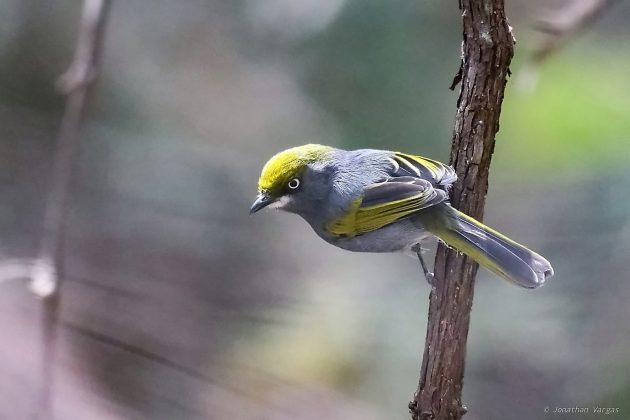
My friend Jonathan Vargas had much better results.
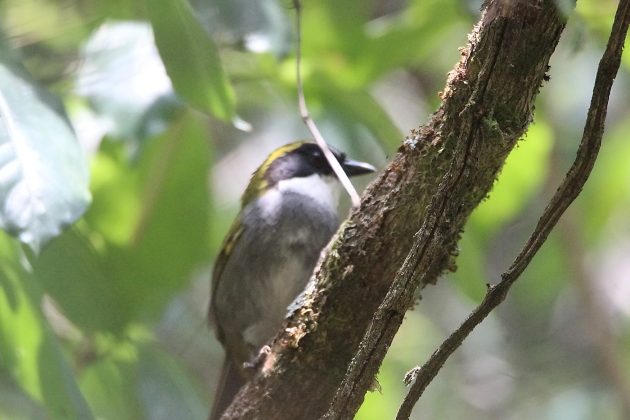
Another 10 horizontal kilometers and 300 meters higher, we found our last major goal for the trip: the Cascada Las Trojes, a lovely waterfall just east of the southward turnoff towards Copuyo. The waterfall is almost dry, as we are just short of the start of this year’s rainy season. But this cool, moist spot still offered us most of the species we had hoped for, a total of 11. The belle of the ball was a lovely Green-striped Brushfinch (technically, a large sparrow). But these birds love poorly lit spots near the ground, so my photos weren’t the best.
We even made time for a one-hour stop in the pine-oak forest of El Temazcal, which added yet another 11 species. Our biggest surprise was yet another female Golden-crowned Emerald. Only once before had I seen this species at such a high altitude. That was several years ago, in my very own garden, where it was also feasting on the lavender flowers of a jacaranda tree.
Since another post was just published about the Big Day in other parts of the world, I will end with a few notes about the particularities of birding in this region: May at 1000 meters in central Mexico is genuinely hot and dry. We were pretty tired when we finished our time there. But the last three sites averaged 1000 meters higher, which felt delightful after the heat of Copuyo. May is also at the very end of our migratory season, so we only saw four species that would soon leave for the north. If the Global Big Day were in February, we would have seen many more. Finally, two of us (myself included) needed to get back to Morelia by around 3 p.m. So that means that our Global Big Day resulted in only 95 shared species.
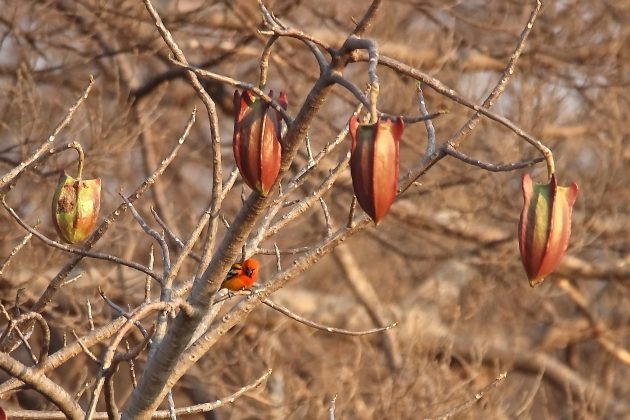
A Streak-backed Oriole came for the papaya-like fruits of the Bonete tree.









Leave a Comment