

By Kendall Britt
Kendall is a resident of Central Texas. She fell in love with birds in her adulthood, but has been making up for lost time. As a physician, she sees the amazing healing power that birds can bring to our lives and firmly believes that if we make the world a better place for birds, it will be a better place for human beings. Like the great Roger Tory Peterson, Kendall believes Texas is the “No. 1 Bird State”. She spends her time chasing birds from the Rio Grande to the Panhandle. When she isn’t outside with her binoculars, she can be found at home in Georgetown, TX, writing about these adventures.
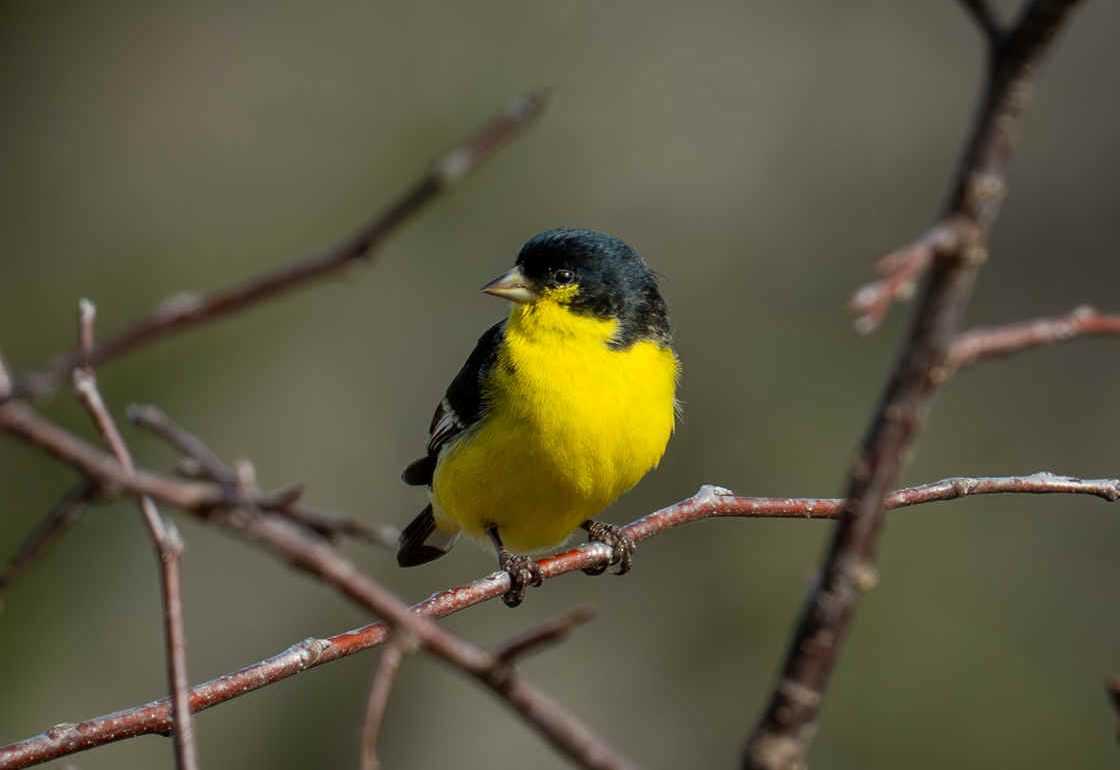
I was introduced to birding through Merlin, which is, as most people know, an app developed by the Cornell Lab of Ornithology. It helps identify birds based on their song. I was with a friend kayaking up Willis Creek near Granger Lake in Central Texas. My friend was calling out each bird as Merlin identified it, and my mind exploded with the potential. For the first two years of birding, I didn’t own a pair of binoculars. I just followed the song, and Merlin identified the bird. During these “binocularless” early days, I was desperate to see a Lesser Goldfinch, not a difficult thing in Texas. These small, yellow birds can be seen in backyards, forest edges, fields, and open areas with scattered trees. Their name, a nod to the larger and more patriotic American Goldfinch, is misleading. Lesser Goldfinches can be just as colorful and vibrant as their cousin. And I’m partial because, unlike the American Goldfinch, which only visits Texas in the winter, the Lesser is a year-round resident. That makes them family.
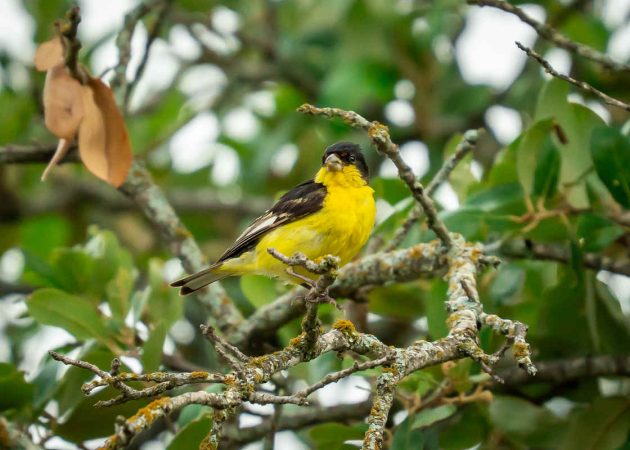
Their favorite food is sunflower seeds, but they’ll eat other kinds of seeds, berries, and even insects. They build cup-shaped nests so tightly woven of grass, bark, and moss that they’ll hold water, which doesn’t seem ideal to me. The male has a bright yellow chest and belly with a black cap and a drab olive back. The more striking Black-backed Lesser Goldfinch is peculiar to Texas, though I’m told they’re extending their range further north with climate change.
All this I learned without ever seeing a single finch. But I was determined. In an attempt to attract these birds to my backyard, I bought a finch feeder and the recommended bird seed. I waited impatiently for 4days without any activity. I now know that four days isn’t long to wait for birds to discover a new feeder. I would have had more success if I’d placed it near a water source or natural shelter. But I didn’t, and I was disappointed. Almost disappointed enough to consider buying a pair of binoculars. Instead, I sought out my own water source and went swimming. It was a very hot Texas summer, and I found myself floating in a friend’s backyard pool, staring mindlessly at her stand of sunflowers. The flowers were bouncing and dipping with movement, and I realized they were covered in a cloud of small, yellow and black birds, a cloud of Lesser Goldfinches! And all less than 10feet away, easy to see without binoculars. I watched them feed, frolic, and serenade to my heart’s content.
I see Lesser Goldfinches everywhere now, with and without binoculars. In the spring and summer, you almost can’t step outside without hearing their sad, high-pitched song. They fly to the top of trees to voice their sorrows. And each time I see or hear them, I remember: If you build it, they don’t always come, but if you pay attention, you’ll see they were always there.
Photos by Rachel Williams of Generally Right-Brained Photography





Common bird but very pretty. Nice article too, brought back fond memories of birding in the US. For the song that Kendall refers to: https://xeno-canto.org/species/Spinus-psaltria