

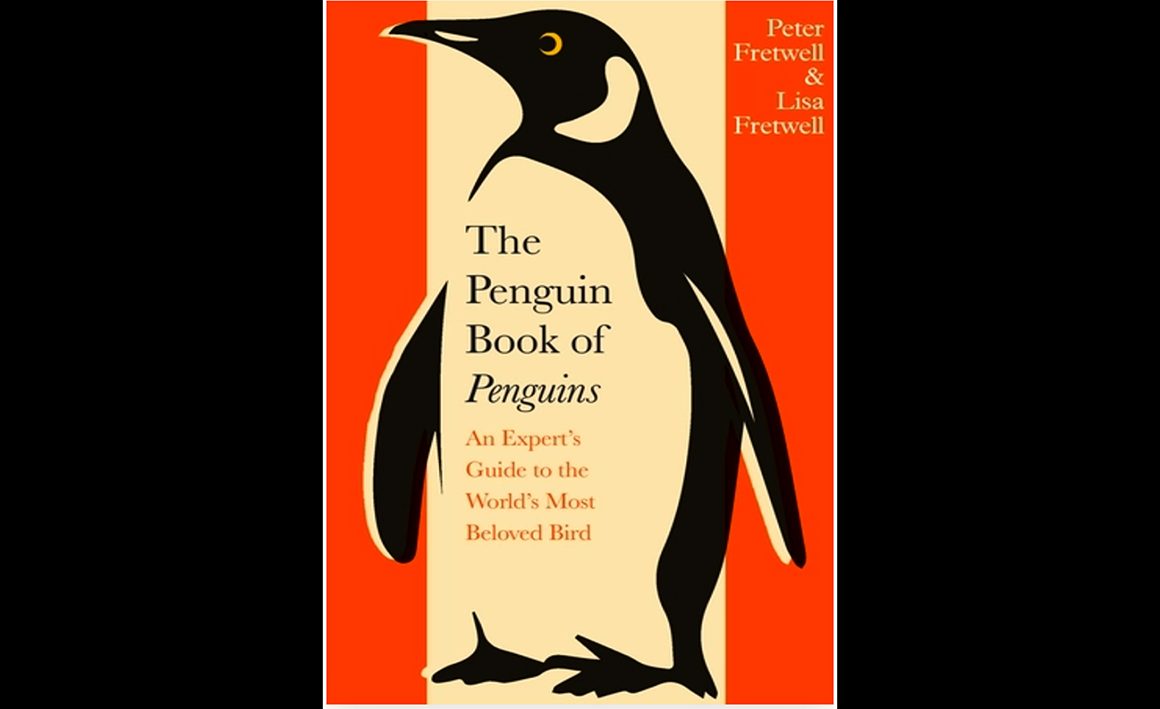
Before penguins became part of the birding ecotourism circuit, before we became attached to a dancing animated penguin named Mumble and real-life Emperor Penguins dads caring for their young in Antarctica, before a Batman villain in a tuxedo got his own television spinoff series, there was the Penguin logo. Created in 1937 by Edward Preston Young based on sketches made at the London Zoo, the Penguin Books penguin logo has been the enduring symbol of the British book imprint founded in 1935 by Allen Lane and his brothers. Strangely, although Penguin Books, now a part of the German publishing behemoth Bertelsmann, has published thousands of fiction and nonfiction paperback books (the original goal was to issue quality, inexpensive paperbacks, an act that revolutionized the industry), it has never published a book about penguins. Till now. The Penguin Book of Penguins: An Expert’s Guide to the World’s Most Beloved Bird by Lisa Fretwell and Peter Fretwell is a one-stop, informative, enjoyable book about the 18nspecies of Penguins found around the world, mostly in Antarctica, but also in South America, Africa, and Australasia.
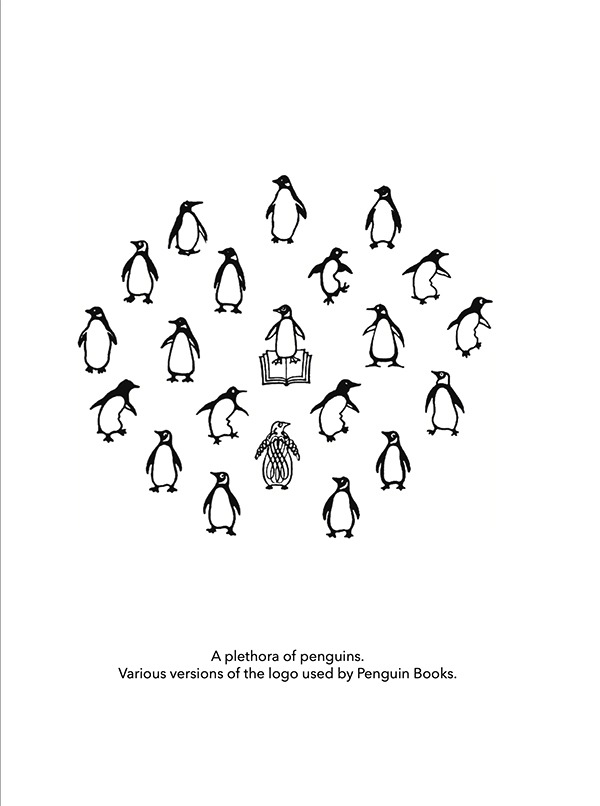
Copyright Peter Fretwell and Lisa Fretwell, 2025; page 21, “A plethora of penguins. Various versions of the logo used by Penguin Books.
The first thing that struck me when I “opened” The Penguin Book of Penguins (I put ‘opened’ in quotes because I was working from a PDF copy of the book), is that it’s illustrated with black-and-white drawings (by Lisa Fretwell). So very different from penguin books I’ve reviewed in past years, which combined text with spectacular color photographs.* I was at first taken aback by this minimalist approach, then grew to totally enjoy it. Lisa Fretwell’s drawings are lovely, simple but specific. Just look at the Emperor Penguin chick drawing below! It conveys the chick’s youth with its gray down coat, and a lot of personality, which apparently are what Emperor Penguin chicks are all about. Dr. Fretwell writes, “As a scientist I am not really supposed to utter words like ‘cute’ or ‘adorable’, but if you ever get to see an emperor penguin chick in the wild, they really are something special. I have seen hardened biologists go all dewy-eyed and wobbly when seeing their very first emperor chicks” (p. 84). As you can see, Dr. Peter Fretwell’s narrative style is friendly, personal, and authoritative, without technical jargon. A cartographer and leading scientist at the British Antarctic Survey, he knows his penguins and the Antarctic. Amongst other achievements, he figured out how to use GIS and satellite imagery to find Emperor Penguin colonies (also whales and albatrosses). The combination of Lisa Fretwell’s drawings and Peter Fretwell’s text is evocative of the original Penguin paperback–simple, basic, smart.
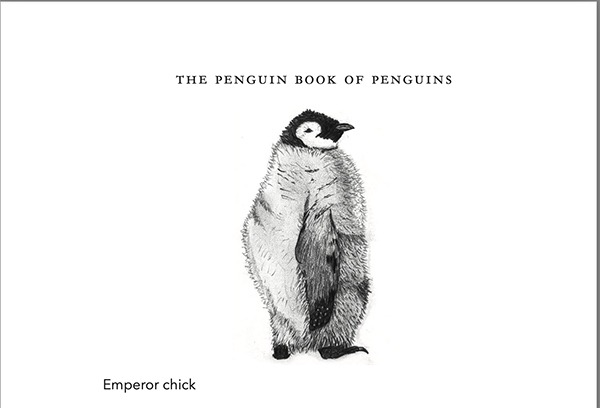
Copyright Peter Fretwell and Lisa Fretwell, 2025, from page 230, Emperor Chick.
The book is organized into seven chapters: Introduction; Geography and Evolution; Flippers, Feathers and Feet; Behaviour; Penguins and People; Species; Into an Uncertain Future. Each chapter is enriched with knowledge carefully selected from a deep body of research on this unique family, and though you may think you know everything there is to know about penguins, you are likely to find new discoveries or rediscover penguin surprises. For example, penguin eyes. Living on land and in the water requires different types of vision, no animal can fully focus in air and in water except for–drum roll–penguins! Which they do can do by altering the shape of their cornea, a unique adaptation. Emperor Penguins have even more adaptations, not totally understood, to enable them to see on their deep, deep dives. When it comes to behavior, everything about penguins is fascinatingly cinematic, from the way they get about on land–walking, hopping, tobogganing and, for smaller penguin, scuttling; to social interactions within the colonies–from mating behavior to complex displays of aggression and submission amongst males and even females; to nesting, childcare and vocalizations. The latter is very important when it comes to finding chicks, which may wander away while a parent is at sea getting food. While other penguins engage in calling and “chick chases,” in which the young penguins chase the parent down for food, Emperor Penguins each have a unique call, “complex and totally unique songs that use ultrasound, unperceivable to the human ear, to call to their chicks” (p. 93), no chases for them! Although Fretwell writes about all penguin species, he admittedly has his favorite, and I am happy to learn all I can about the majestic Emperors.
“Species” takes up a large portion of the book; they are species accounts that give facts and background about all 18 species. Following quick facts–common and scientific names, height and weight, range, population, conservation status, and diet, we are given a distribution map, a drawing of an adult penguin, and descriptive text on the species’ colonies–what they look and sound like, breeding practices, feeding habits, relationships with other penguins in their breeding area (if any), and the latest scientific research on the species, including their future in the face of climate change. This section could stand as a book on its own.
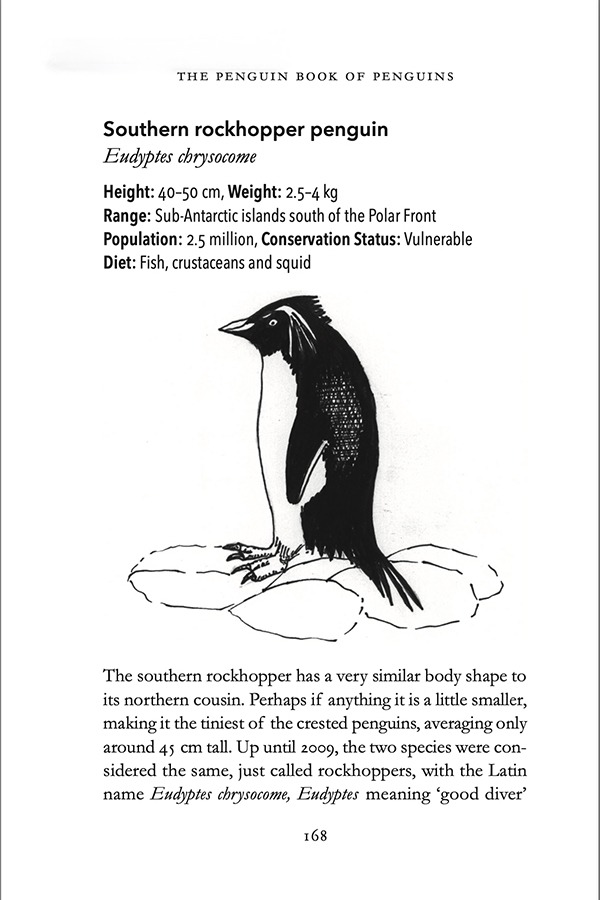
Copyright Peter Fretwell and Lisa Fretwell, 2025, example of species account, Southern Rockhopper Penguin, p. 168
I thoroughly enjoyed the chapter on Penguins and People, which explores the intersection of human and penguins historically and culturally. We didn’t always protect and treasure these creatures, there was a time when they were exploited for their meat, skin, and oil, and my stomach curdled at the description of one particularly nasty villain from New Zealand named Hatch who used machines called ‘penguin digesters’ that consumed millions of penguins, first King, then Royal, to produce machine oil. (This was on Tasmania and Macquarie Island, since New Zealand had already expelled Hatch for illegal slaughter of seals.) Fortunately, the sickening penguin exploitation came to the attention of Arctic explorers, including members of Scott and Shackleton’s expeditions, and pressure mounted till Tasmania made it all stop. Apparently, you can see the remains of the evil digesters on Macquarie Island, amongst the penguins whose numbers rebounded in the years since World War I. Fretwell also writes about scientific research projects on penguins, past and present (though he doesn’t talk enough about this own work with satellite tracking of Emperors), and the penguin ecotourism industry.
There are also chapters on “Penguin Jokes” (very short), an Epilogue, a history of Penguin Books; an explanation of the British Antarctic Survey; plus, Further Reading; a Glossary; and Acknowledgements. There was no index in the PDF I was sent, which is too bad because I think the addition of one would make this a perfect reference book as well as an interesting read.
Ironically, The Penguin Book of Penguins: An Expert’s Guide to the World’s Most Beloved Bird, a 90th birthday tribute to a publishing line that became famous for publishing small, inexpensive paperbacks of quality titles, is coming out at a time when the mass market paperback is on its way out. ReaderLink, the distributor of mass market paperbacks in the U.S. announced at the end of 2025 that they were discontinuing their distribution following years of decreasing sales and the media, from the New York Times to Publishing Weekly to Smithsonian Magazine, have gone into mourning. I don’t know where Penguin Books, or its parent companies, Random House and the Bertelsmann Group, stand on the issue, but it does seem like the Penguin logo will live on in a very different format. In the chapter on Penguin Books, Fretwell writes, “Penguin has been one of the first publishing companies to embrace the digital age, with eBooks, self-publishing and digital print” (p. 248). Indeed, this title itself is available in hardback, eBook, and audio download, but not in paperback. I wish it was. Still, I am very happy that Penguin Books decided to celebrate its 90th birthday with this book (and I’m sure other celebrations, but I only care about bird books). Lisa and Peter Fretwell have written and drawn a wonderful book, appealingly readable and endlessly informative, about these iconic birds. Good to read to prepare for your trip to Antarctica or South Africa, fun to read just to learn how unique they are, scary to read because they are so susceptible to climate change. We love them, now we must protect them.
* Here are the Penguin titles I’ve reviewed over the years, all wonderful:
Journeys With Emperors: Tracking the World’s Most Extreme Penguin, by Gerald L. Kooyman & Jim Mastro, University of Chicago Press, 2023.
Around the World for Penguins by Otto Plantema, Netherlands: Oliver Plantema, 2020.
Penguins: The Ultimate Guide by Tui De Roy, Mark Jones & Julie Cornthwaite, Princeton University Press, Sept. 2014.
The Penguin Book of Penguins: An Expert’s Guide to the World’s Most Beloved Bird
By Lisa Fretwell and Peter Fretwell
Viking, September 2025
288 pages, 5.43 x 0.94 x 8.07 inches
ISBN-10 : 0241732069; ISBN-13 : 978-0241732069











Leave a Comment