

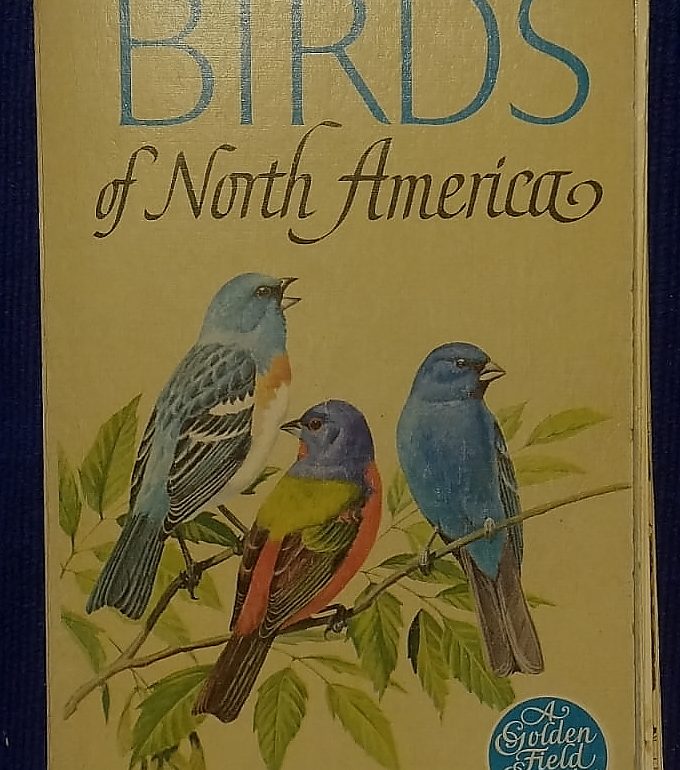
I’m reasonably sure that I did not start really paying attention to birds until 1968, when I would have turned ten years old, or later. Back then, of course, we couldn’t even dream of digital photography, or a magical phone that would fit in one’s pocket and could carry a digital bird guide in an app. So the two indispensable elements for any birder were a good pair of binoculars and a book with pictures of each species, a map of their distribution, and a brief description. Mine was the 1966 “Golden Field Guide” to Birds of North America.
I am not, by nature, a hoarder. And yet, somehow, I still own this book. Only about half of its paperback binding still does its job, and it definitely looks the worse for wear. But I still have it with me. It occurred to me, as I thought about writing this post, that I may still own it precisely because I stopped birding during my middle years; I was just interested enough to want to keep a field guide with me each time I moved, but not interested enough to buy a new one. (For the record, I also still own the first Spanish-language guide to Mexico’s birds that I bought after moving to Mexico in 1983.)
The Golden Field Guide cost me the princely sum of $3.95 USD. Shockingly, that means it was slightly more expensive in current dollars than my latest 2017 National Geographic Field Guide to the Birds of North America, which cost me $22.95 a few years ago.
For the most part, the two books have a similar format, with range maps and a brief description on the left, and painted illustrations on the right. But the older book is much smaller, so its descriptions are much shorter, and it omits rare border-area birds entirely. I imagine this is because bird guides in those days were true field guides, meant to be carried into the field while birding. Nowadays, we just use our mobile phones. And the Golden Field Guide includes visual sonograms for most birds’ songs, which is no longer very helpful in our age of xeno-canto and phone apps with multiple recordings for each species.
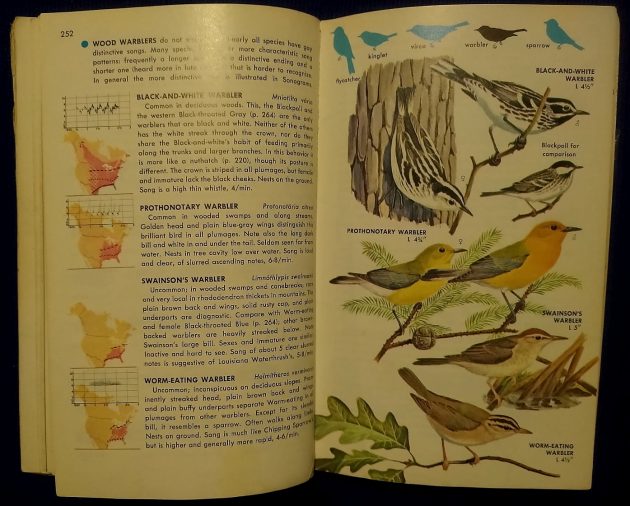
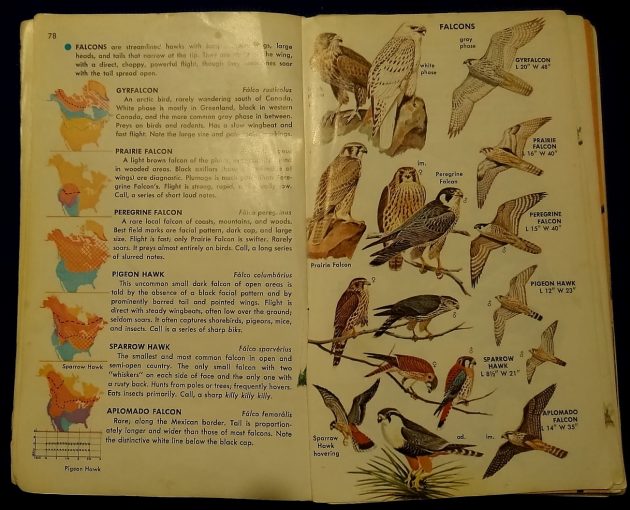
Of course, no one is thinking of buying a 1966 guide today. Instead, the value in looking at such an old book is what it reveals about changes in our natural world and bird science. The taxonomy presented there is wildly different from today’s taxonomy. Back then, falcons were closely related to hawks and vultures, but owls were not. Flamingos were related to herons. The Yellow-breasted Chat and Olive Warbler had not yet been expelled from the wood warblers.
When you get into taxonomic names, things get really wild. The Golden Field Guide lists 9 members of the Vermivora genus of Wood Warblers; today, only two are named as such. In that book’s defense, a third member, Bachman’s Warbler, may have gone extinct since then. In fact, very few of the taxonomic names for Wood Warblers in the 1966 edition still work today.
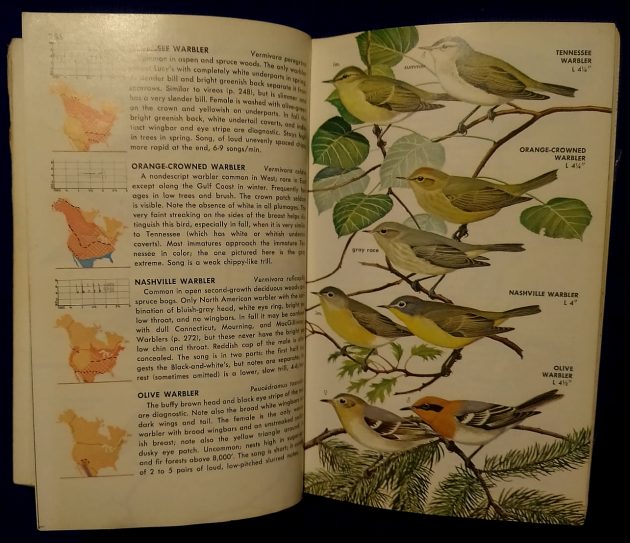
This observation touches a nerve for me, because while birding with my Mexican friends we must decide whether to use Mexican common names, taxonomic names in Latin, or the ABA-approved English common names. Almost nobody uses common names in Spanish, as they have never been standardized and change from town to town, or state to state. Some of my biologist friends prefer to use taxonomic names, a choice which I respect. But my 1966 field guide reveals that English names are enormously more stable than the Latin names. A relatively few English names (Pigeon Hawk? Sparrow Hawk? Boat-tailed Grackle?) have changed in the last 60 years.
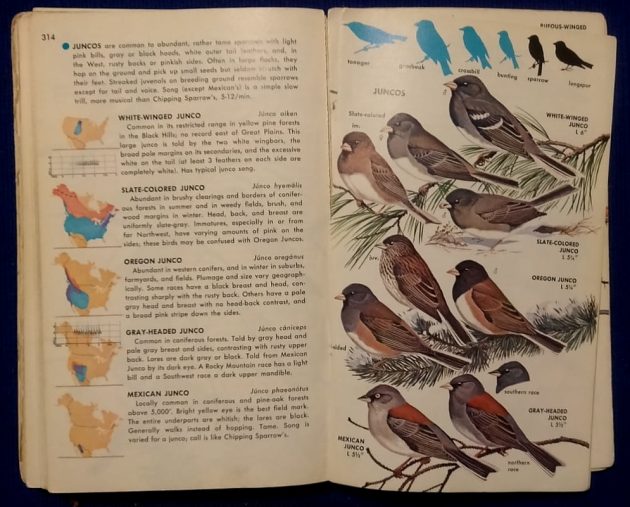
Still, even English names have been greatly complicated by the many splits and lumps that have occurred in the same period. We still talk about Audubon’s and Myrtle Warblers, but they have long been joined into the Yellow-rumped Warbler species. White-winged, Slate-colored, Oregon, and Gray-headed Juncos are all now Dark-eyed Juncos, while the Mexican Junco’s name was changed to Yellow-eyed Junco, perhaps to align with the new name for the more northerly species.
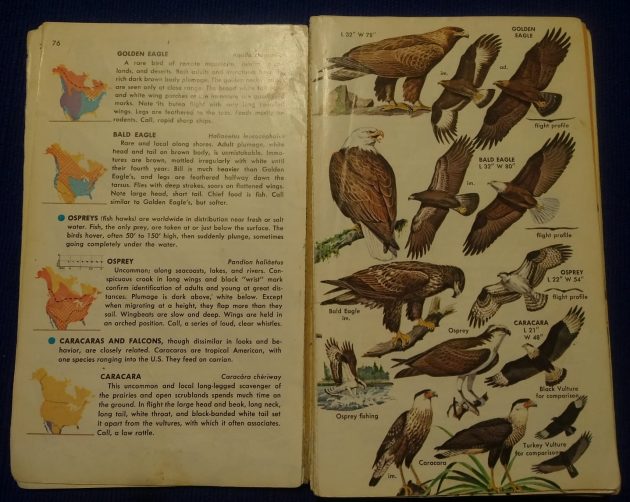
Perhaps the greatest changes can be found in the section dedicated to birds of prey. The DDT-laced 1960s were terrible times for these charismatic birds. The Bald Eagle population in the American “lower 48” states dropped to only some 500 breeding pairs. Today it breeds anew across most of Canada, all the way to the Atlantic, and in much of the United States, with a total population of around one hundred times what could be found back in the 1960s. Peregrine Falcons, which then bred only in the Arctic, now breed over much of North America, even in Mexico. Similar recoveries can be seen for American Kestrels (then called “Sparrow Hawks”), Prairie Falcons, and Ospreys. And extraordinary conservation efforts have allowed even the critically endangered California Condor, then with a population of only some 50 birds, to increase its population nine-fold and return to three American and one Mexican states.
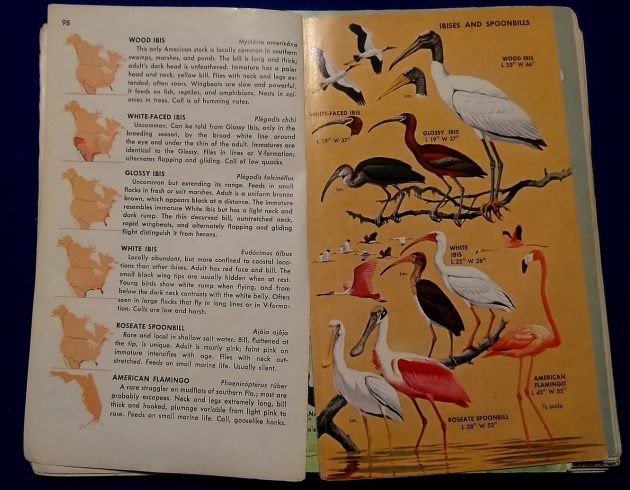
It was interesting to see the 1966 range map for the Old World Western Cattle Egret, then just starting its march across America’s southeastern states. It only shows the species established in Florida, although it was actually well on its way to conquering the entire continental U.S. and Mexico. There was no entry for the now-ubiquitous Eurasian Collared Dove, as those did not arrive until 1974. But other species have increased their ranges in more natural ways. Every species shown on the following page, with the exception of the American Flamingo, has since expanded northward. (The “Wood Ibis” shown here is now more correctly known as the Wood Stork.)
In fact, spending time with my 1966 field guide turned out to be a surprisingly encouraging experience. While we all know that overall bird populations have dropped by 30% since then, many individual species are holding on quite well. To quote the title of one of my favorite books, Earth Abides.









Some time around 1974, my father handed me our copy of Chester A. Reed’s pocket guide, “Land Birds East of the Rockies” (I still have it) and asked me to mark each page containing every bird that we had seen in our yard in northern Virginia. We had been, more or less, paying informal attention to our yard birds for several years, so my efforts were reasonably decent. With one glaring exception…
I had marked the page for Red-Headed Woodpecker. I believe that I probably actually realized at the time that it had never been at our place, but I really, really wished that it had been, so I think I tried to will it into a previous appearance.
It took me exactly 45 more years to actually see one for real!
I’m sure that I used the Golden Guide for my first trip to North America (California) in 1978, but I must have given it away, along with my Peterson field guides, some years ago. I’m still well provisioned for North American guides, with Sibley as my main one, but I rather wish that I’d kept the Golden Guide. Your article, Paul, brought back happy memories.
What a treasure. The photographs brought back the charm of a time when birding relied on binoculars and well-loved books.
I have this book—in hard and soft cover. I would never part with either. I love books and have, not as many as others, but a lot, and am thinking about thinning. But, not my Golden Guide. I met Chandler Robbins once in the early 2000s, I think. He, and his wife, attended a Maryland Ornithological Society meeting held on the Eastern Shore (of Maryland). Both Chandler and his wife must have been in their 90s at that time. Their daughter had brought them to the meeting. In those days and in Maryland I was very low on the birding totem pole. But, in that venue, at the dinner and the silent auction, for everyone, it was like sitting with a celebrity. I lose track of time, but it seems that not long after this meeting, Chandler and his wife died. I remember feeling sadness, but also gratitude that an insignificant birder such as myself, had met Chandler Robbins. Just thumbing through the Birds of North America it is evident of how much so many elements of birding has changed. But, it is also so easy to recognize how foundational this field guide was to the genre of bird/birding guides. Thanks for making this post. Great memories.
Great post! In which Mexican state is the Condor? Here in Oregon research is being done to possibly establish these birds in the N.E. part of the state.