

We sent out another list of questions to bird guides who have already been profiled on 10,000 Birds. In the tenth edition of this second series, we ask
If birds disappeared tomorrow, what would you do instead?
Here are the answers.
Other wildlife tours, butterflies, mammals, etc., and research how we can bring back birds. Gabor Orban, Hungary/Costa Rica
No idea. Zhang Lin, China
No idea, honestly- definitely something in nature. Wildlife guide only, I guess. Marc Cronje, East and Southern Africa
Probably die. David Lindo, Spain
Die. Because their disappearance would signify the undoing of the ecological web that keeps us alive, of course. Faraaz Abdool, Trinidad & Tobago
Nothing! John Hague, UK
I would probably turn to plants and landscapes—guiding people through the poetry of forests, geology, and skies. The interpretive impulse would remain, but the focus would shift to other living and symbolic systems. Marcelo Carlos De Cruzky, Argentina
I will sit still and hope that they will come back someday because the world would no longer be interesting without birds. Kwame Brown, Ghana
Education and awareness: Use the disappearance as a platform to teach about the importance of birds in pollination, pest control, and seed dispersal, reinforcing why conservation matters. Strengthen habitat conservation: Protecting forests, wetlands, and savannahs benefits all wildlife, not just birds, and helps maintain ecological balance. Magada Haily Miriam, Uganda
Get rid of my bird feeders. Spyros Skareas, Greece
Since everything I do is related to birds – our store, my writing, my guiding business, my passion, and my life – without birds I would figuratively cease to exist. And besides, I’m too old and busted to have a future in professional sports. Derek Lovich, Maine, USA
Always try to find a new location and try to find it again, at least somewhere where the bird can be found, and try to keep the new location a secret. Birds often disappear from a location due to habitat disturbance, so there’s always hope of finding one again. Eko Lesomar, Papua New Guinea
I would start learning butterflies and moths. René Santos, Brazil
If birds were to disappear, I would feel very sad, but I would likely redirect my passion toward actively conserving ecosystems and providing environmental interpretation of the flora, insects, and mammals that can still be found. I would devote more time to nature and landscape photography, adapting my work to a drastically unbalanced natural environment and using my photos to highlight the significant impact of such changes. Sandra Maria Plua Alban, Ecuador
While it’s unlikely birds would vanish before humanity does, if they were to go silent, I would turn to the archives of a lifetime. Between my library of raw footage, thousands of unprocessed images, and a mountain of memories, I have enough material to write a trove of stories that would last several lifetimes. My work would shift from finding birds to ensuring their legacy is never forgotten through the stories I’ve gathered in the field. Savio Fonseca, India
I hope I’ll never experience that (as seen in Rachel Carson’s “Silent Spring”). In my 53 years of birdwatching, I’ve seen several bird species disappear – but I’ve also witnessed some new arrivals. If there were no more birds, I would dedicate myself to my “secret hobby,” field herpetology. Rolf Nessing, Germany
The editor concludes:
A surprisingly large number of guides responded to this question with some variation of “die,” which perhaps tells you everything you need to know about birders. Others said they would turn to butterflies, plants, mammals, reptiles, landscapes, or conservation work, though usually with the clear sense that these would be consolation prizes rather than true replacements. Several also pointed out that a world without birds would probably mean a badly damaged world for humans as well. In other words: birders could adapt — but preferably not to the soundtrack of total ecological collapse.
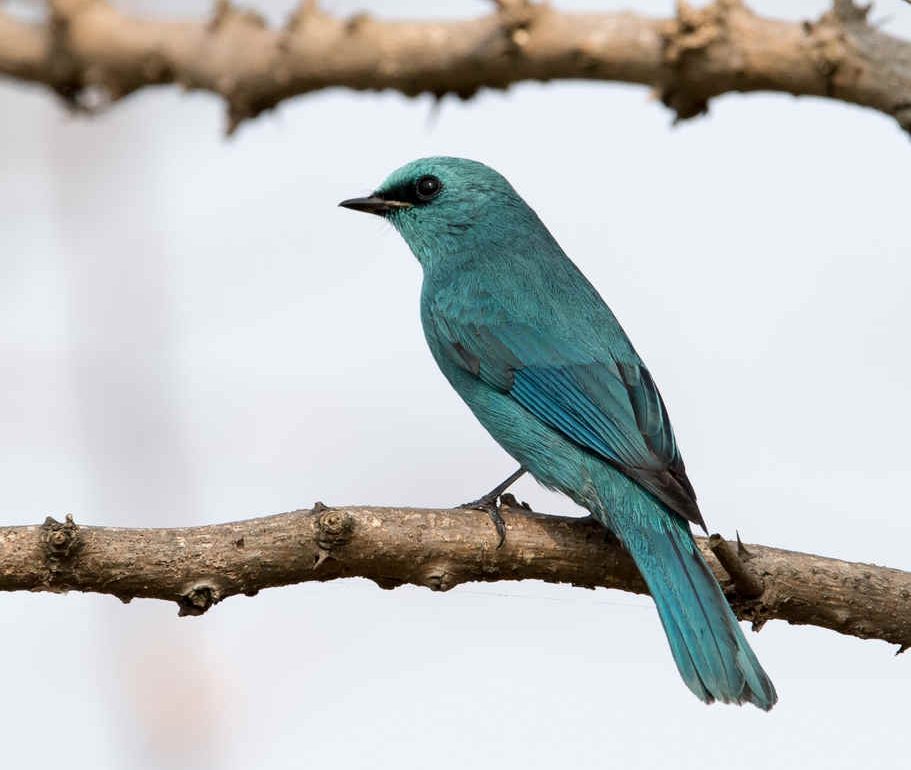
Photo: Verditer Flycatcher, Nanhui, Shanghai, November 2017








It mystifies me why anyone would consider going to live on the Moon, or Mars, if such a thing ever becomes possible. What would be the point of living somewhere without birds (and animals, flowers, trees, butterflies, and even fresh air)? Too horrible to even contemplate.
A number of the guides said they would switch to other guiding; as for insects, moths, butterflies, herps, flora, etc. But, if the birds all disappeared, all of those things would probably have also disappeared. The response of Savio Fonseca would probably be the most useful, because we would have to remember. What an interesting, and scary, question. One I hope to never have to contemplate. Over the recent years I have already observed that I am seeing fewer birds. I’m also with David—living on the moon or another planet is never going to cut it. And what would be the point of living anyway?
I think this was probably the most interesting – and weirdest – question in the series. I did not come up with it (not sure who did, maybe Peter?), so I am allowed to say that.