

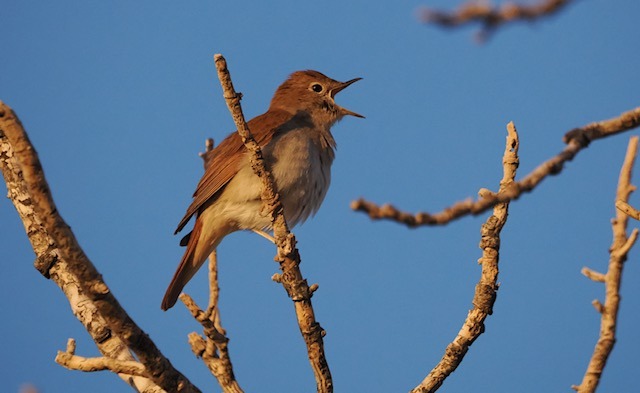
LISTEN to a Nightingale, singing solo at 3am on a May morning, and you can understand why no other bird has inspired more poets, writers and romantics. What makes the song so special is its versatility and subtlety, the quiet, almost thoughtful notes interspersed with astonishing bursts of rich and liquid power. To hear such a performance is one of the great experiences of the natural world.
Among the early poets inspired by the bird was Samuel Taylor Coleridge who wrote his poem The Nightingale in 1798:
And hark! the Nightingale begins its song,
‘Most musical, most melancholy’ bird!
A melancholy bird? Oh! idle thought!
In Nature there is nothing melancholy.
Twenty-one years later John Keats was so excited by a Nightingale he listened to one on Hampstead Heath that he celebrated it in the equally lyrical Ode to a Nightingale. Not everyone was so enamoured, and W.H.Hudson claimed that an excess of praise for its song makes for a disappointment when heard for the first time.
One of the most penetrating comments comes from the poet Edward Thomas, who commented that “beautiful as the notes are for their quality and order, it is their inhumanity that gives the utmost fascination, the mysterious sense which they bear to us that earth is something more than a human estate, that there are things not human yet of great honour and power in the world.”
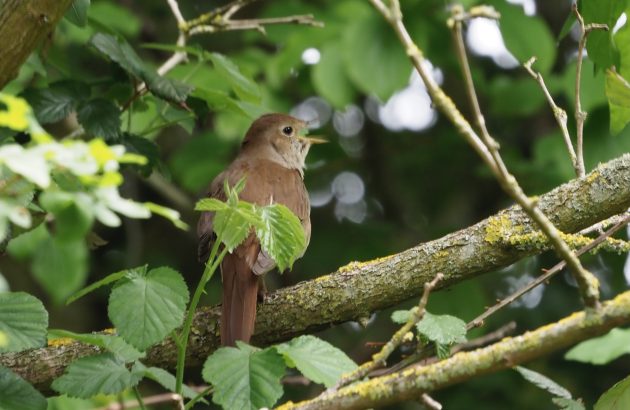
Surprisingly, in view of its celebration, the nightingale is a bird relatively few people have knowingly heard, and even fewer seen. That’s not really surprising, for it has a restricted range in Britain, and is a shy, unobtrusive species that would pass almost un-noticed if it were not for its remarkable song, and the fact that is delivered at dead of night when everything else is silent. Nightingales also sing during the day, but then the dramatic beauty is lost, the performance less exciting.
Nightingales are on the very limit of their range in Britain. They have never bred in either Scotland or Ireland, and last did so in Wales 25 years ago. Most of our 4,400 breeding pairs are to be found south-east of a line between the Wash and the Bristol Channel.
They were much more common in the 19th century. The Victorians were great Nightingale enthusiasts; newspapers published details of where singing males could be heard, while charabanc outings were arranged for people to go to the country to listen to the birds, especially in areas where they were not usually heard. Mistakes were not uncommon, and the unsuspecting public were sometimes taken to hear Blackcaps or even Garden Warblers.
Listen to either of these two species and you could fool yourself into thinking you were listening to a Nightingale, but when you hear the real thing there is no mistaking it. What marks the Nightingale’s song is the mixture of soft, repeated notes, then the sudden crescendo of full-throated power. There may be as many as a dozen main motifs, mixed together in an infinite variety of phrases.
Though all Nightingales may sound the same to us, each one is different, and some are more talented than others. It is only the male that sings. Most early authors, from Chaucer to Shakespeare, invariably referred to the singer as she: hardly surprising, as both male and female are identical to the human eye. It is, however, the male who sings at first to attract a mate, then continues to defend his territory while his mate is incubating the eggs. Once the eggs have hatched the time spent singing declines rapidly.
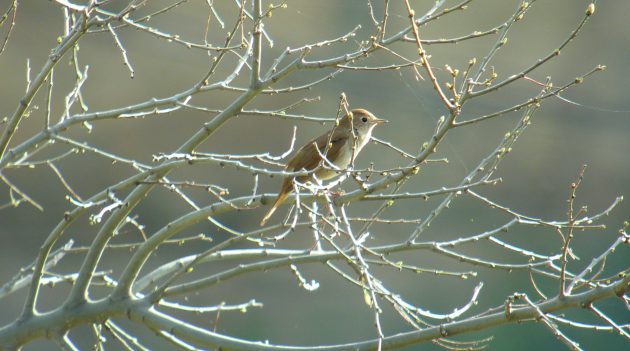
The need to establish a territory is why males arrive back on their breeding grounds several days before the females. In southern England the first singing Nightingales are generally heard towards the end of the first week of April, while by the end of the third week most will have returned. In the early weeks after arrival they will sing almost continually, night and day. They are competitive, and the more birds there are in an area, the more they sing.
Perhaps because it is so intense, the Nightingale’s song period is relatively brief, lasting a mere six or seven weeks. If you haven’t heard one by mid-June, then you have missed it for another year. By mid-summer’s day it is rare to hear more than the odd phrase. Curiously, this isn’t true in southern Europe, where song starts in March and continues until late July. Southern European birds have two broods, so the male has to hold the territory for far longer.
Hearing Nightingales in southern Europe is also much easier because there are so many more of them. France boasts the biggest population with around 1 million breeding pairs, but neither Spain nor Italy are far behind followed by Croatia, Bulgaria, Greece, Hungary, Romania, Germany and Poland. The total European population is estimated to be somewhere between 2.2 and 4.6 million pairs.
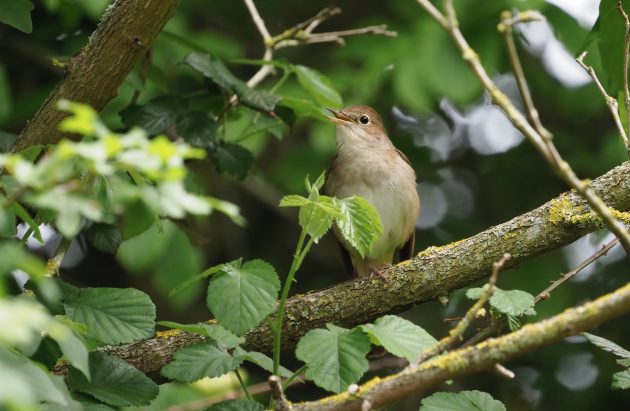
Continental birds are far less choosy when it comes to selecting somewhere to breed, a reflection of the fact that where the population is high, birds have to be more flexible. Favoured sites in Spain and France range from any thick cover surrounding stagnant or running water to chalk hillsides with bushes, or even dry maquis on sandy soils. They can be garden birds, too. Walk through the suburbs of Bulgaria’s capital, Sofia, on a spring evening and you will be serenaded by Nightingales.
It may again be a reflection of the fact that there are so many more of them, but Continental Nightingales are generally less shy and easier to see than our own. English cocks like to sing from dense cover where they can be extremely difficult to spot, but in both France and Spain I have watched them singing from telegraph wires and other prominent perches.
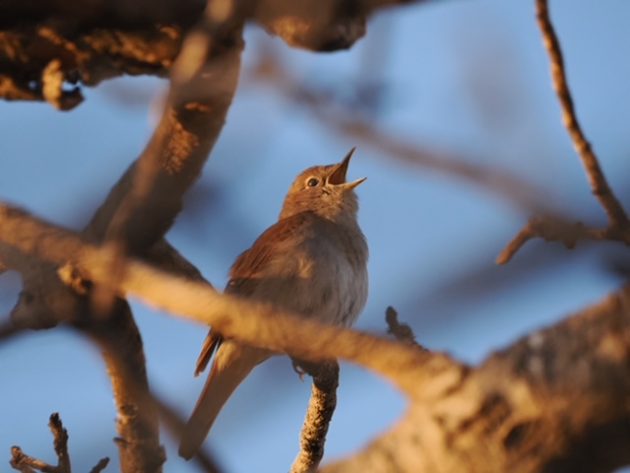
Seeing a Nightingale can be an anti-climax, for like many great songsters it is a plain bird, with no obvious features other than a reddish-brown back and a plain sandy-buff wash on an otherwise white breast. However, look out for the distinctive tail, which looks distinctly red and is often held cocked. If you are lucky enough to get a really good view then the general impression is of a large and rather elegant robin, but without the red breast.
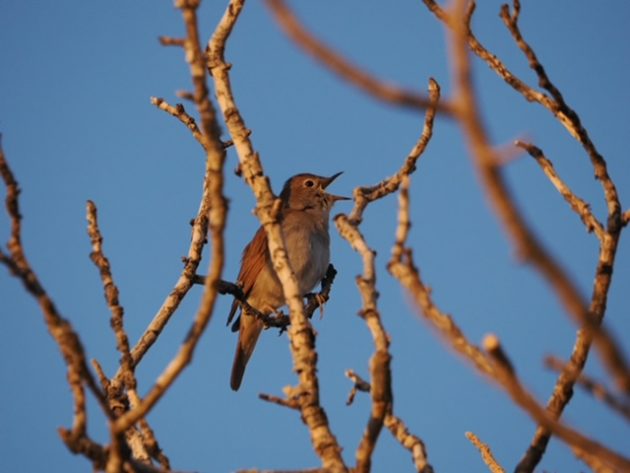
Because of their skulking nature and plain appearance, nightingales are seldom seen when they have finished nesting, but they do remain in their breeding territories until August. Then they are away to wintering grounds in tropical Africa, where they spend the major part of their life unseen, unstudied and almost silent. It will be another eight months before they start singing again.








There are be around 3,000 breeding pairs of nightingales in Berlin. This makes Berlin the capital of nightingales (and Northern Goshawks). http://www.birdingberlin.com
There are only thought to be around 4000 pairs nightingales nightingales in the while of England. Berlin is lucky to have so many!
https://www.dw.com/en/why-nightingales-love-scruffy-berlin/a-48460616#:~:text=The%20city's%20conservation%20authorities%20put,winters%20in%20sub%2DSaharan%20Africa.