

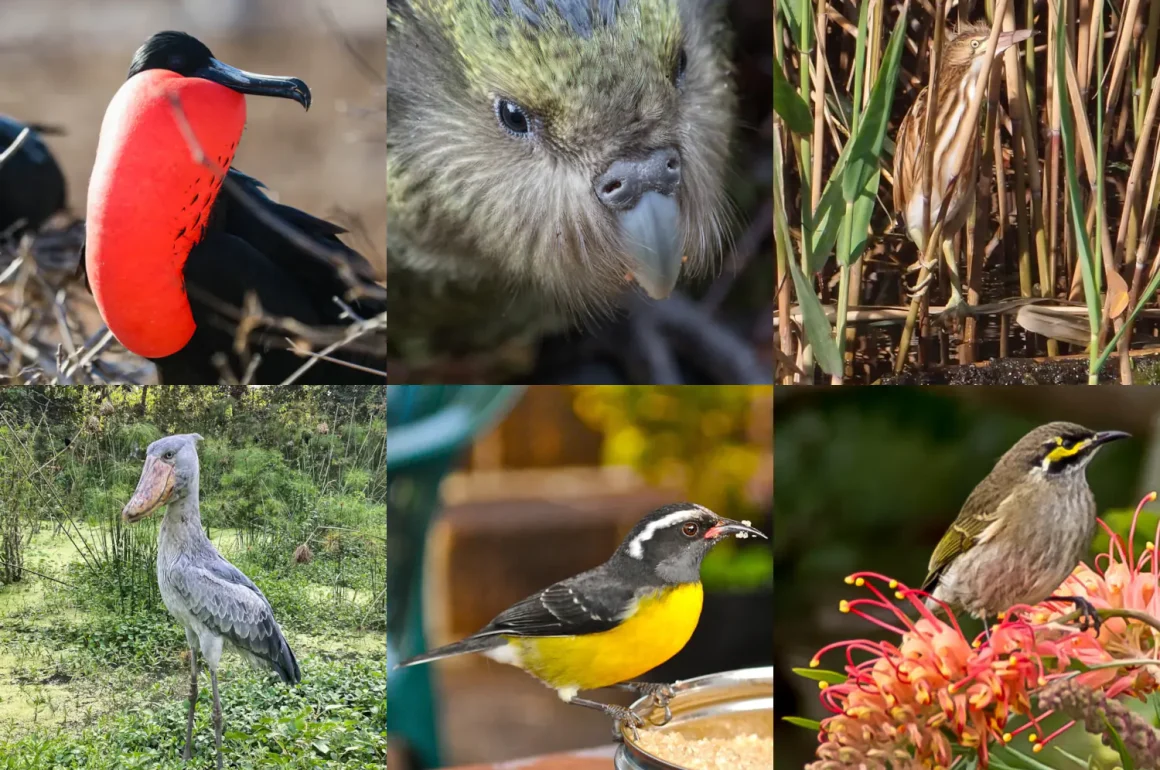
I have compiled below a list of funny bird names, each accompanied by a short explanation, mixing facts with my own thoughts inspired by each bird.
Frigatebird
The male frigatebird flaunts a flashy red pouch under its beak, which they inflate during the breeding season – like a party balloon – to attract females. Threat level: about the same as a helium toy. Though named after a frigate – a type of warship sized between a corvette and a destroyer (typically used for anti-submarine operations!) – the bird poses little real danger.
Kakapo
Around 80 million years ago New Zealand separated from the supercontinent Gondwana – no terrestrial mammals, except bats, were able to make the sea crossing – and remained largely isolated for tens of millions of years. Species like the kakapo thus evolved without mammalian predators. As a result, today they often freeze under threat. Maybe like us humans, when we are trying to remember if we paid our parking meter. That – paired with a baffling male mating call females struggle to localize – helps explain the roughly 235 kakapos alive today.
Great bittern
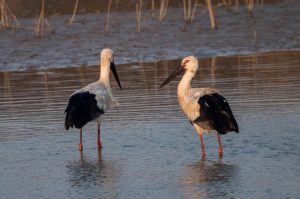
The Great Bittern just makes me wonder if he is in any way related to wormwood or bitter melon. “Not even close”, says the secretive bird, sensing my puzzlement. It turns out that, etymologically, the name is a mix of buteo (Latin for “hawk”) and taurus (“bull”). “By the way, check out my long neck stretched upward and the pointy bill – splendid for blending in with the reeds, isn’t it?”, he interjects. Also known as the Eurasian bittern, this stocky, brown heron is relatively easy to miss, even by skilled observers – until his bizarre booming song is heard, which sounds a lot like a bull’s bellows.
Shoebill
This bird has a comically oversized bill, ideal for snagging even baby crocodiles. They look so oddly prehistoric – and with those bill-clattering sounds that seem to be used as part of greetings, it makes one wonder if having a funny name actually shaped their behaviour, not the other way around. Just like someone named Tooth will gravitate towards dentistry or someone named Storm might take all of us by storm. It’s called “nominative determinism”.
Bananaquit
How many times have you wanted to stop eating bananas? Book a therapy session with the real expert: the bananaquit. His perch would love to hear your secrets! Bananaquits (and related grassquits and orangequits) are small passerine birds native to tropical America. Now, it’s time to debunk a myth: bananas were never their staple food, they just have bright yellow underpants. They actually feed on nectar and small insects, and will puncture various fruits to access the sweet juices. If you’re wondering if “quit” is drawn from the Spanish “chiquito” (meaning “small”), which English speakers heard and clipped to “quit”, that makes us two. Also, their chirping sounds like “quit”.
Yellow-faced honeyeater
If that were my everyday name, I’d rather go by my scientific one: Caligavis chrysops. Just imagine: how would you like to be called… “The Midnight Muncher”? That’s why some countries banned embarrassing names for people. I propose birds get the same courtesy. It’s easy to see how the teasing could reinforce rigid food rules for a bird. Naturalists and ornithologists: help it snack in peace; perhaps by calling it something kinder, like the “Easygoing Nibbler”. You might be rewarded with loud, clear calls – often twenty to thirty minutes before dawn, since in its native Australia, its trills are one of the earliest heard in the morning.
Image attribution:





Leave a Comment