
By Adam Cruickshank
Adam Cruickshank is a team member at Birding Ecotours and the host of The Birding Life Podcast. He is based in South Africa and spends much of his time exploring African birding destinations, sharing personal field experiences, and working with local guides across the continent.
Birders will travel far and wide to add new birds to their life lists. Many end up visiting corners of the planet that they never would have otherwise visited. Some of these places are beautiful, dream destinations that grace the covers of travel magazines. But some of these places are a lot less glamorous.
Almost every birder has at least one story of a rather questionable place that they visited in pursuit of a bird. Sewage treatment works and landfills are two prime examples. There are even stories of relationships that had a dubious beginning, when a potential partner was taken to a sewage treatment facility for a first date!
But there are times when searching for a species takes you to places that are so spectacular that the setting becomes almost as memorable as the bird itself.
Rockjumpers (Chaetopidae) are a bird family found nowhere else in the world, restricted entirely to South Africa and Lesotho. There are two species in the family, Cape Rockjumper and Drakensberg Rockjumper. The two species are allopatric, meaning they are geographically separated from one another, and their ranges do not overlap. Both species are found in rocky, mountainous habitats. They are charismatic birds, with long tails and striking patterns, often flicking their tails, hopping and scrambling among the rocks. These are two of the most sought-after species on our South African tours.
Although when you see a rockjumper, it is hard to argue just how special these birds are, there is another reason that rockjumpers are among Southern Africa’s most special birds. It’s not only the bird, but also where it’s found, that adds to its appeal.
Cape Rockjumper is one of South Africa’s most sought-after species.
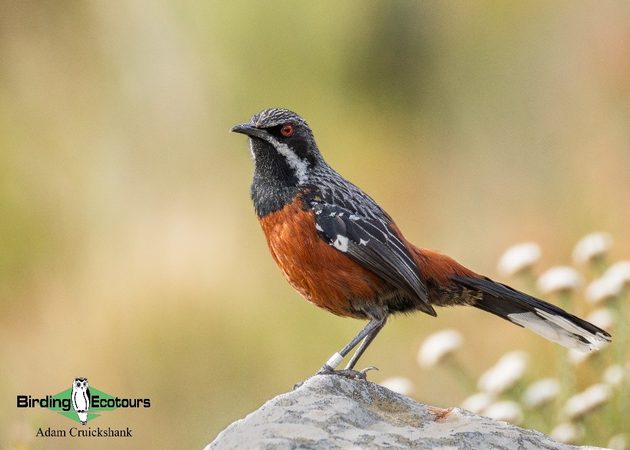
Let’s start with the Cape Rockjumper. This species is endemic to the Mountain Fynbos of the Western and Eastern Cape provinces of South Africa. Fynbos forms part of the Cape Floral Kingdom, the smallest of the six floral kingdoms in the world. The Cape Floral Kingdom is characterized by around 8,700 plant species, with 68% of the species being endemic!
One of the most accessible places to see the Cape Rockjumper is at Rooi Els, situated just over an hour from Cape Town. While looking for the bird on the boulder-strewn and rocky slopes, you will have the stunning ocean behind you. You might be lucky enough to see both a rockjumper moving along the slopes and whales out in the ocean, all within one breathtaking experience.
There are times when you are gifted with close views of this sought-after species. I have sat down on a rock at the base of the mountain and heard the rockjumpers calling some distance up the mountain. At times your patience is rewarded as they move closer, giving you views that will stick with you for a long time. A few years ago, we had them moving alongside us no more than 16 feet away. The 500mm lens that I was using provided too much magnification!
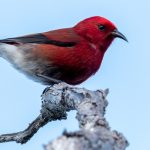
The stunning Orange-breasted Sunbird is endemic to the Fynbos biome
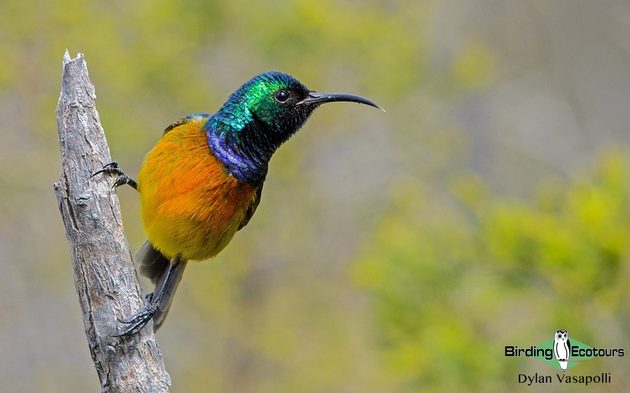
Not only is Rooi Els great for the rockjumpers, but the area is also good for the Ground Woodpecker, Cape Rock Thrush, as well as the endemic Orange-breasted Sunbird. Stony Point penguin colony and Harold Porter National Botanical Garden are also close by, while the surrounding fynbos provides opportunities to find the secretive Victorin’s Warbler.
The Western Cape is widely regarded as one of the most beautiful places anywhere in the world to visit. You have all the attractions that draw visitors from all over the world, and within a short distance you can see one of the region’s most sought-after birds. All of this combined makes this an extra special species to get to see.
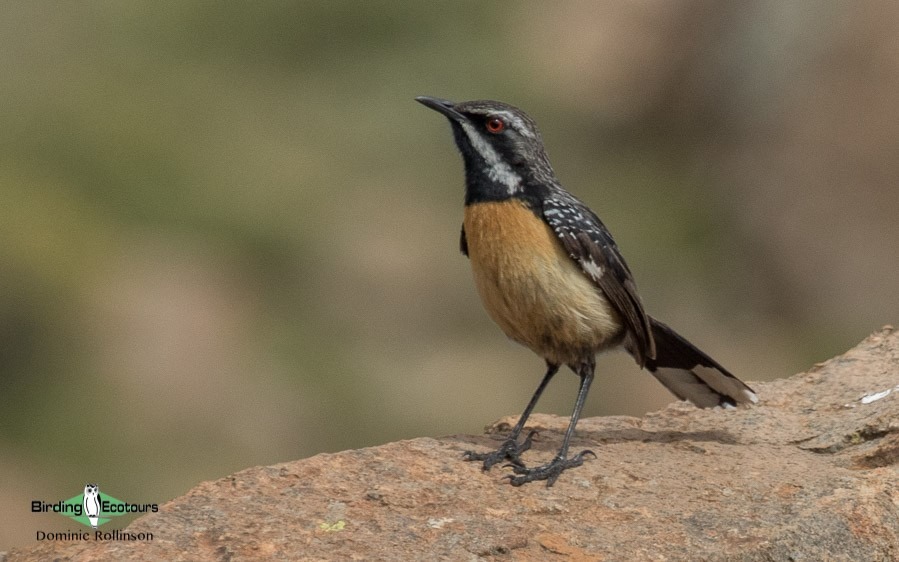
While the Cape Rockjumper is accessible even to the most casual birder, to see the Drakensberg Rockjumper you need to be a little more adventurous.
Drakensberg Rockjumper is a high-altitude specialist!
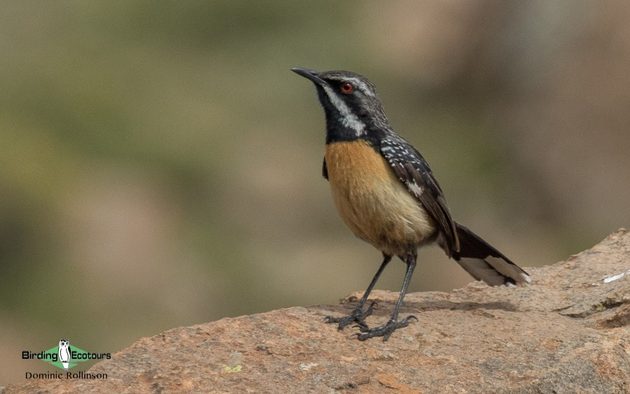
One of the best places to see this species is on the famous Sani Pass. Sani Pass is a high-altitude, steep gravel road that winds up the Drakensberg Mountains, connecting KwaZulu-Natal with the Lesotho highlands. This thrilling 4×4 road ascends a total of 4,370 feet (1,332 vertical meters), providing not only excitement but also some breathtaking views. There are many places where, right alongside the road, there are dramatic drop-offs that will make your heart beat a little faster. But it’s this remote and high-altitude environment that is one of the best places to see the Drakensberg Rockjumper.
Yes, due to its remote location, there are not as many amenities close by as when you look for the Cape Rockjumper in the Cape. But this environment will leave you awestruck and leave you desiring to encounter even more of what it has to offer. Yes, the birding is exceptional, with species such as Bush Blackcap, Bearded Vulture, Cape Vulture, Gurney’s Sugarbird and Drakensberg Siskin. But dare I say that for many people who are lucky enough to experience the magnificence of Sani Pass, the birding might even take second place. This is some of the most spectacular scenery you will ever encounter.
Both of these species, which are part of a special bird family found only in South Africa and Lesotho, may draw people from all over the world who are looking to add the species to their life lists. But the pursuit of these species allows them to experience so much more. They get to experience one of the world’s most unique floral regions as they gaze upon Cape Rockjumpers moving across the rocky mountains in the fynbos of South Africa. When they travel inland to see the Drakensberg Rockjumper, they may notice the plumage variations between the two species, but they will also get to experience a place that many people hear about and never get to visit.
This is what makes these two birds special. They draw people from all around the world, who don’t only connect with a ‘tick’ on a list, but instead connect with scenery, people, and culture.
This is the story of the rockjumpers. But for other people, it may be a different group of birds. Birds that connect us not only with the species, but with so much more. Birding has a way of unlocking locations and experiences that we may never have otherwise experienced. May our pursuit of more birds keep us exploring and allow us to experience more than we otherwise would.




My experience with rockjumpers was completely the opposite of what the (rather excellent) article mentions: Drakensberg was a “gimme bird” and Cape took me forever and a day. I went to Rooiels many times and always dipped. I finally saw the bird at Sir Lowry’s Pass. Why? Who knows? Who cares?