

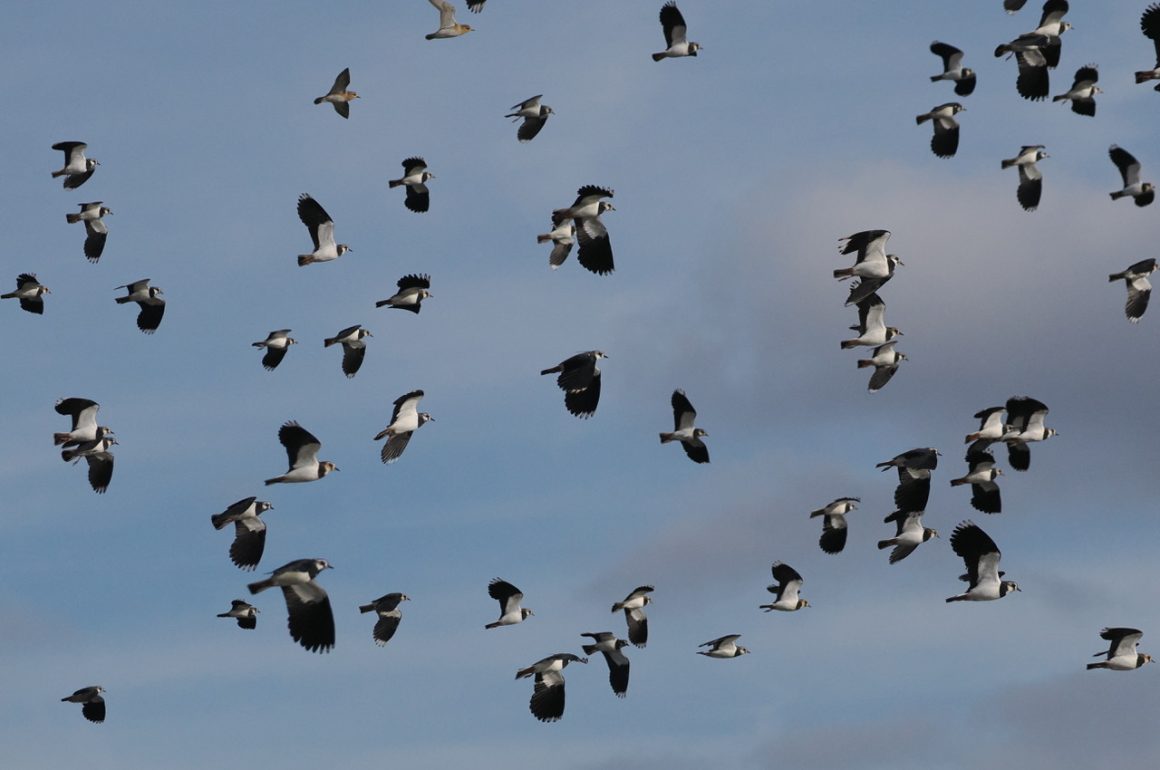
It’s quite possible to see 100 species of birds in a day in any month of the year here in East Anglia, but as the days get longer it becomes much easier. It’s a long time since I last tried for the magic century, but earlier this week my birding companion Andrew and I decided to have a go. The two secrets of success are starting early and visiting as many different habitats as possible, but you also need decent weather and a little luck.
We started at 7.30, which may be quite early, but if we had been really serious in our attempt we should have started at least an hour earlier, and before first light, when there would have been a good chance of hearing a Tawny Owl and picking up a number of early rising birds. However, I got off to a good start in my garden, waiting for Andrew to arrive, with a singing Goldcrest and a more distant Green Woodpecker, while a fly-over Red Kite was a good omen. We would be sure to see plenty of Kites during the day, but it’s always pleasing to see one over the village.
Our first target bird was Woodlark, a scarce and highly localised species in England, but one that breeds on a heath just a couple of miles from home. No walking was necessary, just a quick stop and a listen. We heard one almost instantly, and then spotted a distant bird performing its distinctive song flight. A good bird was in the bag: it was my first sighting of the year.
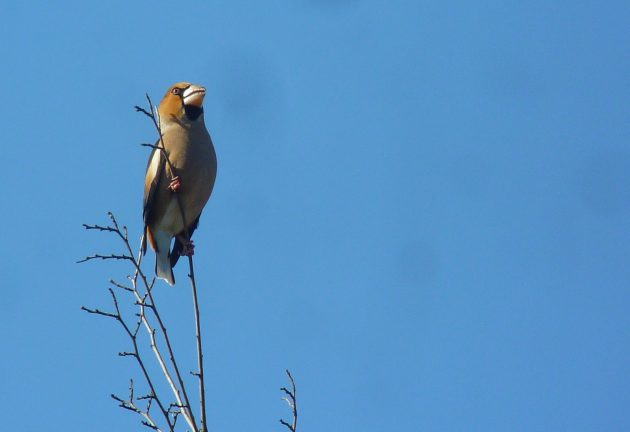
Hawfinches are always a challenge to see in East Anglia
Our next stop was Lynford Arboretum, not only a dependable site for a number of woodland species, but also the most reliable place in East Anglia to see Hawfinches. The latter may be common on the continent, but here in England they are rarities. It didn’t take us long to find a trio of these handsome finches at the top of one of their favoured hornbeams. They were a first-for-the-year for both of us. Lynford went on to provide the expected selection of birds we were hoping for, including two Brambings. These migrant finches have been scarce this winter, so they were a good find.
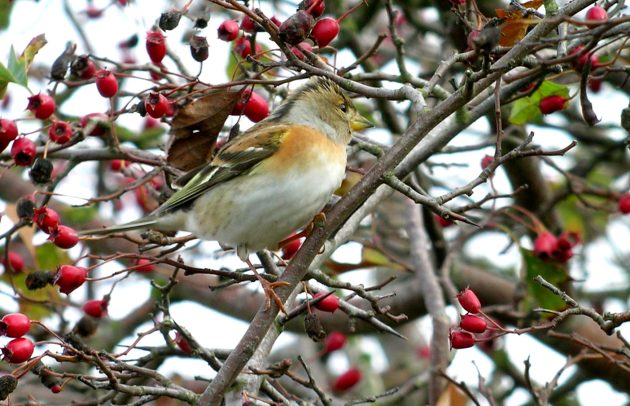
Bramblings – they have been scarce this winter
Lynford not only has a fine arboretum, but it also has a large, shallow lake, appropriately called Lynford Water. In the past I’ve seen some unexpected birds on it, but not today, with just Tufted Ducks and Great Crested Grebes. However, there was a bonus in the shape of an Otter. There’s now a healthy population of Otters in East Anglia (40 years ago they were virtually extinct), so they are always pleasing to see.
With nearly 50 species on the list, or half our target, we moved on to a reliable Breckland site for seeing Goshawks. Within minutes of stopping we had seen one, patrolling high above woodland which regularly holds a breeding pair. Goshawks are often confused with the smaller but similar Sparrowhawk, but they have a very different jizz, for not only are they bigger, but their flight and wing action is quite different. We did see a couple of Sparrowhawks at the same site, plus a bonus Crossbill, perched on the top of a distant pine.
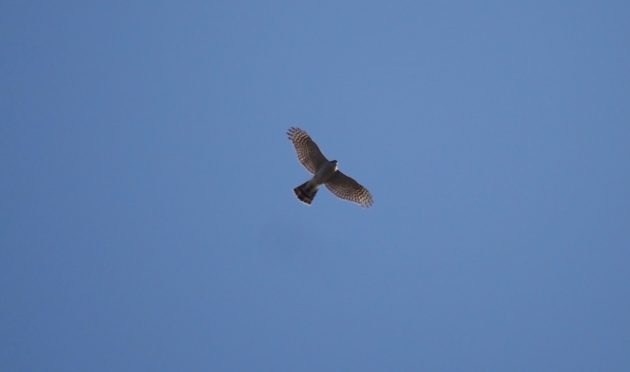
Goshawk overhead – bigger and broader winged than a Sparrowhawk
Next was a 55-minute drive to the coast, though we did pick up a few birds as we travelled: Common Gull, Buzzard, Red-legged Partridge. Our destination was Hunstanton, a seaside town on the edge of the Wash. Ornithologically, Hunstanton’s biggest claim to fame is the colony of Fulmars that nest on its cliffs.
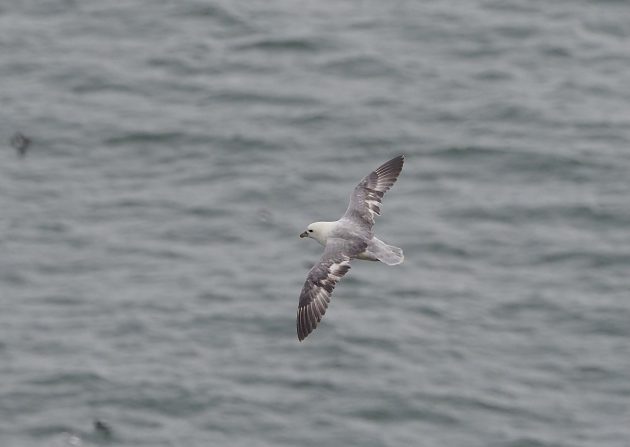
Fulmar – already back patrolling the breeding cliffs in February
Fulmars return early to their breeding sites, and we had no difficulty seeing several individuals patrolling the cliff tops. Scoping the sea often produces a variety if sea ducks, but disappointingly there were none today. However, House Sparrows in the hedge on top of the cliff was a useful addition, as it was a bird we hadn’t seen earlier in the day.
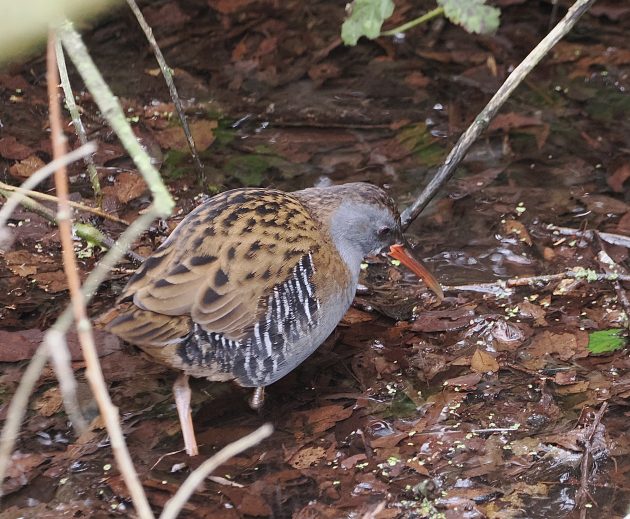
This Water Rail was creeping along a ditch by the side of the path at Titchwell
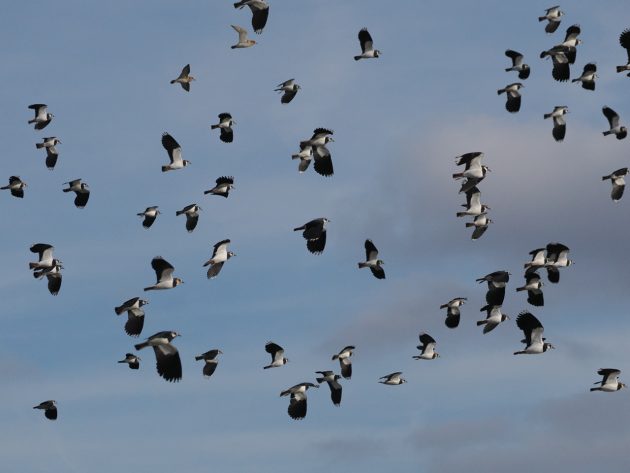
Our next stop was Titchwell RSPB reserve, just a few miles east along the coast. Here we paused to eat our lunch – this was a relaxed day’s birding, not a desperate quest for the 100 species. We knew that Titchwell should boost our list considerably, and so it did. We saw over 50 species here, many of which were new for the day, with a few also new for the year. One of our first birds here was a Water Rail, creeping along a ditch beside the path – this is a bird that you often hear but rarely see. it was a good start. It took a little time with the scope to find a single Ruff among the crowds of Lapwings and Golden Plovers, and the Mediterranean Gulls (four in all) among the throng of Black-headed Gulls. It was interesting to note that three of the Mediterranean Gulls were already in full summer plumage, with smart black hoods, unlike the Black-headed Gulls.
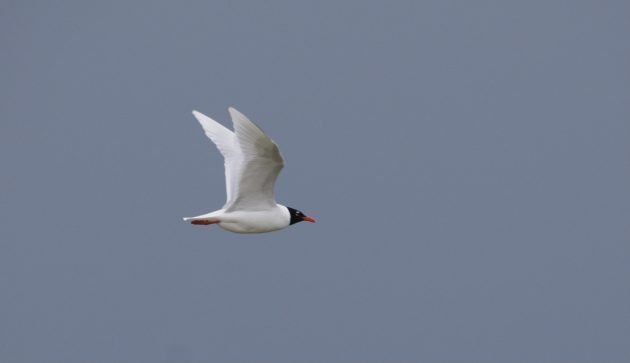
Mediterranean Gull: by late February most are in full summer plumage
Titchwell is always a reliable site for seeing wildfowl, and we enjoyed the expected Wigeon, Pintail, Shoveler, Gadwall and Teal, plus good flocks of dark-bellied Bent Geese. A pleasing addition was a single duck Scaup, the first I had seen for a long time, while on the sea we found several Red-breasted Mergansers and an unexpected Black-throated Diver. Andrew scoped a distant Slavonian (Horned) Grebe, but it was diving constantly and frustratingly I never managed to get on to it.
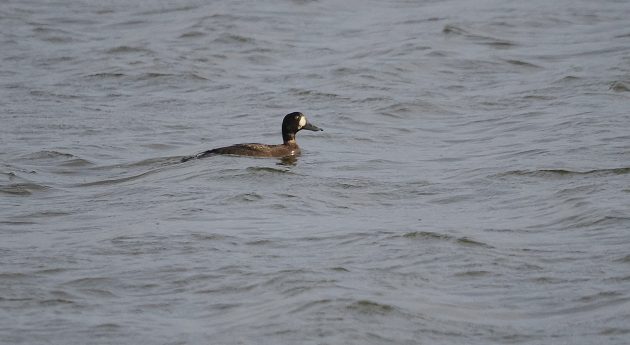
Bonus bird: a female Scaup at Titchwell
The beach at Titchwell is always good for waders, and with the help of a falling tide we weren’t disappointed, scoping Curlew, Redshank, Knot, Turnstone, Sanderling, Dunlin, Grey Plover and Bar-tailed Godwit. However, there’s invariably one you miss, and despite our best efforts we failed to find a Black-tailed Godwit, usually the most numerous of the two godwit species here.
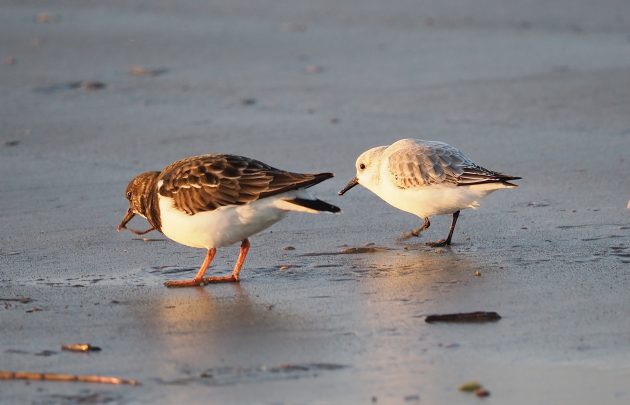
Turnstone and sanderling on Titchwell Beach
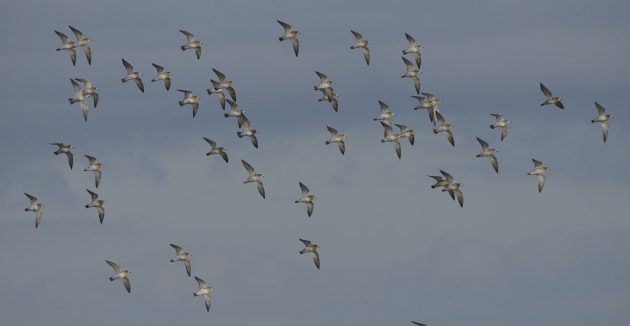
Golden Plovers (above) and Lapwings (below) over Titchwell marsh
This wasn’t the most serious attempt to see a 100 species, as by the time we left Titchwell we were unsure of how many species we were up to, and didn’t want to waste the time counting. Our next stop was Holkham, where on the fresh marsh there was the chance to add three species of geese to the list. We only managed one of them – White-fronted – as we failed to see the reported Tundra Bean Goose, or any of the local flock of Barnacles. However, it was good to see four Spoonbills in full breeding plumage, while a cock Stonechat was an overdue addition to the list.
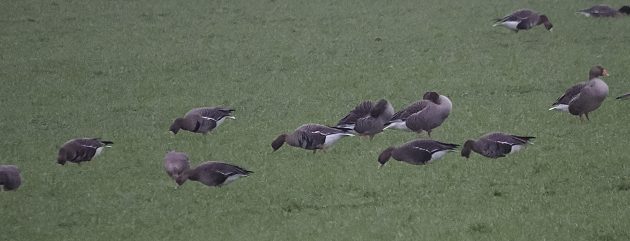
Whitefronts with Greylags
We had enjoyed a sunny afternoon, but the sun was now dipping to the horizon. We continued to Wells Harbour, hoping to see the long-staying Great Northern Diver, but it was nowhere to be seen, so our only addition was Great Black-backed Gull. As we returned to the car we enjoyed the spectacle of thousands of Pink-footed Geese flighting into the fresh marsh at Holkham, the birds silhouetted dramatically against a yellow sky.
The light was now fading fast, but there was time for one last stop, at North Pools, just outside Wells. There were no new birds for us on the pools, though a flock of 14 Avocets, were a pleasing site. Suddenly a hunting Barn Owl appeared, soon followed by another. Watching the later, hunting low across the marsh, I was rewarded when it flushed a Snipe. I didn’t know it at the time, but this was my 99th species.
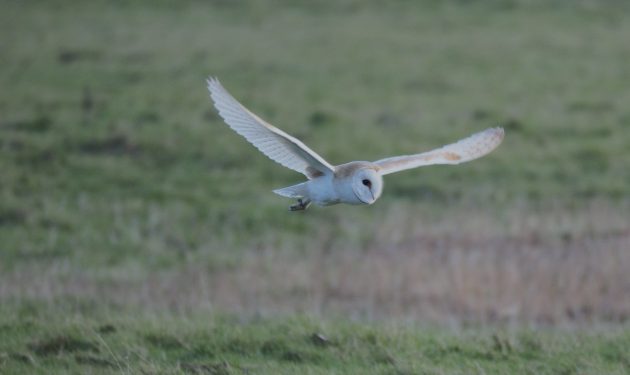
Barn Owl: No 98 for the day
The light had nearly drained from the sky by the time we left, but there was just enough visibility to see a Grey Heron flying over the road. It was only when I got home and added up what we had seen that I realised that this bird was my 100th species of the day. A satisfying conclusion to a classic winter outing.







What a delightful read — and day!