

Anton Schultz is a bird guide at Birding Ecotours. He is based in South Africa and recently completed his honours degree in Zoology at the University of Pretoria, studying Red Larks in the desert. In 2019, Anton completed a Big Year in southern Africa, recording 804 species in one calendar year at the age of 19. Since then, his yearning for adventure has only continued to grow.
There are multiple characteristics that make a strong birder: an acute visual memory, encyclopedic knowledge of calls, and an almost obsessive attention to detail. These are all abilities I don’t necessarily possess in great quantities, but there is another skill I’ve honed over my decade of birding which I would consider among the most valuable of all, and that is patience.
I think we all have a story linked to this word. Patience is inextricably tied to our birding journeys. When you first start birding, it almost feels unnecessary. You see a new bird every few minutes, and often you do not even realize how special some of them truly are.
I still remember my first Botha’s Lark when I was only fifteen, shown to me by a local bird guide my parents had hired in support of my growing obsession with birds. I had barely begun my journey, and I had no idea how special that bird really was. Today, it is critically endangered and extremely rare, but back then, it was another bird mixed in among a flood of exciting new species.
As your list for an area slowly starts closing up, that is when the real fun of birding begins (unless you just prefer the previously described type of birding, which is cool too). Suddenly, you find yourself travelling to places with one or two very specific targets in mind, returning to the same patch again and again in the hope that this time will finally be the time. Gradually, repeated visits start trimming away those missing species, and before long, you begin to discover your blind spots.
“Why is this bird eluding me?”
“Maybe I need to change the way I’m looking for it?”
And if the bird avoids you for long enough:
“Is there something wrong with me?!”
Now it is time to learn patience and its associated cousin, persistence. Not all birds come quickly, and those that don’t are as much a part of your story as those that do. One bird comes to mind, exemplifying this for my journey. It came on my year of self-discovery, just out of high school, when I was nineteen.
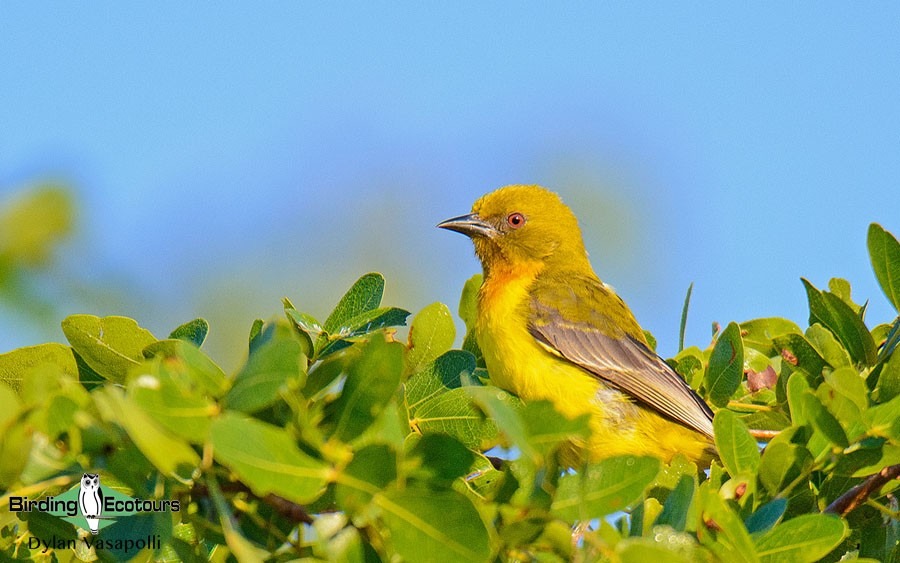
There are two big targets in Southern Mozambique, the Green Tinkerbird and Olive-headed Weaver, and I had just come off lucky with a quick and easy sighting of the Tinkerbird. That late summer afternoon, I raced off to the single patch of woodland in Mozambique where the Weaver resides. I used playback and expected the bird to come in hot. It didn’t; I birded there for one hour, then the next, and then it was sunset.
I went to my accommodation that evening, a one-and-a-half-hour drive from the Weaver site, ate half a chicken and worried not, for tomorrow was a new day. The following day is probably best remembered from my diary excerpt; I think it conveys the pain well.
“Day 26
Easily the most frustrating day of the Mozambique trip. Somehow in my head, I thought that if you give one day and devote it entirely to one target. You’re going to get that target!
Well, not necessarily. Especially when that bloody Weaver is concerned.
Spent the day at Panda Woodlands, searching and searching. Adding more birds to my full protocol card (a local citizen science project called SABAP2 if you’re curious). Seeing some crazy birds, the star of which was a couple of Racket-tailed Rollers making a racket. Got to witness my favourite “weeeee” when the Rollers descend in their aerial display.
Other than that, there were Pale Batises, Stierling’s Wren-Warblers, Southern Hyliotas, Red-faced Crombecs, White-breasted Cuckooshrikes, what felt like every species of Weaver except Olive-headed, Broad-billed Rollers, Bohm’s Spinetails. Again, birds I’d be drooling over at the beginning of the year.
Around midday, rather demotivated and tired, with a cramp in my right leg and feeling mighty sorry for myself. I sat down, made some coffee and listened to a podcast. I soon realized I was still pretty hungry and a bit tired. Checked my sad cooler box to see two choices of culinary delight. Baked beans or sugar. Can you guess what I chose?
So there I sat, eating sugar out of the palm of my hand like an imbecile. I continued searching after my shameful display and pressed deep into the miombo until sunset. No luck… passed by a vendor on the way out and bought some tennis biscuits for my woes.
I decided to give up on the Weaver and go back to the Jolly Roger to eat more food that wasn’t sugar (or baked beans). I got there too late, and they were closing the restaurant half an hour early. Ate some tennis biscuits and slept for the evening, lying inside my car to save money.”
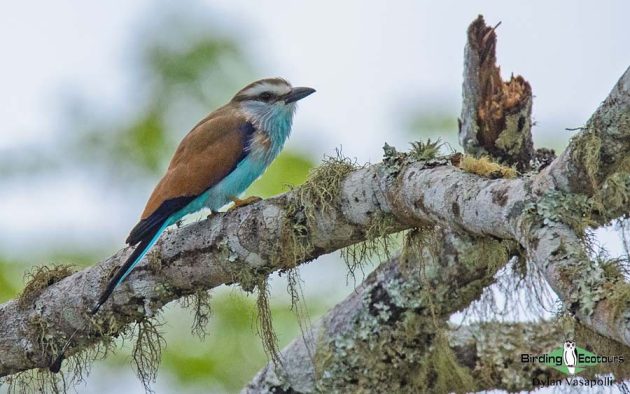
A picture to give you an idea of that stunning Racket-tailed Roller I mentioned; those pieces of lichen you see are what the weaver uses to make its nest.
I’m pretty sure I had a mental breakdown in those woodlands. I was so frustrated. Why didn’t this bird know that it was obligated to let me see it? The plan was not to return; such was my mood the day before. But the next morning, I sat down, ate an omelet for breakfast, and for some reason, my flame was reignited.
I returned to those woodlands in the late morning and gave it everything I had. I wandered, and wandered, and wandered some more. Eventually, I decided to switch things up and moved to another part of the woodland, where I continued wandering aimlessly beneath the trees. Before long, it was around 4 PM, and by then I was convinced it was over. Then it happened, I finally heard the bloody thing!
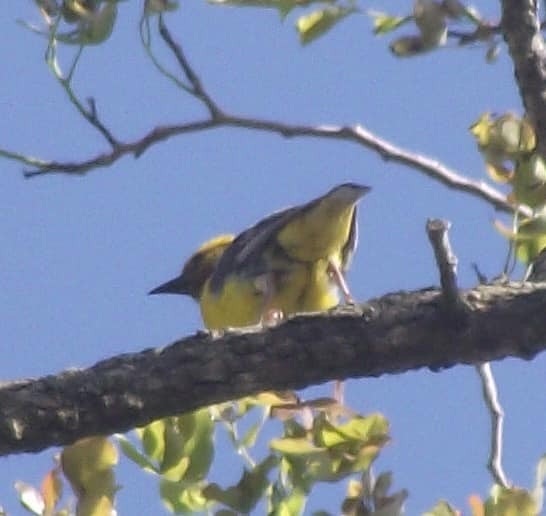
And so I ran towards the sound, crushing leaves beneath my feet like a madman. I stood beneath that bird in the canopy and very nearly cried. At that point in my year of discovery, my camera had broken, and I was relying on a little 16-megapixel Fujifilm zoom camera. The photograph was absolutely terrible, but it meant, and still means, so much to me.
I must have put close to 18 hours of effort into finding that Olive-headed Weaver, but in the end, that only made the moment I finally saw it even sweeter.
That is the thing about birds like these. Sometimes you have to give them every ounce of patience you have. I still have birds that continue to elude me to this day. My white whale at the moment is Pallid Harrier, a bird which probably has well over 200 hours sunk into it across more than a decade of birding. This bird is teaching me a whole other type of patience, but that is an article for another time.
I hope that everyone reading this eventually finds their own Olive-headed Weaver and enjoys the pathway to seeing it more than I did on Day 26.





Leave a Comment