

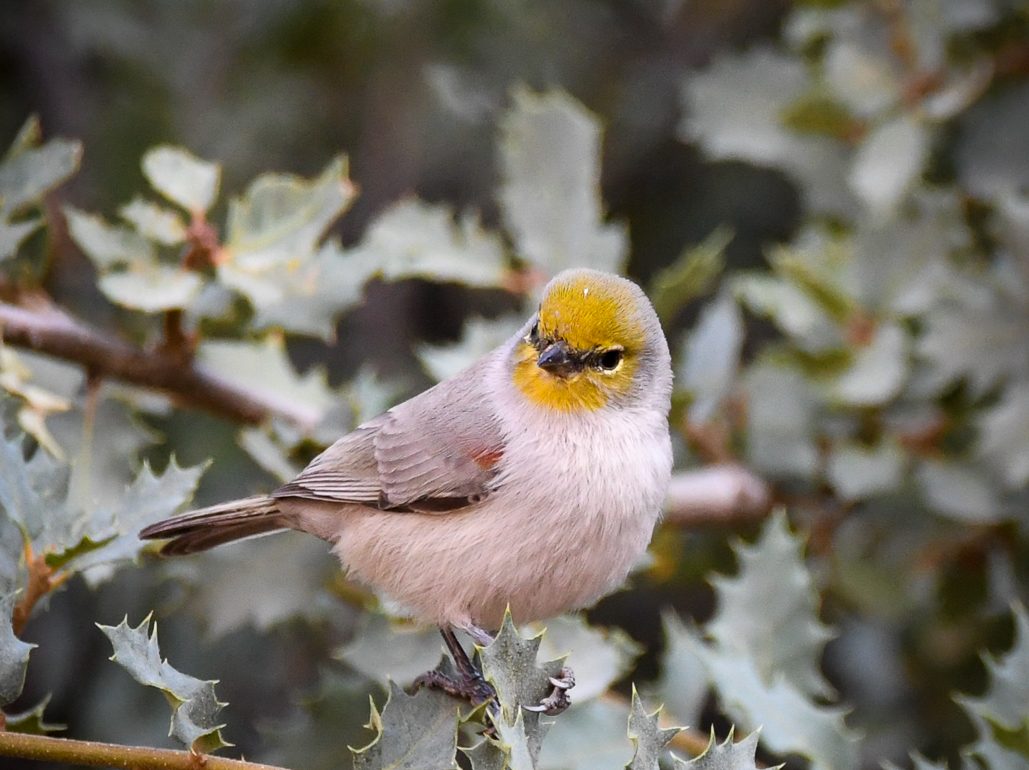
The Verdin is one of the smallest and most captivating songbirds of the American Southwest. They are resilient desert dwellers wrapped in soft gray feathers and crowned with a flash of brilliant yellow. At just four inches long, it’s easy to miss spotting this petite beauty, disappearing into a maze of thorny shrubs and sun-bleached branches. But for those who pause and look closely, the Verdin (Auriparus flaviceps) reveals itself as one of the desert’s most charming and resourceful inhabitants.
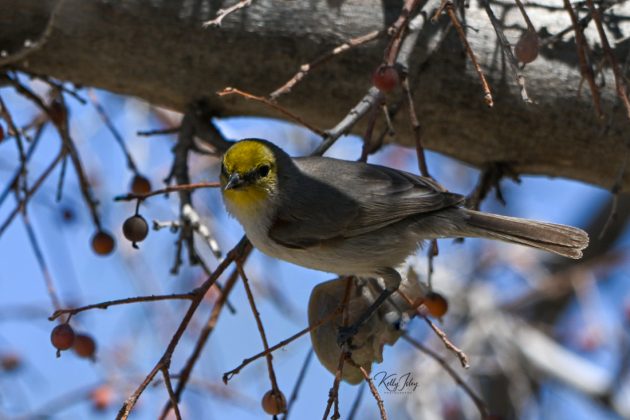
Despite its delicate appearance, this tiny bird thrives in some of the harshest environments in North America. Verdins are year-round residents of arid deserts where temperatures surge, and water is scarce. Rather than fleeing extreme conditions, they adapt by seeking shade deep within vegetation during the hottest hours and foraging actively in the cooler parts of the day. Their diet is equally flexible, consisting of insects, spiders, and occasionally nectar or fruit, allowing them to take advantage of whatever the desert provides.
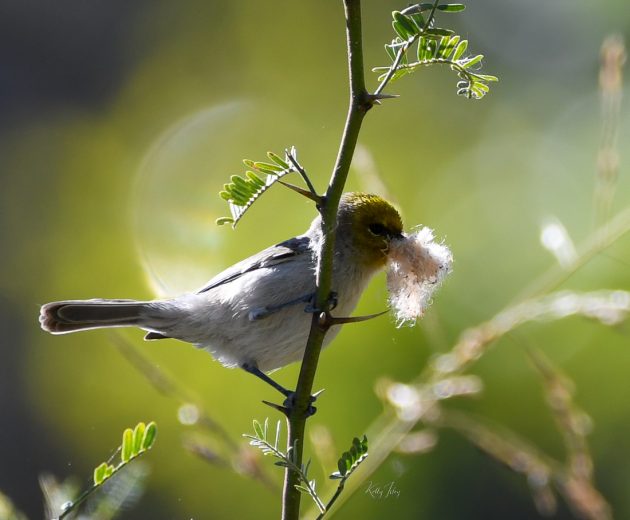
One of the Verdin’s most remarkable traits is its talent for construction. These birds are prolific builders, creating multiple nests throughout the year. Not all are used for raising young; many serve as shelters for sleeping or escaping the elements. Their nests are enclosed, spherical structures built from twigs, grasses, and plant fibers, with a small side entrance that helps protect against predators and temperature extremes. A single pair may maintain several of these tiny refuges, forming a network of safe havens within their territory.
Verdins are typically seen alone or in pairs, moving energetically through mesquite, palo verde, and acacia trees. Though small, they are far from timid. During breeding season, males fill the desert air with high-pitched songs, defending territory and attracting mates with surprising persistence. Their relationship with desert plants is essential—not only for food but also for protection, as they often build nests among thorny branches that deter predators.
Reproduction is closely tied to the rhythms of the desert. After seasonal rains bring a flood of insect life, breeding activity intensifies. Chicks grow quickly in this changing environment, and both parents may share in feeding and care.
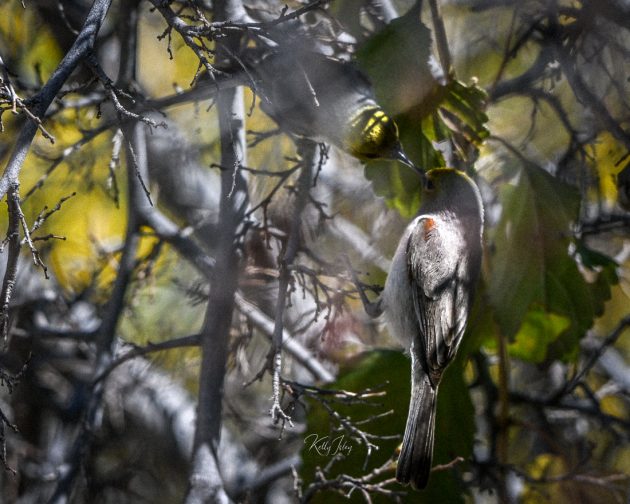
Earlier this spring, hoping to witness this stage of their lives, I set out to observe a group of Verdins I had been watching. Knowing fledglings were beginning to leave the nest, I put on older clothes and settled quietly on the ground beneath a bush, camera in hand. At first, the birds were wary, their movements sharp and cautious. While the minutes passed, they seemed to accept or simply forget my presence.
Then, just a few feet away, an adult Verdin appeared alongside a young bird. It appeared to be a private survival training lesson. The adult moved deliberately, demonstrating how to search for food, pausing to feed the fledgling between attempts. The scene developed with quiet purpose, a mixture of instinct and learning. To witness it so closely was a rare privilege. It was a view into the hidden, special rhythms of desert life.
Moments like this reveal the Verdin for what it truly is: not just a small bird, but a master of survival. Still, even these adaptable creatures face growing challenges. Habitat loss and changing environments continue to reshape the desert landscapes they depend on, threatening the delicate balance which sustains them.
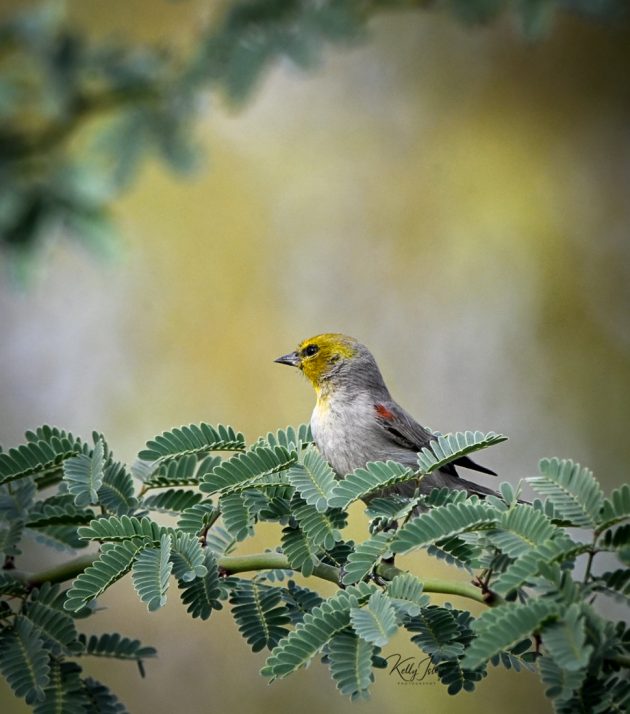
And yet, the Verdin endures. In its calm way, it symbolizes the spirit of the desert, which is resilient, resourceful, and full of understated beauty. For those willing to slow down and look closely, this tiny beauty offers a reminder that even within the harshest environments, life finds ways not just to survive, but to flourish.










My current state of Michoacán in central Mexico was supposedly just south of the Verdin’s range. But we have since determined that it can be found wherever mesquite trees dominate, on a strip of Michoacan’s far north. They do not, however, occur where the visually similar acacia trees dominate. So cute!