
Despite the revolting origins of the term “New World”, it seemed as the best fit for the title of this post. Western Hemisphere is a mouthful, and the word “Americas” also has colonial origins. Before the continents were named and claimed there were millions of indigenous people living alongside (at least) hundreds of billions of birds. Some of these birds were more conspicuous than others, after all not everyone can be as incognito as a seedsnipe! I’m referring to storks – not the famous White Stork that moonlighted as a midwife, nor the iridescent beachcomber Black-necked Stork – tall, graceful, often imposing birds that can be seen from several kilometres away. The majority of stork species are found in Eurasia, Africa, and Australasia, only three out of twenty or so species are distributed across North, Central, and South America.
I remember the first time I saw one of these beasts. It was the largest of the three, the most unique and near mythical Jabiru. Just as a person who decides to be called by a singular name, the Jabiru carries with it a presence that can stop anyone in their tracks. I was driving through some farmland in eastern Trinidad and as I turned a corner, there was what I thought was a scarecrow. It took me a couple long seconds to realise that it was a living creature, hundreds of times larger than the Wattled Jacanas and Pied Water Tyrants I had just been looking at. It blinked and slowly turned away in disgust, my delayed reverence clearly not making any friends.
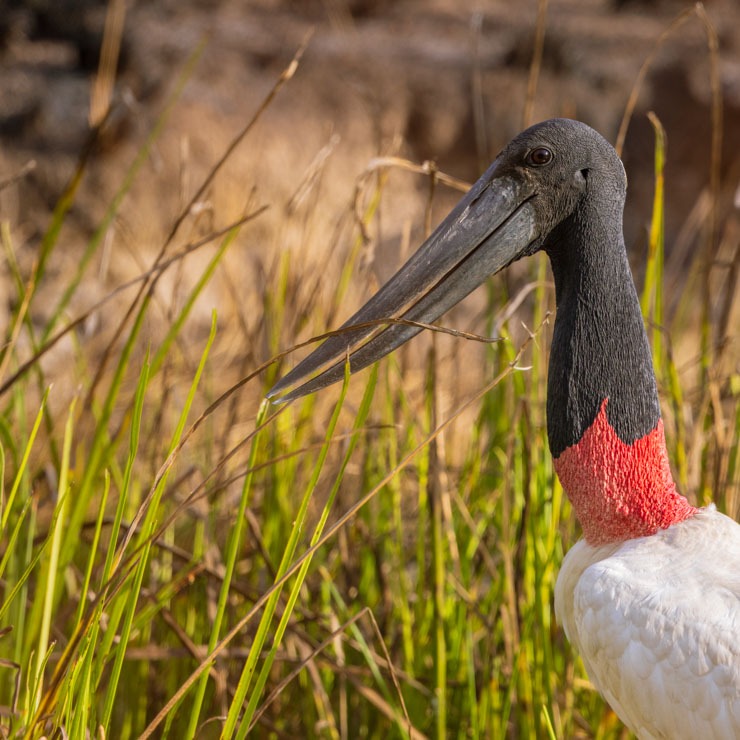
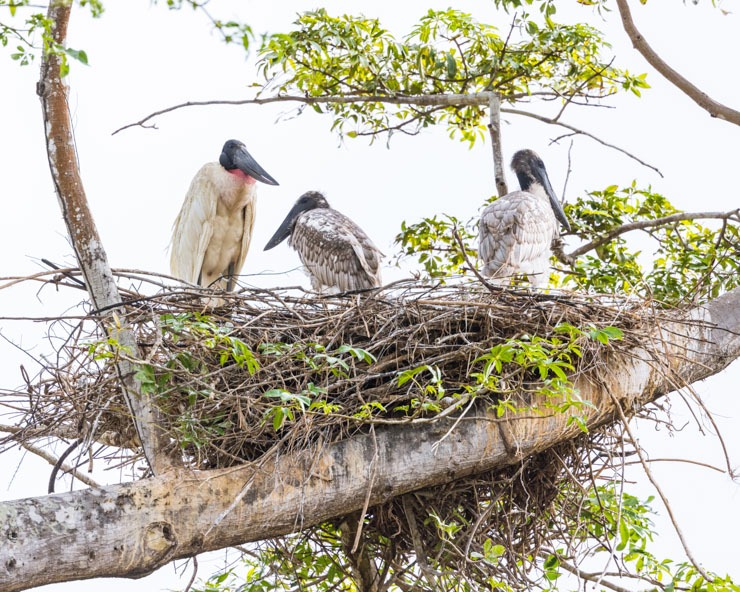
Jabiru means “bird with the swollen neck” in the Tupi-Guaraní language, and this is often apparent in adult birds. It is truly a behemoth, standing close to 1.5m tall with a near 3m wingspan. It is the only stork in this hemisphere that has purely white wings. Further to this, its massive black bill is slightly upturned, making it look like an oversized nuthatch from some angles. The Jabiru is fully aware of its status as el jefe of its flooded habitat – in times of strife it tends to bully smaller birds into giving up their meals.
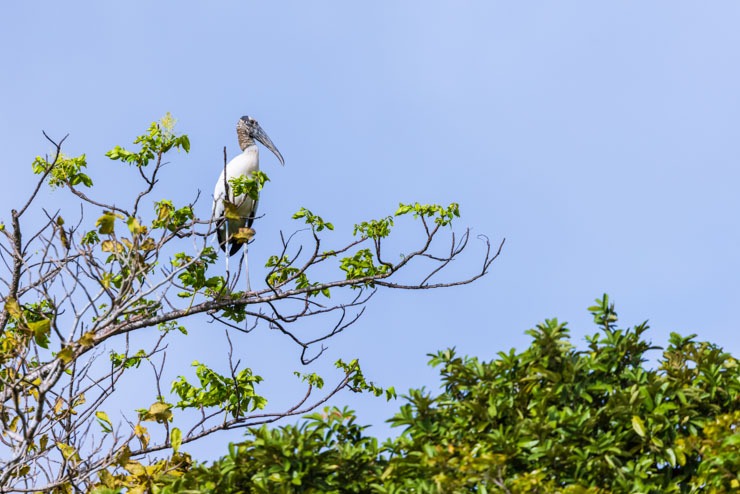
Each of the three storks in this hemisphere hails from different genera, and as such they are all distinct and unlikely to be mistaken for another. For North Americans, the familiar stork is the Wood Stork. It is the largest breeding bird in wetlands of the USA; this alongside its handsome, vulturous appearance renders it a favourite sight for many. I understand this is an assumption and surely some folks may prefer the bright reds and greens of smaller and less threatening birds, but for the purposes of this post I’m boldly sticking with my theory.
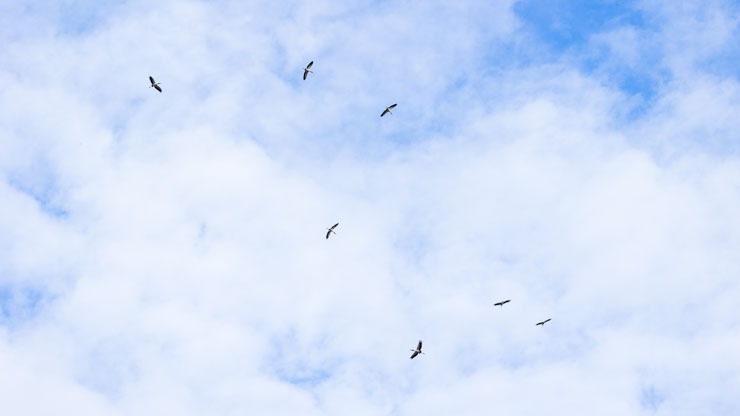
The Wood Stork is often seen soaring, the purpose of which is tied to their preference for certain feeding sites that are considerable distances away from their preferred roost. They are tactile feeders, typically poking around in shallow water for fish and other aquatic life.
One of the most beautiful birds of the open savannahs of South America is the third stork on this list: Maguari Stork. Again, taking its name from the indigenous Tupi language, maguari translates to “lazy”, surely in reference to its sit-and-wait feeding strategy. This stork has a short, straight and robust bill that serves it well in its savannah habitat. While at some times overlapping in habitat with the Jabiru, it tends to prefer drier habitat. This medium-sized stork was at one point placed in its own genus Euxenura for its odd, slightly forked tail. Presently, it taxonomically sits next to the visually similar White Stork.
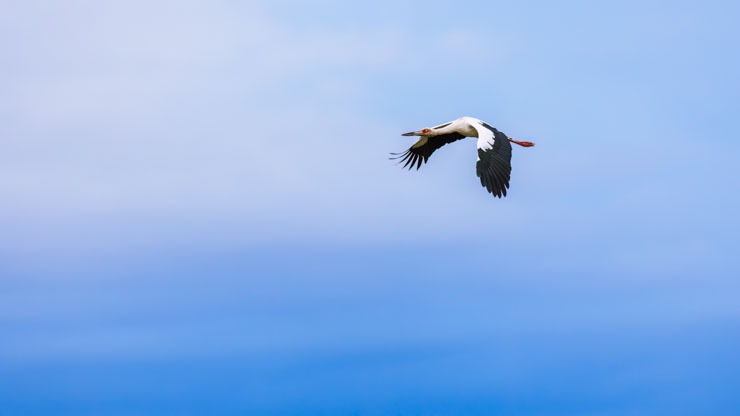
Of these three, the Maguari Stork was personally the most elusive. While it has been on the T&T list after a single bird was recorded in 2001, I only saw it when I went birding in Guyana’s Rupununi Savannah in late 2023. I know I have had an ongoing series on this blog about the proliferation of threes within the avifauna of T&T, but I feel hard-pressed to include this trio as none of these images were made in T&T. Furthermore, I’ve only seen Jabiru on Trinidad, not the other two.
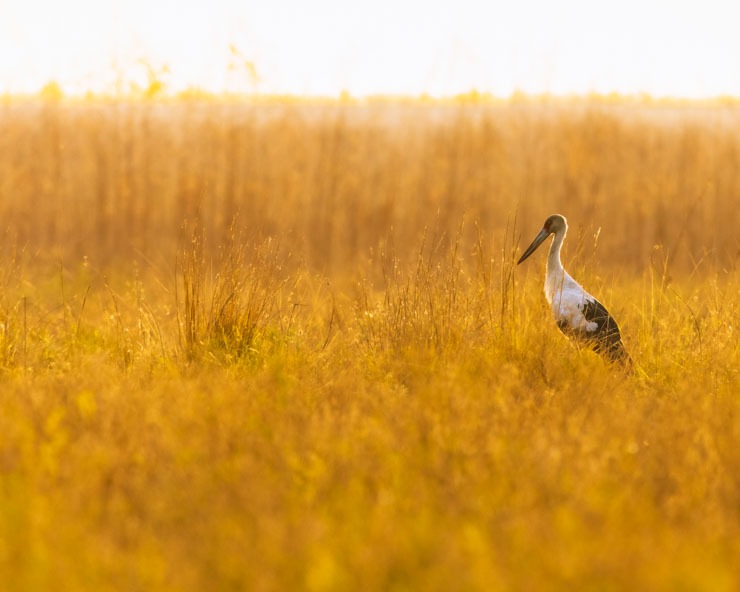
Either way, storks have captivated my imagination since I was a child. As a little boy, a bird that can stand towering over you is a terrifying prospect. Thankfully, I only encountered them as an adult. They clearly aren’t that menacing; I eventually learned of a Jabiru that was rescued and nursed to adulthood by some members of the Macushi community in the Rupununi. That bird was in a nest that was securely built in the fork of a huge old tree – during a storm the entire tree came down, nest and all. The Jabiru would follow them around, even riding on their canoes as they commuted.
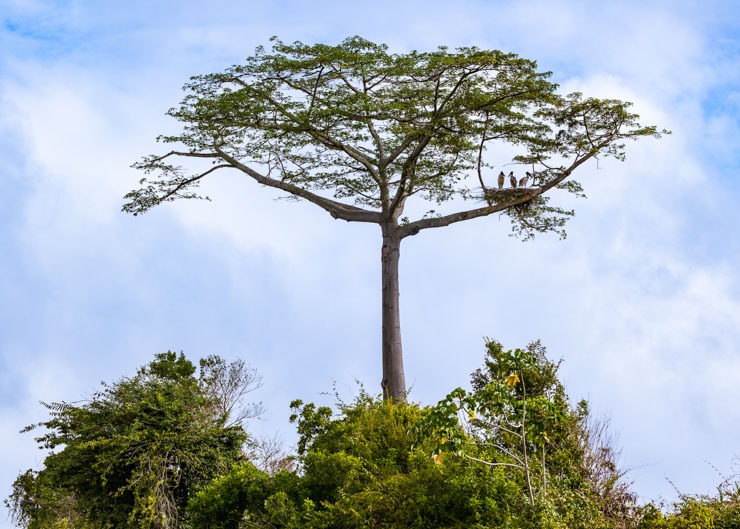
Jabiru nest on a large tree along the Rupununi River
Which of these is your favourite? Have you seen them all?








The Jabiru is my favourite since I saw a picture of it as a six-year old. I have seen all the New World storks (my definition of new means first arrival of people, and then the place is still new). I need more stork species in Asia than the New World holds… great read, thanks.
Saw mine sort of in backwards order: Magurai -> Jabiru -> Wood 🙂
I have only seen a Wood Stork but after your post I have dreams of a quest to complete the triad.
I think if I were in a pinch and had to choose a favourite of the three I’d go with Jabiru.
The good thing about these birds is their reliability. Once in their habitat, it is almost inevitable to cross paths with them.
I’ve seen Jabiru and Wood Stork. I look forward to seeing Wood Storks, as soon as we arrive in Florida. I love seeing them soaring overhead or searching for food in a pond.
Jabiru. The sound of this word is beautiful. I like saying it. The stork is magnificent! Thank you for this interesting and exciting post. I hope to see the Jabiru. I have seen the wood stork and that was impressive so the jabiru would surely blow my mind!
Since you like the word Jabiru: ” The word “jabiru” originates from the Tupi-Guaraní language of South American indigenous peoples, meaning “swollen neck,” a direct reference to the large, inflatable red pouch on the neck of the magnificent Jabiru stork (Jabiru mycteria). The name was adopted through Portuguese into English, describing the tallest flying bird in the Americas
Thanks everyone! I think poor old Maguari is fuming over all this attention being thrown at its larger cousin 🙂
Tupi-Guaraní was the lingua franca in Portuguese colonial Brazil in the early days (when the indigenous people were still quite numerous). The Jabiru is not the only name in Portuguese from this time, and there is a distinct difference between the two languages. That difference is best seen with animal names.