

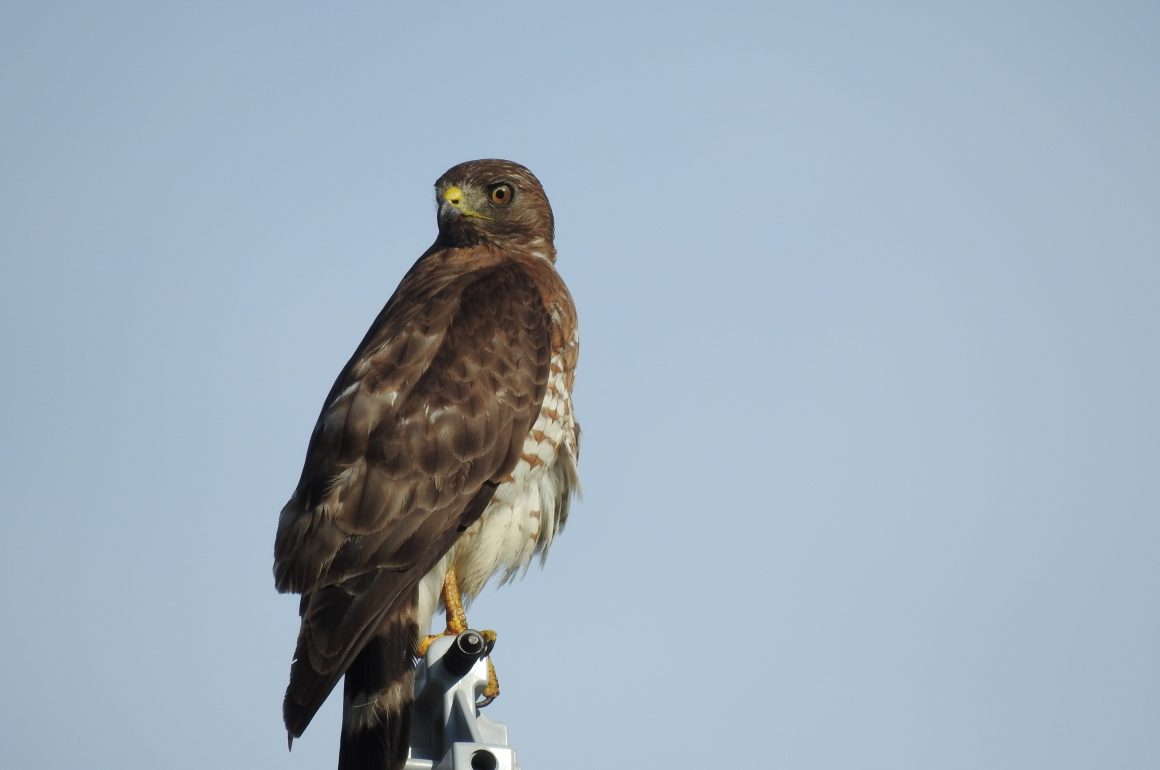
In September, one of the most-hoped for raptors is the Broad-winged Hawk. Among the earliest raptor migrants, Broadies fly in large flocks. Every fall, the entire North American mainland population heads south to their wintering grounds. Some go as far as South America. What makes this migration unusual is that the bulk of the migratory population passes any given point along their route in a two-week period.
These birds are forest buteos, who live in the boreal areas of Ontario and Quebec. They are a compact, crow-sized hawk and the smallest buteo passing over our raptor watches. They are a prey generalist, eating insects, small mammals, reptiles, and birds.
These raptors need to fly on thermals, which is the most energy-efficient way to migrate. They fly down from the north and then follow the shoreline of Lake Ontario before they head south into the US. They don’t fly over water because there is no lift or thermal generation. They typically fly after a cold front has passed through, with northwest winds pushing them along.

Kettle of Broad-winged Hawks
I remember my first experience with Broadies from 22 years ago. The sky seemed empty at first. Then, I noticed birds swirling in the distance. (My husband always said they were pepper spots, not birds.) Suddenly, there were hundreds of birds overhead. They would seem lower until they started moving up on the thermals. Once they reached the top of a thermal, they would see other Broadies and stream toward those birds that were in another thermal. That is why they are said to be “kettling”, because they are like the steam vapour bursting from a kettle’s spout.

Broad-winged Hawks (exhibiting broad tail bands and pale wings with dark tips and trailing edges)
In those first years, the raptor watches I attended had eight to ten thousand birds fly over. In more recent years, if there are two or three thousand birds, that is a good number. We were puzzled by the drop because other raptor watches still had amazing numbers of Broadies. All we could figure is that for some reason, they were flying north of Toronto and creating new migration routes.
Even with lower numbers, it is still possible to see kettles of Broadies. It’s what has me watching in September for northwest winds and some clouds to act as backdrops for these fascinating migrants.
Note: All photos are from Wikipedia Commons, an online source of copyright-free photos: Initial picture by Eric Dewsnap; kettle of Broad-winged Hawks by Rhododendrites; pair of Broad-winged Hawks by Gregory “Slobirdr” Smith.








Leave a Comment