

Highlights
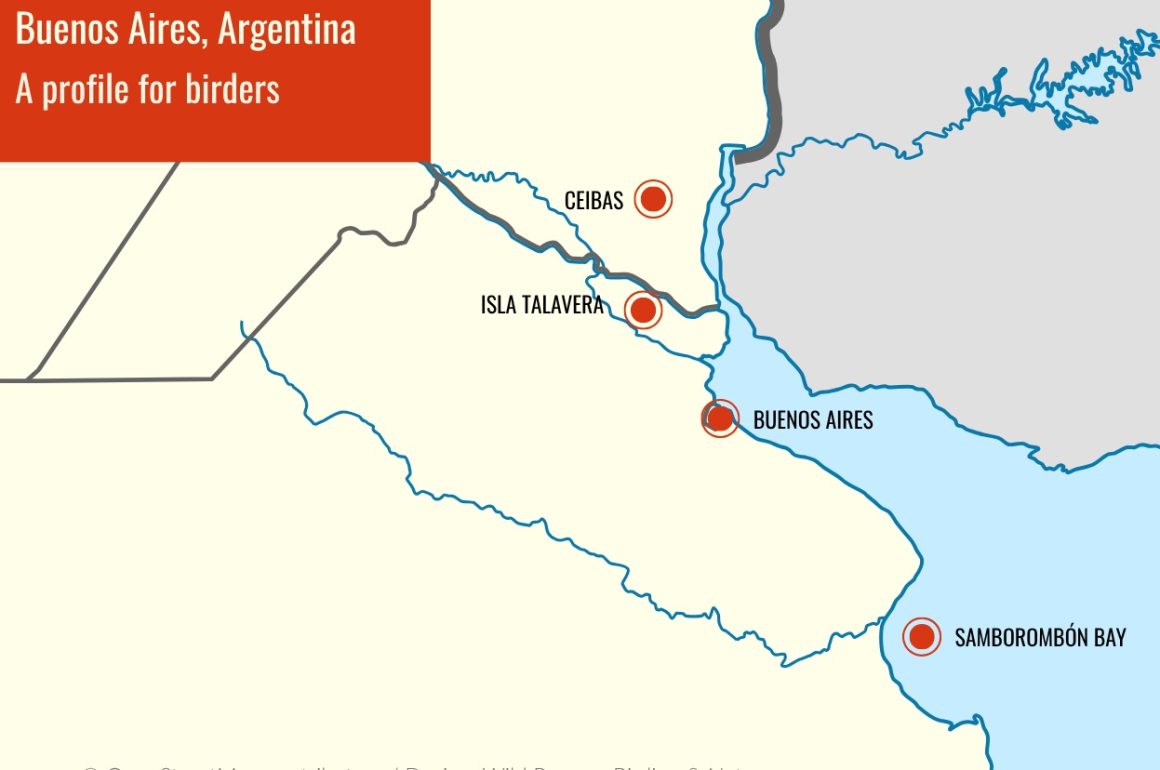
Buenos Aires sits where several Argentine landscapes meet and shift into one another. The city’s own reserves hold wetlands, open water, and woodland against the Río de la Plata. Upriver, the lower Paraná Delta runs in channels, reedbeds, and gallery forest. Farther north, across the river, southern Entre Ríos carries the espinal into open country. To the south, the Pampa Deprimida reaches the Atlantic at Samborombón Bay. None of these places is far from Buenos Aires, and the birding turns on the way; one habitat gives into the next. Buenos Aires works as the base for all of this.
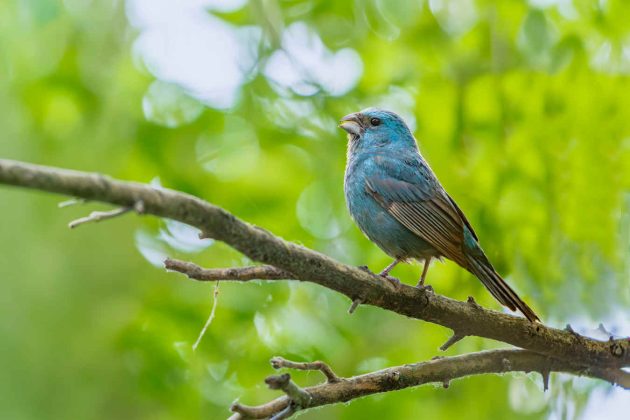
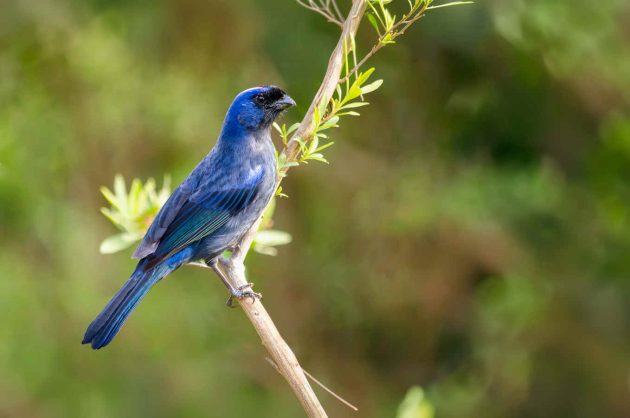
Glaucous-Blue Grosbeak (photo: Javier Pereyra)
Key Bird Species and Families
A selection of representative species across the region’s main habitats:
- Greater Rhea: the great open-country bird of the Pampas, with communal clutches and male-only parental care from clutches laid by several females.
- Southern Screamer: a large wetland bird of long pair bonds, territorial duets, and far-carrying calls.
- Dot-winged Crake: a tiny wetland crake whose recently clarified voice has changed the way birders find and map the species.
- South American Painted-snipe: a cryptic wetland bird of shallow water and low cover, appearing only when water, vegetation and timing agree.
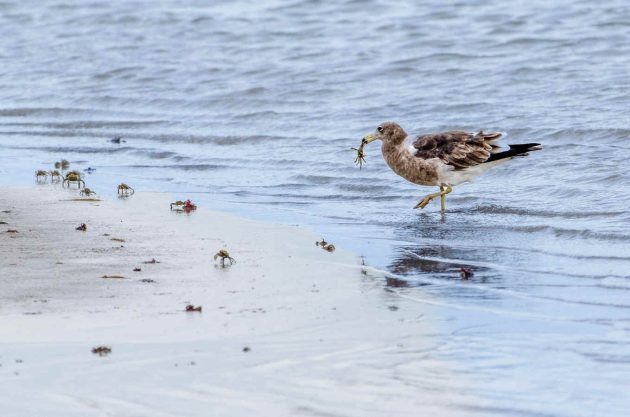
- Olrog’s Gull: a coastal specialist whose link with crab-rich tidal flats is visible in the way it walks the shore and probes for prey.
- Hudson’s Canastero: a secretive furnariid of native wet grassland, carrying W. H. Hudson’s name through a Pampas that keeps losing the habitat he knew.
- Bay-capped Wren-Spinetail: an elusive saltmarsh furnariid whose life depends on tall Spartina, one of the last refuges for high-grass birds in the Pampas.
- Straight-billed Reedhaunter: a local furnariid of wet Pampas caraguatales, moving low through Eryngium and exposing itself mainly when it sings to defend territory.
- Scimitar-billed Woodcreeper: a dry-woodland furnariid of espinal and Chaco, probing the ground as much as the trunks themselves.
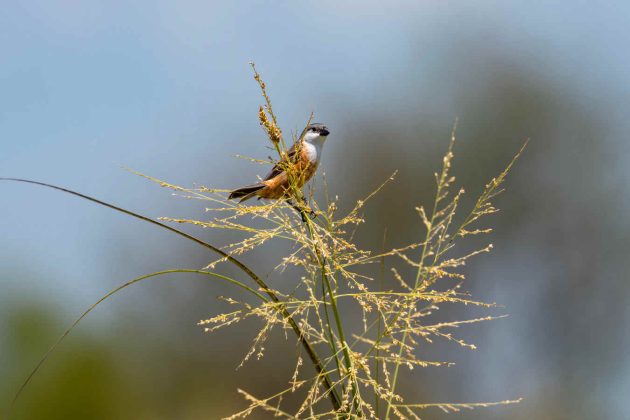
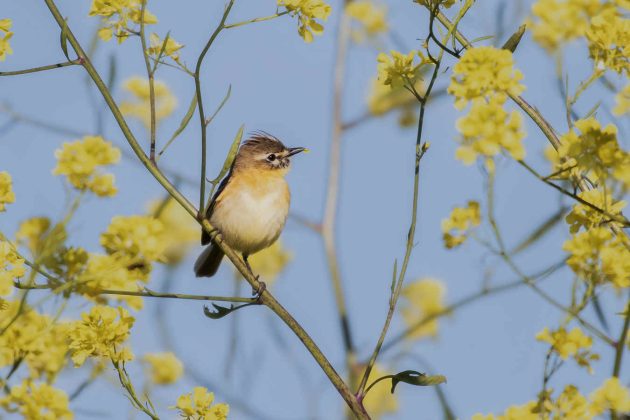
- Bearded Tachuri: a tiny grassland tyrant, often found by watching stems and flowerheads until song, movement, or wing-buzz gives it away.
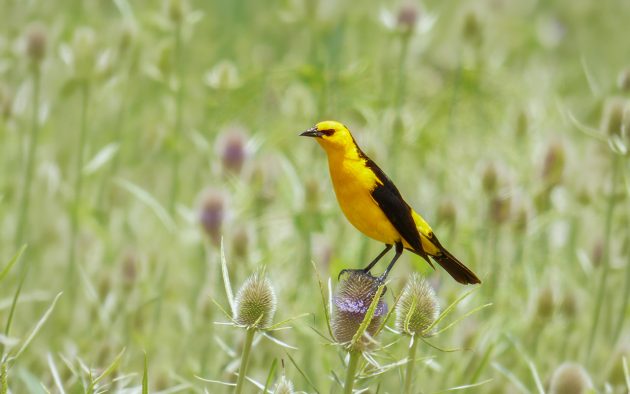
- Saffron-cowled Blackbird: a grassland-and-marsh icterid, tied to a habitat combination that has become one of the rarest things in the Pampas.
- Marsh Seedeater: a migratory Sporophila whose movements follow grass seed on the stem, linking wet breeding grasslands with distant tropical wintering areas.
- Glaucous-blue Grosbeak: a shy grosbeak of gallery forest and dense edges, following wooded river corridors down to Buenos Aires and the Río de la Plata, and shifting north in winter.
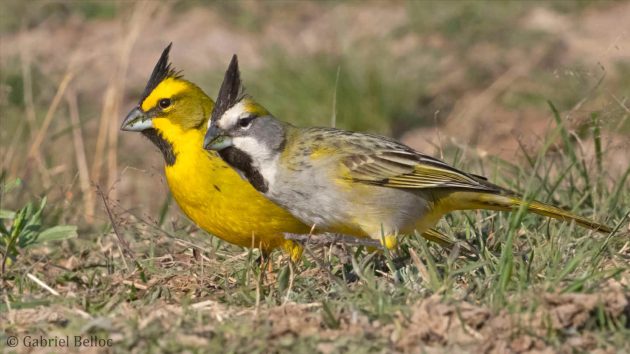
- Yellow Cardinal: a bird of mature espinal woodland, prized for its song and still carrying the cost of the cagebird trade.
Yellow Cardinals Pair (photo: Gabriel Belloc)
Best Regions for Birding
Buenos Aires has several urban reserves useful to a visiting birder. Vicente López and Ribera Norte hold short stretches of riverbank, the woods of Palermo can be productive on a quiet morning, and the best known of all is Costanera Sur Ecological Reserve, on the Río de la Plata bank, a short walk from downtown. Built on land reclaimed from the river, it now holds lagoons, reedbeds, grassland, and gallery woodland, with the river as its eastern boundary. Habitats meet at a short distance here, and the birds allow close views. Southern Screamer often stands metres from the path. A morning brings ducks, herons, and rails on the water, furnariids and tyrant flycatchers in the reeds, with Rufous-sided Crake among the more elusive presences, and woodpeckers, woodcreepers, and warblers along the wooded edges, including Checkered Woodpecker and Narrow-billed Woodcreeper.
Upriver from the city, the lower Paraná Delta spreads into islands, channels, and strips of gallery forest. Isla Talavera, reached by road across the Zárate-Brazo Largo bridge, sits at the southern edge of this system, where the day moves between water and forest. The reedbeds and reed-fringed channels carry the species that define the place. All three of the world’s reedhaunters occur here, and a single day can produce Curve-billed, Straight-billed, and Sulphur-bearded together, with Long-tailed Reed Finch in the same habitat. The riparian forest patches bring a different cast of birds. The canopy holds Dusky-legged Guan, reaching its southern range here, and Diademed Tanager. Listening matters as much as looking. Talavera is a place where the south of one bird world meets the north of another.
Across the river, southern Entre Ríos carries the espinal into open country. Around Ceibas, and farther north and east toward Gualeguay, Perdices, and Médanos, the birding moves along rural roads through a landscape that changes every few hundred metres. Espinal woodland, open grassland, wet meadows, and flooded fields sit close to one another. The woodland holds Scimitar-billed Woodcreeper, Brown Cacholote, and Lark-like Brushrunner, with woodpeckers and flycatchers in the same low trees. The open ground brings Greater Rhea, White-browed Meadowlark, and the pipits. In wet years, flooded fields and grassland edges add Saffron-cowled Blackbird and several migratory Sporophila seedeaters. Glaucous-blue Grosbeak appears in forest edges and gallery woodland. Yellow Cardinal occurs in mature espinal, although the species is no longer easy to find anywhere in its range.
Where the Río de la Plata widens into the Atlantic, the Pampa Deprimida reaches the coast at Samborombón Bay. The scale opens slowly, and distance becomes the dominant feature of the landscape. Open grassland holds Hudson’s Canastero, Bearded Tachuri, and Hellmayr’s Pipit. Channels, streams, and seasonal lagoons cut across the plain, with Many-colored Rush Tyrant in the juncal and Bay-capped Wren-Spinetail in the reedbeds. Old tosqueras, abandoned clay pits now held as stable water, concentrate waterfowl in numbers. Relict patches of talar woodland sustain Firewood-gatherer and Tufted Tit-Spinetail. The bay itself, where the rivers reach salt water and the tide governs the day, holds shorebirds, terns, skimmers, and a coastal gull whose life is tied to the crab-rich tidal flats. Winter brings southern arrivals, with Austral Negrito and Chocolate-vented Tyrant among the most reliable.
Marsh Seedeater (photo: Javier Pereyra)
Best Birding Season
Buenos Aires can be birded year-round. Spring and summer bring song, breeding activity, and summer visitors, especially among flycatchers, swallows, seedeaters, and grassland birds. Autumn and winter open a different season altogether. The city’s reserves see arrivals like White-tipped Plantcutter, Buff-winged Cinclodes, and Dark-faced Ground-Tyrant, and Fawn-breasted Tanager turns up in gallery woodland. The open country of southern Entre Ríos and Samborombón Bay receives southern birds moving north, with Austral Negrito, Black-crowned Monjita, and White-banded Mockingbird among the most reliable, and Chocolate-vented Tyrant or Rufous-chested Dotterel as less frequent but possible additions. From the second half of the year, skuas can be seen along the Atlantic coast.
Olrog’s Gull (photo: Javier Pereyra)
Birding Trip Suggestion
A focused itinerary of five or six days covers the four regions at a working pace. The first day leaves Buenos Aires early for a morning at Isla Talavera, with lunch in Ceibas and an afternoon in the Espinal of southern Entre Ríos, and overnight in Ceibas. The second day follows rural roads around Ceibas for migratory Sporophila seedeaters and other specialties, with owling at the close of the day and overnight in Ceibas or Gualeguay. The third day moves through the Gualeguay sector before the return drive to Buenos Aires. The fourth and fifth days head south to Samborombón Bay, with an overnight in General Lavalle or San Clemente, reaching both the northern coast and the southern sectors of the bay. An optional sixth day closes at Costanera Sur, an unhurried morning to revisit local targets, fill gaps, and watch common species at close range. Shorter formats can be built around any combination of these regions, including single-day or half-day visits for travelers with limited time. For those joining or leaving an Antarctic cruise, the buffer days before or after fit naturally with any of these destinations.
Saffron-cowled Blackbird (photo: Francisco Táboas)
Practical Tips
Most trips begin in Buenos Aires. Costanera Sur, Isla Talavera, and Samborombón Bay are all reached from the city. For southern Entre Ríos, multi-day routes usually stay in Ceibas or Gualeguay, while Samborombón Bay extensions stay in General Lavalle or San Clemente. The two airports are Ezeiza International (EZE) for international flights and Aeroparque (AEP) for domestic flights, which matters for travelers combining the trip with Patagonia, Iguazú, or other destinations. A spotting scope is essential for much of the open country at Samborombón Bay and southern Entre Ríos, where birding is often at a distance. Rural roads in these regions can become difficult after heavy rain, and the route is rebuilt around what conditions allow on the day. English is widely spoken in hotels and tourist areas of Buenos Aires city, but Spanish is helpful for taxis, public transport, and local stops, and is essential in the field. The city is well connected by an inexpensive public transport network of subway, train, and buses.
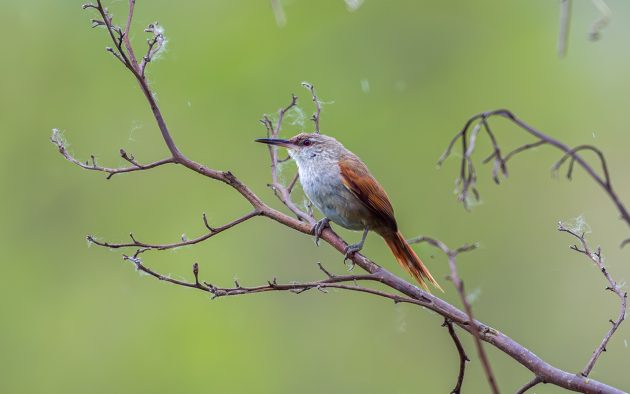
Straight-billed Reedhaunter (photo: Javier Pereyra)
Links
- Wild Pampas Birding & Nature
- Aves Argentinas, the national ornithological society
- Fatbirder country guides for Buenos Aires city and southern Entre Ríos
- eBird hotspots:
- Costanera Sur Ecological Reserve (ebird.org/hotspot/L472208)
- For Isla Talavera, the Isla Talavera hotspot (ebird.org/hotspot/L22501772) and Camino a Camping Buena Onda y Canal Alem (ebird.org/hotspot/L30041787).
- For southern Entre Ríos, Ceibas Terraplén (ebird.org/hotspot/L2762863) and Ceibas camino Cuatro Hermanas (ebird.org/hotspot/L2762853).
- For Samborombón Bay, Reserva Natural Municipal Punta Rasa (ebird.org/hotspot/L496005) and Estancia El Palenque (ebird.org/hotspot/L16619305).
Bearded Tachuri (photo: Javier Pereyra)
By Javier Pereyra
Javier Pereyra is a Buenos Aires-based bird guide, licensed to guide in El Palmar National Park and Ciervo de los Pantanos National Park, and an active member of Aves Argentinas. He guides in English and Spanish, with deep field knowledge of the Pampas, the Paraná Delta, Entre Ríos, and the Río de la Plata coast. Wild Pampas is his own operation, built around private guiding and a direct, unhurried approach to the field.
Diademed Tanager (photo: Javier Pereyra)







Excellent information, very useful. Thank you!