
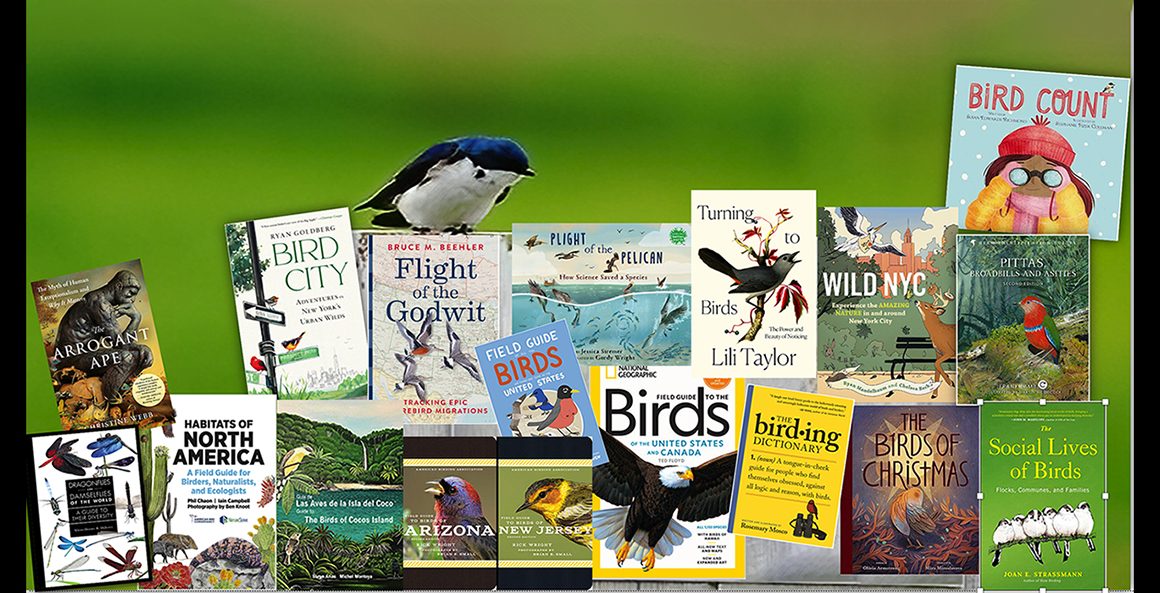
Thank the birding goddesses for books! In a year full of natural and human challenges, books have been a source of comfort, insight, and inspiration. Here are our Favorite Titles of 2025, selected by 10,000 Birds reviewers and writers. These are books we enjoyed reading or using as birding resources, that we think are notable because of a unique subject, excellent writing, a high level of expertise, and that we think would make outstanding holiday gifts. We cast our nets wide, because an interest in birds can’t help but expand into an interest in nature and the environment. We all have our individual specific preferences, so if you don’t see a 2025 title you enjoyed here, add it in the comments. All birding and nature are welcome!
Birding books explored a range of topics in 2025, from natural histories to humor to books for nature neophytes to classic field guides to beautifully illustrated and informative books for children.
NATURAL HISTORIES, PERSONAL HISTORIES
 One of my favorites in the natural history category is Flight of the Godwit: Tracking Epic Shorebird Migrations by Bruce M. Beehler (Smithsonian Books). A personal narrative by ornithologist Beehler, he takes us along as he travels across North America during the Covid years, tracking the migration routes and exploring the northern nesting sites of seven charismatic shorebirds. The focus is his personal favorite, the Hudsonian Godwit, a large, striking, super-migrator that can be frustratingly elusive, but many other shorebirds make appearances. Fact sheets on over 30 shorebirds reinforce the information Beehler effortlessly gives us as he enjoys the beauty of the United States and Canada and the wonders of solo road tripping.
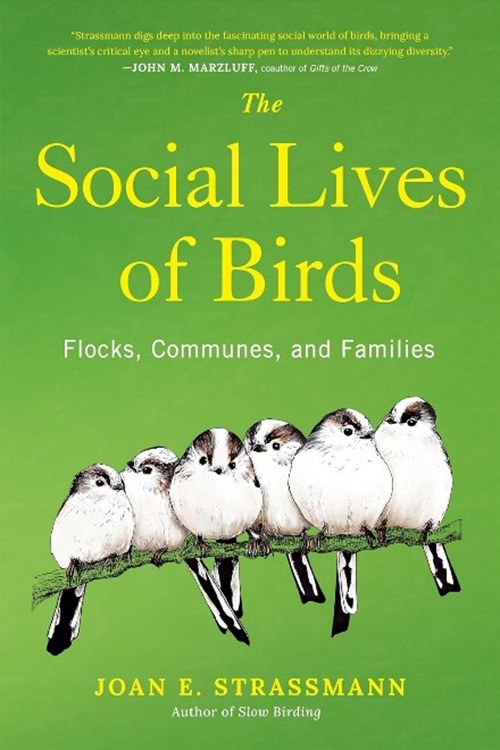 The Social Lives of Birds: Flocks, Communes, and Families by Joan E. Strassmann (Tarcher) is one of Kai Pflug’s selections. This broad and readable overview of the meaning and importance of birds’ social lives–from migrating in flocks to roosting together to communal nesting and group child rearing–stresses its multiple functions and benefits, but also its negative aspects, such as increased competition. In her interview with Kai, Strassmann comments, “Social Lives of Birds is written for anyone who wants to learn about birds and get a peek into the lives of ornithologists. You might be surprised at the stories I’ve been told! I do have references, so anyone who wonders where I got the information can look at the notes. It is not a technical book, though. I imagined what it would be like to listen to, and I narrated it myself. I hope readers from all backgrounds enjoy it!”
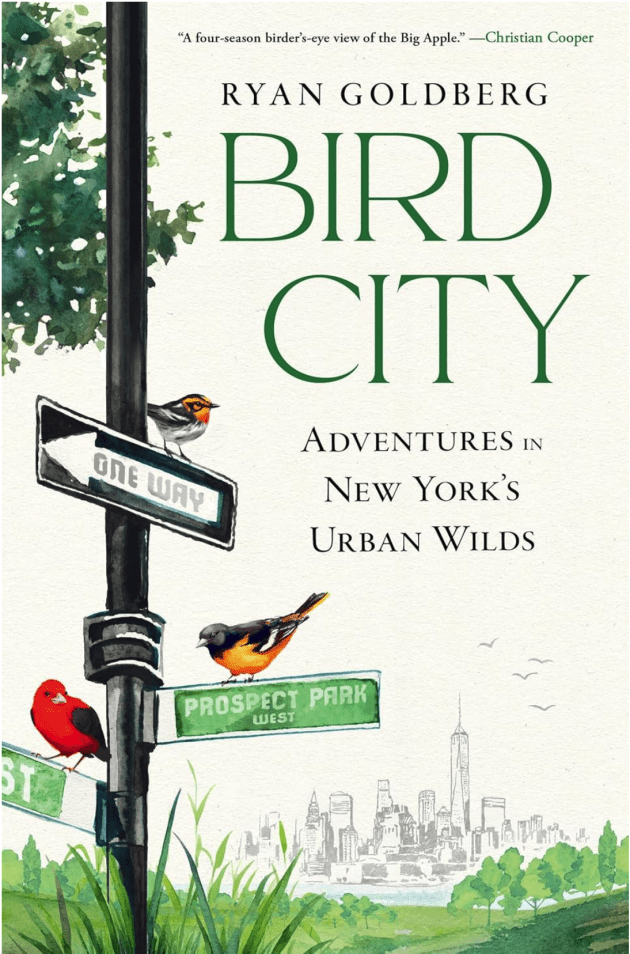 I may be biased towards Bird City: Adventures in New York’s Urban Wilds by Ryan Goldberg (Algonquin Books) because it’s about my home town, but I sincerely think readers from all over will appreciate this reporting of birding experiences in New York City’s five boroughs. Goldberg writes about his participation in birding events (water fowl counts, Christmas Bird Counts), monitors birds caught in the 9/11 Tribute in Light in downtown Manhattan, interviews researchers and conservationists about grassland and river projects in Staten Island and the Bronx, celebrates his favorite hotspots in Brooklyn and Queens, and most importantly tells the stories of birders he meets who have influenced the state of birds and habitat in New York. The adventures are specific but the larger issues are universal: why urban birding matters.
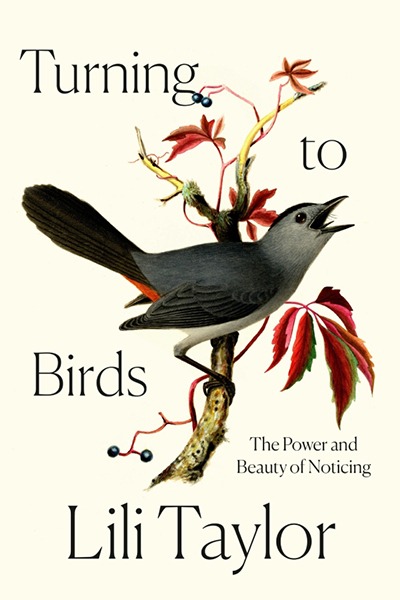 Actress Lili Taylor presents a more personal approach to birding in New York City and the many other places her acting and personal life has taken her, in Turning to Birds: The Power and Beauty of Noticing (Crown). In thirteen essays, she writes about how she learned to use the skills of her acting craft to consciously observe birds and how observing birds has, in turn, inspired her curiosity and wonder. Her essays tell wonderful stories–her first birding festival, figuring out how to build birdhouses for finches on a bare movie set, observing chimney swift roosts with her mother, figuring out how to bird in the desert at another film location–in an engaging yet elegant style. I think birders who enjoy good writing and smartly crafted essays will enjoy this book.
 Kai recommends The Arrogant Ape: The Myth of Human Exceptionalism and Why It Matters by Christine Webb (Avery/Penguin Random House), a book also on the New York Times Notable Book list of 2025. (Kai recommended this title way before that list came out, illustrating that he knows a good book when he reads one.) Here is an excerpt from his introduction to the 10,000 Birds interview with author Christine Webb:
When I first read the title The Arrogant Ape: The Myth of Human Exceptionalism and Why It Matters, I knew I had to read it. Why? I’ve always suspected that humans glorify their own species, just as individuals tend to glorify themselves. In my work as a management consultant, I’ve never heard a client say their problems were simple — everyone insists their work is more complex, their challenges more daunting than anyone else’s. If this is true at the individual level, why wouldn’t it apply at the species level too?
Webb puts it more sharply: “Psychologists have shown that people overemphasize their own abilities and accomplishments to conceal actual feelings of shortcomings and failure. When it comes to other species, do we have a so-called superiority complex?” She argues that this superiority complex — human exceptionalism, or anthropocentrism — lies at the root of the ecological crisis. It grants us a sense of dominion over nature, the entitlement to commodify other species, and it is backfiring badly: forest fires, sea-level rise, mass extinctions, even pandemics. Webb quickly dismisses the claim that humans are exceptional simply because we have distinctive traits: “All species have evolved specialized adaptations to their environments. If humans are unique, then every species is unique. However, human exceptionalism is different from human uniqueness. Human exceptionalism suggests that what is distinctive about humans is more worthy and advanced than the distinguishing features of other forms of life.” With sharp arguments, cultural references (even The Onion), and personal stories, The Arrogant Ape makes a strong case.
INTRODUCTIONS TO BIRDING & NATURE (with fun & humor)
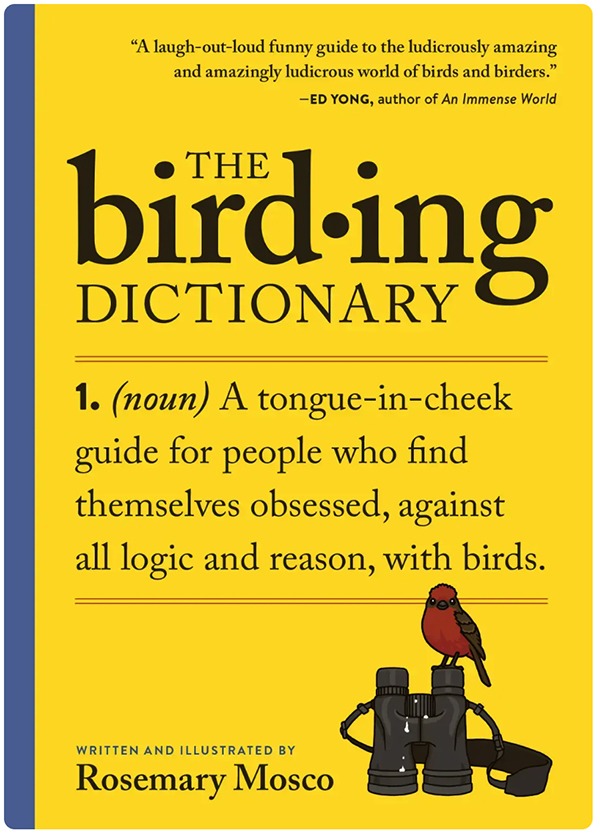
In The Birding Dictionary (Workman Publishing), Rosemary Mosco applies her cheeky sense of humor and delightful drawings to scientific and idiomatic terms of the field. Though her definitions are clearly tongue-in-cheek (it even says so on the cover!), most also mix in hard core definitions. Precocial, for example: “Hatching out with open eyes and a full coat of down feathers. A precocial chick grows up very fast, so it can scurry out of the nest shortly after hatching, sending the parents dashing after it across the beach or forest floor to give it some pointers before it tries to drive a car or sign up for a credit card.” This small book will expand your birding knowledge base (or that of your newbie birding parent, child, or neighbor) as you laugh.
 Also in the humor category is Field Guide of All the Birds We Found One Year in the United States written and illustrated by Quentin Reiser with commentary by Own Reiser. This self-published companion to the mega-hit (at least in the birding community) Listers continues the Reiser brothers’ outrageous approach to doing a big year while learning how to bird. Reviewer Catherine Carroll notes that the book is hilarious, giving her belly laughs at 1:30am, and astonishingly clever, with illustrations that are completely charming and startlingly accurate. And it’s not all laughs, the authors share their discovery that birding can sometimes be bittersweet, as we well know.
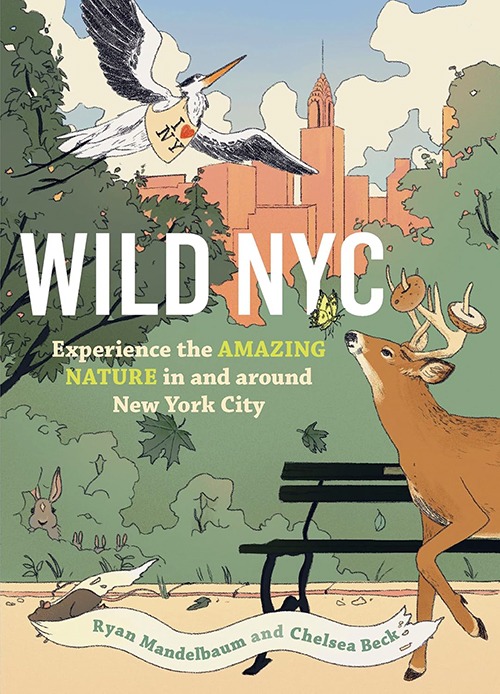 If you live in or near New York City, I highly recommend Wild NYC (Timber Press, published April 2024 but I didn’t read it till 2025), an enthusiastic, loving introduction to the trees, fungi, plants, invertegrates, fish, reptiles and amphibians, birds, mammals, parks, hotspots, and overall ecology of the five boroughs and a bit beyond. Written by Ryan Mandelbaum and illustrated by Chelsea Beck, with photographs from both creators and archival sources, WildNYC offers knowledgeable routes and pathways towards becoming an urban naturalist or simply a curious city citizen. There are species accounts, suggested field trips, a history of New York City’ ecology, the stories of some of the city’s young environmental researchers, and a chapter on urban naturalist basics–tools and tech, ethics, and what to do if you find an injured animal. Mandelbaum, a science writer and Brooklyn birder/naturalist, writes with humor and intelligence; in addition to his own personal experiences in New York, he’s clearly done his research. I certainly learn a lot every time I read it.
BOOKS FOR CHILDREN
Susan Wroble, our Kidlit specialist, recommends three delightful books for holiday reading and gift giving:
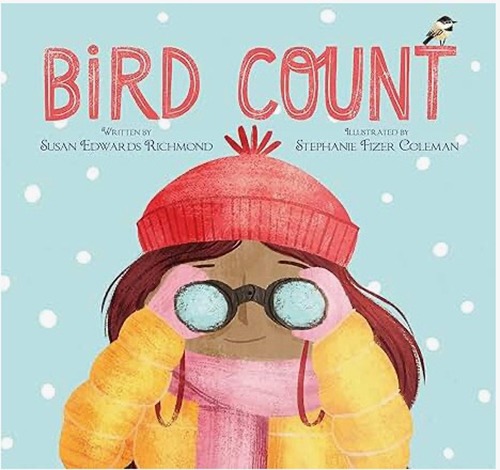
Bird Count by Susan Edwards Richmond, illustrated by Stephanie Fizer Coleman, Peachtree, 2019. If your holiday plans include the Christmas Bird Count and there are kids in your life, considering getting a copy of the picture book Bird Count by Susan Edwards Richmond, illustrated by bird artist Stephanie Fizer Coleman. Despite its name, the Christmas Bird Count (CBC) does not fall on Christmas. It’s an annual census of birds in the Western Hemisphere, and takes place anytime between mid-December and early January. It’s a great activity to introduce children to birding, and reading this book beforehand would be a fabulous place to start.
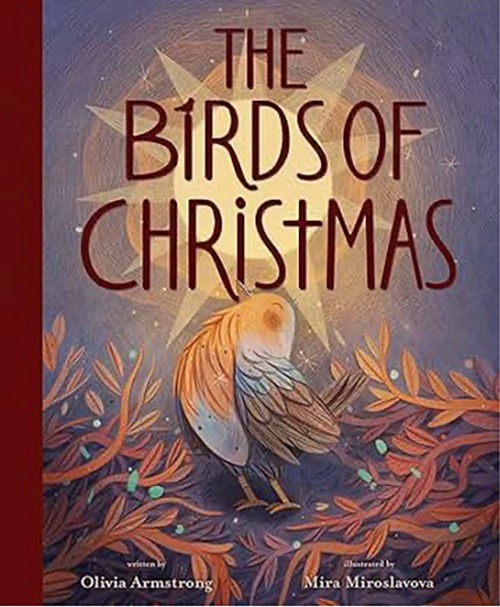
The Birds of Christmas, written by Olivia Armstrong and illustrated by Mira Miroslavova, Eerdmans Books for Young Readers, 2025. For families who celebrate Christmas and who have young children (and for anyone who collects Christmas books) The Birds of Christmas is a perfect gift. Author Olivia Armstrong’s storytelling background makes this book a joy to read aloud, with word choices that are lyrical and precise. The warm brown palette of Mira Miroslavova’s illustrations drops readers from the cold of the night into the warmth of the stable. Christmas books are their own special genre, and having one that celebrates birds is its own special gift.
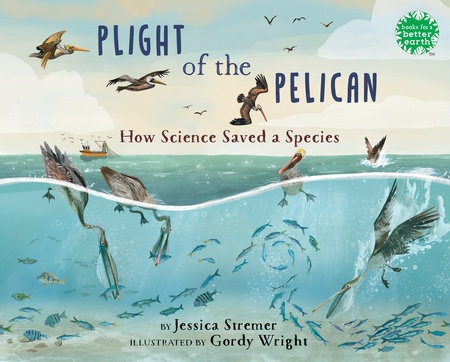 Plight of the Pelican, written by Jessica Stremer, illustrated by Gordy Wright, Holiday House Publishing, 2025. In Plight of the Pelican: How Science Saved a Species, author Jessica Stremer uses the decline of pelicans to explain how scientists were able to identify the impact of pesticides on birds. As the national bird of the United States, the Bald Eagle is usually held up as the poster child to highlight the impacts of the pesticide DDT. But DDT’s impact wasn’t limited to eagles, and Jessica’s choice to center this book on brown pelicans broadens the story. This book is part of publisher Holiday House’s “Books for a Better Earth” collection, focusing on solutions to climate change challenges. These books are designed to inspire young people to become knowledgeable participants in caring for our planet.
REFERENCE BOOKS: FIELD GUIDES, HABITAT GUIDES, A SITE GUIDE, THREE BIRD FAMILIES, ODONATES!

National Geographic made field guide aficionados happy this year with three–count them, THREE–completely rewritten, reorganized, and retitled editions of its North American field guide series. First they published National Geographic Field Guide to the Birds of the U.S. and Canada East, 2nd edition and National Geographic Field Guide to the Birds of the U.S. and Canada West, 2nd edition in February, and then they issued National Geographic Field Guide to the Birds of the United States and Canada, 8th edition in September. Ted Floyd has completely rewritten species accounts and added genus descriptions; Andrew Guttenberg has added new illustrations, including birds of Hawaii; distribution maps are now based on eBird data; all editions offer updated species names and taxonomic order as of 2023 (the large book also includes an Appendix with 2024 updates). The 8th edition covers 911 species that occur regularly, with long descriptions for 707 species; it’s larger size allows for renewed appreciation of the artwork and its annotations (less cluttered than previous editions). With so many taxonomic changes every year and with so many years since the last editions of Sibley’s and Peterson’s guides, it’s hard to resist these books.
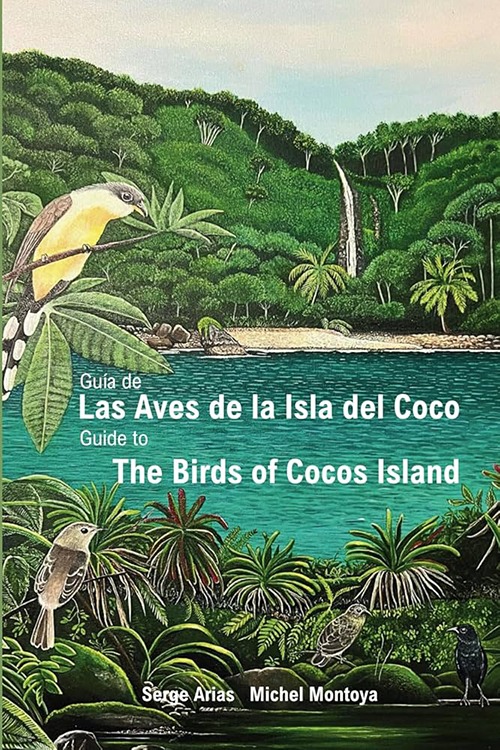 Dragan recommends Guide to the Birds of Cocos Island/Guia de las aves de la Isla del Coco by Arias & Montoya (published by Costa Rica Birding). It may technically be a book, but in reality, it is a treasure island map leading you to a certain spot in the Pacific Ocean, 550 km (342 mi) off the coast of Costa Rica. On my bookshelf, I have a sailing travelogue by a Croatian author Joza Horvat, who passed through the Panama Canal in the 1960s, when a con man offered him a map of pirates’ treasure on Cocos Island. Reputedly, the stories of buried treasure on this very island inspired Robert Louis Stevenson, yet hundreds of attempts to find it have failed. Unlike Horvat’s con man with a dream of Spanish doubloons, Serge Arias is offering something real and achievable: three feathery gold pieces.
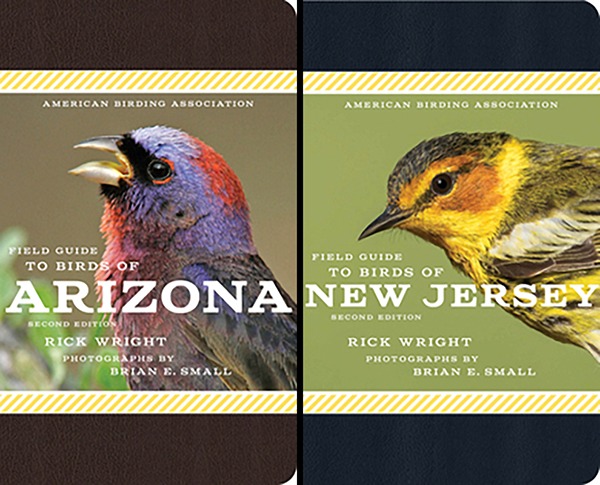 The American Birding Association Field Guides are always excellent gifts for beginning birders and this year they’ve updated guides to two popular birding states: ABA Field Guide to Birds of Arizona, Second Edition and ABA Field Guide to Birds of New Jersey, Second Edition, both by Rick Wright with photographs by Brian E. Small (Scott & Nix). In the nine and eleven years since these field guides were first published, names have changed, species have been split and lumped (think Western Cattle Egret, Blue-throated Mountain Gem, Northern House Wren, Canada Jay, Western Flycatcher, Chihuahuan Meadowlark), taxonomic order has shifted. The new editions incorporate changes that have occurred through 2024 and also updates sections of the Introductions to reflect updated birding resources and, for New Jersey, birding sites.

Birding is about habitat. In 2021, Princeton University Press published Habitats of the World, offering a new way to look at birds. Four successor continue this unique look at ecosystems: Habitats of North America by Phil Chaon and Iain Campbell and Habitats of Africa by Ken Behrens, Keith Barnes and Campbell, published in 2025; Habitats of Europe by Dale Forbes, Iain Campbell, and Pete Morris and Habitats of Australia, New Guinea, and the Solomons by Iain Campbell, Charley Hesse, and Phil Gregory to be published in 2026 (shoutout to Dale, a former 10,000 Birds beat writer!). The regional focus makes these books much more useable, offering tools for knowing what birds (and mammals, reptiles, amphibians, and plants) to look for in specific habitats and for appreciating the complex ways in which nature functions and changes.f
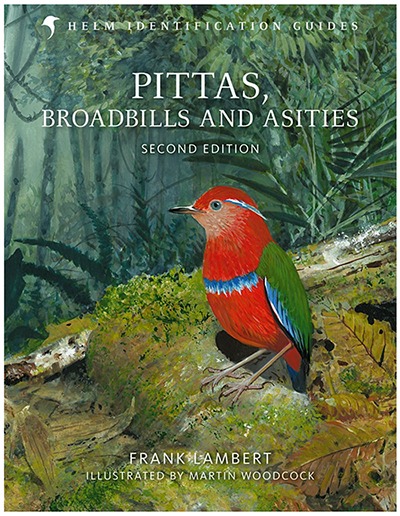 Pittas, Broadbills and Asities, Second edition by Frank Lambert (Bloomsbury), is another excellent selection by Kai, one he read because he wanted to. He writes: This is a follow-up to the first edition, published by the same author in 1996, part of the Helm Identification Guide series. It collects all that is known about some of the most fascinating bird families in the world – Pittas, Broadbills, and Asities (a very small family–four species). It is very nicely illustrated as well, both with photos and drawings. Not a book to read in one go as it is mostly a species-by-species description, but one to drool over while thinking about another birding trip.
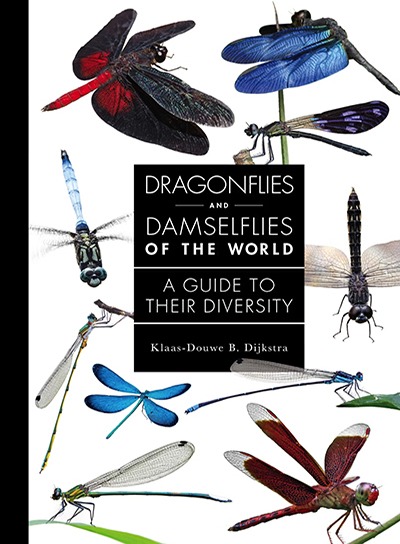 As a postscript to this varied listing of our favorite birding and nature books, I add Dragonflies and Damselflies of the World: A Guide to Their Diversity by Klaas-Douwe B. Dijkstra (PUP). There are over 6,400 species in the order Odondata, organized into 690 genera, and if you’ve ever tried to identify a dragonfly or damselfly from another country, you know how confusing it can be. This book is a deep-dive introduction to major groups of odonates, with an emphasis on evolutionary radiation as well as physical description, habitat, behavior, and geographic distribution. You may not definitively identify that gorgeous red dragonfly you photographed in Africa, but this beautifully illustrated book will help narrow down the possibilities.



An overwhelming list of great reading! Thank you, Donna, for compiling this. This list has introduced me to books I am definitely going to pick-up. It’s really fun to find the niche “hobby” of birding recognized in so many different categories. Such lists add an extra zing to this time of year.