
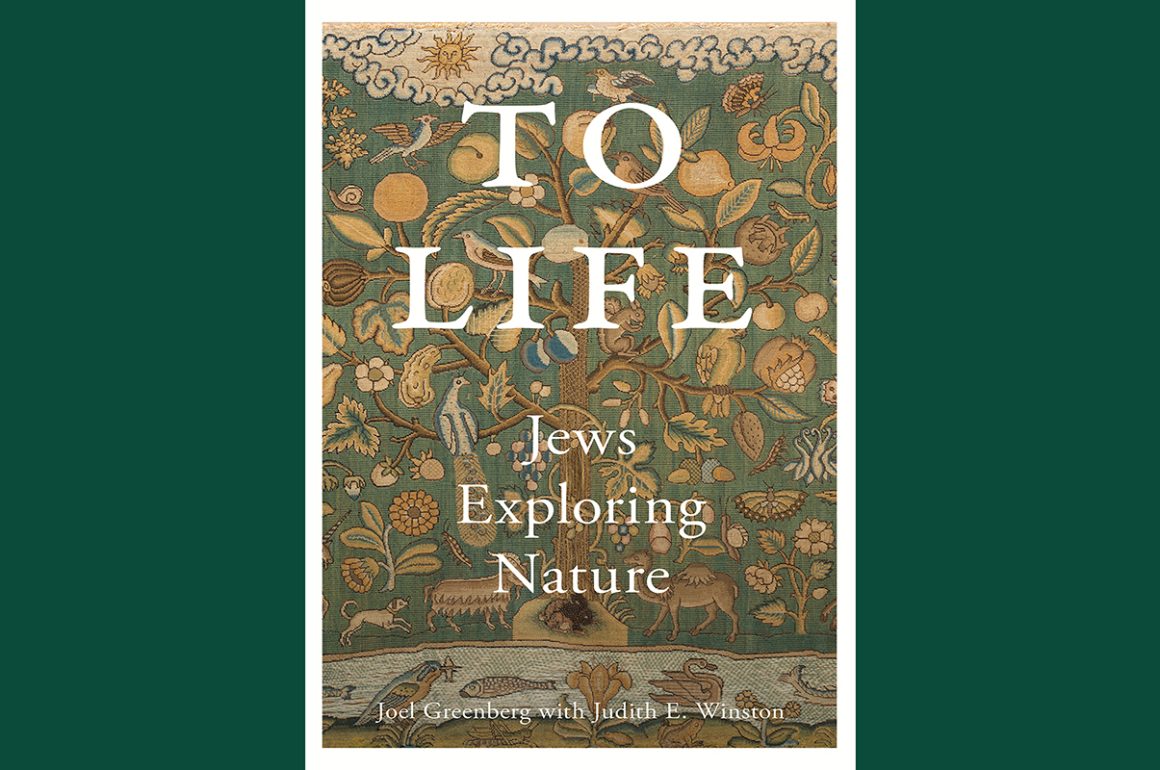
We think birds are fascinating. Human beings may rival birds in lives that are unexpectedly rich in adventure, rebellion, and quiet, discerning forays into unexpected tunnels of knowledge, combined, as birds’ lives tend to be, with loving, problematic family and social attachments. In To Life: Jews Exploring Nature, Joel Greenberg and Judith Winston present the lives of eight naturalists (Winston contributed one significant chapter) whose lives revolved around nature. The uniting factor is their Jewish heritage and identity, which plays varying degrees of influence on their upbringing, life choices, and career paths. In the larger sense, as Greenberg points out in his introduction, “The People of the Book Venture Outside,” for many years there was a “convention” of Jewish people pursuing indoor, urban, “bookish” lives, alienated from nature, rooted in a history that limited their legal rights to own or rent land or even live outside of predetermined areas in many countries. Mathematics, astrology, medicine–yes; biology, zoology, ornithology–what, are you crazy? There are bugs, mud, and bears out there! (That’s my grandmother talking, not Joel Greenberg.) Greenberg’s goal is to tell “compelling individual stories that illustrate Jewish involvement in natural history (often having to overcome various obstacles) and Jewish contributions to the relevant field of science, as well as portals into the fields they explored” (p 2). The biographies offer examples, mostly inspiring (there is one figure here who may shock some readers), of what it took to be a pioneering, innovative scientist in the early and mid-20th century, and, for us birders, insights into the puzzles and language of other fields related to the natural world.
The eight people portrayed in this collective biography represent a spectrum of natural science careers and sometimes other unusual life activities. We have a botanist and spy (Aaron Aaronsohn); a zoologist (Libbie Henrietta Hyman); an ornithologist and murderer (Nathan Leopold); a neotropical mammalogist and adventurer (Philip Hershkovitz); an arachnologist (Herbert Levi); a herpetologist (Hymen Marx); a public health entomologist (Andrew Spielman); and an environmental scientist (Joan Ehrenfield). There are two women, three university professors, and three museum curators (some overlap with professors there). Four scientists were associated with the University of Chicago and/or the Field Museum of Natural History in Chicago, Greenberg’s home city. Two immigrated as a child and a teenager to their new homes (Romania to Israel for Aaronsohn, Hitler’s Germany to the U.S. for Levi); two were children of East European immigrants; three were grandchildren of East European immigrants; most had parents or grandparents affected by pogroms (mob attacks), the threat of forced conscription, or the forced loss of property and civil rights. Each of the eight have made significant contributions to their respective scientific fields, many have had new species named after them, and received awards from prestigious scientific organizations, most have substantial Wikipedia articles describing their careers. Perhaps most importantly, many of these scientists mentored–formally as advisors, informally as colleagues or in answer to youngsters’ questions–current scientists and naturalists who are continuing and expanding on their research and discoveries. Whether it be describing new species of spiders, understanding the ecology of the New Jersey Pine Barrens, or discovering exactly how ticks feed on other organisms this is important work that contributes to our understanding of our world and how it’s changing.
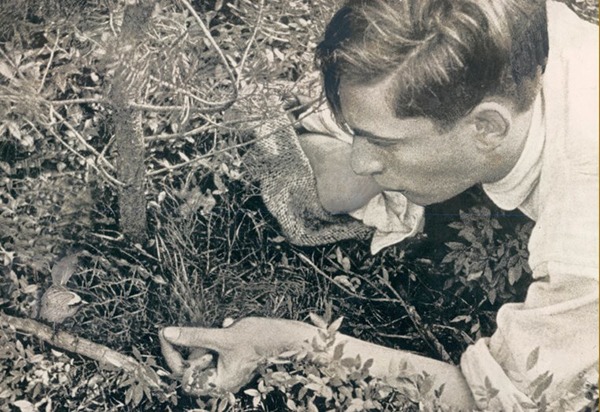
Photo still of Nathan Leopold feeding a Kirtland’s Warbler from Leopold, N. F. Jr. (1924) “The Kirtland’s Warbler in Its Summer Home,” The Auk: Vol. 41: Issue 1, Article 5. Available at: https://digitalcommons.usf.edu/auk/vol41/iss1/5; “this Content is brought to you for free and open access by the Searchable Ornithological Research Archive at Digital Commons @ University of South Florida”
One name that leaps out of this brilliant roster, at least for me is Nathan Leopold. Doesn’t ring a bell? How about Leopold and Loeb? Alfred Hitchcock’s 1948 film Rope? The 1990 Columbo television episode, “Columbo Goes to College”? Nathan Leopold, scion of a wealthy German-Jewish Chicago family, and his friend Richard Loeb kidnapped and killed a 14-year-old boy in May 1924 in an effort to prove that they were so intellectually superior to everyone else that they could commit ‘the perfect crime.’ The infamous murder inspired 19 nonfiction books, according to Greenberg, and at least 190 fictional pieces, including the film and TV show named above, an off-Broadway musical, a graphic novel, novels, songs, poems, and several other TV episodes. These works focus on the young men’s relationship, intellect, and class. But discerning birders may have read about Nathan Leopold the birder in Susan Fox Roger’s essay “The Other Leopold,” in her collection Learning the Birds, or from a short video posted to the Internet by the Field Museum, or in a wonderful book about the Kirtland’s Warbler. Remarkably, Nathan Leopold contributed important early research about Kirtland’s Warbler before he committed his so-called perfect crime, the observation that a key factor in their scarcity is Brown-headed Cowbird parasitism. Ironically, a key piece of evidence in the case, a pair of glasses found in the area of the body, was probably dropped while Leopold was birding. He continued birding while in prison and after his release on parole, as part of a new life in Puerto Rico, compiled a Checklist of Birds of Puerto Rico and the Virgin Islands and documented proof that Plain Pigeon, thought to be extirpated on the island, was still a presence. Greenberg tells Leopold’s story, still engrossing even for those of us familiar with it, with an emphasis on his birding and the added framework of his German-Jewish family and community and his Jewish identity. Apparently, the tradition in which he was raised was strong enough that he said kaddish (mourner’s prayer) when he visited his parents’ graves after his release, even if it didn’t prevent him from illegally killing some of the Kirtland’s Warblers he observed as a teenager or commit murder. Interestingly, Greenberg doesn’t comment on the irony, he approaches Leopold’s story with a detached fascination, presenting the two sides of a man who was both monster and lover of nature.
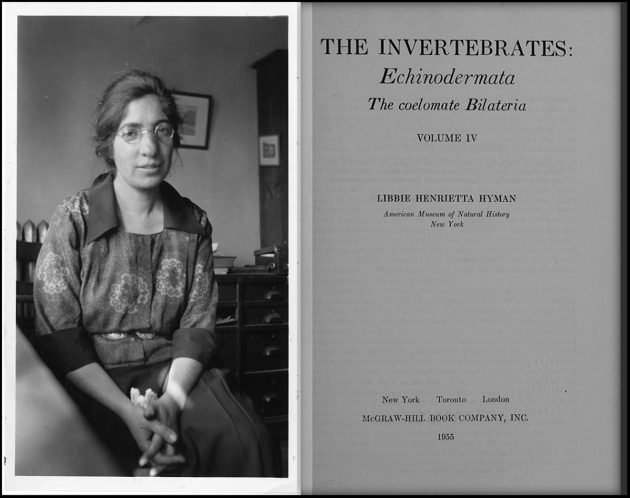
Libbie Henrietta Hyman (1888-1969); Smithsonian Institution Archives, Accession 90-105, Science Service Records, Image No. SIA2008-4247; https://siarchives.si.edu/collections/siris_arc_297446 and the cover of one of the volumes of her great achievement, the six-volume treatise The Invertebrates.
Libbie Henrietta Hyman and Joan Ehrenfeld, the two women presented here, couldn’t be more different in background, careers, personality, and family life. Representing two very different eras for women in science and American Judaism, I found both lives fascinating. Hyman’s chapter was written by Judith Winston, a researcher of marine invertebrates herself, who edited and contributed to a special issue of the journal Novitates presenting papers given at a special symposium on Hyman’s life and works (Nov. 1999). Libbie Hyman was born in 1888, the daughter of East European and German immigrant parents, and grew up in Fort Dodge, Iowa. From her father she got access to an eclectic library, from her mother she got discouragement and was assigned constant housekeeping chores. Although she graduated valedictorian of her class, she had no direction to her life and was working in a factory when a chance encounter with her favorite high school teacher led to a one-year scholarship to the University of Chicago, where she stayed for the next two decades, getting an undergraduate degree, a Ph.D. in zoology, and working for 16 years as assistant to zoologist Charles Manning Child. She ended up in zoology rather than her first scientific love, botany, because of the antisemitism actions of a graduate assistant. Most biographies of Hyman stop there. Winston solidifies the accusation–Leonas Burlingame was a white supremacist, a believer in then popular eugenics movement who went on to preach his poison at Stanford. “Hyman was fortunate that this man had not achieved the power he would later have, and could only make her change her academic major, not destroy her career” (p. 57).
This was not Hyman’s last encounter with antisemitism and the belief that women did not belong in universities or science, but she seems to have adopted a ‘head down, ears shut, keep on moving forward’ attitude that reminded me very much of another woman scientist, Roxie Laybourne, whose achievements were recently documented in The Feather Detective. Like Laybourne (whose career started a few decades later and who was not Jewish, but who also encountered endless efforts to dim her light), Libbie Hyman had a passionate goal–the study of invertebrates–insects, mollusks, crustaceans, sponges, flatworms (Hyman’s favorite), etc. Invertebrates make up 95% of all animal species, there are more than 1.25 million described species. She aimed to write a treatise that would compile and codify all studies and knowledge about invertebrates, particularly the work done in Germany, which was not well-known in North America. She had no grants, no publishing advances, no university department willing to pay her to research and write. She did have an income from two laboratory manuals on comparative vertebrate anatomy and zoology she wrote while working for Dr. Child. Published by the University of Chicago Press, they were surprising popular, enabling her to leave Chicago (if she stayed, she would have to keep house for her bachelor brothers) and move to New York City, where she was able to obtain an office at and library privileges (but no salary) at the Museum of Natural History, very much like Roxie Laybourne years later at the Smithsonian.
Hyman worked on The Invertebrates, which eventually came to six volumes, much of which she illustrated herself, for the rest of her life. She lived much of that time in an apartment near the museum so she could come and go easily, though for a period she did enjoy a home north of the city where she could grow her flowers (again, shades of Roxie!). She published some 90 articles, was active in scientific organizations, and even traveled, but remarkably it does not seem that she had any partners, or possible partners, in her life. The latter is my observation, not Winston’s or Greenberg’s, and I write it because while reading about Libbie Hyman I was reminded of my grandmother and her sisters. Though they were born roughly 12 years after Hyman and grew up in New York City’s lower East side, they lived in a similar Jewish immigrant culture. Yet, they all went to work after eighth grade (office jobs) and it was understood that this was temporary until they found husbands (one sister remained unmarried and lived out her life in a small apartment on the upper West side, probably because she too did not want to keep house for her bachelor brother). Thinking about them, all smart women limited in choices by culture and tradition, makes me appreciate Libbie Hyman’s quiet passion and determination to overcome obstacles even more. She is called “the most influential comparative invertebrate zoologist of the 20th century in the English-speaking world” (biologist Ronald Jenner, quoted on p. 49) and is probably the scientific heroine you never heard of till now.
Joan Ehrenfeld, in contrast, was an ecologist and professor at Rutgers University who studied wetlands, soil density, invasive plants; she approached ecology as system of related parts which made her an effective participant in significant environmental protection projects, including the Pine Barrens and N.J. Meadowlands. Born in 1948, Ehrenfeld’s obstacles were very different from Libbie Hyman’s (and more familiar to many of use)–how to get her Ph.D. and survive academically while maintaining a family of what was eventually four children and a husband who was also an academic scientist. Ehrenfeld’s great achievement was the balancing of work and family–an observant Jewish family whose members participated in the Jewish activities of their Highland Park community, often including undergraduate and graduate students in their circle. Greenberg interviewed many of these students, who relate how even if they were not Jewish, Joan and her husband David’s wide, inclusive lives were role models for their own. The photograph of Joan presented at the beginning of the chapter shows a smiling woman with a long braid seated, knees up, beneath at a huge rock, Tripod Rock, on an outing in Montville Township, N.J. The caption doesn’t say if the outing is with her family or her students, but it’s clear that this was a special life, enriched by nature, science, and Judaism. Ehrenfeld sadly died in 2011 from leukemia.
I imagine it never occurred to Joel Greenberg while he was researching this book that it would be published at a time when the very ideas of Judaism and Zionism would become fodder for political and social controversy. It was hard not to think of current events while reading the biography of Aaron Aaronsohn, a brilliant man who did pioneering botanical work in Palestine, where his family settled in the 1880’s when it was part of the Ottoman Empire. Aaronsohn also organized a spy network with his sister Sarah, and a few others, that gathered information for the British during World War I, contributing to the successful campaign of General Allenby (and which caused Sarah’s death and probably Aaronsohn’s own (he died in a mysterious plane crash over the English Channel in 1919). Aaronsohn’s story–his botanical and geological research, his establishment of an agricultural research station, his discovery of wild emmer, the uber-wheat–is also the story of the first Aliyah, the first modern Jewish settlement of Palestine. It’s the only chapter of the book that talks about Zionism, and it’s an intriguing one–Aaronsohn was clearly something of a botanical savant and Palestine offered a blank slate for research. This is not the forum for discussing the politics of Aaronsohn’s life. I do hope that readers will focus on scientific achievements of the man and the charismatic personality that persuaded Jews of the U.S. and Europe to support them.
Joel Greenberg is an author, birder, and friend. A lively presence in the Chicagoland birding scene, he writes on the website that he’s lived most of his life in the Chicago area and traces his love of nature back to a stuffed toy, an okapi, given to him when he was five or six, fishing trips with his father at Montrose Point, and, officially, “that day in November 1966 when I went on my first birding trip and saw six long-eared owls comfortably ensconced within the boughs of a Northbrook (IL) blue spruce.” With a law degree and a master’s degree in technology and human affairs from Washington University, St. Louis, his ‘day jobs’ have included environmental protection stints at the Public Interest Bureau of the Cook County State’s Attorney’s Office, Illinois Nature Preserves Commission, City of Chicago’s Department of Environment, and the Forest Preserve District of Du Page County. He’s also worked as a consultant for the U.S. Army Corps of Engineers, Prairie Island Indian Community, Wetlands Research Inc., U.S. Fish and Wildlife Service, Integrated Lakes Management, and Barr Engineering. For us as birders, his significant achievements are his articles and books: the excellent A Feathered River Across the Sky: The Passenger Pigeon’s Flight to Extinction, Bloomsbury, 2014, in my opinion the best book that has been written about the Passenger Pigeon, and three books focusing on his beloved Chicago (A Birders’ Guide to the Chicago Region, co-authored with Lynn Carpenter, 1999; A Natural History of the Chicago Region, Univ. of Chicago Press, 2004; Of Prairie, Woods, and Water: Two Centuries of Chicago Nature Writing, editor, Univ. of Chicago Press, 2008).
To Life: Jews Exploring Nature is clearly a project of love that took Greenberg at least eight years to research and write (he started in 2016). In an Epilogue that I almost missed, he talks about the process of conceiving this book, the wide net he originally cast, the naturalists he decided not to include (most from foreign countries which made interviews and research difficult and expensive). In Acknowledgments, the next chapter (which I did not miss), he describes the scope of his research–175 people interviewed in person, by phone, Skype, or written correspondence, who lived in ten countries. The interviews are listed in the detailed Bibliography (excepting those on subjects ultimately not profiled, those are thanked in Acknowledgments), along with 16 pages of journal articles (many by the books’ subjects), books, museum bulletins, government reports, and web sites. It’s an impressive bibliography. The Notes section gives extensive footnotes and other sources for each chapter; there is not one fact or quotation that is not diligently documented.
Illustrations are limited to a photograph of the scientist being profiled at the beginning of each chapter, accompanied on the opposite page by the scientist’s name, years of life, and quotations by colleagues or family members on the person’s achievements and temperament. It’s fascinating flipping through the pages and looking at these photographs, from a young Aaron Aaronsohn’s muscular stand on a farm; to Libbie Hymen teaching a class on biology, solemnly drawing some kind of invertebrate; to mammalist Phil Hershkovitz sitting behind trays of specimens in his Field Museum lab (a bit of an ironic since the nerdy-looking Hershkovitz obtained these specimens through adventurous treks in unexplored parts of South America); to herpetologist Hymen Marx lovingly holding a Madagascan chameleon; to Joan Ehrenfeld, in color, smiling under a great rock. They speak to the range of sciences practiced and also the range of Jewish observance and tradition with which these naturalists lived their lives. Looking at this book in the broader sense, it’s about how science, including ornithology and birding, is capable of embracing people of all backgrounds and personal identities. I think the lives in To Life are worth reading about regardless of your background–they are inspiring, educational, and simply really interesting in the best sense of the word.
To Life: Jews Exploring Nature
by Joel Greenberg with Judith Winston
Rutgers University Press, 2026, 326 pages
Paperback 9781978844483, $30.95
Hardback 9781978844490, $125.00
eBook 9781978844506, $30.95




Leave a Comment