

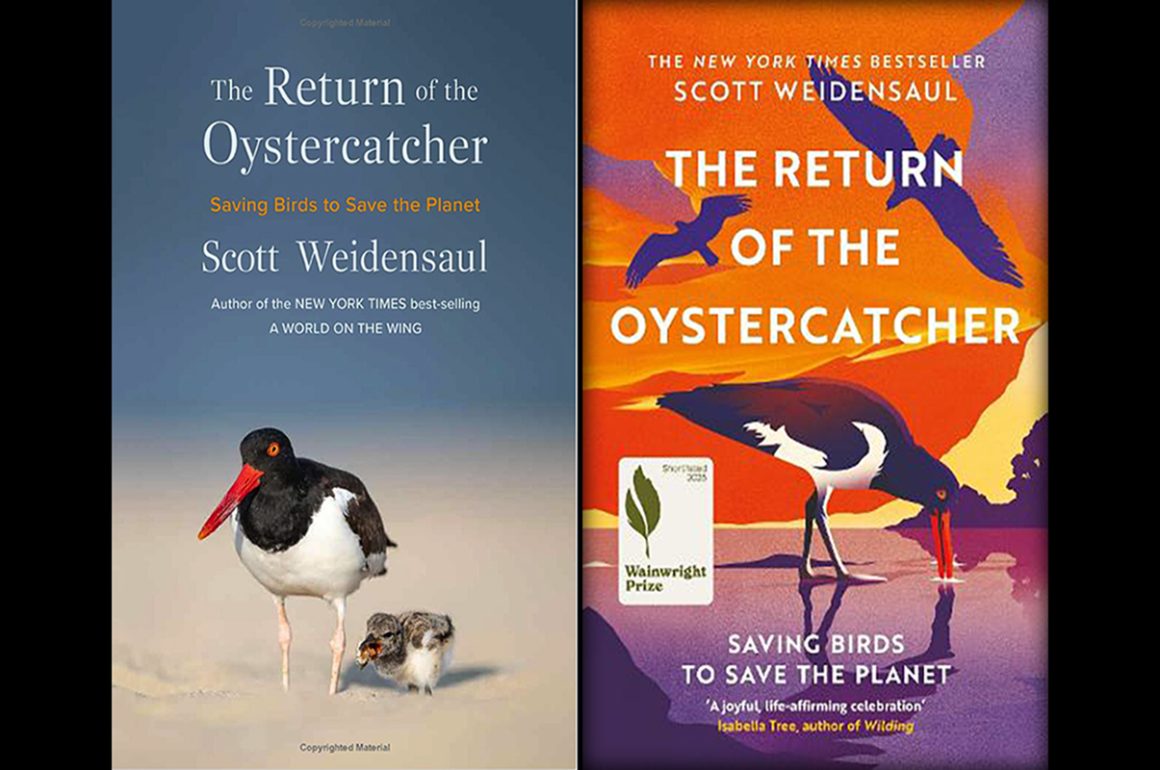
Scott Weidensaul seems to have optimism in his DNA. I wrote that a little over five years ago in my review of his second book about bird migration, A World on the Wing, and if anything Weidensaul’s optimism seems to have gotten wider and deeper, a shining if quixotic beacon in an often dark world. The Return of the Oystercatcher: Saving Birds to Save the Planet is all about the actions people–farmers, ranchers, estate owners, government employees, graduate students, scientists, some representing organizations, all committed individuals–are engaged in to save birds and, by extension, mammals, insects, plants, huge tracts of land all over the world. The birds range from waterfowl to seabirds to shorebirds to raptors to sage-grouse to songbirds (literally, there are nightingales here). The places Weidensaul visits range from a small town in Colorado that hosts a Mountain Plover festival to the Hawaiian island of Kaua’i where Laysan Albatrosses nest in residents’ backyards to the Knepp Castle Estate in Great Britain, the center of a successful ‘rewilding’ project, to the Rhodope Mountains of Bulgaria, home to Egyptian Vultures, to Massachusetts beaches, to massive boreal forests in the Canadian Northwest territories, now under the stewardship of First Nations. It’s grand and personal in scope, exceptionally readable and quietly educational, a book I think all 10,000 Birds readers will want to take in.
One of the few caveats I have with The Return of the Oystercatcher is the title. I originally thought it was about American Oystercatchers, a species I adore and love photographing. It is, as I indicate above, much broader and more ambitious in scope, though American Oystercatchers are covered in the shorebird chapter, a reminder to me of just how close I came to having no large, goofy birds to enjoy every summer. I guess the title “The Return of the Oystercatcher, Piping Plover, Mountain Plover, Bald Eagle, Snow Goose, Atlantic Puffin, Egyptian Vulture, Cinereous Vulture, White Stork, and a Lot of Other Species, Including Some Mammals” would be a little awkward.
My other caveat is the introductory chapter, “Rebound,” an account of how we, the people, decimated species of abundance with guns, development, and no understanding of consequences, a necessary history but one I feel I’ve read too many times this year (this is a “book reviewer’s complaint” which probably doesn’t apply to most readers). The chapter also recounts what is probably the United States’ most successful story, the ‘rebound’ of waterfowl–ducks in the prairie pothole region, Canada Geese all over, Snow Geese in eastern North America–through legislative provisions discouraging farmers in the northern Great Plains from converting wetlands to farmland, a transnational treaty encouraging conservation partnerships amongst “state, provincial, federal, local, and tribal governments, along with conservation NGO’s, businesses, and private individuals” (p. 13), and with the support of waterfowls’ most enthusiastic and powerful fans (also the most controversial in the birding world), duck hunters and the Ducks Unlimited organization. The chapter lays out principles of success that Weidensaul will return to throughout: focus on habitat conservation, knowledge of migration routes on a yearly and daily basis, organizational partnerships, and, most importantly, convincing stakeholders to be on the side of the birds.
North American readers will hopefully be familiar with some of the conservation stories Weidensaul relates. The fight of the beaches, the clashes between Piping Plover monitors and summer beach goers, particularly drivers of SUVs, are familiar to those of us who live on the Eastern seaboard. Weidensaul focuses on the struggles that took place on Massachusetts beaches, which he says “was then [1986] and now the heart of the piping plover story” (p. 226), but I can attest that residents of Southampton on Eastern Long Island also shouted, “Tastes like chicken!” to plover monitors and protective birders as recently as last year. Steve Kress’s work bringing back Atlantic Puffins to Eastern Egg Rock is probably even more well-known. Weidensaul visits the Rock with Kress, where the Common Terns give him a ‘warm’ welcome, and give us an idea of the primitive conditions under which the five young women live while monitoring the Puffins and Terns, counting eggs, fending off predators that haven’t already been killed. I’ve read about Kress, but I didn’t know that it was he who pioneered the technique called “social attraction,” the use of decoys and sound broadcasts to lure Puffins back to Maine. Like the young conservationists Weidensaul talks to at one point, I too thought that this technique was always there. On the other side of the continent, the work of writer and photographer Hob Osterlund has educated many of us about the M?l?, the Laysan Alabatrosses who nest in the backyards of the residents of suburban Princeville, Kaua’i. Osterlund was a resource for Weidensaul, who traveled to Kaua’i to talk to biologist André Raine about his successful work bringing back two of Hawaii’s three endangered seabird species–Newell’s Shearwater and Hawaiian Petrel–using social attraction, exclusion fences, and working with the electrical company to install ‘visual flight diverters’ on utility wires. It’s good to read about conservation success on the Hawaiian Islands for once.
More unfamiliar, I think, are the stories of the Colorado ranches that host Mountain Plovers and biodiverse short-grass prairie fields of abundance, and the descriptions of how tracts of sagebrush steppe at the intersection of Oregon and Idaho are being remade into habit for Greater Sage-Grouse by axing down Juniper Trees. But Weidensaul smartly structures the book so we read about these North American stories after we encounter conservation stories that follow very different paths–the mixed success halting the shooting of hawks in Great Britain and the Rewilding movement in Great Britain, Romania, and Bulgaria. The first story is simply depressing, focusing on the failure to stop Brits in a certain section of England from shooting Hen Harriers, a species in steep decline in England. It’s a tale rooted in centuries of patrician custom and entitlement, the shooting of the Hen Harriers to protect the driven Red Grouse hunt despite the best efforts of RSPB wardens and Birdcrime reports. The rewilding projects, on the other hand, are tales of wonder. Rewilding in Europe is a very different concept than ‘rewilding’ in the United States; it’s a movement and a very popular one, surprisingly, Weidensaul notes, unknown in the States.
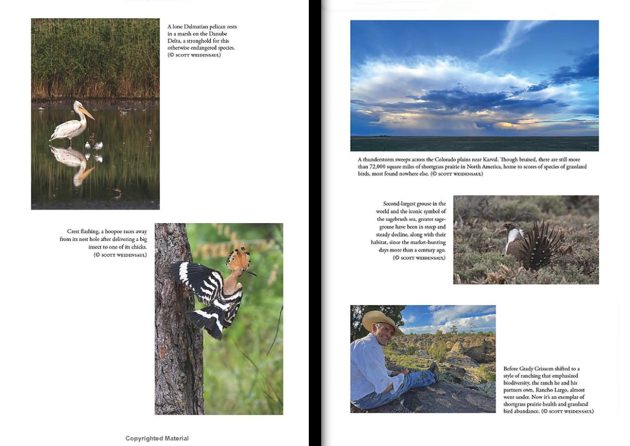 Two of the illustration pages: a lone Dalmation Pelican on the Danube Delta and a Hoopoe delivering a big insect to its chicks; a thunderstorm across the Colorado plains near Karval, a Greater Sage-Grouse, and Grady Grissomo, co-owner of Rancho Largo, “an exemplar of shortgrass prairie health and grassland bird abundance.” @ Scott Weidensaul, 2026.
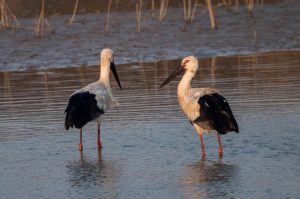
Weidensaul defines rewilding as a conservation effort whose goal “is to create functional, sustainable natural systems that support rich, wild biodiversity that do not require intensive human management….it often relies on domestic livestock…that serve as analogues for now-extinct species…” (p. 85). The Rewilding Institute emphasizes the use of “apex predators and highly interactive species” and the “4 C’s”- Cores, Corridors, Carnivores, and Coexistence.” So, these are conservation tales about the land, not a specific species or bird family. Weidensaul visits first visits a small and very successful rewilding project, the Knepp Wildlands. Knepp was failing ancestral estate and farm when the owners applied the rewilding principles, largely in desperation, and with a lot of effort and the partnership of the Roy Dennis Wildlife Federation eventually produced “a mecca of biodiversity,” including the reintroduction of the first breeding White Storks in England in centuries. Knepp is open to the public and it’s possible, if you have the resources, to glamp on the property, visit the storks, or in April and May have a two-course vegetarian dinner and then hike in the dark into the woods to hear the Nightingales, a bird once plentiful in England and now rarely found outside of southeast England, sing (information I’ve gleaned from their website, Weidensaul had of course his own privately guided tour).
Weidensaul’s next rewilding journeys take him to areas far less civilized, the Southern Carpathian Mountains and the Danube Delta of Romania (well, the latter is mostly in Romania, part of it is in the Ukraine, which does make Weidensaul somewhat uneasy–what happens to conservation when there’s a war?), and the Rhodope Mountains of Bulgaria. In Romania, Rewilding Europe and the newer Rewilding Romania have reintroduced European Bison in the Carpathians, using the mammal to preserve “one of the most diverse bird communities remaining anywhere in Europe” (p. 119). This includes Red-backed Shrikes, functionally extinct in Great Britain, uncommon in most of Europe, abundant in the Carpathians. In the Delta, water buffalo are used to remake wetland habitat, and the author is able to see a totally unexpected bird, a Dalmatian Pelican, as he enjoys water and shorebirds at a hide near Ultima Frontiera, a nature photography lodge Weidensaul uses when he can’t travel to the Ukraine. Bulgaria is all about vultures (the chapter’s title is “Rescuing the Unlovely,” a population that has unexpectedly and quickly collapsed due to the use of NSAIDs (nonsteroidal anti-inflammatory drugs) in the mammals they feed on. Here the answer isn’t rewilding, it’s the use of poison-detecting dogs, education, a “reinforcement program” with captive-reared chicks, and feeding stations with non-poisonous food. Although most of Weidensaul’s text focuses on the people who carry out conservation projects and the history behind the projects, we learn a lot about vultures, the birds themselves, in this chapter as he describes the hierarchy involved when Griffon, Cenereous, Egyptian, and Bearded Vultures chow down on the same carcass.
Fittingly, The Return of the Oystercatcher ends not with the conservation success story of a bird species or of a small, specific habitat area, but with what he describes as “one of the most ambitious conservation initiatives in the world,” the return the Canadian boreal forest, about 1 billion acres, to the stewardship of Indigenous-led communities (p. 308). Weidensaul sees the change as a triumph for conservation and social justice, for birds and indigenous culture; the chapter talks about the land’s intertwined history with its people and the rich habitats of different protected areas–tundra, bogs, old-growth forest, 600-foot-high cliffs, fish-filled lakes–but little about specific bird species. Yet, it is here that Weidensaul seems to see the most hope. Perhaps because to get to this place, all concerned parties, the Canadian government and the indigenous tribes, had to put aside political differences and put the land first. Throughout the book, Weidensaul is saying save the birds and you save the planet (in fact, it’s the subtitle of the book), but in the end it appears that saving the planet will also save the birds. Either way, it’s a goal to which we need to hold fast.
Scott Weidensaul is a writer, birder, field researcher, and speaker whose boyhood in the Appalachian Mountains of Pennsylvania has clearly influenced his passion for nature and conservation (he is also a hunter, a background which I think gives his writings on waterfowl conservation a balanced and appreciative perspective). His over 30 book titles include Living on the Wind: Across the Hemisphere with Migratory Birds (1999), Return to Wild America: A Yearlong Search for the Continent’s Natural Soul (2005), Of a Feather: A Brief History of American Birding (2007), Peterson Reference Guide to Owls of North America and the Caribbean (2015), A World on the Wing: The Global Odyssey of Migratory Birds (2021), and A Warbler’s Journey (with illustrator Nancy Lane, 2022), a children’s book that won the John Burroughs Association Riverby Award for Young Readers. His field research activities include banding and studying Northern Saw-whet Owls, part of Project Owlnet, which he co-directs; co-founding Project SNOWstorm, which tracks Snowy Owls; founding Critical Connections, a project that tracks the migration of birds that breed on National Park lands in Alaska; banding and tracking hummingbirds; and co-founding the Northeast Motus Collaboration, an automated telemetry receiver network that tracks the movements of bat, insects and small birds. If you’re interested in hearing Weidensaul speak, there is a long list of speaking and conference appearances on his website, or you can listen to him discuss Return of the Oystercatcher with Nate Swick on the American Birding Association Podcast (April 16, 2026) or with George Armistead and his colleagues on the Lifelist podcast (July 5, 2026).
Like his books on migration, Weidensaul’s text in The Return of the Oystercatcher is a graceful combination of the personal combined with historical background, biographical snapshot, and statistical overview. We see the birds, people, land through his eyes, underscored with data that helps us understand the enormity of losses and gains, but never feel overwhelmed by the amount of research that clearly went into writing it all. Although there are some notes to the text in the appendix, the full bibliography of sources is located on Weidensaul’s website. I’m glad he went to the trouble of making it available but wish this reference had been placed in more than one place; I almost missed it. Sixteen pages of photographs, most by Weidensaul, nicely illustrate all chapters. They show birds, people, and the land. The chapters also contain maps, illustrating exactly where Weidensaul traveled. All in all, it’s a book put together with thought and respect for the reader and for the people he interviewed. Not every conservationist and scientist agrees with the ideas behind the projects profiled here, and Weidensaul succinctly outlines their objections with a neutral and concerned eye. He isn’t blind to the problems in our natural and political worlds, but he won’t let the nay sayers stomp over these opportunities to treasure success and feel hope.
The Return of the Oystercatcher: Saving Birds to Save the Planet
by Scott Weidensaul
W. W. Norton & Company, 2026, 368 pages
ISBN-10 : 1324036788; ISBN-13 : 978-1324036784
UK publication by Picador, ISBN 9781035016518
Hardcover: $32.99 (discounts from the usual suspects); also available in eBook formats, paperback to be published in 2027







Leave a Comment