
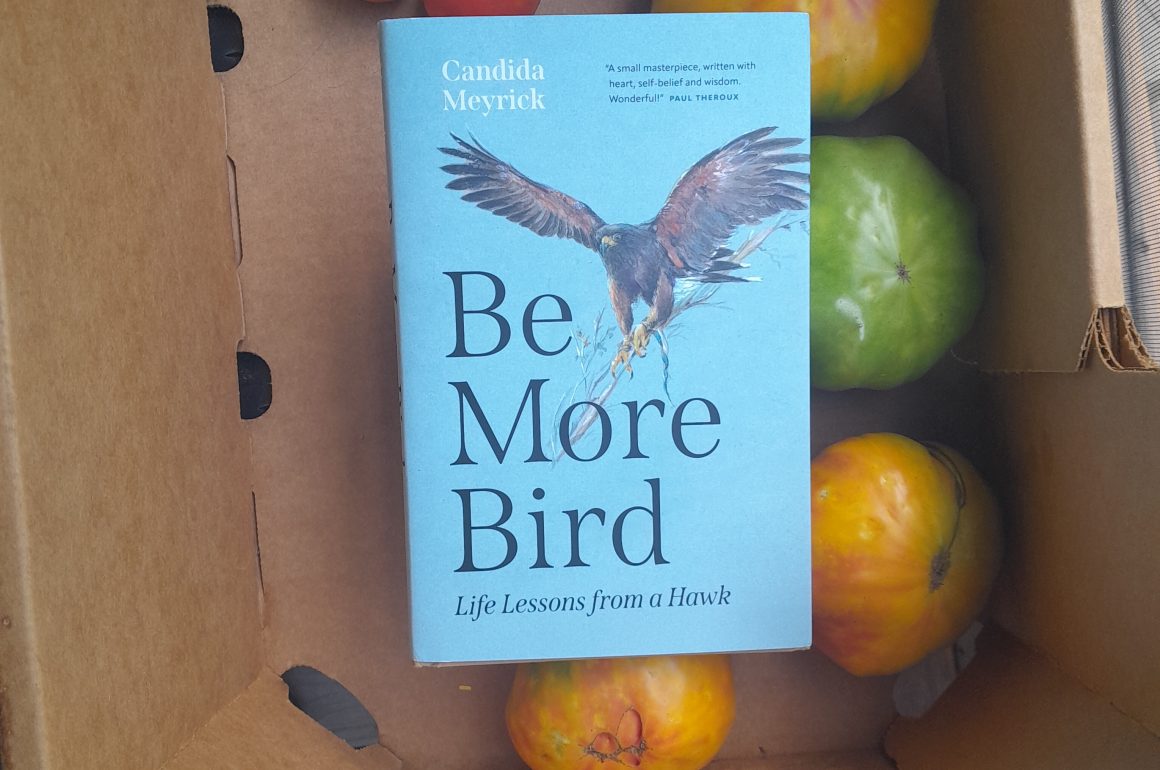
Harris’s Hawk is considered a particularly smart bird, but what does that mean? That the bird can be trained by a human? Or that the bird has instincts lost (if ever had) by humans? Those may be nice questions for the animal philosophers, but however you define certain activity, whatever box you put it in, the following story seems wonderful and astounding, especially as told, marvelously, by author Candida Meyrick in her book Be More Bird: Life Lessons from a Hawk.
Meyrick adopted a bird (formally named Sophia Houdini White Wing, but referred to everywhere after page 6 of the book as “Bird”) to train to hunt in North Wales. While still young, Bird got into a tussle with a stoat (stoat grabbing one end of a rabbit, hawk the other). She came away with a bloody gash on her talon, which became infected. Such things in hawks can kill quickly. But a couple of days later, she perched, unusually for her, on a willow branch, taking sideways bites of it. Later, she, no vegetarian, was seen eating wild thyme.
In other words, with no formal medical training (and after seeing a clueless vet) she knew (sensed?) that white willow is the active ingredient in aspirin, and thyme is a powerful antiviral and antibacterial — thus treating her pain and peril at the same time.
Meyrick has had her own travails in life, of body and soul, which she mentions briefly and without melodrama. Rather, she uses them (e.g., a parents’ divorce, the death of her father during covid) to show how Bird has helped her deal with . . . well, everything. (That’s the meaning of her subtitle.)
Indeed, the thought of acquiring a bird to train came around the five-year anniversary of her own (in her mid-forties) cancer diagnosis. Later, it, Bird, “changed the dynamic not only of my life, the life of my family, but [also] effected a complete and palpable shift in energy of the place.”
Bird’s “life lessons” are given in short instructional epigraphs at the beginning of every chapter, such as this one in the front of Chapter 10:
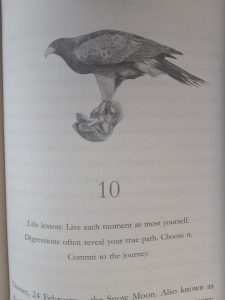
Sound hokey or twee? No, no, not really – rather, charming and, via Meyrick’s pen, exactly perfect. Chapter 10 is one of the longer chapters, having to do with hunting on the verge of a February storm; of Bird’s ability to camouflage (“Landing, she was Houdini – instantly hidden from sight, even though the trees were leafless”); and the many ways in which a bird and the human who seeks to train it can and do educate each other. With both Bird and Meyrick, by the end of the chapter, joyous and “in full acceptance and absolute confidence that” the human is on Bird’s side.
Meyrick, an accomplished novelist, is a fine and witty prose stylist. Her book is full of literary and other artistic references (Whitman, Henry James, de Kooning) which she employes used to mull over such things as (in her words) “the photographic aspect of memory” or, as William Faulkner puts it in an extraordinary phrase, “the one red instant’s fierce obliteration.”
As Meyrick says, there have been numerous eminent female falconers through the ages — Queen Elizabeth I and others. And the notion that birds of prey have healing power for their handlers has been a popular subject of some good books by women authors (as reviewed here and discussed here and here) and men, here. Be More Bird is in that line, a lovely and enchanting meditation.
___________________________________________________________________________________________________
Be More Bird: Life Lessons from a Hawk. By Candida Meyrick. Greystone Books (Vancouver/Berkeley/London), 184 pp., $26.95 USD; $34.95 CAN, September 22, 2026.




Thank you so much for this really lovely review – you have understood exactly what I meant in writing this book, and I’m so glad that Bird is finding favour in her natural habitat!