

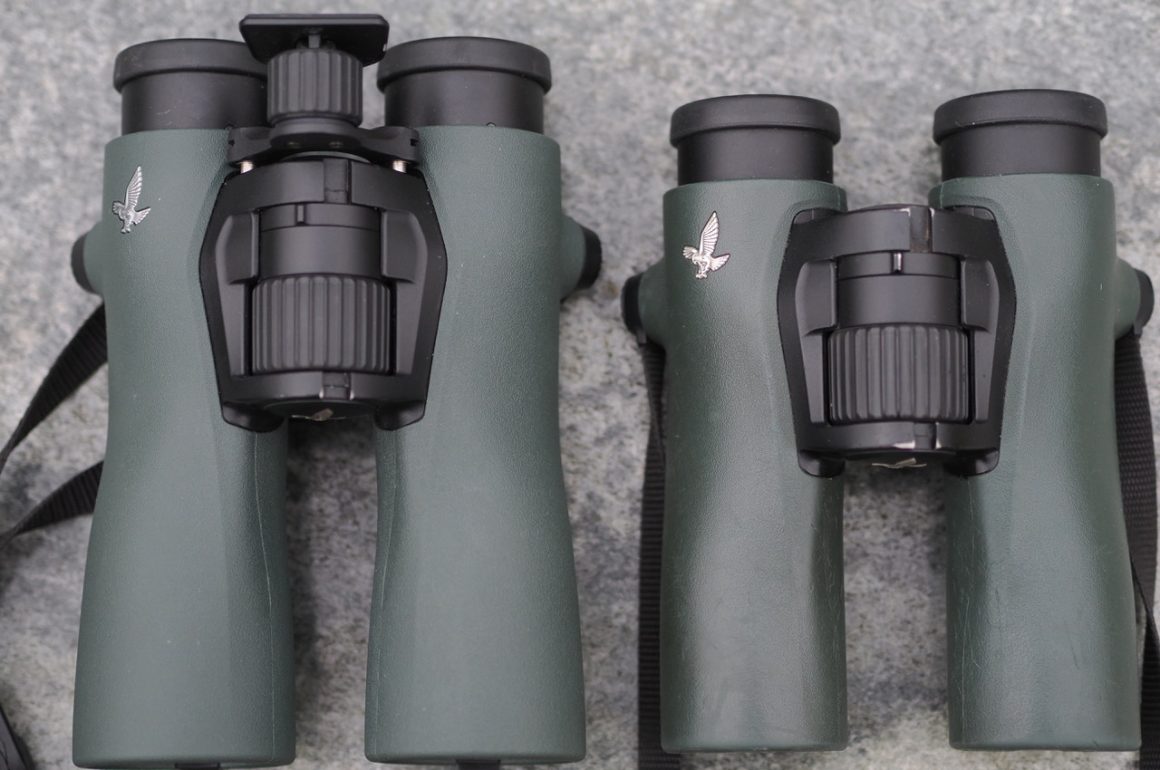
It’s a thought that has never really struck me before, but high-performance cars and high-end binoculars have a lot in common. Similarities include sleek design, great handling, precision engineering, and, of course, a high price. The other similarity is steep initial depreciation. As soon as you drive your Ferrari out of the garage the value starts to drop, and the same is true when you take your new binocular out of its box.
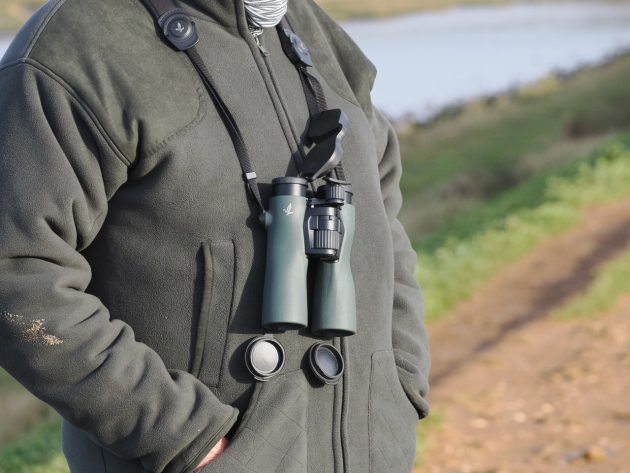
I was reminded of this last week when I treated myself to a new Swarovski 12×42 NL Pure. It wasn’t, in fact, new, but was what a purveyor of fine motor cars would term as pre-owned. It was immaculate, unmarked and showed no signs of ever been used, but because someone had owned it before me, the price was much more affordable than new. I paid £1,900, but if I had purchased the same binocular, brand new, from the Swarovski Optik UK website, I would have paid a whopping £2,800. I might add that I bought it from one of the UK’s top optical suppliers, Cley Spy, and not on E-Bay.
However, while initial depreciation might be great, such is the demand for Swarovski binoculars here in the UK that after the initial hit they tend to hold their value remarkably well.
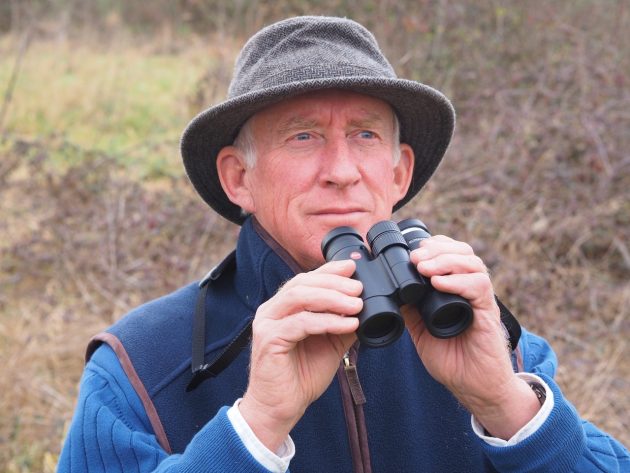
My Leica 8×32 Ultravid – tough, and just the job to take with me when I’m dog walking
OK, I admit it. Buying the 12×42 was an extravagance, even an indulgence, as I wasn’t in need of new binoculars. I use a Leica 8×32 Ultravid as my dog-walking binocular. Compact, tough and with fine optics, it gets a lot of use. The binocular I take when birding is a Swarovski 8×32 NL Pure, an instrument I love. Never mind the fact that its optics are unsurpassed by any other binocular I’ve ever looked through, this is an instrument that feels so good in the hand, thanks to its waisted shape, that it gives me pleasure just holding it.
I’ve long been an advocate of relatively lightweight, compact binoculars with modest magnification. The smaller magnification means a wider field of view, something that’s particularly useful when looking for a bird in thick cover, and or when trying to pick up a fast-flying bird. A magnification of just 8x means it’s much easier to hold steady than higher magnifications. Equally important, the lightweight makes an 8×32 the sort of binocular you can use all day with getting neck ache. If I was restricted to just a single binocular, it would be my Swarovski 8×32.
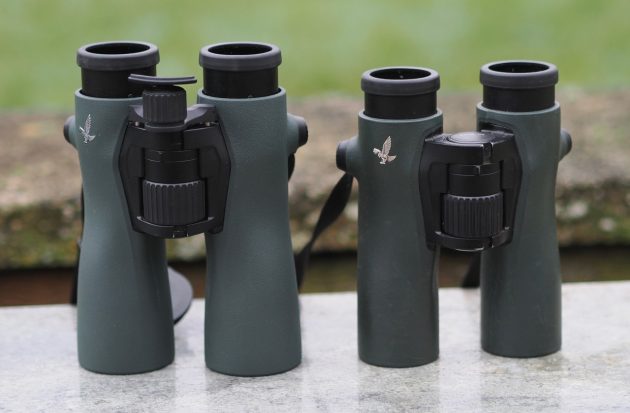
A pair of Swarovski binoculars. The 12×42 NL Pure weighs 200gm more than the 8×32 NL Pure
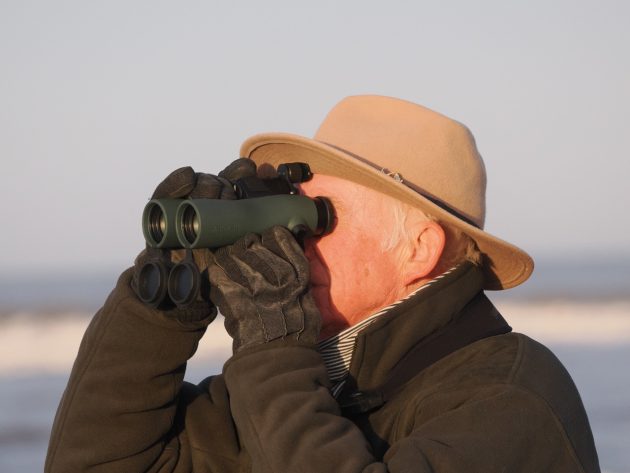
So why, you might ask, have I splashed out all that cash on a bigger, heavier, less practical 12×42? My simple explanation is that I fancied a higher magnification for winter birding, when I’m often looking at distant ducks, or trying to identify far-away grebes or divers out at sea. In the winter I tend to do more birding from the car, or from hides, where it’s easy to rest the elbows and ensure a steady image. I can’t always be bothered to carry my scope, so extra magnification is certain to be useful.
My new binocular came fitted with what Swarovski calls a forehead rest, enabling you to rest the binocular against your forehead for extra stability, which is just what you need when using a binocular with higher magnification. It’s a clever piece of kit which, so far, I’m impressed with. It costs a ridiculously expensive £132; I don’t think that I would have paid this if my binocular hadn’t been so equipped, but I’m delighted to have it.
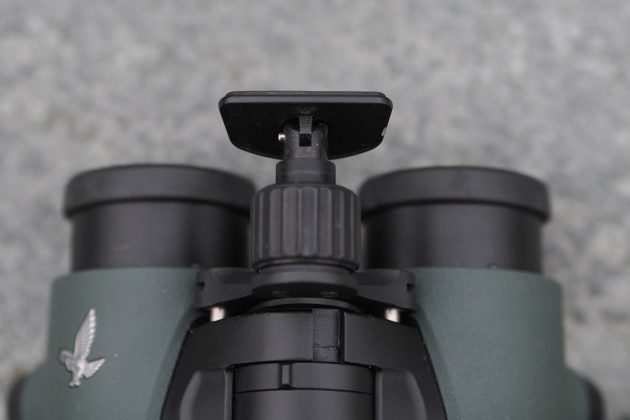
The forehead rest, a ridiculously expensive option for Swarovski’s NL range, works remarkably well
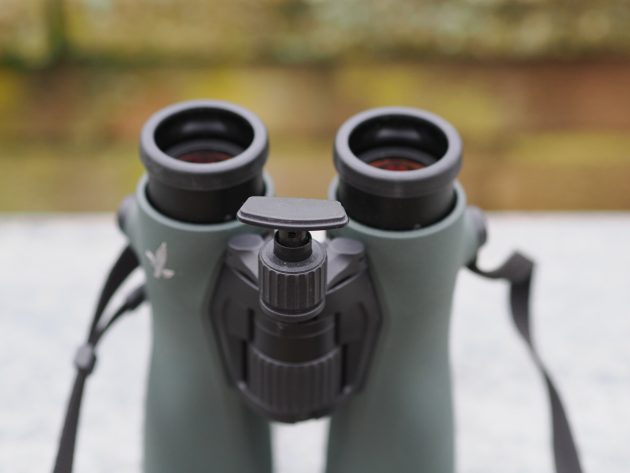
The weight difference of the bigger binocular is noticeable, but not as much as I expected it to be. The 8×32 weighs 640g, the 12×42 840g. OK, 840g is not really that bad, but I’m not sure that I would want to cart that extra weight around for a whole day if I was birding in woodland or a rain forest, where you are raising your binocular continually. This is a binocular best suited to open country, not woodland.
Both binoculars deliver an extraordinary bright, crisp image, but the big difference is that the 12’s image is half as big again as that of the 8. That’s fine in theory, but in practice would hand shake prevent me seeing the extra detail? It hasn’t. Perhaps the forehead rest is responsible, but the shape and balance of the 12×42 makes it feel very comfortable in the hand and helps give extra stability.
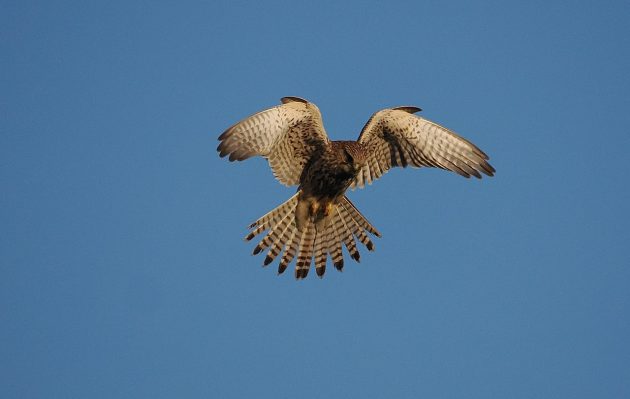
A Kestrel – the 8x view
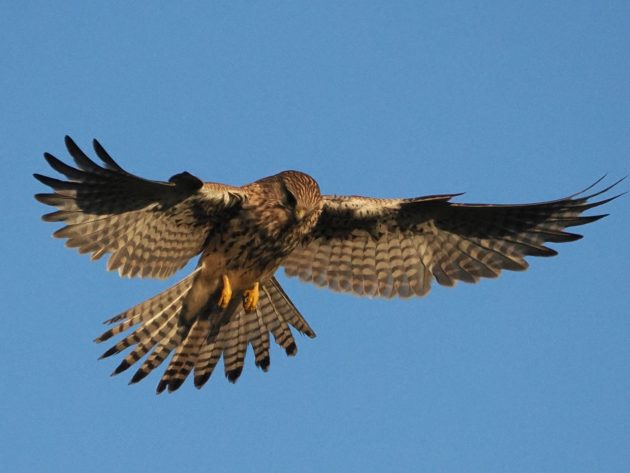
The 12x view of the same bird. More detail, more impact, but less field of view
The bigger magnification means that the field of view with the 12×42 is smaller: it’s 113m at 1000m compared with the 8×32’s impressive 150m. However, in practice it isn’t as noticeable as you might expect, and I’m agreeably surprised at how little difference it seems to make. I agree with a reviewer I read on the Birdforum website who wrote of the Swarovski 12×42: “Would I miss the wide-ish field of view I’ve been used to? In practice, I do not notice it. To me, it feels like I have the same field of view that I had with my 8x, but everything is 50% larger. It’s like magic. I don’t know how else to describe it.” Spot on.
The same reviewer pondered whether “After 20 years of living in an 8x world, would 12x be too much? It is not. Oh my goodness it is not. It’s sublime. I’ve become hypnotized by every bird that comes in close now. I spent several minutes watching a Carolina Chickadee (a species eBird tells me I’ve seen on nearly 1700 checklists) because I had never seen such detail on its feathers, the scaling on its legs, the glisten in its eyes…” Couldn’t put it better myself.
Close focus isn’t quite as close as my toes, but it’s not far off, and is only slightly more distant than it is with the 8x. It’s a binocular you could certainly use for butterfly watching should you want to do so.

Juvenile Great Northern Diver – it looked magnificent through the new binocular
Conclusion: the image with the 12 is, quite simply, superb. I christened my new binocular by pointing it at a juvenile Great Northern Diver (a much more impressive title for such a fine bird than the American name of Common Loon). It looked magnificent. I think I’m going to enjoy my new investment.
Grammatical note. For some reason, possibly historical, most English speakers refer to having “a pair of binoculars”, which is incorrect as the bi (meaning two) in front of the nocular indicates. (You never talk of “having a pair of bicycles”.) I am now the proud owner of a pair of Swarovski binoculars – the 8×32 and the 12×42, and a fine pair they make.













Great article – I may not share David’s love for cars but I do have the very same pair of binoculars. Being a birder of wide open spaces the magnification is important. I have a 8x Nikon for forests (not my prefered habitat, but birds like it). I have bought myself a good harness because that weight on your neck vertebrae is not good.
This is a terrific review. David, if he doesn’t already, could have a side job reviewing optics; I would include cameras in this job too. Wonderful photos. I also do mixed birding; woodland, open space and in between. I have 8×32 Swarovski bins (I say binoculars, but I usually see binocular in print) from 2006 vintage. After many years of use, they failed on my once, in Ecuador, the focus ring went awry. They were repaired at no cost and returned to me as almost new. Since then, I treat them like a rare jewel (no pun here, because Swarovski also makes fine jewelry). I purchased an excellent, but much less expensive 8×42 binocular, to travel with knowing that I would not be able to replace the Swarovski 8×32 if something happened (stolen, lost, etc.). I admire David’s decision to purchase the 12×42 and appreciate their worth. To Peter’s comment about using a harness. Excellent suggestion. On a recent trip, our guide, a relatively young, tall and hunky man used a harness. I’m planning to make the purchase.
On one of my trips last year, my co-lead was using a Swarovski 12×42 – probably this exact model? He was identifying distant swifts with ease that I couldn’t even see, didn’t seem to have a problem in forest habitat either. I also can’t do without my binocular harness!
Binoculars with 8x magnification provide a wide field of view, , 10x binoculars offer greater detail and are ideal for open fields or mountainous regions where long-distance viewing is required.